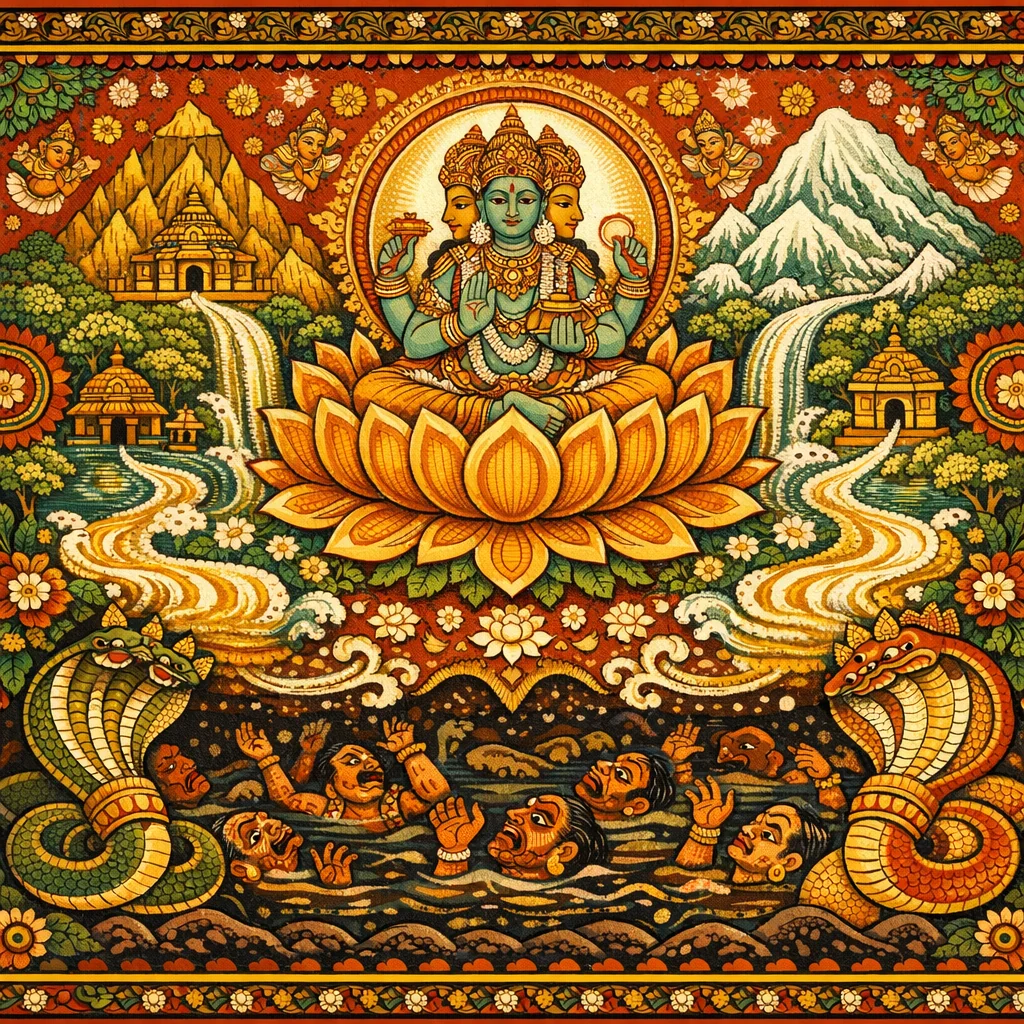
Adhyaya 169: Emergence of Brahmā from the Golden Lotus and the Lotus-Form Earth (Cosmic Geography)
हिरण्यपद्मोत्पत्ति-ब्रह्मसृष्टि-भूधारणवर्णनम्
Speaker: Lord Matsya
In dialogue form, Matsya continues instructing the king (narādhipa) on primordial creation and the ordering of the world. He tells how Nārāyaṇa brings forth Brahmā within a vast golden lotus, and then explains the lotus as a cosmographic template: its core is Earth within the single cosmic ocean; its mountains and rivers establish the support-ordinance (dhāraṇā-vidhi); its filaments signify innumerable mineral mountains; and its leaves denote many regions, including hard-to-reach tracts and Mleccha lands. The lower portions are allotted to Daityas, Nāgas, and birds, including the ocean Tadrasā where great sinners sink. Matsya concludes by linking cosmology to ritual: since Earth manifested in lotus-form (Puṣkara/Padma), sacrificers prescribe the lotus-form procedure (Padma-vidhi) in yajña, so the rite’s design mirrors the structure of the cosmos.
Key Concepts
Shlokas in Adhyaya 169
Verse 1
*मत्स्य उवाच अथ योगवतां श्रेष्ठम् असृजद्भूरितेजसम् स्रष्टारं सर्वलोकानां ब्रह्माणं सर्वतोमुखम् //
Matsya said: Then He brought forth Brahmā—foremost among yogins, radiant with immense splendor—the creator of all the worlds, the all-faced (all-directional) Lord.
Verse 2
यस्मिन्हिरण्मये पद्मे बहुयोजनविस्तृतम् सर्वतेजोगुणमयं पार्थिवैर्लक्षणैर्वृतम् //
Within that golden lotus—spreading across many yojanas—there was a form made of the quality of universal radiance, encircled by the earthly (material) marks and characteristics.
Verse 3
तच्च पद्मं पुराणज्ञाः पृथिवीरूपमुत्तमम् नारायणसमुद्भूतं प्रवदन्ति महर्षयः //
And that lotus—those who know the Purāṇas declare it to be the supreme form of the Earth; the great seers proclaim that it arose from Nārāyaṇa.
Verse 4
या पद्मा सा रसा देवी पृथिवी परिचक्ष्यते ये पद्मसारगुरवस् तान्दिव्यान् पर्वतान्विदुः //
That which is called Padmā is also known as the goddess Rasā—indeed, she is spoken of as the Earth. And those mountains that are weighty with the essence (sāra) of the Padma are to be understood as divine mountains.
Verse 5
हिमवन्तं च मेरुं च नीलं निषधमेव च कैलासं मुञ्जवन्तं च तथान्यं गन्धमादनम् //
“(They speak of) Himavān and Meru, Nīla and Niṣadha, likewise Kailāsa and Muñjavat, and also the other (mountain) Gandhamādana.”
Verse 6
पुण्यं त्रिशिखरं चैव कान्तं मन्दरमेव च उदयं पिञ्जरं चैव विन्ध्यवन्तं च पर्वतम् //
“(These are) the mountains: Puṇya, Triśikhara, Kānta, and Mandara; likewise Udaya, Piñjara, and the mountain Vindhyavanta.”
Verse 7
एते देवगणानां च सिद्धानां च महात्मनाम् आश्रयाः पुण्यशीलानां सर्वकामफलप्रदाः //
These are the sanctuaries of the hosts of gods and of the perfected Siddhas—of great-souled beings of holy conduct—and they bestow the fruits of all desired aims.
Verse 8
एतेषामन्तरे देशो जम्बूद्वीप इति स्मृतः जम्बूद्वीपस्य संस्थानं यज्ञिया यत्र वै क्रियाः //
The land lying in between these (regions) is remembered as Jambūdvīpa. There is the ordered formation of Jambūdvīpa, the place where sacrificial rites are indeed performed.
Verse 9
एभ्यो यत्स्रवते तोयं दिव्यामृतरसोपमम् दिव्यास्तीर्थशताधाराः सुरम्याः सरितः स्मृताः //
From these, the water that flows forth is like the divine nectar in taste; these are remembered as delightful, sacred rivers—streams that support hundreds of holy bathing-places (tīrthas).
Verse 10
स्मृतानि यानि पद्मस्य केसराणि समन्ततः असंख्येयाः पृथिव्यास्ते विश्वे वै धातुपर्वताः //
All around, the filaments of the cosmic lotus are remembered (to be) innumerable; likewise, in this universe, the earth’s dhātu-mountains—mountains of ores and mineral strata—are indeed countless.
Verse 11
यानि पद्मस्य पर्णानि भूरीणि तु नराधिप ते दुर्गमाः शैलचिता म्लेच्छदेशा विकल्पिताः //
O king, just as a lotus has many leaves, so too are there many regions—conceived as difficult to access—mountain-strewn tracts and the lands of the Mlecchas, set apart in this division.
Verse 12
यान्यधोभागपर्णानि ते निवासास्तु भागशः दैत्यानामुरगाणां च पतङ्गानां च पार्थिव //
O king, those portions lying in the lower divisions are, in due allotment, the dwelling-places of the Daityas, the serpents, and the winged creatures.
Verse 13
तेषां महार्णवो यत्र तद्रसेत्यभिसंज्ञितम् महापातककर्माणो मज्जन्ते यत्र मानवाः //
Among those (hell-realms), there is a vast ocean known by the name “Tadrasā”; there, human beings who have committed the acts of the great sins (mahāpātakas) sink down (and are overwhelmed).
Verse 14
पद्मस्यान्तरतो यत्तद् एकार्णवगता मही प्रोक्ताथ दिक्षु सर्वासु चत्वारः सलिलाकराः //
That which lies within the interior of the lotus is declared to be the Earth, immersed in the single cosmic ocean; and in all the directions there are said to be four great reservoirs of waters.
Verse 15
एवं नारायणस्यार्थे मही पुष्करसंभवा प्रादुर्भावो ऽप्ययं तस्मान् नाम्ना पुष्करसंज्ञितः //
Thus, for the sake of Nārāyaṇa, the Earth—arisen from Puṣkara—manifested in this form; therefore it is known by the name “Puṣkara.”
Verse 16
एतस्मात्कारणात्तज्ज्ञैः पुराणैः परमर्षिभिः याज्ञिकैर्वेददृष्टान्तैर् यज्ञे पद्मविधिः स्मृतः //
For this very reason, the learned authorities—supreme seers versed in the Purāṇas and ritual experts who cite Vedic precedents—have prescribed, for a sacrifice, the ‘Padma-vidhi’, the lotus-form method of performance.
Verse 17
एवं भगवता तेन विश्वेषां धारणाविधिः पर्वतानां नदीनां च ह्रदानां चैव निर्मितः //
Thus, by that Blessed Lord, the ordinance of support for all the worlds was established—through the formation of mountains, rivers, and lakes.
Verse 18
विभुस्तथैवाप्रतिमप्रभावः प्रभाकराभो वरुणः सितद्युतिः शनैः स्वयंभूः शयनं सृजत्तदा जगन्मयं पद्मविधिं महार्णवे //
Then the Self-born Lord—all-pervading, of incomparable power, radiant like the sun, Varuṇa-like in majesty, and shining with a pure white splendor—gradually brought forth in the great cosmic ocean a couch (resting-place) that was itself the universe, and established the Lotus-born Ordainer (Brahmā) upon it.
Frequently Asked Questions
Adhyaya 169 teaches a lotus-based cosmology: Brahmā is manifested within a golden lotus arising from Nārāyaṇa, and that lotus is interpreted as the archetypal form of Earth and world-structure. Mountains, rivers, and lakes are presented as the divine ‘support-system’ (dhāraṇā-vidhi) sustaining the worlds, while the chapter also links this cosmic model to ritual by prescribing the Padma-vidhi—performing sacrifice in a lotus-form arrangement that mirrors creation.
This chapter is primarily Sṛṣṭi (creation) and Bhuvana-kośa (cosmography/sacred geography). It is not a genealogy-focused passage, and it does not give technical temple-building measurements; however, it has a Vastu/ritual-architecture implication through the Padma-vidhi (lotus-form layout) used in yajña design. It also contains a dharmic-moral mapping via Tadrasā, where mahāpātaka-doers are described as sinking.