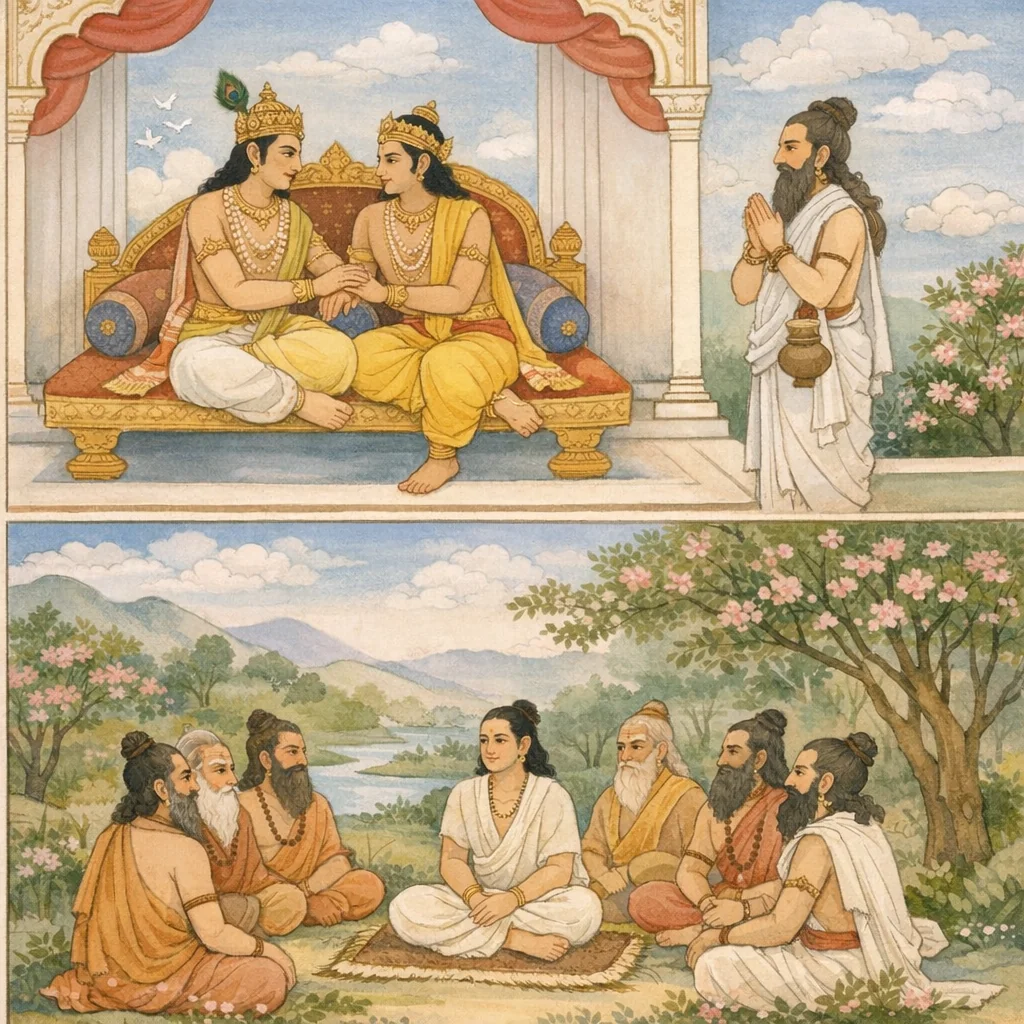
Adhyaya 47
Kāmyake Pāṇḍavānāṃ Bhojana-vyavasthā (Provisioning and Welfare in the Kāmyaka Forest)
Upa-parva: Kāmyaka-vāsa (Residence in the Kāmyaka Forest) — Exile Sustenance and Brahmin Retinue
Janamejaya questions the rationality of Dhṛtarāṣṭra’s lament after expelling the Pandavas and asks how the Pandavas secured food in the forest—whether wild produce or cultivated supplies. Vaiśaṃpāyana answers with an administrative-ethical account: the Pandavas obtain forest produce and hunt deer and other permissible game with clean arrows, then present the first share to Brahmins before eating. Large numbers of Brahmins, both maintaining sacred fires and without fires, accompany them; Yudhiṣṭhira is described as sustaining thousands of snātakas and additionally specialists oriented to liberation-teachings. The brothers procure meat by regular expeditions in different directions, maintaining steady supply. The narrative stresses welfare outcomes—no one appears ill, weak, fearful, or impoverished—framing exile leadership as protective nurture; Yudhiṣṭhira supports kin and dependents like sons and brothers. Draupadī is portrayed as feeding husbands and Brahmins first, then eating what remains, emphasizing household discipline and service. The chapter closes by situating this regulated life in Kāmyaka over a multi-year span marked by study, recitation, and offerings, with a noted period of separation from Arjuna that heightens their longing while maintaining ritual continuity.
Chapter Arc: जनमेजय के समक्ष वैशम्पायन लोमश-मुनि की स्वर्ग-यात्रा का वृत्तांत उठाते हैं—कैसे वह इन्द्र से मिलने, अर्जुन का समाचार लेने और देव-कार्य का संदेश लेकर काम्यकवन लौटने को उद्यत हुए। → स्वर्ग में लोमश इन्द्र के समीप पहुँचते हैं और अर्जुन को वासव के अर्धासन के निकट प्रतिष्ठित देखते हैं। वहीं देवताओं की चिंता उद्घाटित होती है—निवातकवच नामक उन्मत्त असुर वरदान-बल से मदान्ध होकर देवताओं को तुच्छ समझते हैं और संहार का विचार करते हैं। → देव-सभा में यह निर्णायक बोध उभरता है कि यह साधारण संकट नहीं—ऐसा कार्य है जिसके लिए असाधारण पुरुषार्थ चाहिए; और ‘मधुसूदन’ जैसे महातेजस्वी को तुच्छ कारण से जगाना उचित नहीं, क्योंकि जाग्रत तेज का प्रवाह जगत को दग्ध कर सकता है। → लोमश इन्द्र से मिलकर अर्जुन का संदेश/समाचार लेकर पृथ्वी पर काम्यकवन की ओर लौटते हैं। वहाँ पहुँचकर वे धर्मराज युधिष्ठिर को भाइयों और तपस्वियों से घिरा हुआ देखते हैं—स्वर्ग की चिंता अब वनवास की सभा में उतरने को तैयार है। → लोमश के आगमन के साथ प्रश्न हवा में लटकता है—देवताओं के इस असुर-संकट में अर्जुन की भूमिका क्या होगी, और युधिष्ठिर को कौन-सा संदेश/आह्वान सुनाया जाएगा?
Shlokas
Verse 1
हि आय न चुके है सप्तचत्वारिशो<्ध्याय: लोमश मुनिका स्वर्गमें इन्द्र और अर्जुनसे मिलकर उनका संदेश ले काम्यकवनमें आना वैशम्पायन उवाच कदाचिदटमानस्तु महर्षिरुत लोमश: । जगाम शक्रभवन पुरन्दरदिदृक्षया
Vaiśampāyana said: Once, while wandering on pilgrimage, the great sage Lomaśa went to Śakra’s celestial abode, wishing to behold Purandara (Indra).
Verse 2
स समेत्य नमस्कृत्य देवराजं महामुनि: । ददर्शार्धासनगतं पाण्डवं वासवस्य हि
Having approached and offered reverent salutations to the king of the gods, the great sage beheld the Pāṇḍava seated upon half of Vāsava’s throne.
Verse 3
वैशम्पायनजी कहते हैं--जनमेजय! एक समयकी बात है, महर्षि लोमश इधर-उधर घूमते हुए इन्द्रसे मिलनेकी इच्छा लेकर स्वर्गलोकमें गये। उन महामुनिने देवराज इन्द्रसे मिलकर उन्हें नमस्कार किया और देखा, पाण्डुनन्दन अर्जुन इन्द्रके आधे सिंहासनपर बैठे हैं ।। ततः शक्राभ्यनुज्ञात आसने विष्टरोत्तरे । निषसाद द्विजश्रेष्ठ: पूज्यमानो महर्षिभि:,तदनन्तर इन्द्रकी आज्ञासे एक उत्तम सिंहासनपर, जहाँ ऊपर कुशका आसन बिछा हुआ था, महर्षियोंसे पूजित द्विजवर लोमशजी बैठे
Then, with Śakra (Indra)’s permission, the best of twice-born sages (Lomaśa) sat down upon an excellent seat furnished with a proper ritual arrangement, while being honored by the great seers.
Verse 4
तस्य दृष्टवा भवद् बुद्धि: पार्थमिन्द्रासने स्थितम् । कथं नु क्षत्रिय: पार्थ: शक्रासनमवाप्तवान्,इन्द्रके सिंहासनपर बैठे हुए कुन्तीकुमार अर्जुनको देखकर लोमशजीके मनमें यह विचार हुआ कि “क्षत्रिय होकर भी कुन्तीकुमारने इन्द्रका आसन कैसे प्राप्त कर लिया?
Seeing Pārtha Arjuna, Kuntī’s son, seated upon Indra’s throne, Lomaśa thought to himself: “How has Pārtha—though a kṣatriya—come to attain Śakra’s seat?”
Verse 5
कि त्वस्य सुकृतं कर्म के लोका वै विनिर्जिता: । स एवमनुसम्प्राप्त: स्थानं देवनमस्कृतम्,“इनका पुण्य-कर्म क्या है? इन्होंने किन-किन लोकोंपर विजय पायी है? किस पुण्यके प्रभावसे इन्होंने यह देववन्दित स्थान प्राप्त किया है?'
“But what meritorious deed has he performed? What worlds has he truly conquered? By the power of what virtue has he attained this place—revered even by the gods?”
Verse 6
तस्य विज्ञाय संकल्पं शक्रो वृत्रनिषूदन: । लोमशं प्रहसन् वाक्यमिदमाह शचीपति:
Perceiving his intention, Śakra—Indra, the slayer of Vṛtra—smiled at Lomaśa and spoke these words, the lord of Śacī.
Verse 7
लोमश मुनिके संकल्पको जानकर वृत्रहन्ता शचीपति इन्द्रने हँसते हुए उनसे कहा -- [६ ।। ब्रह्मर्षे श्रूयतां यत् ते मनसैतद् विवक्षितम् | नायं केवलमर्त्यों वै मानुषत्वमुपागत:,“ब्रह्मर्ष] आपके मनमें जो प्रश्न उठा है” उसका समाधान कर रहा हूँ, सुनिये। ये अर्जुन मानवयोनिमें उत्पन्न हुए केवल मरणधर्मा मनुष्य नहीं हैं
Indra, the slayer of Vṛtra and lord of Śacī, smiling, said: “O brahmarṣi, listen to what you wish to ask in your mind. This Arjuna is not merely a mortal man who has only assumed human birth.”
Verse 8
महर्षे मम पुत्रो5यं कुन्त्यां जातो महाभुज: । अस्त्रहेतोरिह प्राप्त: कस्माच्चित् कारणान्तरात्,“महर्षे! ये महाबाहु धनंजय कुन्तीके गर्भसे उत्पन्न हुए मेरे पुत्र हैं और कुछ कारणवश अस्त्रविद्या सीखनेके लिये यहाँ आये हैं। आश्वर्य है कि आप इन पुरातन ऋषिप्रवरको नहीं जानते हैं। ब्रह्म! इनका जो स्वरूप है और इनके अवतार-ग्रहणका जो कारण है, वह सब मैं बता रहा हूँ। आप मेरे मुँहसे यह सब सुनिये
“O great sage, this is my son—mighty-armed—born of Kuntī. He has come here for the sake of acquiring weapons and their lore, driven by some other circumstance as well.”
Verse 9
अहो नैनं भवान् वेत्ति पुराणमृषिसत्तमम् | शृणु मे वदतो ब्रह्मन् यो5यं यच्चास्य कारणम्,“महर्षे! ये महाबाहु धनंजय कुन्तीके गर्भसे उत्पन्न हुए मेरे पुत्र हैं और कुछ कारणवश अस्त्रविद्या सीखनेके लिये यहाँ आये हैं। आश्वर्य है कि आप इन पुरातन ऋषिप्रवरको नहीं जानते हैं। ब्रह्म! इनका जो स्वरूप है और इनके अवतार-ग्रहणका जो कारण है, वह सब मैं बता रहा हूँ। आप मेरे मुँहसे यह सब सुनिये
Vaiśampāyana said: “Alas, you do not recognize this most ancient and foremost of seers. Listen, O brāhmaṇa, as I speak: I shall tell you who he is and what the cause is for his taking this form.”
Verse 10
नरनारायणौ यौ तौ पुराणावृषिसत्तमौ । ताविमावनुजानीहि हृषीकेशधनंजयौ,“नर-नारायण नामसे प्रसिद्ध जो पुरातन मुनीश्वर हैं” वे ही श्रीकृष्ण और अर्जुनके रूपमें अवतीर्ण हुए हैं, यह बात आप जान लें
Vaiśampāyana said: “Know this for certain: those two ancient and foremost sages, Nara and Nārāyaṇa, have here manifested as these very two—Hṛṣīkeśa (Kṛṣṇa) and Dhanañjaya (Arjuna).”
Verse 11
विख्यातौ त्रिषु लोकेषु नरनारायणावृषी । कार्यार्थमवतीर्णो तौ पृथ्वीं पुण्यप्रतिश्रयाम्,'तीनों लोकोंमें विख्यात नर-नारायण ऋषि ही देवताओंका कार्य सिद्ध करनेके लिये पुण्यके आधाररूप भूतलपर अवतीर्ण हुए हैं
Vaiśampāyana said: “Renowned throughout the three worlds, the sages Nara and Nārāyaṇa have descended upon the earth—this very ground that serves as a refuge and foundation for merit—in order to accomplish the gods’ purpose.”
Verse 12
यन्न शक््यं सुरैर्द्ष्टमृषिभिर्वा महात्मभि: । तदाश्रमपदं पुण्यं बदरीनाम विश्रुतम्,“देवता अथवा महात्मा महर्षि भी जिसे देखनेमें समर्थ नहीं, वह बदरी नामसे विख्यात पुण्यतीर्थ इनका आश्रम है; वही पूर्वकालमें इन श्रीकृष्ण और अर्जुनका (नारायण और नरका) निवासस्थान था। जहाँसे सिद्ध-चारणसेवित गंगाका प्राकट्य हुआ है
Vaiśampāyana said: “That holy hermitage-site, famed as Badarī, is such that even the gods, or the great-souled seers, cannot easily behold it. It is a supremely pure sacred abode—renowned for its sanctity and spiritual power.”
Verse 13
स निवासो<भवद् विप्र विष्णोर्जिष्णोस्तथैव च । यतः प्रववृते गड़ा सिद्धचारणसेविता,“देवता अथवा महात्मा महर्षि भी जिसे देखनेमें समर्थ नहीं, वह बदरी नामसे विख्यात पुण्यतीर्थ इनका आश्रम है; वही पूर्वकालमें इन श्रीकृष्ण और अर्जुनका (नारायण और नरका) निवासस्थान था। जहाँसे सिद्ध-चारणसेवित गंगाका प्राकट्य हुआ है
Vaiśampāyana said: “O brāhmaṇa, that place became the dwelling of Viṣṇu (Nārāyaṇa) and likewise of Jiṣṇu (Arjuna). From there the Gaṅgā—revered and attended by Siddhas and Cāraṇas—issued forth.”
Verse 14
तो मन्नियोगाद् ब्रह्म॒र्षे क्षितो जातौ महाद्युती । भूमेर्भारावतरणं महावीर्यों करिष्यत:,“ब्रह्मर्ष! ये दोनों महातेजस्वी नर और नारायण मेरे अनुरोधसे पृथ्वीपर उत्पन्न हुए हैं। इनकी शक्ति महान् है, ये दोनों इस पृथ्वीका भार उतारेंगे
Vaiśampāyana said: “O brahmarṣi, at my request those two—Nara and Nārāyaṇa—have been born upon the earth, radiant with great splendor. Possessed of mighty power, they will accomplish the removal of the earth’s burden.”
Verse 15
उद्वृत्ता हुसुरा: केचिन्निवातकवचा इति । विप्रियेषु स्थितास्माकं वरदानेन मोहिता:,“इन दिनों निवातकवच नामसे प्रसिद्ध कुछ असुरगण बड़े उद्ण्ड हो रहे हैं, वे वरदानसे मोहित होकर हमारा अनिष्ट करनेमें लगे हुए हैं
Vaiśaṃpāyana said: “Certain fierce and unruly Asuras, known by the name Nivātakavacas, have grown insolent. Deluded by the boon they have obtained, they are bent on harming us and stand opposed to our welfare.”
Verse 16
तर्कयन्ते सुरान् हन्तुं बलदर्पसमन्विता: । देवान् न गणयन्त्येते तथा दत्तवरा हि ते,“उनमें बल तो है ही, बली होनेका अभिमान भी है। वे देवताओंको मार डालनेका विचार करते हैं। देवताओंको तो वे लोग कुछ गिनते ही नहीं; क्योंकि उन्हें वैसा ही वरदान प्राप्त हो चुका है
“Filled with the pride of strength, they plot to slay the gods. They hold the Devas in no regard, for such a boon has been granted to them.”
Verse 17
पातालवासिनो रौद्रा दनो: पुत्रा महाबला: | सर्वदेवनिकाया हि नाल॑ योधयितुं हि तान्,“वे महाबली भयंकर दानव पातालमें निवास करते हैं। सम्पूर्ण देवता मिलकर भी उनके साथ युद्ध नहीं कर सकते। इस समय भूतलपर जिनका अवतार हुआ है वे श्रीमान् मधुसूदन विष्णु ही कपिल नामसे प्रसिद्ध देवता हुए हैं। वे ही भगवान् अपराजित हरि हैं
Vaiśampāyana said: “Fierce and terrible, the mighty sons of Danu dwell in Pātāla. Indeed, even the entire host of the gods together is not sufficient to wage war against them.”
Verse 18
योडसौ भूमिगत: श्रीमान् विष्णुर्मधुनिषूदन: । कपिलो नाम देवो5सौ भगवानजितो हरि:,“वे महाबली भयंकर दानव पातालमें निवास करते हैं। सम्पूर्ण देवता मिलकर भी उनके साथ युद्ध नहीं कर सकते। इस समय भूतलपर जिनका अवतार हुआ है वे श्रीमान् मधुसूदन विष्णु ही कपिल नामसे प्रसिद्ध देवता हुए हैं। वे ही भगवान् अपराजित हरि हैं
Vaiśampāyana said: “That illustrious Viṣṇu, the slayer of Madhu, who has now descended upon the earth—He is the very deity renowned by the name Kapila. He is Bhagavān Hari, the unconquered.”
Verse 19
येन पूर्व महात्मान: खनमाना रसातलम् | दर्शनादेव निहता: सगरस्यात्मजा विभो,“महर्षे! पूर्वकालमें रसातलको खोदनेवाले सगरके महामना पुत्र उन्हीं कपिलकी दृष्टिमात्र पड़नेसे भस्म हो गये थे
Vaiśampāyana said: “O mighty one, in former times the high-souled sons of Sagara, while digging down toward Rasātala, were slain merely by the sight of Kapila.”
Verse 20
तेन कार्य महत् कार्यमस्माकं द्विजसत्तम । पार्थेन च महायुद्धे समेताभ्यां न संशय:,द्विजश्रेष्ठ! वे भगवान् श्रीहरि हमारा महान् कार्य सिद्ध कर सकते हैं। कुन्तीकुमार अर्जुनसे भी हमारा कार्य सिद्ध हो सकता है। यदि श्रीकृष्ण और अर्जुन किसी महायुद्धमें एक-दूसरेसे मिल जायाँ तो वे दोनों एक साथ होकर महान्-से-महान् कार्य सिद्ध कर सकते हैं! इसमें संशय नहीं है
Vaiśampāyana said: “By him (Śrī Hari) our great objective can indeed be accomplished, O best of twice-born. And by Pārtha (Arjuna) too our purpose may be fulfilled. If Śrī Kṛṣṇa and Arjuna come together in a great war, then united they can accomplish even the greatest undertaking—of this there is no doubt.”
Verse 21
सोअसुरान् दर्शनादेव शक्तो हन्तुं सहानुगान् । निवातकवचान् सर्वान् नागानिव महाह्नदे,भगवान् श्रीकृष्ण तो दृष्टिनिक्षेपमात्रसे ही महान् कुण्डमें निवास करनेवाले नागोंकी भाँति समस्त “निवातकवच” नामक दानवोंको उनके अनुयायियोंसहित मार डालनेमें समर्थ हैं
Śrī Kṛṣṇa is able to slay the asuras, together with their followers, by a mere cast of his gaze; he can destroy all the demons called Nivātakavaca, as one might crush serpents dwelling in a vast deep pool.
Verse 22
कि तु नाल्पेन कार्येण प्रबोध्यो मधुसूदन: । तेजस: सुमहाराशि: प्रबुद्धः प्रदेज्जगत्,'परंतु किसी छोटे कार्यके लिये भगवान् मधुसूदनको सूचना देनी उचित नहीं जान पड़ती। वे तेजके महान् राशि हैं; यदि प्रज्वलित हों तो सम्पूर्ण जगत्को भस्म कर सकते हैं
But it does not seem proper to rouse Madhusūdana for some trifling task. He is a vast mass of fiery power; once fully awakened, he could blaze forth and consume the entire world.
Verse 23
अयं तेषां समस्तानां शक्त: प्रतिसमासने । तान् निहत्य रणे शूर: पुनर्यास्थति मानुषान्,'ये शूरवीर अर्जुन अकेले ही उन समस्त निवात-कवचोंका संहार करनेमें समर्थ हैं। उन सबको युद्धमें मारकर ये फिर मनुष्यलोकको लौट जायँगे
Vaiśampāyana said: “This hero is capable, single-handedly, of facing all of them together in direct combat. Having slain them in battle, he will return again to the world of men.”
Verse 24
भवानस्मन्नियोगेन यातु तावन््महीतलम् | काम्यके द्र॒क्ष्यसे वीर॑ं निवसन्तं युधिष्ठिरम्,“मुने! आप मेरे अनुरोधसे कृपया भूलोकमें जाइये और काम्यकवनमें निवास करनेवाले युधिष्ठिससे मिलिये
Vaiśaṃpāyana said: “At my request, go down now to the earth. There, in the Kāmyaka forest, you will see the heroic Yudhiṣṭhira living in exile.”
Verse 25
स वाच्यो मम संदेशाद् धर्मात्मा सत्यसंगर: । नोत्कण्ठा फाल्गुने कार्या कृतास्त्र: शीघ्रमेष्यति,वे बड़े धर्मात्मा और सत्यप्रतिज्ञ हैं। उनसे मेरा यह संदेश कहियेगा--'राजन्! आप अर्जुनके वापस लौटनेके विषयमें उत्कण्ठित न हों। वे अस्त्रविद्या सीखकर शीघ्र ही लौट आयेंगे
Vaiśampāyana said: “Convey my message to that righteous king, steadfast in truth: ‘O King, do not be anxious about Phālguna (Arjuna). Having mastered the celestial weapons, he will return swiftly.’”
Verse 26
नाशुद्धबाहुवीर्येण नाकृतास्त्रेण वा रणे । भीष्मद्रोणादयो युद्धे शक््या: प्रतिसमासितुम्,“जिसका बाहुबल पूर्ण अस्त्रशिक्षाके अभावसे त्रुटिपूर्ण हो तथा जिसने अस्त्रविद्याका पूर्ण ज्ञान न प्राप्त किया हो, वह युद्धमें भीष्म-ट्रोण आदिका सामना नहीं कर सकता
“Neither with imperfect strength of arm, nor without having mastered the weapons, can one in battle stand against Bhīṣma, Droṇa, and the rest.”
Verse 27
गृहीतास्त्रो गुडाकेशो महाबाहुर्महामना: । नृत्यवादित्रगीतानां दिव्यानां पारमीयिवान्,“महाबाहु महामना अर्जुन अस्त्रविद्याकी पूरी शिक्षा पा चुके हैं। वे दिव्य नृत्य, वाद्य एवं गीतकी कलामें भी पारंगत हो गये हैं
Vaiśampāyana said: “Arjuna—known as Guḍākeśa, mighty-armed and great-souled—having mastered the science of weapons, also attained full proficiency in the divine arts of dance, instrumental music, and song.”
Verse 28
भवानपि विविक्तानि तीर्थानि मनुजेश्वर । भ्रातृभि: सहित: सर्वैर्द्र्ठमर्हत्यरिंदम
Vaiśampāyana said: “O lord of men, you too—together with all your brothers—ought to go and behold the secluded sacred fords (tīrthas). Such a pilgrimage is fitting for one who subdues his foes.”
Verse 29
तीर्थेष्वाप्लुत्य पुण्येषु विपाप्मा विगतज्वर: । राज्यं भोक्ष्यसि राजेन्द्र सुखी विगतकल्मष:
Vaiśampāyana said: “Having bathed in the sacred tīrthas, you will be cleansed of sin and freed from the fever of distress. Then, O king of kings, you will enjoy your kingdom in happiness, with every taint removed.”
Verse 30
“मनुजेश्वर! शत्रुदयन! आप भी अपने सभी भाइयोंके साथ पवित्र तीर्थोंका दर्शन कीजिये। राजेन्द्र! पुण्यतीर्थोमें स्नान करके पाप-तापसे रहित हो सुखी एवं निष्कलंक जीवन बिताते हुए आप राज्यभोग करेंगे” ।। भवांश्वैनं द्विजश्रेष्ठ पर्यटन्तं महीतलम् । त्रातुमर्हति विप्राग्रय तपोबलसमन्वित:,द्विजश्रेष्ठू आप भी भूतलपर विचरनेवाले राजा युधिष्ठिरकी रक्षा करते रहें; क्योंकि आप तपोबलसे सम्पन्न हैं
Vaiśampāyana said: “O lord among men, O subduer of foes, you too—together with all your brothers—should go to behold the holy tīrthas. O best of kings, by bathing in meritorious tīrthas you will be freed from sin and the heat of affliction; living happily and without stain, you will yet enjoy the fruits of kingship. And you, O best of twice-born, should protect this Yudhiṣṭhira as he wanders over the earth, for you are endowed with the power of austerity.”
Verse 31
गिरिदुर्गेषु च सदा देशेषु विषमेषु च । वसन्ति राक्षसा रौद्रास्तेभ्यो रक्षां विधास्यति,'पर्वतोंके दुर्गम स्थानोंमें तथा ऊँची-नीची भूमियोंमें भयंकर राक्षस निवास करते हैं; उनसे आप भाइयोंसहित युधिष्ठिरकी रक्षा कीजियेगा'
Vaiśampāyana said: “In mountain-fastnesses and in rugged, uneven tracts, fierce and violent rākṣasas dwell continually. From them, you must provide protection—guarding Yudhiṣṭhira together with his brothers.”
Verse 32
एवमुक्तो महेन्द्रेण बीभत्सुरपि लोमशम् | उवाच प्रयतो वाक्यं रक्षेथा: पाण्डुनन्दनम्,महेन्द्रके ऐसा कहनेपर अर्जुनने भी विनीत होकर लोमश मुनिसे कहा--'मुने! पाण्डुनन्दन युधिष्ठिरकी भाइयोंसहित रक्षा कीजिये
Thus addressed by Mahendra (Indra), even Bībhatsu (Arjuna) spoke with humility to the sage Lomaśa: “O sage, please protect the son of Pāṇḍu (Yudhiṣṭhira), together with his brothers.”
Verse 33
यथा गुप्तस्त्वया राजा चरेत् तीर्थानि सत्तम | दानं॑ दद्याद् यथा चैव तथा कुरु महामुने,'साधुशिरोमणे! महामुने! आपसे सुरक्षित रहकर राजा युधिष्ठिर तीर्थोमें भ्रमण करें और दान दें--ऐसी कृपा कीजिये”
Vaiśampāyana said: “O best of the good, please act in such a way that the king may, under your protection and in secrecy, travel to the sacred tīrthas and make gifts. Arrange it so that Yudhiṣṭhira can undertake pilgrimage safely and practice generosity as befits his dharma.”
Verse 34
वैशम्पायन उवाच तथेति सम्प्रतिज्ञाय लोमश: सुमहातपा: । काम्यकं वनमुद्दिश्य समुपायान्महीतलम्,वैशम्पायनजी कहते हैं--जनमेजय! “बहुत अच्छा” कहकर महातपस्वी लोमशजीने उनका अनुरोध मान लिया और काम्यकवनमें जानेके लिये भूलोककी ओर प्रस्थान किया
Vaiśampāyana said: Having assented with the words “So be it,” the great ascetic Lomaśa, faithful to his vow, accepted their request and set out upon the earth, directing his journey toward the Kāmyaka forest.
Verse 35
ददर्श तत्र कौन्तेयं धर्मराजमरिंदमम् | तापसैर्भ्रातृभिश्वैव सर्वतः परिवारितम्
Vaiśampāyana said: There he beheld the son of Kuntī—King Yudhiṣṭhira, the subduer of foes—surrounded on every side by ascetics and by his brothers.
Verse 46
इस प्रकार श्रीमहाभारत वनपववके अन्तर्गत इन्रलोकाभिगमनपर्वनें उर्वशीशाप नामक छियालीसवाँ अध्याय पूरा हुआ
Thus, in the Śrī Mahābhārata, within the Vana Parva, in the section called the ‘Journey to Indra’s World’, the forty-sixth chapter—known as ‘The Curse of Urvaśī’—is concluded.
Verse 47
वहाँ पहुँचकर उन्होंने शत्रुदमन कुन्तीकुमार धर्मराज युधिष्ठिरको भाइयों तथा तपस्वी मुनियोंसे घिरा हुआ देखा ।। इति श्रीमहाभारते वनपर्वणि इन्द्रलोकाभिगमनपर्वणि लोमशगमने सप्तचत्वारिंशो5ध्याय:
Having reached that place, they saw Yudhiṣṭhira—the Kuntī-born Dharmarāja, famed as a subduer of foes—surrounded by his brothers and by austere sages. Thus ends the forty-seventh chapter, “Lomaśa’s Journey,” in the Vana Parva, in the section called the “Journey to Indra’s World,” of the Śrī Mahābhārata.
Frequently Asked Questions
Janamejaya implicitly challenges the coherence of Dhṛtarāṣṭra’s regret after expelling capable heirs and asks whether exile necessarily produces deprivation; the chapter answers by demonstrating competent, ethical provisioning and welfare maintenance.
Dharma is operational: leadership is measured by distribution order, protection of dependents, and continuity of learning and ritual practice, not merely by territorial control.
No explicit phalaśruti is stated in this passage; instead, the meta-commentary is implicit through welfare markers (absence of sickness, fear, weakness) that function as evidence validating Yudhiṣṭhira’s dharmic governance during exile.