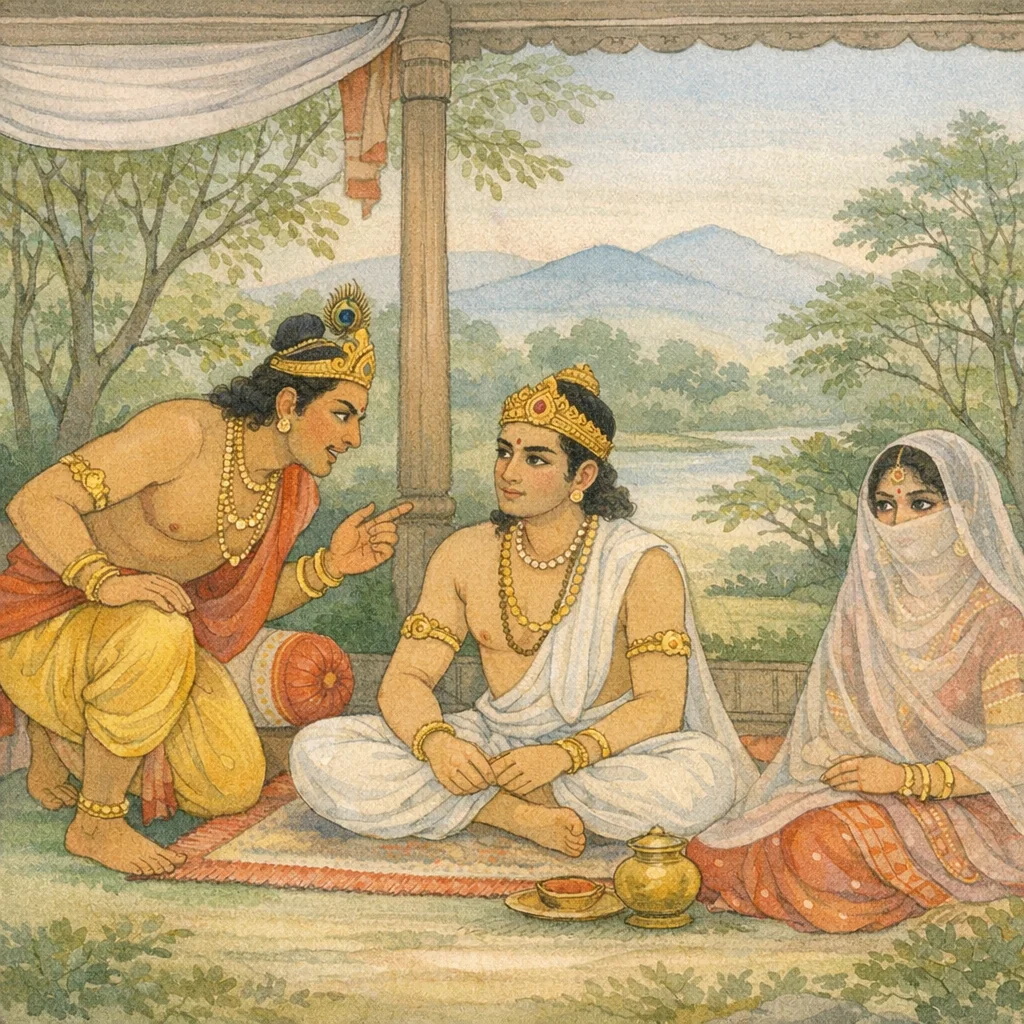
Adhyaya 35
Yudhiṣṭhira’s Reproof and Vow-Logic: On Dice-Deception, Exile Terms, and the Governance of Anger (Adhyāya 35)
Upa-parva: Forest-Exile Ethical Discourse (Yudhiṣṭhira–Bhīmasena Saṃvāda within Āraṇyaka-parva)
This chapter presents Yudhiṣṭhira’s measured address to Bhīmasena in the aftermath of the dice-game catastrophe. He acknowledges Bhīma’s harsh words as factually grounded and does not censure him for speaking against the injustice, yet he clarifies causal responsibility: Yudhiṣṭhira himself pursued the dice match while seeking to recover the kingdom, and Śakuni—described as expert in deception—engineered the loss through manipulation. Yudhiṣṭhira then moves from attribution to governance: even if one recognizes the opponent’s rigging, anger can destroy a person’s steadiness, and the self is not easily restrained by valor alone once bound by pride and fury. He recalls the public stipulations imposed by Dhṛtarāṣṭra’s son: twelve years of forest dwelling followed by an additional year of concealed living; discovery would reset the term. The discourse shifts into a doctrine of timing (kāla): immediate retaliation is declared infeasible because a vow was made in the Kuru assembly; instead, Bhīma is urged to wait for the ‘ripening’ of outcomes like seed to fruit. Yudhiṣṭhira concludes by elevating satya and dharma above life, wealth, and sovereignty, asserting that truth is the metric by which all other goods are diminished, thereby grounding political recovery in moral credibility rather than impulse.
Chapter Arc: वन के निर्वासन में धैर्य धारण किए युधिष्ठिर को भीमसेन झकझोरता है—‘काल के बंधन में बँधे नश्वर शरीर के लिए कब तक प्रतीक्षा?’ → भीम समय की क्षणभंगुरता का बिंब रचता है—फेन-धर्मा, फल-धर्मा जीवन; निमेष-निमेष आयु का क्षय; मृत्यु शरीर में ही निवास करती है। वह तर्क देता है कि विलंब स्वयं पराजय है और वैर को ‘अयातयित्वा’ छोड़ देना राजधर्म का भार बन जाता है। साथ ही वह अज्ञातवास की व्यावहारिक असंभवता उठाता है—द्रौपदी, भीम, नकुल-सहदेव जैसे विख्यात जन कैसे छिपेंगे? → भीम का निर्णायक आह्वान: ‘मृत्यु तो निश्चित है, इसलिए राज्य और न्याय के लिए अभी उद्योग करो’—और अज्ञातचर्या को ‘मेरु को छिपाने’ जैसी असंभव उपमा देकर युधिष्ठिर की नीति (संधि/प्रतीक्षा/गोपन) पर सीधा प्रहार। → अध्याय का अंत भीम के तर्क-प्रहार के साथ ठहरता है—वह युधिष्ठिर को क्षात्र-कर्तव्य, प्रतिशोध-न्याय और समयोचित कर्म की ओर मोड़ने का प्रयास करता है; निर्णय का भार युधिष्ठिर के विवेक पर छोड़ दिया जाता है। → क्या युधिष्ठिर भीम के उग्र क्षात्र-तर्क को स्वीकार कर तत्काल कर्म (युद्ध/उद्योग) की ओर बढ़ेंगे, या धैर्य, संधि और नियत-काल की नीति पर अडिग रहेंगे?
Shlokas
Verse 1
अप. ऋा- [हुक है आम पजञ्चत्रिशोड्ध्याय: दुःखित भीमसेनका युधिष्ठिरको युद्धके लिये उत्साहित करना भीमसेन उवाच संधि कृत्वैव कालेन ह्ुन्तकेन पतत्त्रिणा । अनन्तेनाप्रमेयेण स्रोतसा सर्वहारिणा,भीमसेन बोले--महाराज! आप फेनके समान नश्वर, फलके समान पतनशील तथा कालके बन्धनमें बँधे हुए मरणधर्मा मनुष्य हैं तो भी आपने सबका अन्त और संहार करनेवाले, बाणके समान वेगवान, अनन्त, अप्रमेय एवं जलस्रोतके समान प्रवाहशील लंबे कालको बीचमें देकर दुर्योधनके साथ सन्धि करके उस कालको अपनी आँखोंके सामने आया हुआ मानते हैं
Bhīma said: “O King, you have made a pact with Time itself—Time like a bird ever in flight, swift and unstoppable; endless, immeasurable, and like a river-current that carries everything away. Yet you treat that Time as though it were already before your eyes, and on that basis you have entered into conciliation with Duryodhana.”
Verse 2
प्रत्यक्ष मन्यसे काल॑ मर्त्य: सन् कालबन्धन: । फेनधर्मा महाराज फलधर्मा तथैव च,भीमसेन बोले--महाराज! आप फेनके समान नश्वर, फलके समान पतनशील तथा कालके बन्धनमें बँधे हुए मरणधर्मा मनुष्य हैं तो भी आपने सबका अन्त और संहार करनेवाले, बाणके समान वेगवान, अनन्त, अप्रमेय एवं जलस्रोतके समान प्रवाहशील लंबे कालको बीचमें देकर दुर्योधनके साथ सन्धि करके उस कालको अपनी आँखोंके सामने आया हुआ मानते हैं
Bhīmasena said: “O great king, though you are a mortal bound by Time—perishable like foam and destined to fall like a fruit—you still treat Time as something directly before your eyes.”
Verse 3
निमेषादपि कौन्तेय यस्यायुरपचीयते । सूच्येवाञ्जनचूर्णस्य किमिति प्रतिपालयेत्,किंतु कुन्तीकुमार! सलाईसे थोड़ा-थोड़ा करके उठाये जानेवाले अंजनचूर्ण (सुरमे)-की भाँति एक-एक निमेषमें जिसकी आयु क्षीण हो रही है, वह क्षणभंगुर मानव समयकी प्रतीक्षा क्या कर सकता है?
O son of Kuntī, a man’s life ebbs away even in a single blink—like collyrium powder lifted little by little on a needle’s point. How can one so fleeting wait upon time?
Verse 4
यो नूनममितायु: स्वादथवापि प्रमाणवित् । स काल वै प्रतीक्षेत सर्वप्रत्यक्षदर्शिवान्,अवश्य ही जिसकी आयुकी कोई माप नहीं है अथवा जो आयुकी निश्चित संख्याको जानता है तथा जिसने सब कुछ प्रत्यक्ष देख लिया है। वही समयकी प्रतीक्षा कर सकता है
Only one whose lifespan is truly immeasurable—or one who knows with certainty the fixed measure of his life—and who has already seen everything directly, could afford to wait for the “right time”.
Verse 5
प्रतीक्ष्म्माण: कालो न: समा राजंस्त्रयोदश | आयुषो<5पचयं कृत्वा मरणायोपनेष्यति,राजन! तेरह वर्षोतक हमें जिसकी प्रतीक्षा करनी है, वह काल हमारी आयुको क्षीण करके हम सबको मृत्युके निकट पहुँचा देगा
Bhīmasena said: “O King, the thirteen years we must wait for will not pass harmlessly. That time, while we endure it, will steadily diminish our lifespan and bring us all closer to death.”
Verse 6
शरीरिणां हि मरणं शरीरे नित्यमाश्रितम् । प्रागेव मरणात् तस्माद् राज्यायैव घटामहे,देहधारीकी मृत्यु सदा उसके शरीरमें ही निवास करती है, अतः मृत्युके पहले ही हमें राज्य-प्राप्तिके लिये चेष्टा करनी चाहिये
Bhīmasena said: “For embodied beings, death is ever lodged within the body itself. Therefore, before death overtakes us, we must strive—indeed, strive only—for the attainment of the kingdom.”
Verse 7
यो न याति प्रसंख्यानमस्पष्टो भूमिवर्धन: । अयातयित्वा वैराणि सोडवसीदति गौरिव,जिसका प्रभाव छिपा हुआ है, वह भूमिके लिये भाररूप ही है, क्योंकि वह जनसाधारणमें ख्याति नहीं प्राप्त कर सकता। वह वैरका प्रतिशोध न लेनेके कारण बैलकी भाँति दुःख उठाता रहता है
Bhīmasena said: “One whose power remains unseen and who fails to win public renown is merely a burden upon the earth. And if he does not settle his enmities—does not exact due retribution—he languishes in misery, like an ox made to bear the yoke.”
Verse 8
यो न यातयते वैरमल्पसत्त्वोद्यम: पुमान् | अफलं जन्म तस्याहं मन्ये दुर्जातजायिन:,जिसका बल और उद्यम बहुत कम है, जो वैरका बदला नहीं ले सकता, उस पुरुषका जन्म अत्यन्त घृणित है। मैं तो उसके जन्मको निष्फल मानता हूँ
Bhīmasena said: “A man of scant strength and effort who cannot requite an enmity—his very birth, in my view, is fruitless; he is as one ill-born.”
Verse 9
हैरण्यौ भवतो बाहू श्रुतिर्भवति पार्थिवी । हत्वा द्विषन्तं संग्रामे भुडुक्ष्य बाहुजितं वसु,महाराज! आपकी दोनों भुजाएँ सुवर्णकी अधिकारिणी हैं। आपकी कीर्ति राजा पृथुके समान है। आप युद्धमें शत्रुका संहार करके अपने बाहुबलसे उपार्जित धनका उपभोग कीजिये
Bhīmasena said: “Your two arms are worthy of gold—fit to win and to bear royal prosperity. Your fame is like that of King Pṛthu. Having slain the hostile foe in battle, O great king, enjoy the wealth won by the strength of your own arms.”
Verse 10
हत्वा वै पुरुषो राजन् निकर्तारमरिंदम । अद्वाय नरकं गच्छेत् स्वर्गंणास्य स सम्मित:,शत्रुदमन नरेश! यदि मनुष्य अपनेको धोखा देनेवाले शत्रुका वध करके तुरंत ही नरकमें पड़ जाय तो उसके लिये वह नरक भी स्वर्गके तुल्य है
Bhīmasena says: “O King, O subduer of foes—if a man, having slain the treacherous enemy who seeks to undermine him, were to fall at once into hell, then for him that very hell would be reckoned as heaven.”
Verse 11
अमर्षसे जो संताप होता है, वह आगसे भी बढ़कर जलानेवाला है। जिससे संतप्त होकर मुझे न तो रातमें नींद आती है और न दिनमें
Bhīmasena said: “The burning of indignation is more scorching than fire itself. Tormented by it, I find no sleep at night, nor peace by day.”
Verse 12
अयं च पार्थो बीभत्सुर्वरिष्ठो ज्याविकर्षणे | आस्ते परमसंतप्तो नूनं सिंह इवाशये,ये हमारे भाई अर्जुन धनुषकी प्रत्यंचा खींचनेमें सबसे श्रेष्ठ हैं; परंतु ये भी निश्चय ही अपनी मगुफामें दुःखी होकर बैठे हुए सिंहकी भाँति सदा अत्यन्त संतप्त होते रहते हैं
And this Pārtha—Bībhatsu—who is foremost in drawing the bowstring, sits in deep anguish, surely like a lion in its lair. Bhīma points to Arjuna’s restrained power: though supremely capable, he remains inwardly tormented, suggesting a moral tension between strength and the suffering that comes from exile, loss, and the burden of duty.
Verse 13
अमर्षजो हि संताप: पावकाद दीप्तिमत्तर: । येनाहमभिसंतप्तो न नक्त न दिवा शये,योडयमेको5भिमनुते सर्वान् लोके धनुर्भुतः । सो<यमात्मजमूष्माणं महाहस्तीव यच्छति जो अकेले ही संसारके समस्त धनुर्धर वीरोंका सामना कर सकते हैं, वे ही अर्जुन महान् गजराजकी भाँति अपने मानसिक क्रोधजनित संतापको किसी प्रकार रोक रहे हैं
Bhīma said: “The burning anguish born of indignation is fiercer even than fire. By it I am so inflamed that I can neither sleep by night nor by day. Yet he—who alone deems himself able to face all the bow-bearing warriors in the world—he, like a mighty elephant, somehow restrains the heat of his own inner wrath.”
Verse 14
नकुल: सहदेवश्व वृद्धा माता च वीरसू: । तवैव प्रियमिच्छन्त आसते जडमूकवत्,नकुल, सहदेव तथा वीरपुत्रोंको जन्म देनेवाली हमारी बूढ़ी माता कुन्ती--ये सब-के- सब आपका प्रिय करनेकी इच्छा रखकर ही मूर्खों और गूँगोंकी भाँति चुप रहते हैं
Bhīmasena said: “Nakula and Sahadeva, and our aged mother Kuntī—she who bore heroes—remain silent like the dull and the mute, solely because they wish to do what is pleasing to you. Their restraint is not weakness, but a deliberate choice to preserve harmony and honor within the family.”
Verse 15
सर्वे ते प्रियमिच्छन्ति बान्धवा: सह सृञज्जयै: । अहमेकश्न् संतप्तो माता च प्रतिविन्ध्यत:,आपके सभी बन्धु-बान्धव और सूंजयवंशी योद्धा भी आपका प्रिय करना चाहते हैं। केवल हम दो व्यक्तियोंको ही विशेष कष्ट है। एक तो मैं संतप्त होता हूँ और दूसरी प्रतिविन्ध्यकी माता द्रौपदी
Bhīmasena said: “All your kinsmen, together with the warriors of the Sṛñjaya line, wish to do what is pleasing to you. Yet only two of us suffer in a special way: I, burning with anguish, and Draupadī—the mother of Prativindhya.”
Verse 16
प्रियमेव तु सर्वेषां यद् ब्रवीम्युत किंचन । सर्वे हि व्यसन प्राप्ता: सर्वे युद्धाभिनन्दिन:,मैं जो कुछ कहता हूँ, वह सबको प्रिय है। हम सब लोग संकटमें पड़े हैं और सभी युद्धका अभिनन्दन करते हैं
Bhīmasena said: “Whatever little I say is meant to be agreeable to everyone. For we are all overtaken by calamity, and all of us welcome the prospect of battle.”
Verse 17
नात: पापीयसी काचिदापदू राजन् भविष्यति । यन्ञो नीचैरल्पबलै राज्यमाच्छिद्य भुज्यते,राजन्! इससे बढ़कर अत्यन्त दुःखदायिनी विपत्ति और क्या होगी कि नीच और दुर्बल शत्रु हम बलवानोंका राज्य छीनकर उसका उपभोग कर रहे हैं
Bhīmasena said: “O King, there can be no calamity more grievous than this: that low and feeble men have seized the kingdom and now enjoy it. For us who are strong, this is the bitterest misfortune.”
Verse 18
शीलदोषाद् घृणाविष्ट आनृशंस्यात् परंतप । क्लेशांस्तितिक्षसे राजन् नान्य: कश्चिचत् प्रशंसति,परंतप युधिष्ठिर! आप शील-स्वभावके दोष और कोमलतासे एवं दयाभावसे युक्त होनेके कारण इतने क्लेश सह रहे हैं, परंतु महाराज! इसके लिये आपकी कोई प्रशंसा नहीं करता है
Bhīma said: “O scorcher of foes, because of a flaw in your very disposition—being overcome by tenderness and moved by compassion—you endure these hardships. Yet, O King, no one praises you for bearing such suffering.”
Verse 19
श्रोत्रियस्थेव ते राजन् मन्दकस्याविपक्षित: । अनुवाकहता बुद्धिर्नैषा तत्त्वार्थदर्शिनी,राजन! आपकी बुद्धि अर्थज्ञानसे रहित वेदोंके अक्षरमात्रको रटनेवाले मन्दबुद्धि श्रोत्रियकी तरह केवल गुरुकी वाणीका अनुसरण करनेके कारण नष्ट हो गयी है। यह तात्विक अर्थको समझने या समझानेवाली नहीं है
Bhīmasena said: “O King, your understanding is like that of a dull-witted śrotriya—unripened and unexamined. Because you merely follow the teacher’s utterance, your intellect has been struck down by rote recitation; it neither sees nor can it convey the true meaning of reality.”
Verse 20
घृणी ब्राह्मणरूपो$सि कथं क्षत्रे5भ्यजाय था: । अस्यां हि योनौ जायन्ते प्रायश: क्रूरबुद्धयः,आप दयालु ब्राह्मणरूप हैं। पता नहीं, क्षत्रियकुलमें कैसे आपका जन्म हो गया; क्योंकि क्षत्रिय योनिमें तो प्राय: क्रूर बुद्धिके ही पुरुष उत्पन्न होते हैं
Bhīmasena said: “You are compassionate and bear the very form of a brāhmaṇa. How, then, were you born among kṣatriyas? For in this lineage, men are generally born with harsh and cruel intent.”
Verse 21
अश्रौषीस्त्वं राजधर्मान् यथा वै मनुरब्रवीत् । क्ररान् निकृतिसम्पन्नान् विहितानशमात्मकान्,बुद्धया वीर्येण संयुक्त: श्रुेतेनाभिजनेन च । महाराज! आपने राजधर्मका वर्णन तो सुना ही होगा, जैसा मनुजीने कहा है। फिर क्रूर, मायावी, हमारे हितके विपरीत आचरण करनेवाले तथा अशान्तचित्तवाले दुरात्मा धृतराष्ट्रपुत्रोंका अपराध आप क्यों क्षमा करते हैं? पुरुषसिंह! आप बुद्धि, पराक्रम, शास्त्रज्ञान तथा उत्तम कुलसे सम्पन्न होकर भी जहाँ कुछ काम करना है, वहाँ अजगरकी भाँति चुपचाप क्यों बैठे हैं?
Bhīma said: “You have surely heard of the duties of kings, just as Manu declared them. Why, then, do you forgive the offenses of Dhṛtarāṣṭra’s sons—men who are cruel, steeped in deceit, acting against our welfare, and restless in mind? O great king, though endowed with intelligence, valor, learning, and noble birth, why do you sit silent like a python when decisive action is required?”
Verse 22
धार्तराष्ट्रानू महाराज क्षमसे किं दुरात्मन: । कर्तव्ये पुरुषव्याप्र किमास्से पीठसर्पवत्
Bhīmasena said: “O great king, why do you keep forgiving those wicked sons of Dhṛtarāṣṭra? O tiger among men, when action is required, why do you sit still—like a serpent coiled upon its seat?”
Verse 23
तृणानां मुष्टिनेकेन हिमवन्तं च पर्वतम्
Bhīmasena declares that with a single clenched fist he could crush mere blades of grass—and even the mighty Himālaya mountain. The line conveys his fierce confidence and physical prowess, a forceful assertion meant to intimidate opponents and strengthen resolve, while also hinting at the ethical tension between rightful strength and unchecked pride.
Verse 24
अज्ञातचर्या गूढेन पृथिव्यां विश्रुतेन च
Bhīmasena said: “By living in concealment through an unknown mode of conduct, and also by being widely renowned across the earth…”
Verse 25
दिवीव पार्थ सूर्येण न शक््याचरितुं त्वया । पार्थ! आप इस भूमण्डलमें विख्यात हैं, जैसे सूर्य आकाशमें छिपकर नहीं रह सकते, उसी प्रकार आप भी कहीं छिपे रहकर अज्ञातवासका नियम नहीं पूरा कर सकते ।। २४६ || बृहच्छाल इवानूपे शाखापुष्पपलाशवान्
Bhīmasena said: “O Pārtha, it is not possible for you to live in concealment—just as the sun cannot remain hidden in the sky. You are renowned throughout this whole earth; therefore, you cannot fulfill the vow of living incognito by staying hidden somewhere. Like a great śāla tree standing in a marsh, laden with branches, blossoms, and leaves, you would inevitably be noticed.”
Verse 26
इमौ च सिंहसंकाशौ भ्रातरी सहितौ शिशू
Bhīmasena said: “And these two, like young lions—two brothers together—are still mere children.”
Verse 27
पुण्यकीर्ती राजपुत्री द्रौपदी वीरसूरियम्
Bhīmasena said: “Draupadī, the king’s daughter, is of holy renown—she is a radiant source of heroic energy.”
Verse 28
मां चापि राजज्जानन्ति हयाकुमारमिमा: प्रजा:
O King, these people also recognize me as Hayakumāra. My identity is known among the subjects.
Verse 29
तथैव बहवो<स्माभी राष्ट्र भ्यो विप्रवासिता:,राजन! इसके सिवा एक बात और है, हमलोगोंने भी बहुत-से राजाओं तथा राजकुमारोंको उनके राज्यसे निकाल दिया है। वे सब आकर राजा धुतराष्ट्रसे मिल गये होंगे, हमने जिनको राज्यसे वंचित किया अथवा निकाला है, वे कदापि हमारे प्रति शान्तभाव नहीं धारण कर सकते
Bhīma said: “In the same way, O King, many have been driven by us into exile from their realms. And besides this, there is another point: we too have expelled many kings and princes from their own kingdoms. All of them may have gone and joined King Dhṛtarāṣṭra. Those whom we have deprived of their sovereignty or cast out can never truly hold a peaceful disposition toward us.”
Verse 30
राजानो राजपूत्राश्न धृतराष्ट्रमनुव्रता: । न हि ते5प्युपशाम्यन्ति निकृता वा निराकृता:,राजन! इसके सिवा एक बात और है, हमलोगोंने भी बहुत-से राजाओं तथा राजकुमारोंको उनके राज्यसे निकाल दिया है। वे सब आकर राजा धुतराष्ट्रसे मिल गये होंगे, हमने जिनको राज्यसे वंचित किया अथवा निकाला है, वे कदापि हमारे प्रति शान्तभाव नहीं धारण कर सकते
Bhīma says: “Kings and princes, loyal followers of Dhṛtarāṣṭra, are also there. Those whom we have wronged—either deceived or driven out—will not truly become calm toward us. Such displaced rulers, having lost their realms, are unlikely to bear goodwill; their resentment can be expected to gather around Dhṛtarāṣṭra and strengthen hostility against us.”
Verse 31
अवश्यं तैर्निकर्तव्यमस्माकं तत्तप्रियैषिभि: । तेअप्यस्मासु प्रयुञ्जीरन् प्रच्छन्नान् सुबहूंश्षरान् । आचक्षीरंश्न नो ज्ञात्वा ततः स्यात् सुमहत् भयम्,अवश्य ही दुर्योधनका प्रिय करनेकी इच्छा रखकर वे राजालोग भी हमलोगोंको धोखा देना उचित समझकर हमलोगोंकी खोज करनेके लिये बहुत-से छिपे हुए गुप्तचर नियुक्त करेंगे और पता लग जानेपर निश्चय ही दुर्योधनको सूचित कर देंगे। उस दशामें हमलोगोंपर बड़ा भारी भय उपस्थित हो जायगा
Bhīma said: “Those kings, eager to win Duryodhana’s favor, will surely deem it proper to deceive us. They will also set many hidden spies upon us; and once they learn our whereabouts, they will report it to Duryodhana. Then a very great danger will inevitably arise for us.”
Verse 32
अस्माभिरुषिता: सम्यगूवने मासास्त्रयोदश । परिमाणेन तान् पश्य तावत: परिवत्सरान्,हमने अबतक वनमें ठीक-ठीक तेरह महीने व्यतीत कर लिये हैं, आप इन्हींको परिमाणमें तेरह वर्ष समझ लीजिये
Bhīmasena said: “We have truly lived in the forest for thirteen months. Now, by reckoning, regard those months as equivalent to thirteen years.”
Verse 33
अस्ति मास: प्रतिनिधिर्यथा प्राहुर्मनीषिण: । पूतिकामिव सोमस्य तथेदं क्रियतामिति,मनीषी पुरुषोंका कहना है कि मास संवत्सरका प्रतिनिधि है। जैसे पूतिका सोमलताके स्थानपर यज्ञमें काम देती है, उसी प्रकार आप इन तेरह मासोंको ही तेरह वर्षोंका प्रतिनिधि स्वीकार कर लीजिये
“The wise declare that a month may stand as a year’s representative. As pūtikā grass can serve in a sacrifice in place of the soma vine, so too let these thirteen months be accepted as the proxy for thirteen years.”
Verse 34
अथवानडुहे राजन् साधवे साधुवाहिने | सौहित्यदानादेतस्मादेनस: प्रतिमुच्यते,राजन्! अथवा अच्छी तरह बोझ ढोनेवाले उत्तम बैलको भरपेट भोजन दे देनेपर इस पापसे आपको छुटकारा मिल सकता है
Bhīmasena said: “Or else, O King—by giving a full, satisfying feed to a good ox, gentle and well accustomed to bearing loads—you may be released from this sin. Such kindly nourishment serves as an expiation, O King.”
Verse 35
तस्माच्छत्रुवधे राजन् क्रियतां निश्चयस्त्वया । क्षत्रियस्य हि सर्वस्य नान््यो धर्मोडस्ति संयुगात्,अतः महाराज! आप शत्रुओंका वध करनेका निश्चय कीजिये; क्योंकि समस्त क्षत्रियोंके लिये युद्धसे बढ़कर दूसरा कोई धर्म नहीं है इति श्रीमहाभारते वनपर्वणि अर्जुनाभिगमनपर्वणि भीमवाक्ये पज्चत्रिंशो ध्याय: ।। ३५ | इस प्रकार श्रीमहाभारत वनपव्वके अन्तर्गत अजुनाभिगमनपर्वमें भीमवाक्यविषयक पैंतीसवाँ अध्याय पूरा हुआ
Bhīmasena said: “Therefore, O King, resolve firmly to slay the enemies. For every kṣatriya, there is no duty higher than battle; apart from the righteous struggle of war, no other dharma surpasses it.”
Verse 226
बुद्धया वीर्येण संयुक्त: श्रुेतेनाभिजनेन च । महाराज! आपने राजधर्मका वर्णन तो सुना ही होगा, जैसा मनुजीने कहा है। फिर क्रूर, मायावी, हमारे हितके विपरीत आचरण करनेवाले तथा अशान्तचित्तवाले दुरात्मा धृतराष्ट्रपुत्रोंका अपराध आप क्यों क्षमा करते हैं? पुरुषसिंह! आप बुद्धि, पराक्रम, शास्त्रज्ञान तथा उत्तम कुलसे सम्पन्न होकर भी जहाँ कुछ काम करना है, वहाँ अजगरकी भाँति चुपचाप क्यों बैठे हैं?
Bhima said: “O great king! Endowed with intelligence and valor, and supported by learning and noble birth—you have surely heard the exposition of royal duty, as Manu has declared. Then why do you forgive the offenses of Dhritarashtra’s sons—cruel and deceitful men, acting against our welfare, restless in mind, and wicked at heart? O lion among men! Though you possess discernment, prowess, knowledge of the scriptures, and an excellent lineage, why do you sit silent like a python when there is work that must be done?”
Verse 236
छन्नमिच्छसि कौन्तेय यो<स्मात् संवर्तुमिच्छसि । कुन्तीनन्दन! आप अज्ञातवासके समय जो हम-लोगोंको छिपाकर रखना चाहते हैं, इससे जान पड़ता है कि आप एक मुट्ठी तिनकेसे हिमालय पर्वतको ढक देना चाहते हैं
Bhima said: “O son of Kunti, you wish to keep this concealed—yet from this very course you are trying to turn away. O Kunti’s son, in the period of living incognito you want to hide us; but that makes it seem as though you intend to cover the Himalaya with a mere handful of straw.”
Verse 253
हस्ती श्वेत इवाज्ञात: कथं जिष्णुश्नरिष्यति । जहाँ जलकी अधिकता हो, ऐसे प्रदेशमें शाखा, पुष्प और पत्तोंसे सुशोभित विशाल शालवृक्षके समान अथवा श्वेत गजराज ऐरावतके सदृश ये अर्जुन कहीं भी अज्ञात कैसे रह सकेंगे?
Bhīmasena said: “Like a white elephant, how could Jiṣṇu (Arjuna) remain unknown and unnoticed? In any land—especially one rich in water—he would stand out, splendid like a vast śāla tree adorned with branches, blossoms, and leaves, or like the white lord of elephants, Airāvata. How, then, could Arjuna possibly pass as unrecognized?”
Verse 266
नकुल: सहदेवश्न कथं पार्थ चरिष्यत: । कुन्तीकुमार! ये दोनों भाई बालक नकुल-सहदेव सिंहके समान पराक्रमी हैं। ये दोनों कैसे छिपकर विचर सकेंगे?
Bhīmasena said: “O Pārtha, how will Nakula and Sahadeva manage to move about (in concealment)? O sons of Kuntī—those two younger brothers, Nakula and Sahadeva, are lion-like in valor. How can such men possibly wander about while remaining hidden?”
Verse 283
नाज्ञातचर्या पश्यामि मेरोरिव निगूहनम् | महाराज! मुझे भी प्रजावर्गके बच्चेतक पहचानते हैं, जैसे मेरुपर्वतको छिपाना असम्भव है, उसी प्रकार मुझे अपनी अज्ञातचर्या भी सम्भव नहीं दिखायी देती
Bhīmasena said: “I do not see how a life lived in concealment could be possible for me—hiding would be like trying to hide Mount Meru. O great king, even the common people, down to the very children, recognize me. Just as Meru cannot be concealed, so too an incognito life does not appear feasible for me.”
Verse 2736
विश्रुता कथमज्ञाता कृष्णा पार्थ चरिष्यति । पार्थ! यह वीरजननी पवित्रकीर्ति राजकुमारी द्रौपदी सारे संसारमें विख्यात है। भला, यह अज्ञातवासके नियम कैसे निभा सकेगी
Bhīmasena said: “How could Kṛṣṇā (Draupadī), renowned everywhere, live as one unknown? O Pārtha, this princess Draupadī—mother of heroes, of stainless fame—is celebrated throughout the world. How, then, could she keep the strict rules of living incognito?”
Frequently Asked Questions
The dilemma is whether to answer injustice with immediate forceful retaliation or to preserve legitimacy by honoring a publicly accepted covenant of exile; Yudhiṣṭhira prioritizes vow-consistency over impulse.
Anger undermines discernment and steadiness; ethical action requires mastery of timing (kāla) and fidelity to truth (satya), even when such restraint postpones rightful claims.
No explicit phalaśruti is stated; the chapter’s meta-logic is normative rather than promissory—truth is presented as a supreme value against which life, wealth, and kingship are measured.