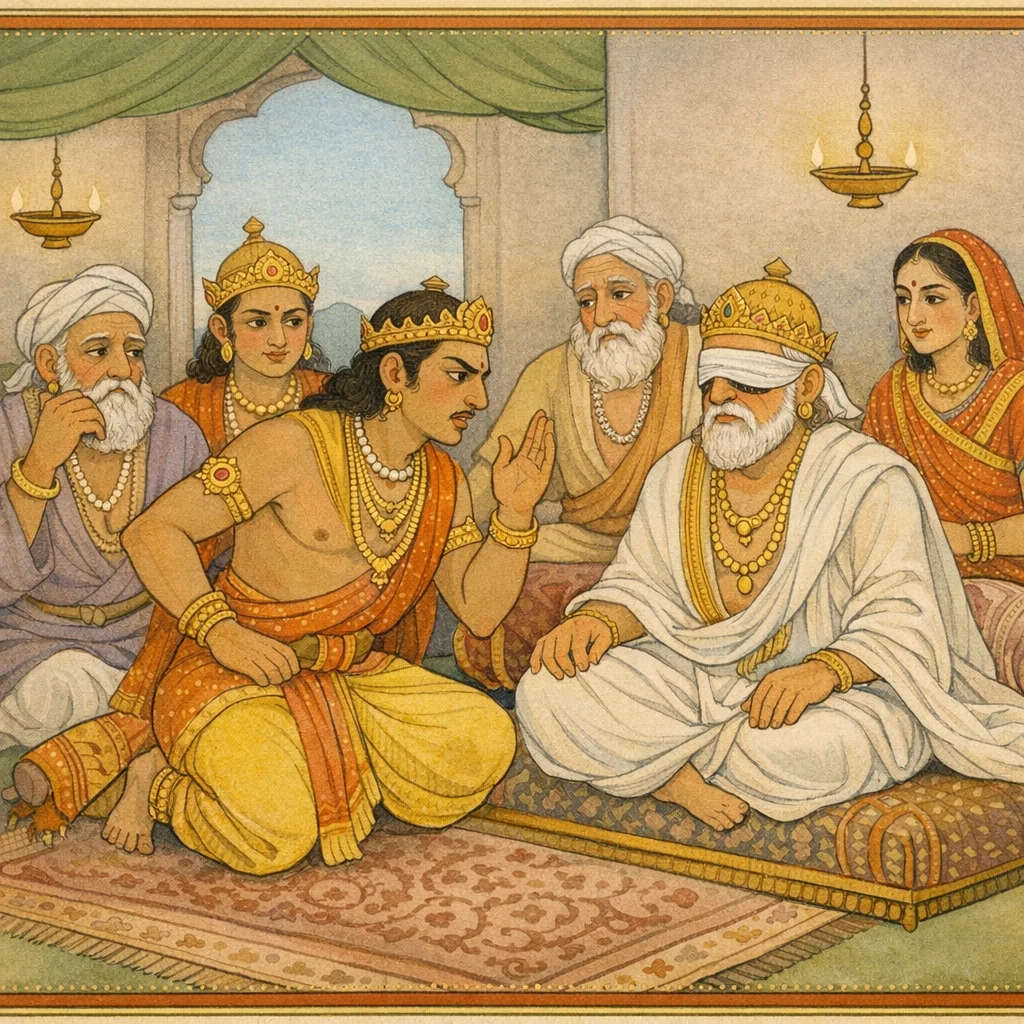
Adhyaya 60
Adhyaya 60: Self-Assertion, Daiva, and the Rhetoric of Inevitability (उद्योग पर्व)
Upa-parva: Sanjaya–Dhritarashtra Dialogue on Power and Daiva (Udyoga-parva, Adhyaya 60 context unit)
Vaiśaṃpāyana narrates a court exchange in which, after hearing paternal words, Dhārtarāṣṭra’s side responds with heightened indignation and a sustained argument about power. The speaker contends that “divine secretaries” (devasacivāḥ) cannot render the Pārthas invulnerable, and reframes the gods as operating without human-like passions (kāma, lobha, dveṣa), implying that divine order will not override the speaker’s resolve. A sequence of hyperbolic claims follows: control over elemental forces, the ability to restrain calamities, command over waters and terrain, and the capacity to secure the realm from threats—presented as public, ‘world-witnessed’ renown rather than mere boasting. The discourse culminates in explicit forecasts of defeating the Pāṇḍavas and their allies (Matsyas, Pāñcālas, Kekayas, Sātyaki, Vāsudeva) and in assertions of superior buddhi, tejas, vīrya, vidyā, and yoga, including mastery comparable to renowned martial teachers. The chapter ends with renewed questioning of Sañjaya, signaling an operational shift from ideological assertion to immediate planning within a time-sensitive crisis.
Chapter Arc: राजसभा के भीतर दुर्योधन अपने ही शब्दों को शस्त्र बनाकर उठता है—वह पिता धृतराष्ट्र के भय को काटने के लिए नहीं, अपने अहं को सिंहासन पर बैठाने के लिए बोलता है: ‘पार्थों को अजेय मानना छोड़िए।’ → वह तर्क नहीं, दर्प का घोष करता है—देवताओं के देवत्व का कारण बताकर (काम, द्वेष, लोभ, क्रोध आदि दोषों से रहित होना) संकेत देता है कि ‘मैं भी वैसा ही अडिग हूँ’; फिर व्यास-नारद-परशुराम की पुरानी कथाओं का स्मरण कराकर अपने पक्ष को ‘धर्म-ज्ञान’ की आड़ देता है। → दुर्योधन की प्रतिज्ञा उग्र शिखर पर पहुँचती है: ‘पृथ्वी फटती हो, पर्वत टूटें—मैं मंत्रबल से थाम दूँ; और जिन्हें मैं द्वेष करता हूँ, उन्हें देव-गन्धर्व-असुर-राक्षस भी नहीं बचा सकते।’ यह आत्मप्रशंसा नहीं, युद्ध-निश्चय का उद्घोष है। → अंत में वह विजय की सूची सुनाता है—पाण्डव, मत्स्य, पाञ्चाल, केकय, सात्यकि और स्वयं वासुदेव तक को ‘मेरे द्वारा जीते हुए’ सुनोगे—और यह भी कि भीष्म-द्रोण-कृप-शल्य-शल जैसे आचार्यों का समस्त अस्त्र-ज्ञान ‘मुझमें’ है; सभा पर उसका आत्मविश्वास भारी पड़ता है। → दुर्योधन के ऐसे वचन सुनकर संजय से फिर प्रश्न किया जाता है—अब आगे कौन-सा उपाय, कौन-सी चाल, और किसका मन बदलेगा?
Shlokas
Verse 1
/ [दाक्षिणात्य अधिक पाठके २ ३ श*लोक मिलाकर कुल २५ ह “लोक हैं।] #ीी:)#ीीि >> ह््न श्रीशम्ि एकषष्टितमो< ध्याय: दुर्योधनद्वारा आत्मप्रशंसा वैशम्पायन उवाच पितुरेतद् वच: श्रुत्वा धार्तराष्ट्रो 5त्यमर्षण: । आधाय विपुलं क्रोध॑ं पुनरेवेदमब्रवीत्,वैशम्पायनजी कहते हैं--जनमेजय! पिताकी यह बात सुनकर अत्यन्त असहिष्णु दुर्योधनने भीतर-ही-भीतर भारी क्रोध करके पुन: इस प्रकार कहा--
Vaiśampāyana said: Hearing these words of his father, the son of Dhṛtarāṣṭra—ever intolerant—took up a great surge of anger within himself and then spoke again as follows. The scene frames Duryodhana’s ethical failure: instead of receiving counsel with restraint, he responds from wounded pride and impatience, setting the tone for self-justifying speech and the hardening of conflict.
Verse 2
अशक्या देवसचिवा: पार्था: स्युरिति यद् भवान् | मन्यते तद् भयं व्येतु भवतो राजसत्तम,“नृपश्रेष्ठ आप जो ऐसा मानते हैं कि कुन्तीके पुत्रोंकी जीतना असम्भव है, क्योंकि देवता उनके सहायक हैं, यह ठीक नहीं है। आपके मनसे यह भय निकल जाना चाहिये
“O best of kings, if you think, ‘The Pārthas are impossible to overcome because the gods stand as their allies,’ then let that fear leave your mind. Such an assumption should not unnerve you.”
Verse 3
अकामद्वेषसंयोगलो भद्रोहाच्च भारत । उपेक्षया च भावानां देवा देवत्वमाप्रुवन्,“भरतनन्दन! काम (राग), द्वेष, संयोग (ममता), लोभ और दट्रोह (क्रोध)-रूपी दोषोंसे रहित होनेके कारण तथा दूषित भावोंकी उपेक्षा कर देनेके कारण ही देवताओंने देवत्व प्राप्त किया है
“O Bhārata, the gods attained their divine status because they were free from the faults of desire (attachment), hatred, possessive clinging, greed, and hostile wrath, and because they disregarded and set aside corrupting mental dispositions.”
Verse 4
इति द्वैपायनो व्यासो नारदश्न महातपा: । जामदग्न्यशक्ष॒ रामो न: कथामकथयत् पुरा,“यह बात पूर्वकालमें द्वैवायन व्यासजी, महातपस्वी नारदजी तथा जमदग्निनन्दन परशुरामजीने हमलोगोंको बतायी थी
Vaiśaṃpāyana said: “Thus, in former times, Dvaipāyana Vyāsa, the great ascetic Nārada, and Rāma the son of Jamadagni (Paraśurāma) recounted this account to us.” The verse frames the narrative as a received tradition from revered sages, underscoring the ethical weight and authority of what follows.
Verse 5
नैव मानुषवद् देवा: प्रवर्तन्ते कदाचन । कामात् क्रोधात् तथा लोभाद् द्वेषाच्च भरतर्षभ
Vaiśampāyana said: “The gods never act in the manner of ordinary humans. They do not set themselves in motion from desire, from anger, from greed, or from hatred, O bull among the Bharatas.”
Verse 6
“भरतश्रेष्ठ! देवता मनुष्योंकी भाँति काम, क्रोध, लोभ और द्वेषभावसे किसी कार्यमें प्रवृत्त नहीं होते हैं ।। यदा हानिनिश्च वायुश्न धर्म इन्द्रोडश्विनावपि । कामयोगातु प्रवर्तेरन् न पार्था दुःखमाप्तनुयु:,“यदि अग्नि, वायु, धर्म, इन्द्र तथा दोनों अश्विनी-कुमार भी कामनाके वशीभूत होकर सब कार्योमें प्रवृत्त होने लग जाते, तब तो कुन्तीपुत्रोंकी कभी दुःख उठाना ही नहीं पड़ता
Vaiśampāyana said: “O best of the Bharatas, the gods do not set themselves to action the way human beings do—driven by desire, anger, greed, and hatred. For if Agni, Vāyu, Dharma, Indra, and even the two Aśvin twins were to act in every matter under the compulsion of desire, then the sons of Kuntī (the Pāṇḍavas) would never have had to undergo suffering at all.”
Verse 7
तस्मान्न भवता चिन्ता कार्यषा स्यात् कथंचन । दैवेष्वपेक्षका होते शश्वद् भावेषु भारत,“अतः: भरतनन्दन! आप किसी प्रकार भी ऐसी चिन्ता न करें, क्योंकि देवता सदा दिव्यईभाव--शम आदिकी ही अपेक्षा रखते हैं, काम, क्रोध आदि आसुरभावोंकी नहीं
Therefore, you should not entertain any anxiety at all. The gods ever look for divine dispositions—such as calmness and self-restraint—O Bhārata, and not for demonic impulses like desire and anger.
Verse 8
अथ चेत् कामसंयोगाद् द्वेषो लोभश्व लक्ष्यते । देवेषु दैवप्रामाण्यान्नैषां तद् विक्रमिष्यति,“तथापि यदि देवताओंमें कामनावश द्वेष और लोभ लक्षित होता है तो (उनमें देवत्वका अभाव हो जानेके कारण) उनकी वह शक्ति हमलोगोंपर कोई प्रभाव नहीं दिखा सकेगी, क्योंकि देवोंमें देवभावकी प्रधानता है
Vaiśampāyana said: “But if, through association with desire, hatred and greed are seen even among the gods, then their power will not prevail over us; for among the gods, the authority of the divine principle is paramount.”
Verse 9
मयाभिमन्त्रित: शश्वज्जातवेदा: प्रशाम्यति । दिधक्षु: सकलॉल्लोकान् परिक्षिप्प समन्ततः,(वैसे तो मुझमें भी दैवबल है ही;) यदि मैं अभिमन्त्रित कर दूँ तो सदा सम्पूर्ण लोकोंको जलाकर भस्म कर डालनेकी इच्छासे प्रज्वलित हुई आग भी सब ओरसे सिमटकर बुझ जायगी
Vaiśampāyana said: “If I utter the consecrating mantra over it, the fire—Jātavedas—will at once be quenched, even if it has been blazing with the desire to burn all the worlds to ashes, having spread itself on every side.”
Verse 10
यद् वा परमकं तेजो येन युक्ता दिवौकस: । ममाप्यनुपमं भूयो देवेभ्यो विद्धि भारत,“भारत! यदि कोई ऐसा उत्कृष्ट तेज है, जिससे देवता युक्त हैं तो मुझे भी देवताओंसे ही अनुपम तेज प्राप्त हुआ है, यह आप अच्छी तरह जान लें
Vaiśampāyana said: “O Bhārata, if there exists any supreme radiance by which the gods are endowed, know well that I too possess a matchless radiance—indeed, one obtained from the very gods.”
Verse 11
विदीर्यमाणां वसुधां गिरीणां शिखराणि च । लोकस्य पश्यतो राजन् स्थापयाम्यभिमन्त्रणात्,“राजन! मैं सब लोगोंके देखते-देखते विदीर्ण होती हुई पृथ्वी तथा टूटकर गिरते हुए पर्वत-शिखरोंको भी मन्त्रबलसे अभिमन्त्रित करके पहलेकी भाँति स्थापित कर सकता हूँ
“O king, before the eyes of all the world, by the power of consecrated mantras I can halt and set in place again, as before, the earth as it splits apart and the mountain-peaks as they break and fall.”
Verse 12
चेतनाचेतनस्यास्य जड़मस्थावरस्य च । विनाशाय समुत्पन्नमहं घोर॑ महास्वनम्,“इस चेतन-अचेतन और स्थावर-जंगम जगत्के विनाशके लिये प्रकट हुई महान् कोलाहलकारी भयंकर शिलावृष्टि अथवा आँधीको भी मैं सदा समस्त प्राणियोंपर दया करके सबके देखते-देखते यहीं शान्त कर सकता हूँ
Vaiśaṃpāyana said: “This dreadful, thunderous uproar—arisen to bring destruction upon this world of the sentient and the insentient, the inert and the immovable—can, out of compassion for all living beings, be stilled by me at once, before everyone’s very eyes.”
Verse 13
अश्मवर्ष च वायुं च शमयामीह नित्यश: । जगत: पश्यतो5भीक्ष्णं भूतानामनुकम्पया,“इस चेतन-अचेतन और स्थावर-जंगम जगत्के विनाशके लिये प्रकट हुई महान् कोलाहलकारी भयंकर शिलावृष्टि अथवा आँधीको भी मैं सदा समस्त प्राणियोंपर दया करके सबके देखते-देखते यहीं शान्त कर सकता हूँ
“Here I ever quell both the rain of stones and the raging wind, again and again before the world’s gaze, out of compassion for all beings.”
Verse 14
स्तम्भितास्वप्सु गच्छन्ति मया रथपदातय: । देवासुराणां भावानामहमेकः: प्रवर्तिता,मेरे द्वारा स्तम्भित किये हुए जलके ऊपर रथ और पैदल सेनाएँ चल सकती हैं। एकमात्र मैं ही दैव तथा आसुर शक्तियोंको प्रकट करनेमें समर्थ हूँ
Vaiśaṃpāyana said: “Across waters that I have held fast and made still, chariots and foot-soldiers can pass. I alone am capable of setting in motion and manifesting the powers and dispositions that belong to gods and to asuras.”
Verse 15
अक्षौहिणीभिर्यान् देशान् यामि कार्येण केनचित् । तत्राश्वा मे प्रवर्तन्ते यत्र यत्राभिकामये,“मैं किसी कार्यके उद्देश्यसे जिन-जिन देशोंमें अनेक अक्षौहिणी सेनाएँ लेकर जाता हूँ, उनमें जहाँ-जहाँ मेरी इच्छा होती है, उन सभी स्थानोंमें मेरे घोड़े (अप्रतिहत गतिसे) विचरते हैं
Vaiśampāyana said: “When, for some purpose, I travel to whatever lands accompanied by many akṣauhiṇī divisions of troops, there my horses range freely—wherever I wish, to those very places they go unhindered.”
Verse 16
भयानकानि विषये व्यालादीनि न सन्ति मे । मन्त्रगुप्तानि भूतानि न हिंसन्ति भयंकरा:
Vaiśaṃpāyana said: “In my domain there are no terrifying dangers such as serpents and other wild creatures. Even fearsome beings do not harm, for they are restrained and kept in check by sacred mantras.”
Verse 17
“मेरे राज्यमें सर्प आदि भयंकर जीव-जन्तु नही हैं। यदि कोई भयंकर प्राणी हों तो भी वे मेरे मन्त्रोंद्वारा सुरक्षित जीव-जन्तुओंकी कभी हिंसा नहीं करते हैं ।। निकामवर्षी पर्जन्यो राजन् विषयवासिनाम् । धर्मिष्ठाक्ष प्रजा: सर्वा ईतयश्व न सन्ति मे,“महाराज! मेरे राज्यमें रहनेवाली प्रजाओंके लिये बादल प्रचुर जल बरसाता है, सम्पूर्ण प्रजाएँ धर्ममें तत्पर रहती हैं तथा मेरे राष्ट्रमें अनावृष्टि और अतिवृष्टि आदि किसी प्रकारका भी उपद्रव नहीं है
Vaiśampāyana said: “O King, in my realm the rains fall in due measure for those who dwell in the countryside. All my subjects are devoted to dharma, and in my kingdom there are no calamities—neither drought nor excessive rain nor other afflictions.”
Verse 18
अश्विनावथ वाय्वग्नी मरुद्धि: सह वृत्रहा । धर्मश्नैव मया द्विष्टान् नोत्सहन्तेडभिरक्षितुम्,“जिनसे मैं द्वेष रखता हूँ, उनकी रक्षाका साहस अश्विनीकुमार, वायु, अग्नि, मरुदगणोंसहित इन्द्र तथा धर्ममें भी नहीं है
Vaiśampāyana said: “Even Indra, the slayer of Vṛtra—together with the Aśvin twins, Vāyu, Agni, and the Marut hosts—indeed even with Dharma itself, lacks the power to protect those whom I have come to hate.”
Verse 19
यदि होते समर्था: स्युर्मद्द्विषस्त्रातुमजजसा । न सम त्रयोदश समा: पार्था दुःखमवाप्रुयु:,“यदि ये लोग अनायास ही मेरे शत्रुओंकी रक्षा करनेमें समर्थ होते तो कुन्तीके पुत्र तेरह वर्षोतक कष्ट नहीं भोगते
Vaiśampāyana said: “If these people had truly been capable of protecting my enemies with ease, then the sons of Kuntī—the Pārthas—would not have had to endure suffering for thirteen full years.”
Verse 20
नैव देवा न गन्धर्वा नासुरा न च राक्षसा: । शक्तास्त्रातुं मया द्विष्टं सत्यमेतद् ब्रवीमि ते,“पिताजी! मैं आपसे यह सत्य कहता हूँ कि देवता, गन्धर्व, असुर तथा राक्षस भी मेरे शत्रुकी रक्षा करनेमें समर्थ नहीं हैं
Vaiśampāyana said: “Neither the gods, nor the Gandharvas, nor the Asuras, nor even the Rākṣasas can protect the one whom I have come to hate. This I tell you as the truth.”
Verse 21
यदभिध्याम्यहं शश्वच्छुभं वा यदि वाशुभम् । नैतद् विपन्नपूर्व मे मित्रेष्वरिषु चोभयो:,“मैं अपने मित्रों और शत्रुओं--दोनोंके विषयमें शुभ या अशुभ जैसा भी चिन्तन करता हूँ, वह पहले कभी निष्फल नहीं हुआ है
Vaiśampāyana said: “Whatever I continually contemplate—whether auspicious or inauspicious—regarding both my friends and my enemies, it has never before proved fruitless for me.”
Verse 22
भविष्यतीदमिति वा यद् ब्रवीमि परंतप । नान्यथा भूतपूर्व च सत्यवागिति मां विदु:,'शत्रुओंको संताप देनेवाले महाराज! मैं जो बात मुँहसे कह देता हूँ कि यह इसी प्रकार होगा, मेरा वह कथन पहले कभी भी मिथ्या नहीं हुआ है। इसीलिये लोग मुझे सत्यवादी मानते हैं
“O scorcher of foes, when I declare, ‘This will indeed happen in this way,’ it has never in the past turned out otherwise. Therefore people know me as one whose speech is truthful.”
Verse 23
लोकसाक्षिकमेतन्मे माहात्म्यं दिक्षु विश्रुतम् । आश्चासनार्थ भवतः प्रोक्ते न श्लाघया नूप,“राजन! मेरा यह माहात्म्य सब लोगोंकी आँखोंके समक्ष है; सम्पूर्ण दिशाओंमें प्रसिद्ध है। मैंने आपके आश्वासनके लिये ही इसकी यहाँ चर्चा की है, आत्मप्रशंसा करनेके लिये नहीं
“O King, this greatness of mine is witnessed by the world, plain before all eyes, and renowned in every direction. I have spoken of it here only to reassure you, not out of self-praise.”
Verse 24
न हाहं “लाघनो राजन् भूतपूर्व: कदाचन । असदाचरितं होतद् यदात्मानं प्रशंसति,“महाराज! आजसे पहले मैंने कभी भी आत्मप्रशंसा नहीं की है; क्योंकि मनुष्य जो अपनी प्रशंसा करता है, यह अच्छे पुरुषोंका कार्य नहीं है
Vaiśampāyana said: “O King, never before have I been one to boast. For it is conduct unworthy of the good when a man praises himself.”
Verse 25
पाण्डवांश्वैव मत्स्यांश्व पज्चालान् केकयै: सह । सात्यकिं वासुदेवं॑ च श्रोतासि विजितान् मया,“आप किसी दिन सुनेंगे कि मैंने पाण्डवोंको, मत्स्यदेशके योद्धाओंको, केकयोंसहित पांचालोंको तथा सात्यकि और वसुदेवनन्दन श्रीकृष्णको भी जीत लिया है
Vaiśampāyana said: “One day you will hear that I have conquered the Pāṇḍavas, the warriors of Matsya, the Pāñcālas together with the Kekayas, and even Sātyaki and Vāsudeva (Kṛṣṇa), the son of Vasudeva.”
Verse 26
सरित: सागरं प्राप्य यथा नश्यन्ति सर्वश: । तथैव ते विनड्क्ष्यन्ति मामासाद्य सहान्वया:,'जैसे नदियाँ समुद्रमें मिलकर सब प्रकारसे अपना अस्तित्व खो बैठती हैं, उसी प्रकार वे पाण्डव आदि योद्धा मेरे पास आनेपर अपने कुल-परिवारसहित नष्ट हो जायँगे
Vaiśampāyana said: “Just as rivers, on reaching the ocean, lose their separate identity entirely, so too will they—approaching me—perish together with their whole line and kin.”
Verse 27
परा बुद्धि: परं तेजो वीर्य च परमं मम । परा विद्या पते योगो मम तेभ्यो विशिष्यते,“मेरी बुद्धि उत्तम है, तेज उत्कृष्ट है, बल-पराक्रम महान् है, विद्या बड़ी है तथा उद्योग भी सबसे बढ़कर है। ये सारी वस्तुएँ पाण्डवोंकी अपेक्षा मुझमें अधिक हैं
Vaiśampāyana said: “My intellect is superior, my radiance is supreme, and my valor is foremost. My learning is higher, and my resolve and exertion are unmatched; in all these respects I surpass them.”
Verse 28
पितामहमश्न द्रोणश्न॒ कृप: शल्य: शलस्तथा । अस्त्रेषु यत् प्रजानन्ति सर्व तनन््मयि विद्यते,“पितामह भीष्म, आचार्य द्रोण, कृपाचार्य, शल्य तथा शल--ये लोग अस्त्रविद्याके विषयमें जो कुछ जानते हैं, वह सारा ज्ञान मुझमें विद्यमान है”
Vaiśampāyana said: “Whatever knowledge of weapons and their use is possessed by Grandfather Bhīṣma, by Droṇa, by Kṛpa, by Śalya, and likewise by Śala—every bit of that expertise is present in me.”
Verse 29
इत्युक्ते संजयं भूय: पमेर्यपृच्छत भारत: । ज्ञात्वा युयुत्सो: कार्याणि प्राप्तकालमरिंदम,शत्रुओंका दमन करनेवाले जनमेजय! दुर्योधनके ऐसा कहनेपर भरतनन्दन धूृतराष्ट्रने युद्धकी इच्छा रखनेवाले दुर्योधनके अभिप्रायको समझकर पुन: संजयसे समयोचित प्रश्न किया
Vaiśampāyana said: “When Duryodhana had spoken thus, Dhṛtarāṣṭra, scion of Bharata, understanding the intent of Duryodhana who longed for war, again put a timely question to Sañjaya—O Janamejaya, tamer of foes.”
Verse 61
इति श्रीमहाभारते उद्योगपर्वणि यानसंधिपर्वणि दुर्योधनवाक्ये एकषष्टितमो< ध्याय:,इस प्रकार श्रीमह्याभारत उद्योगपर्वके अन्तर्गत यानसंधिपर्वमें दुर्योधनवाक्यविषयक इकसठवाँ अध्याय पूरा हुआ
Thus, in the Śrī Mahābhārata, within the Udyoga Parva—specifically the Yāna–Sandhi Parva on the mission and negotiations—the sixty-first chapter, concerning Duryodhana’s speech, comes to an end. This colophon marks the close of a discourse that frames the ethical tension between conciliation and obstinacy on the eve of war.
Frequently Asked Questions
The tension lies between responsible kingship grounded in counsel and restraint versus governance driven by anger and self-certainty, where claims of inevitability are used to bypass ethical deliberation.
The chapter functions as a cautionary illustration: when agency is inflated and daiva is rhetorically minimized, decision-making can become insulated from corrective feedback, increasing the likelihood of avoidable escalation.
No formal phalaśruti appears in this excerpt; the meta-layer is indirect, conveyed through the narrator’s framing and the contrast between asserted ‘world-witnessed’ greatness and the chapter’s role in accelerating the crisis toward confrontation.