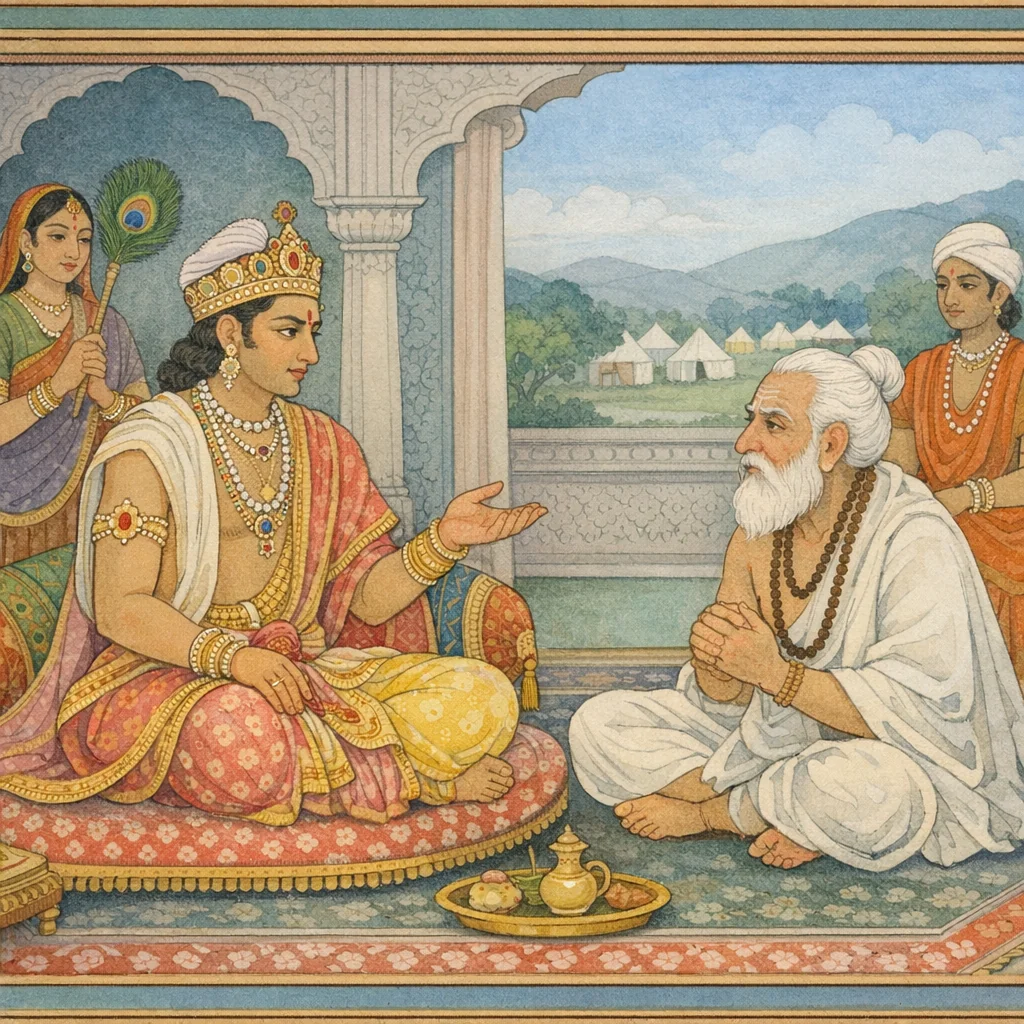
Adhyaya 6
Drupada’s Instruction to the Purohita for the Kaurava Embassy (द्रुपदोपदेशः दूतप्रेषणम्)
Upa-parva: Dūta-prayāṇa (Embassy Preparations) – Drupada’s Counsel to the Purohita
Drupada opens with a hierarchical valuation of beings, identifying the intellectually guided as superior and then praising the dvija order; within that frame he elevates physicians and, among the discerning, the addressed priest as foremost—an argument establishing the envoy’s competence and moral authority. He then notes the envoy’s advantages of lineage, age, learning, and wisdom, presenting him as fully informed about the histories and dispositions of both the Kaurava party and Yudhiṣṭhira. Drupada summarizes the prior deception of the Pāṇḍavas, Dhṛtarāṣṭra’s complicity through continued alignment with his son despite Vidura’s counsel, and Śakuni’s calculated exploitation of Yudhiṣṭhira’s inexperience in dice. He proposes that the envoy’s dharmic speech to Dhṛtarāṣṭra can reorient the minds of warriors and ministers, and that Vidura’s support may generate deliberative divergence among key elders (Bhīṣma, Droṇa, Kṛpa), weakening unanimity behind injustice. This internal reconfiguration, Drupada argues, would hinder hostile preparations while allowing the Pāṇḍavas to consolidate resources and organize forces. He encourages the envoy to speak of the Pāṇḍavas’ hardships to compassionate listeners and to invoke ancestral custom (kuladharma), assuring him of safety due to his Brahmin status, Vedic learning, seniority, and suitability for diplomatic duty. The chapter concludes with Vaiśaṃpāyana stating that, so instructed, the virtuous purohita departs promptly for Nāgasāhvaya under auspicious Puṣya-yoga for the success of the Kuntī-putra’s aims.
Chapter Arc: राजा द्रुपद अपने पुरोहित को आदरपूर्वक संबोधित करते हैं और श्रेष्ठता की सीढ़ी गिनाते हुए (प्राणियों में बुद्धिजीवी, द्विजों में विद्वान, विद्वानों में सिद्धान्त-ज्ञ, और कर्ताओं में ब्रह्मवादियों की महिमा) यह स्थापित करते हैं कि दूत-कर्म के लिए सबसे योग्य कौन है। → द्रुपद का लक्ष्य स्पष्ट होता जाता है—कौरव सभा में धर्मयुक्त वाणी के द्वारा धृतराष्ट्र और कृपालु वृद्धों के मन को मोड़ना, ताकि युद्ध की ओर बढ़ती धारा रोकी जा सके; पर साथ ही संकेत मिलता है कि विदुर के समझाने पर भी धृतराष्ट्र पुत्र-आसक्ति से हट नहीं पाते और शकुनि बुद्धिपूर्वक कुन्तीपुत्रों को चुनौती की दिशा में धकेल चुका है। → द्रुपद पुरोहित को ‘कृतबुद्धियों में प्रधान’ मानकर, कुल-वंश, आयु और श्रुति-ज्ञान के आधार पर दूत-धर्म का भार सौंपते हैं—और यह निर्णायक रूप से कहा जाता है कि आपकी संगति से धृतराष्ट्र धर्म्य वचन स्वीकार कर सकते हैं तथा कौरवों के मन में भय/संकोच उत्पन्न हो सकता है। → दूत के लिए आश्वासन दिया जाता है कि भय का कारण नहीं—आप वेदवेत्ता ब्राह्मण हैं, वृद्ध हैं और दूतकर्म में नियुक्त हैं; अतः धर्मानुकूल आचरण करते हुए कौरवकुल के वृद्ध, कृपालु जनों के समक्ष सत्य-वाणी रखनी है। → कौरव सभा में यह धर्म-दूत किस प्रकार धृतराष्ट्र की पुत्र-आसक्ति और शकुनि की नीति से टकराएगा—और क्या यह प्रयास युद्ध को टाल पाएगा?
Shlokas
Verse 1
राजा द्रुपदने (पुरोहितसे) कहा--पुरोहितजी! समस्त भूतोंमें प्राणधारी श्रेष्ठ हैं। प्राणधारियोंमें भी बुद्धिजीवी श्रेष्ठ हैं। बुद्धिजीवी प्राणियोंमें भी मनुष्य और मनुष्योंमें भी ब्राह्मण श्रेष्ठ माने गये हैं
King Drupada said, “Revered priest! Among all beings, those endowed with life are held to be superior. Among the living, those possessed of intellect are superior. Among the intelligent, human beings are foremost; and among humans, Brahmins are regarded as the highest.”
Verse 2
द्विजेषु वैद्या: श्रेयांसो वैद्येषु कृतबुद्धयः । कृतबुद्धिषु कर्तार: कर्तषु ब्रह्मवादिन: २ ।। ब्राह्मणोंमें विद्वान, विद्वानोंमें सिद्धान्तके जानकार, सिद्धान्तके ज्ञाताओंमें भी तदनुसार आचरण करनेवाले पुरुष तथा उनमें भी ब्रह्मवेत्ता श्रेष्ठ हैं
Drupada declares a hierarchy of excellence: among the twice-born, the truly learned are superior; among the learned, those whose understanding is firmly settled in right doctrine are superior; among those of settled understanding, the ones who act in accordance with it are superior; and among such doers, the knowers and expounders of Brahman are the highest.
Verse 3
( ५ | है |] ॥ न & अजब _ैअकनी .... >> अप ४ _ स भवान् कृतबुद्धीनां प्रधान इति मे मति: । कुलेन च विशिष्टोडसि वयसा च श्रुतेन च,मेरा ऐसा विश्वास है कि आप सिद्धान्तवेत्ताओंमें प्रमुख हैं। आपका कुल तो श्रेष्ठ है ही, अवस्था तथा शास्त्र-ज्ञानमें भी आप बढ़े-चढ़े हैं
Drupada said: “In my judgment, you are foremost among men of settled understanding. You are distinguished by noble lineage, and you surpass others also in maturity of years and in learning.”
Verse 4
प्रज्ञया सदृशश्वासि शुक्रेणाज्ञिरसेन च । विदितं चापि ते सर्व यथावृत्त: स कौरव:,आपकी बुद्धि शुक्राचार्य और बृहस्पतिके समान है। दुर्योधनका आचार-विचार जैसा है, वह सब भी आपको ज्ञात ही है
Drupada said: “In wisdom you are comparable to Śukra and to the Āṅgirasa (Bṛhaspati). And you also know in full how that Kaurava truly is—his conduct and disposition as they have actually unfolded.”
Verse 5
पाण्डवश्व यथावृत्त: कुन्तीपुत्रो युधिष्ठिर: । धृतराष्ट्रस्य विदिते वज्चिता: पाण्डवा: परै:,कुन्तीपुत्र पाण्डुनन्दन युधिष्ठिरका आचार-विचार भी आपलोगोंसे छिपा नहीं है। धृतराष्ट्रकी जानकारीमें शत्रुओंने पाण्डवोंको ठगा है
“As for Kuntī’s son Yudhiṣṭhira—Pāṇḍu’s heir among the Pāṇḍavas—his conduct and the course of events are no secret to you. And it is with Dhṛtarāṣṭra’s knowledge that the Pāṇḍavas have been deceived by their adversaries.”
Verse 6
विदुरेणानुनीतो<पि पुत्रमेवानुवर्तते । शकुनिर्बुद्धिपूर्व हि कुन्तीपुत्रं समाह्नयत्,इति श्रीमहाभारते उद्योगपर्वणि सेनोद्योगपर्वणि पुरोहितयाने षष्ठो5ध्याय:
Drupada said: Though Vidura has sought to restrain him and give counsel, he still follows only his son’s course. For Śakuni, acting with deliberate calculation, has indeed summoned the son of Kuntī. Thus, in the Mahābhārata, in the Udyoga Parva, in the section on the marshaling of the armies, in the episode of the priest’s mission, ends the sixth chapter.
Verse 7
ते तथा वज्चयित्वा तु धर्मराजं युधिष्ठिरम्
“Having thus deceived Dharmarāja Yudhiṣṭhira…”
Verse 8
न कस्याज्चिदवस्थायां राज्यं दास्यन्ति वै स्वयम् । उन सबने मिलकर धर्मराज युधिष्ठिरको ठगा है। अब वे किसी भी अवस्थामें स्वयं राज्य नहीं लौटायेंगे ।। भवांस्तु धर्मसंयुक्तं धृतराष्ट्रं ब्रुवन् वच:
‘They will not, of their own accord, hand over the kingdom under any circumstances. United together, they have deceived Dharmarāja Yudhiṣṭhira; and now they will not voluntarily restore the sovereignty in any situation. Therefore, you should address Dhṛtarāṣṭra with words grounded in dharma.’
Verse 9
विदुरश्चापि तद् वाक््यं साधयिष्यति तावकम्
Drupada said: “Vidura too will carry out that message of yours.”
Verse 10
अमात्येषु च भिन्नेषु योधेषु विमुखेषु च
“When the ministers are divided, and when the warriors have turned away (lost heart or withdrawn their support)…”
Verse 11
एतस्मिन्नन्तरे पार्था: सुखमेकाग्रबुद्धयः
Drupada said: “Meanwhile, the sons of Pṛthā (the Pāṇḍavas), with minds calmly fixed on a single purpose, remained at ease.”
Verse 12
विद्यमानेषु च स्वेषु लम्बमाने तथा त्वयि
“Even while my own people are present, you too are left hanging in uncertainty.”
Verse 13
एतत् प्रयोजन चात्र प्राधान्येनोपलभ्यते
“And here, the true purpose is discerned above all else as the primary consideration.”
Verse 14
स भवान् धर्मयुक्तश्न धर्म्य तेषु समाचरन्,विभेत्स्यति मनांस्येषामिति मे नात्र संशय: । आप धर्मपरायण तो हैं ही, वहाँ धर्मानुकूल बर्ताव करते हुए कौरवकुलमें जो कृपालु वृद्ध पुरुष हैं, उनके समक्ष पूर्वपुरुषोंद्वारा आचरित कुलधर्मका प्रतिपादन एवं पाण्डवोंके क्लेशोंका वर्णन कीजियेगा। इस प्रकार आप उनका मन दुर्योधनकी ओरसे फोड़ लेंगे, इसमें मुझे कोई संशय नहीं है
Drupada said: “You are firmly aligned with dharma; and by conducting yourself among them in a manner consistent with righteousness, you will surely unsettle their hearts—of this I have no doubt. Before the compassionate elders of the Kuru house, set forth the ancestral code of conduct upheld by their forefathers, and describe the hardships the Pāṇḍavas have endured. In this way you will turn their minds away from Duryodhana’s side; I have no uncertainty about it.”
Verse 15
कृपालुषु परिक्लेशान् पाण्डवीयान् प्रकीर्तयन् । वृद्धेषु कुलधर्म च ब्रुवन् पूर्वरनुछितम्
Drupada spoke, recounting the hardships endured by the Pāṇḍavas—men of compassionate disposition—and, addressing the elders, he also spoke of the duty of the family line, in a manner consistent with what had been observed from of old. In doing so, he frames the present crisis within inherited norms of conduct and appeals to senior authority and tradition as ethical grounds for action.
Verse 16
न च तेभ्यो भयं ते<स्ति ब्राह्मणो हासि वेदवित्
And you have no fear from them; you are a Brahmin, a knower of the Vedas.
Verse 17
स भवान् पुष्ययोगेन मुहूर्तेन जयेन च । कौरवेयान् प्रयात्वाशु कौन्तेयस्यार्थसिद्धये,अतः आप पुष्य नक्षत्रसे युक्त जय नामक मुहूर्तमें कुन्तीनन्दन युधिष्ठिरके कार्यकी सिद्धिके लिये कौरवोंके पास शीघ्र जाइये
Drupada said: “May you, under the auspicious conjunction of the Puṣya nakṣatra and at the victorious ‘Jaya’ muhūrta, go swiftly to the Kauravas, so that the purpose of Kuntī’s son (Yudhiṣṭhira) may be accomplished.”
Verse 18
वैशम्पायन उवाच तथानुशिष्ट: प्रययौ ट्रपदेन महात्मना । पुरोधा वृत्तसम्पन्नो नगरं नागसाह्दयम्,वैशम्पायनजी कहते हैं--जनमेजय! महामना राजा द्रुपदके द्वारा इस प्रकार अनुशासित होकर सदाचार-सम्पन्न पुरोहितने हस्तिनापुरको प्रस्थान किया
Vaiśampāyana said: Thus instructed by the high-souled King Drupada, the family priest—endowed with upright conduct—set out for the city known as Nāgasāhvaya (Hastināpura).
Verse 19
शिष्यै: परिवृतो विद्वान नीतिशास्त्रार्थकोविद: । पाण्डवानां हितार्थाय कौरवान् प्रति जग्मिवान्,वे विद्वान तथा नीतिशास्त्र और अर्थशास्त्रके विशेषज्ञ थे। वे पाण्डवोंके हितके लिये शिष्योंके साथ कौरवोंकी (राजधानीकी) ओर गये थे
Vaiśampāyana said: Surrounded by his disciples, the learned man—well-versed in the principles of polity and statecraft—set out toward the Kauravas, seeking the welfare of the Pāṇḍavas.
Verse 66
अनक्षज्ञं मताक्ष: सन् क्षत्रवृत्ते स्थितं शुचिम् । विदुरजीके अनुनय-विनय करनेपर भी धूृतराष्ट्र अपने पुत्रका ही अनुसरण करते हैं। शकुनिने स्वयं जूएके खेलमें प्रवीण होकर यह जानते हुए भी कि युधिष्ठिर जूएके खिलाड़ी नहीं हैं, वे क्षत्रियधर्मपर चलनेवाले शुद्धात्मा पुरुष हैं, उन्हें समझ-बूझकर जूएके लिये बुलाया
Drupada said: ‘Though Yudhiṣṭhira was no knower of dice, he was pure in conduct and firmly established in the Kṣatriya way of life. Even when Vidura pleaded with humility and reason, Dhṛtarāṣṭra still followed only his sons’ course. And Śakuni—skilled in the game of dice—despite knowing that Yudhiṣṭhira was not a gambler but a man of clean soul who walked in Kṣatriya dharma, deliberately summoned him to the dice-match.’
Verse 86
मनांसि तस्य योधानां ध्रुवमावर्तयिष्यति । परंतु आप राजा धुृतराष्ट्रसे धर्मयुक्त बातें कहकर उनके योद्धाओंका मन निश्चय ही अपनी ओर फेर लेंगे
Drupada said: “He will surely turn the minds of that king’s warriors. Yet you, O King, by speaking to Dhṛtarāṣṭra words grounded in dharma, will certainly draw the hearts of his fighters over to your side.”
Verse 93
भीष्मद्रोणकृपादीनां भेदं संजनयिष्यति । दुरजी भी वहाँ आपके वचनोंका समर्थन करेंगे तथा आप भीष्म, द्रोण एवं कृपाचार्य आदिदमें भेद उत्पन्न कर देंगे
Drupada said: “He will bring about a rift among Bhīṣma, Droṇa, Kṛpa, and the other elders. Even those hard to sway will end up supporting your words, and by your counsel you will sow division within that senior leadership.”
Verse 106
पुनरेकत्रकरणं तेषां कर्म भविष्यति । जब मन्त्रियोंमें फूट पड़ जायगी और योद्धा भी विमुख होकर चल देंगे, तब उनका (प्रधान) कार्य होगा--पुनः नूतन सेनाका संग्रह और संगठन
Drupada said: “Their chief task will again be to bring things back into one place—reuniting and reorganizing. When dissension arises among the ministers and even the warriors turn away and depart, their primary work will be to gather a fresh army and restore its order.”
Verse 116
सेनाकर्म करिष्यन्ति द्रव्याणां चैव संचयम् । इसी बीचमें एकाग्रचित्तवाले कुन्तीकुमार अनायास ही सेनाका संगठन और द्रव्यका संग्रह कर लेंगे
Drupada said: “They will carry out the work of organizing the army, and also the accumulation of resources.” In context, he expresses confidence that the sons of Kuntī, acting with focused resolve and without undue strain, will arrange the military order and gather the necessary wealth—an ethically framed preparation for a conflict undertaken as a matter of duty rather than greed.
Verse 126
न तथा ते करिष्यन्ति सेनाकर्म न संशय: । जब वहाँ हमारे स्वजन उपस्थित रहेंगे और आप भी वहाँ रहकर लौटनेमें विलम्ब करते रहेंगे, तब निस्संदेह वे सैन्यसंग्रहका कार्य उतने अच्छे ढंगसे नहीं कर सकेंगे
Drupada said: “There is no doubt they will not be able to carry out the work of raising and organizing the army in the same effective way—especially when our own kinsmen are present there, and you too remain there and delay your return.”
Verse 136
संगत्या धृतराष्ट्रश्न कुर्याद् धर्म्य वचस्तव । वहाँ आपके जानेका यही प्रयोजन प्रधान-रूपसे दिखायी देता है। यह भी सम्भव है कि आपकी संगतिसे धृतराष्ट्रका मन बदल जाय और वे आपकी धर्मानुकूल बात स्वीकार कर लें
By associating with you, even Dhṛtarāṣṭra may be brought to speak and act in a righteous way. This seems to be the chief purpose of your going there. It is also possible that, through your company, Dhṛtarāṣṭra’s mind may change and he may accept your words as being in accord with dharma.
Verse 156
विभेत्स्यति मनांस्येषामिति मे नात्र संशय: । आप धर्मपरायण तो हैं ही, वहाँ धर्मानुकूल बर्ताव करते हुए कौरवकुलमें जो कृपालु वृद्ध पुरुष हैं, उनके समक्ष पूर्वपुरुषोंद्वारा आचरित कुलधर्मका प्रतिपादन एवं पाण्डवोंके क्लेशोंका वर्णन कीजियेगा। इस प्रकार आप उनका मन दुर्योधनकी ओरसे फोड़ लेंगे, इसमें मुझे कोई संशय नहीं है
Drupada said: “There is no doubt in my mind that their hearts will be shaken. You are devoted to dharma; therefore, when you go there, conduct yourself in a manner befitting dharma. In the presence of the compassionate elders of the Kuru line, set forth the ancestral code of the family as practiced by forefathers, and describe the hardships the Pāṇḍavas have endured. By doing so, you will turn their minds away from Duryodhana—of this I have no doubt.”
Verse 166
दूतकर्मणि युक्तश्न स्थविरश्न॒ विशेषत: । आपको उनसे कोई भय नहीं है; क्योंकि आप वेदवेत्ता ब्राह्मण हैं। विशेषतः दूतकर्ममें नियुक्त और वृद्ध हैं
Drupada said: “You have no cause to fear them. You are a Brahmin learned in the Vedas; and all the more so because you are an elder and have been appointed to the duty of an envoy. One who bears a message in accordance with dharma should not be harmed.”
Frequently Asked Questions
The dilemma is whether a ruler and his court should correct a known injustice (the deceptive dispossession of the Pāṇḍavas) when doing so conflicts with loyalty to one’s own son and entrenched political advantage.
Ethical political speech is portrayed as a legitimate instrument of change: dharma-based persuasion, grounded in learning and precedent, can be strategically deployed to restrain harmful action and reopen space for just settlement.
No explicit phalaśruti is stated; the meta-commentary appears indirectly through the emphasis on auspicious timing (Puṣya-yoga) and the narrative closure that frames the embassy as a purposeful, efficacy-oriented act within dharmic statecraft.