Adhyaya 79
आपद्धर्मे वैश्यवृत्तिः, विक्रय-निषेधाः, तथा ब्रह्म-क्षत्र-सम्बन्धः (Emergency Livelihood, Prohibited Trade, and Brahman–Kshatra Regulation)
Upa-parva: Rājadharmānuśāsana (Instruction on Royal Duty) — Āpaddharma and Varṇa-Functions
Yudhiṣṭhira asks whether a brāhmaṇa, unable to sustain himself through kṣātra-functions during adversity, may live by vaiśya-dharma. Bhīṣma permits emergency recourse to agriculture and cattle-tending when ordinary livelihood collapses, but enumerates commodities a brāhmaṇa must avoid selling in all circumstances—explicitly including intoxicants, salt, sesame, certain animals, bulls, honey, meat, and prepared foods—warning of severe demerit from such trade. The discourse then treats exchange ethics: the virtuous do not praise trading raw for cooked (or exploiting asymmetry), yet barter for sustenance can be non-blameworthy when examined prudently. Yudhiṣṭhira next raises a systemic crisis: when all take up arms and kṣatra power declines, what becomes the refuge? Bhīṣma answers that brahmanical power—through tapas, yajña, self-restraint, and non-hostility—serves as stabilizing refuge and can restore royal strength. If kṣatra turns hostile toward brāhmaṇas, regulation may require ascetic force, strategic means, and, when necessary, protective force; brahman is portrayed as the ultimate regulator because kṣatra is said to arise from brahman. The chapter further argues that deśa-kāla can invert apparent dharma/adharma, and it permits brāhmaṇas to take up weapons in three cases: self-defense, varṇa-disorder, and fortress exigencies. Finally, Bhīṣma states that whoever protects people from predation deserves honor regardless of varṇa, and defines the king’s essential function as continual protection of the good and restraint of the harmful.
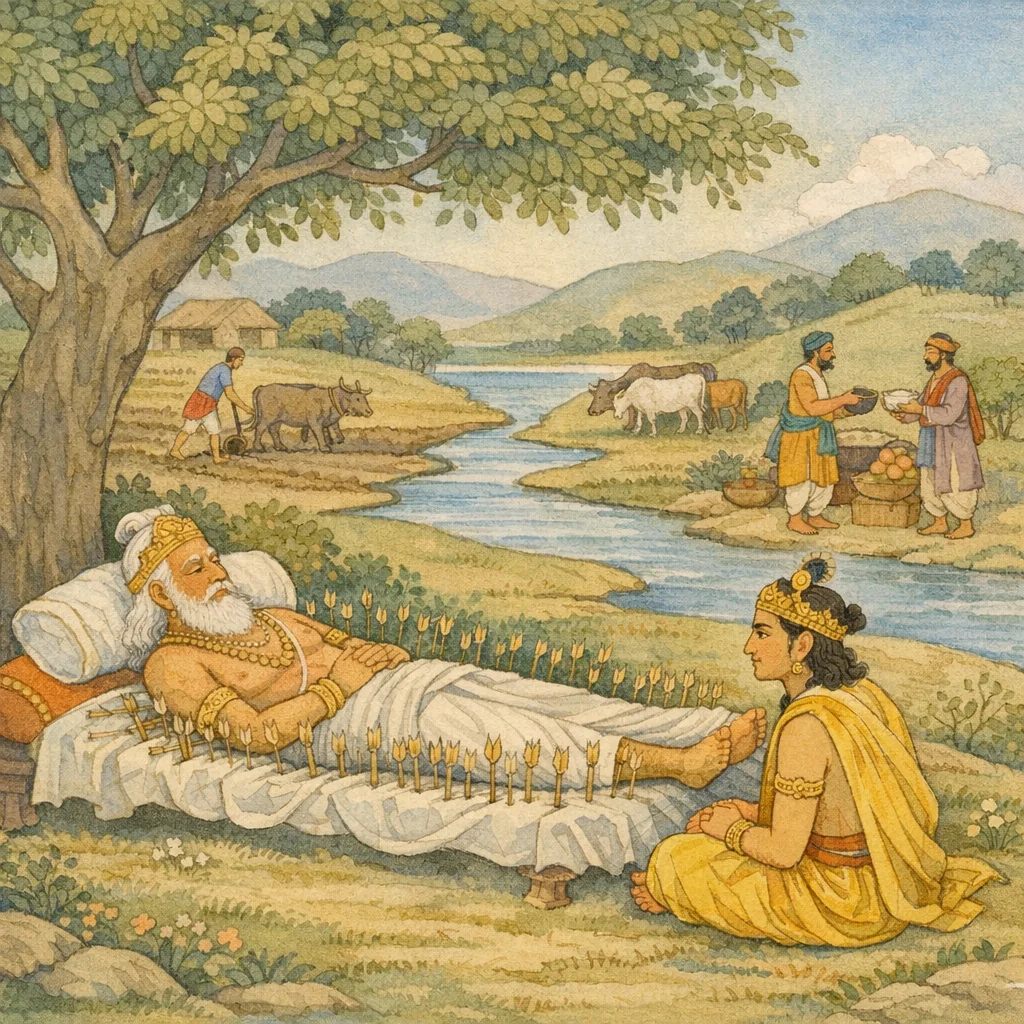
Chapter Arc: शरशय्या पर पड़े भीष्म युधिष्ठिर को आपत्तिकाल-धर्म का द्वार दिखाते हैं—जब ब्राह्मण की आजीविका नष्ट हो जाए, तब वह किन-किन वृत्तियों से जीवित रह सकता है। → भीष्म बताते हैं कि असमर्थ ब्राह्मण, यदि क्षात्र-वृत्ति भी न निभा सके, तो वैश्य-वृत्ति (कृषि, गोरक्षा, व्यापार) से निर्वाह करे; पर साथ ही व्यवहार की शुचिता—‘बलात् नहीं, रुचि और विनिमय से’—पर जोर देते हैं। युधिष्ठिर की चिंता बढ़ती है: जब प्रजा शस्त्र उठा ले और स्वधर्म से विचलित हो, तब राज्य-व्यवस्था कैसे टिकेगी? → धर्म-व्यवस्था के उलट जाने का तीखा संकेत आता है—जब लोहे का पत्थर काटना, अग्नि का जल के पास जाना, और क्षत्रिय-ब्राह्मण का परस्पर द्वेष जैसे ‘विपर्यय’ घटित हों, तब समाज के आधार-स्तम्भ नष्ट होने लगते हैं; इसी बिंदु पर आपत्तिकाल-धर्म की अनिवार्यता और उसकी सीमा दोनों स्पष्ट होती हैं। → भीष्म निष्कर्ष देते हैं कि प्राचीन सत्पुरुषों के व्यवहार का मूल ‘न्यायपूर्ण विनिमय’ और ‘रक्षा’ है—राजा वही योग्य है जो सज्जनों की रक्षा करे और दुष्टों को दण्ड देकर अधर्म रोके; तभी जगत सुरक्षित रहता है। → युधिष्ठिर के प्रश्न की छाया बनी रहती है—यदि सब अपने-अपने धर्म से हटें, तो राजा किस उपाय से पुनः मर्यादा स्थापित करे?
Shlokas
Verse 1
ऑपन- मा छा ्-ज::अ अष्टसप्ततितमो< ध्याय: आपपत्तिकालनमें ब्राह्मणके लिये वैश्यवृत्तिसे निर्वाह करनेकी छूट तथा लुटेरोंसे अपनी और दूसरोंकी रक्षा करनेके लिये सभी जातियोंको शस्त्र धारण करनेका अधिकार एवं रक्षकको सम्मानका पात्र स्वीकार करना युधिछिर उवाच व्याख्याता राजधर्मेण वृत्तिरापत्सु भारत । कथं स्विद् वैश्यधर्मेण संजीवेद् ब्राह्मणो न वा,युधिष्ठिरने पूछा--भरतनन्दन! आपने ब्राह्मणके लिये आपत्तिकालमें क्षत्रियधर्मसे जीविका चलानेकी बात पहले बतायी है। अब मैं यह जानना चाहता हूँ कि ब्राह्मण किसी तरह वैश्य-धर्मसे भी जीवन-निर्वाह कर सकता है या नहीं?
Yudhiṣṭhira said: “O Bhārata, you have explained that in times of calamity a Brahmin may sustain himself by adopting the livelihood associated with royal (Kṣatriya) duty. How, then, may a Brahmin live by the duties and means of the Vaiśya—can he do so, or not?”
Verse 2
भीष्म उवाच अशक्ति: क्षत्रधर्मेण वैश्यधर्मेण वर्तयेत् । कृषिगोरक्ष्यमास्थाय व्यसने वृत्तिसंक्षये
Bhishma said: When one lacks the capacity to live by the duties of a kshatriya, one should sustain oneself by adopting the duties of a vaishya. In times of calamity, when one’s customary livelihood is diminished, one may take up agriculture and the protection and tending of cattle as a means of support.
Verse 3
भीष्मजीने कहा--राजन! यदि ब्राह्मण अपनी जीविका नष्ट होनेपर आपत्तिकालमें क्षत्रियधर्मसे भी जीवननिर्वाह न कर सके तो वैश्यधर्मके अनुसार खेती और गोरक्षाका आश्रय लेकर वह अपनी जीविका चलावे ।। युधिछिर उवाच कानि पण्यानि विक्रीय स्वर्गलोकान्न हीयते । ब्राह्मणो वैश्यधर्मेण वर्तयन् भरतर्षभ,युधिष्ठिरने पूछा--भरतश्रेष्ठ] यह तो बताइये कि यदि ब्राह्मण वैश्यधर्मसे जीविका चलाते समय व्यापार भी करे तो किन-किन वस्तुओंका क्रय-विक्रय करनेसे वह स्वर्गलोककी प्राप्तिके अधिकारसे वज्चित नहीं होगा
Yudhiṣṭhira said: “O bull among the Bharatas, if a brāhmaṇa maintains himself by adopting the livelihood of a vaiśya, which goods may he buy and sell without thereby falling away from his claim to heaven?”
Verse 4
भीष्म उवाच सुरा लवणमित्येव तिलान् केसरिण: पशून् | वृषभान् मधुमांसं च कृतान्नं च युधिष्ठिर,भीष्मजीने कहा--तात युधिष्ठिर! ब्राह्मणको मांस, मदिरा, शहद, नमक, तिल, बनायी हुई रसोई, घोड़ा तथा बैल, गाय, बकरा, भेड़ और भैंस आदि पशु--इन वस्तुओंका विक्रय तो सभी अवस्थाओंमें त्याग देना चाहिये; क्योंकि इनको बेचनेसे ब्राह्मण नरकमें पड़ता है
Bhishma said: “O Yudhishthira, liquor and salt, sesame seeds, tawny (lion-colored) animals, bulls, honey and meat, and cooked food—these are items whose trade a Brahmin should renounce in every circumstance.”
Verse 5
सर्वास्ववस्थास्वेतानि ब्राह्मण: परिवर्जयेत् । एतेषां विक्रयात् तात ब्राह्मणो नरकं व्रजेत्,भीष्मजीने कहा--तात युधिष्ठिर! ब्राह्मणको मांस, मदिरा, शहद, नमक, तिल, बनायी हुई रसोई, घोड़ा तथा बैल, गाय, बकरा, भेड़ और भैंस आदि पशु--इन वस्तुओंका विक्रय तो सभी अवस्थाओंमें त्याग देना चाहिये; क्योंकि इनको बेचनेसे ब्राह्मण नरकमें पड़ता है
Bhishma said: “Dear child (Yudhishthira), a Brahmin should renounce the sale of these items in every circumstance. For, by trading in them, a Brahmin falls into hell.”
Verse 6
अजोडन्निर्वरुणो मेष: सूर्यो5श्वः पृथिवी विराट । धेनुर्यज्ञश्न सोमश्न न विक्रेया: कथंचन
Bhīṣma said: “A goat should not be castrated; a ram dedicated to Varuṇa must not be harmed; the horse of the Sun is inviolable; the earth (as the all-supporting Virāṭ) is not to be treated as property. Likewise, a milch-cow, and one that has been consecrated to sacrificial use—whether marked for offerings or for Soma—must never be sold under any circumstance.”
Verse 7
पकक््वेनामस्य निमयं न प्रशंसन्ति साधव: । निमयेत् पक्वमामेन भोजनार्थाय भारत
Bhishma said: The virtuous do not approve of exchanging what is ripe and wholesome for what is unripe. One should rather exchange the unripe for the ripe, O Bharata, when the aim is nourishment and sustenance.
Verse 8
बकरा अग्निस्वरूप, भेड़ वरुणस्वरूप, घोड़ा सूर्यस्वरूप, पृथ्वी विराट्स्वरूप तथा गौ यज्ञ और सोमका स्वरूप है; अतः इनका विक्रय कभी किसी तरह नहीं करना चाहिये। भरतनन्दन! ब्राह्मणके लिये बनी-बनायी रसोई देकर बदलेमें कच्चा अन्न लेनेकी साधुपुरुष प्रशंसा नहीं करते हैं; किंतु केवल भोजनके लिये कच्चा अन्न देकर उसके बदले पका- पकाया अन्न ले सकते हैं ।। वयं सिद्धमशिष्यामो भवान् साधयतामिदम् । एवं संवीक्ष्य निमयेन्नाधर्मोडस्ति कथंचन,“हम लोग बनी-बनायी रसोई पाकर भोजन कर लेंगे। आप यह कच्चा अन्न लेकर इसे पकाइये' इस भावसे अच्छी तरह विचार करके यदि कच्चे अन्नसे पके-पकाये अन्नको बदल लिया जाय तो इसमें किसी प्रकार भी अधर्म नहीं होता
Bhishma said: “The goat embodies Agni, the sheep embodies Varuṇa, the horse embodies the Sun, the earth embodies the Virāṭ, and the cow embodies sacrifice and Soma; therefore their sale should never be undertaken in any manner. O delight of the Bharatas, the good do not praise the practice of giving a prepared meal meant for a Brāhmaṇa and taking raw grain in exchange; yet, when it is solely for the sake of eating, one may give raw grain and receive cooked food in return. ‘We shall eat what is already prepared; you take this raw grain and cook it’—when the exchange is made after such careful consideration, there is no unrighteousness in it at all.”
Verse 9
अन्न ते वर्तयिष्यामि यथा धर्म: सनातन: । व्यवहारप्रवृत्तानां तन्निबोध युधिष्ठिर,युधिष्ठिर! इस विषयमें व्यवहारपरायण मनुष्योंके लिये सनातन कालसे चला आता हुआ धर्म जैसा है, वैसा मैं तुम्हें बतला रहा हूँ सुनो
Bhishma said: “I shall explain to you, O Yudhishthira, the eternal dharma as it has long been upheld—especially for those engaged in worldly dealings and social conduct. Listen and understand it well.”
Verse 10
भवते*हं ददानीदं भवानेतत् प्रयच्छतु । रुचितो वर्तते धर्मो न बलात् सम्प्रवर्तते,मैं आपको यह वस्तु देता हूँ, इसके बदलेमें आप मुझे वह वस्तु दे दीजिये, ऐसा कहकर दोनोंकी रुचिसे जो वस्तुओंकी अदला-बदली की जाती है, उसे धर्म माना जाता है। यदि बलात्कारपूर्वक अदला-बदली की जाय तो वह धर्म नहीं है
Bhishma said: “I give this to you; you, in return, give that to me.” When an exchange of goods is carried out by the mutual liking and consent of both parties, it is regarded as dharma (a rightful, ethical transaction). But if such an exchange is forced through coercion, it does not become dharma.
Verse 11
इत्येवं सम्प्रवर्तन्ते व्यवहारा: पुरातना: । ऋषीणामितरेषां च साधु चैतदसंशयम्,प्राचीन कालसे ऋषियों तथा अन्य सत्पुरुषोंके सारे व्यवहार ऐसे ही चले आ रहे हैं। यह सब ठीक है, इसमें संशय नहीं है
Bhīṣma said: “Thus, in this very manner, the ancient usages and standards of conduct have continued in practice—among the seers and among others as well. This is indeed proper; of this there is no doubt.”
Verse 12
युधिछिर उवाच अथ तात यदा सर्वा: शस्त्रमाददते प्रजा: । व्युत्क्रामन्ति स्वधर्मेभ्य: क्षत्रस्य क्षीयते बलम्,युधिष्ठिरने पूछा--तात! नरेश्वर! यदि सारी प्रजा शस्त्र धारण कर ले और अपने धर्मसे गिर जाय, उस समय क्षत्रियकी शक्ति तो क्षीण हो जायगी। फिर राजा राष्ट्रकी रक्षा कैसे कर सकता है और वह सब लोगोंको किस तरह शरण दे सकता है। मेरे इस संदेहका आप विस्तारपूर्वक समाधान करें
Yudhiṣṭhira said: “Then, revered sir, when all the people take up weapons and stray from their own ordained duties, the strength of the kṣatra (the royal, protective order) is diminished. In such a situation, how can a king protect the realm, and how can he grant refuge to all? Please resolve this doubt of mine in detail.”
Verse 13
राजा त्राता तु लोकस्य कथं च स्यथात् परायणम् | एतन्मे संशयं ब्रूहि विस्तरेण नराधिप,युधिष्ठिरने पूछा--तात! नरेश्वर! यदि सारी प्रजा शस्त्र धारण कर ले और अपने धर्मसे गिर जाय, उस समय क्षत्रियकी शक्ति तो क्षीण हो जायगी। फिर राजा राष्ट्रकी रक्षा कैसे कर सकता है और वह सब लोगोंको किस तरह शरण दे सकता है। मेरे इस संदेहका आप विस्तारपूर्वक समाधान करें
Yudhiṣṭhira said: “A king is indeed the protector of the people; but how can he truly become their final refuge? Explain this doubt of mine in detail, O lord of men.”
Verse 14
भीष्म उवाच दानेन तपसा यज्ञैरद्रोहेण दमेन च । ब्राह्मणप्रमुखा वर्णा: क्षेममिच्छेयुरात्मन:
Bhishma said: By generosity, austerity, sacrificial worship, non-malice, and self-restraint, the social orders—led by the Brahmanas—should seek their own welfare and security.
Verse 15
भीष्मजीने कहा--राजन! ब्राह्मण आदि सभी वर्णोको दान, तप, यज्ञ, प्राणियोंके प्रति द्रोह का अभाव तथा इन्द्रिय-संयमके द्वारा अपने कल्याणकी इच्छा रखनी चाहिये ।। तेषां ये वेदबलिनस्ते5भ्युत्थाय समन्ततः । राज्ञो बल॑ वर्धयेयुर्महेन्द्रस्येव देवता:,उनमेंसे जिन ब्राह्मणोंमें वेद-शास्त्रोंका बल हो, वे सब ओरसे उठकर राजाका उसी प्रकार बल बढ़ावें, जैसे देवता इन्द्रका बल बढ़ाते हैं
Bhishma said: O King, all the social orders beginning with the Brahmins should seek their own welfare through generosity, austerity, sacrifice, non-violence toward living beings, and restraint of the senses. Among them, those Brahmins who are strong in the Vedas should rise up on every side and increase the king’s strength—just as the gods augment the power of great Indra.
Verse 16
राज्ञोउपि क्षीयमाणस्य ब्रह्मैवाहु: परायणम् । तस्माद् ब्रह्मबलेनैव समुत्थेयं विजानता,जिसकी शक्ति क्षीण हो रही हो, उस राजाके लिये ब्राह्मणको ही सबसे बड़ा सहायक बताया गया है; अतः बुद्धिमान नरेशको ब्राह्मणके बलका आश्रय लेकर ही अपनी उन्नति करनी चाहिये
Bhishma said: Even for a king whose power is waning, the wise declare that Brahman—the support of the Brahmin order and sacred knowledge—is the highest refuge. Therefore, a discerning ruler should seek his restoration and advancement by relying on the strength that comes from Brahman.
Verse 17
यदा भुवि जयी राजा क्षेमं राष्ट्रेडभिसंदधेत् । तदा वर्णा यथाधर्म निविशेयु: कथंचन,जब भूतलपर विजयी राजा अपने राष्ट्रमें कल्याणमय शासन स्थापित करना चाहता हो, तब उसे चाहिये कि जिस किसी प्रकारसे सभी वर्णके लोगोंको अपने-अपने धर्मका पालन करनेमें लगाये रखे
When a king, victorious upon the earth, seeks to establish a wholesome and secure rule in his realm, he must, by whatever means, keep all the social orders steadfast in the practice of their own dharma.
Verse 18
उन्मयदि प्रवृत्ते तु दस्युभि: संकरे कृते । सर्वे वर्णा न दुष्येयु: शस्त्रवन्तो युधिष्ठिर,युधिष्ठिर! जब डाकू और लुटेरे धर्ममर्यादाका उल्लड्घन करके स्वेच्छाचारमें प्रवृत्त हुए हों और प्रजामें वर्णसंकरता फैला रहे हों, उस समय इस अत्याचारको रोकनेके लिये यदि सभी वर्णोके लोग हथियार उठा लें तो उन्हें कोई दोष नहीं लगता
Bhishma said: “O Yudhiṣṭhira, when bandits, driven by lawless frenzy, violate the bounds of dharma and create social confusion and intermixture, then if people of all the varṇas take up weapons to restrain that oppression, they incur no fault.”
Verse 19
युधिछिर उवाच अथ चेत् सर्वतः क्षत्रं प्रदुष्येद् ब्राह्मणं प्रति । कस्तस्य ब्राह्मणस्त्राता को धर्म: कि परायणम्,युधिष्ठिरने पूछा--पितामह! यदि क्षत्रिय जाति ही सब ओससे ब्राह्मणोंके साथ दुर्व्यवहार करने लगे, उस समय उस ब्राह्मणकुलकी रक्षा कौन ब्राह्मण कर सकता है? उनके लिये कौन-सा धर्म (कर्तव्य) है तथा कौन-सा महान् आश्रय?
Yudhiṣṭhira said: “If, on all sides, the kṣatriya order were to turn corrupt and act hostile toward the brāhmaṇa, who then would be the protector of that brāhmaṇa? What duty would remain for him, and what supreme refuge should he take?”
Verse 20
भीष्म उवाच तपसा ब्रह्मचर्येण शस्त्रेण च बलेन च | अमायया मायया च नियन्तव्यं तदा भवेत्,भीष्मजीने कहा--राजन्! उस समय ब्राह्मण अपने तपसे, ब्रह्मचर्यसे, शस्त्रसे, बलसे, निष्कपट व्यवहारसे अथवा भेदनीतिसे--जैसे भी सम्भव हो, उसी तरह क्षत्रिय जातिको दबानेका प्रयत्न करे
Bhīṣma said: “O king, at that time the brāhmaṇa should strive to restrain the kṣatriya—by austerity and brahmacarya, by weapons and strength, by guileless uprightness or by stratagem—by whatever means are possible.”
Verse 21
क्षत्रियस्यातिवृत्तस्य ब्राह्मणेषु विशेषत: । ब्रह्मैव संनियन्त् स्यात् क्षत्रं हि ब्रह्मसम्भवम्,जब क्षत्रिय ही प्रजाके ऊपर, उसमें भी विशेषतः ब्राह्मणोंपर अत्याचार करने लगे तो उस समय उसे ब्राह्मण ही दबा सकता है; क्योंकि क्षत्रियकी उत्पत्ति ब्राह्मणसे ही हुई है
Bhīṣma said: “When a kṣatriya oversteps all bounds—especially by oppressing brāhmaṇas—then it is Brahmanical authority alone that can restrain him; for the power of kingship (kṣatra) itself arises from brahman.”
Verse 22
अद्भयोडन्नि््रह्युत: क्षत्रमश्मनो लोहमुत्थितम् । तेषां सर्वत्रगं तेज: स्वासु योनिषु शाम्यति,अग्नि जलसे, क्षत्रिय ब्राह्मणसे और लोहा पत्थरसे पैदा हुआ है। इनका तेज या प्रभाव सर्वत्र काम करता है; परंतु अपनी उत्पत्तिके मूल कारणोंसे मुकाबला पड़नेपर शान्त हो जाता है
“Fire arises from water; the power of kingship (kṣatra) arises from the brāhmaṇa; and iron arises from stone. Their radiance and force range everywhere, yet when they meet the very source from which they were born, they are quelled.”
Verse 23
यदा छिनत्त्ययो5श्मानमनग्निश्चापो5भिगच्छति । क्षत्रं च ब्राह्माणं द्वेष्टि तदा नश्यन्ति ते त्रयः,जब लोहा पत्थर काटता है, अग्नि जलके पास जाती है और क्षत्रिय ब्राह्मणसे द्वेष करने लगता है, तब ये तीनों नष्ट हो जाते हैं
Bhīṣma said: “When iron begins to cut stone, when fire approaches water, and when the warrior order comes to hate the Brahmin, then those three are ruined.”
Verse 24
तस्माद् ब्रह्मणि शाम्यन्ति क्षत्रियाणां युधिष्ठिर । समुदीर्णान्यजेयानि तेजांसि च बलानि च,युधिष्ठिर! यद्यपि क्षत्रियोंके तेज और बल प्रचण्ड और अजेय होते हैं, तथापि ब्राह्मणसे टक्कर लेनेपर शान्त हो जाते हैं
Bhīṣma said: “Therefore, O Yudhiṣṭhira, the blazing energies and the mighty strengths of kṣatriyas—though roused to their height and seemingly unconquerable—are pacified when they come up against brahman, the spiritual authority embodied by the brāhmaṇa.”
Verse 25
ब्रह्मवीर्ये मृदुभूते क्षत्रवीर्ये च दुर्बले । दुष्टेषु सर्ववर्णेषु ब्राह्मणान् प्रति सर्वश:,जब ब्राह्मणकी शक्ति मन्द पड़ जाय, क्षत्रियका पराक्रम भी दुर्बल हो जाय और सभी वर्णोंके लोग सर्वथा ब्राह्मणोंसे दुर्भाव रखने लगें, उस समय जो लोग ब्राह्मणोंकी, धर्मकी तथा अपने आपकी रक्षाके लिये प्राणोंकी परवा न करके दुष्टोंके साथ क्रोधपूर्वक युद्ध करते हैं, उन मनस्वी पुरुषोंका पवित्र यश सब ओर फैल जाता है; क्योंकि ब्राह्मणोंकी रक्षाके लिये सबको शस्त्र ग्रहण करनेका अधिकार है
Bhīṣma said: “When the spiritual potency of the brāhmaṇas has grown feeble, and the martial vigor of the kṣatriyas too has become weak, and when people of all social orders, having turned corrupt, everywhere bear hostility toward the brāhmaṇas—then those resolute men who, without regard for their own lives, take up arms and fight the wicked in righteous wrath to defend the brāhmaṇas, to safeguard dharma, and to protect themselves, attain a pure fame that spreads in all directions; for in safeguarding the brāhmaṇas, all are entitled to wield weapons.”
Verse 26
ये तत्र युद्ध कुर्वन्ति त्यक्त्वा जीवितमात्मन: । ब्राह्मणान् परिरक्षन्तो धर्ममात्मानमेव च,जब ब्राह्मणकी शक्ति मन्द पड़ जाय, क्षत्रियका पराक्रम भी दुर्बल हो जाय और सभी वर्णोंके लोग सर्वथा ब्राह्मणोंसे दुर्भाव रखने लगें, उस समय जो लोग ब्राह्मणोंकी, धर्मकी तथा अपने आपकी रक्षाके लिये प्राणोंकी परवा न करके दुष्टोंके साथ क्रोधपूर्वक युद्ध करते हैं, उन मनस्वी पुरुषोंका पवित्र यश सब ओर फैल जाता है; क्योंकि ब्राह्मणोंकी रक्षाके लिये सबको शस्त्र ग्रहण करनेका अधिकार है
Bhīṣma said: “Those who, in such a crisis, cast aside concern for their own lives and fight—protecting the brāhmaṇas, safeguarding dharma, and defending their very selves—win a pure fame that spreads in all directions. For when the protection of brāhmaṇas and dharma is at stake, taking up arms against the wicked becomes a rightful duty.”
Verse 27
मनस्थविनो मन्युमन्तः पुण्यश्लोका भवन्ति ते । ब्राह्मणार्थ हि सर्वेषां शस्त्रग्रहणमिष्यते,जब ब्राह्मणकी शक्ति मन्द पड़ जाय, क्षत्रियका पराक्रम भी दुर्बल हो जाय और सभी वर्णोंके लोग सर्वथा ब्राह्मणोंसे दुर्भाव रखने लगें, उस समय जो लोग ब्राह्मणोंकी, धर्मकी तथा अपने आपकी रक्षाके लिये प्राणोंकी परवा न करके दुष्टोंके साथ क्रोधपूर्वक युद्ध करते हैं, उन मनस्वी पुरुषोंका पवित्र यश सब ओर फैल जाता है; क्योंकि ब्राह्मणोंकी रक्षाके लिये सबको शस्त्र ग्रहण करनेका अधिकार है
Bhīṣma said: “Those who are resolute and filled with righteous anger become men of holy fame. For the sake of protecting the brāhmaṇas, it is approved that all may take up weapons.”
Verse 28
अतिस्विष्टमधीतानां लोकानतितपस्विनाम् । अनाशनाम्न्योर्विशतां शूरा यान्ति परां गतिम्,अतिमात्रामें यज्ञ, वेदाध्ययन, तपस्या और उपवासब्रत करनेवालोंको तथा आत्मशुद्धिके लिये अग्निप्रवेश करनेवाले लोगोंको जिन लोकोंकी प्राप्ति होती है, उनसे भी उत्तम लोक ब्राह्मणके लिये प्राण देनेवाले शूरवीरोंको प्राप्त होते हैं
Bhishma said: Even beyond the worlds attained by those who have performed exceedingly perfect sacrifices, by those devoted to profound Vedic study, by great ascetics, and by those who enter the fire through the vow of fasting for self-purification—heroes who give up their lives for a Brahmin attain the highest state.
Verse 29
ब्राह्मणस्त्रिषु वर्णेषु शस्त्र गृह्नन्न दुष्पति । एवमेवात्मनस्त्यागान्नान्यं धर्म विदुर्जना:,ब्राह्मण भी यदि तीनों वर्णोंकी रक्षाके लिये शस्त्र ग्रहण करे तो उसे दोष नहीं लगता। विद्वान् पुरुष इस प्रकार युद्धमें अपने शरीरके त्यागसे बढ़कर दूसरा कोई धर्म नहीं मानते हैं
Bhishma said: “If a Brahmin takes up weapons for the protection of the three social orders, he incurs no fault. Likewise, the wise recognize no higher duty than the offering up of one’s own body in battle (when undertaken for righteous protection).”
Verse 30
तेभ्यो नमश्न भद्रं च ये शरीराणि जुद्धते । ब्रह्मद्विषो नियच्छन्तस्तेषां नो5स्तु सलोकता । ब्रह्मलोकजित: स्वर्ग्यान् वीरांस्तान् मनुरब्रवीत्
Bhīṣma said: “Salutations to them, and blessings upon them—those heroes who stake their very bodies in battle, restraining the haters of Brahman. May we attain fellowship in the same world as they. Having conquered Brahmaloka, Manu declared those valiant ones to be worthy of heaven.”
Verse 31
जो लोग ब्राह्मणोंसे द्वेष करनेवाले दुराचारियोंको दबानेके लिये युद्धकी ज्वालामें अपने शरीरकी आहुति दे डालते हैं, उन वीरोंको नमस्कार है, उनका कल्याण हो। हम लोगोंको उन्हींके समान लोक प्राप्त हो। मनुजीने कहा है कि *वे स्वर्गीय शूरवीर ब्रह्मलोकपर विजय पा जाते है' ।। यथाश्वमेधावभृथे स्नाता: पूता भवन्त्युत । दुष्कृतस्य प्रणाशेन तत: शस्त्रहता रणे,जैसे अश्वमेध यज्ञके अन्तमें अवभूथस्नान करनेवाले मनुष्य पापरहित एवं पवित्र हो जाते हैं, उसी प्रकार युद्धमें शस्त्रोंद्वारा मारे गये वीर अपने पाप नष्ट हो जानेके कारण पवित्र हो जाते हैं
Bhishma said: Salutations to those heroes who, to restrain wicked men of corrupt conduct who bear hatred toward Brahmins, offer their own bodies as an oblation in the blaze of battle; may welfare be theirs. May we too attain the same world as they. Manu has declared that such heavenly warriors win victory over Brahmaloka. Just as those who bathe at the concluding ablution of the Aśvamedha become purified and free from sin, so too the heroes slain by weapons in battle become pure, for their evil deeds are destroyed.
Verse 32
भवत्यथधर्मो धर्मो हि धर्माधर्मावुभावपि । कारणाद् देशकालस्य देशकाल: स तादृश:,देश-कालकी परिस्थितिके कारण कभी अधर्म तो धर्म हो जाता है और धर्म अधर्मरूपमें परिणत हो जाता है; क्योंकि वह वैसा ही देश काल है
Bhishma said: What is called dharma can, in certain circumstances, become adharma—and what is called adharma can, in certain circumstances, take on the character of dharma. This reversal happens because of the determining force of place and time; when the place and time are of such a kind, the moral character of an act is judged accordingly.
Verse 33
मैत्रा: क्रूराणि कुर्वन्तो जयन्ति स्वर्गमुत्तमम् । धर्म्या: पापानि कुर्वाणा गच्छन्ति परमां गतिम्,सबके प्रति मैत्रीका भाव रखनेवाले मनुष्य भी (दूसरोंकी रक्षाके लिये किसी दुष्टके प्रति) क्रूरतापूर्ण बर्ताव करके उत्तम स्वर्गलोकपर अधिकार प्राप्त कर लेते हैं तथा धर्मात्मा पुरुष किसीकी रक्षाके लिये पाप (हिंसा आदि) करते हुए भी परम गतिको प्राप्त हो जाते हैं
Bhīṣma said: Those who are friendly in disposition toward all beings—even if they must act with harshness against a wicked person in order to protect others—win the highest heaven. Likewise, righteous men, even while committing acts that appear sinful (such as violence) for the sake of safeguarding others, attain the supreme goal.
Verse 34
ब्राह्मणस्त्रिषु कालेषु शस्त्र गृह्नन्न दुष्पति । आत्मत्राणे वर्णदोषे दुर्दम्यनियमेषु च,अपनी रक्षाके लिये, अन्य वर्णो्में यदि कोई बुराई आ रही हो तो उसे रोकनेके लिये तथा दुर्दान्त दुष्टोंका दमन करनेके लिये--इन तीन अवसरों पर ब्राह्मण भी शस्त्र ग्रहण करे तो उसे दोष नहीं लगता
Bhishma said: A Brahmin does not incur blame if he takes up weapons on three occasions: for self-protection, to prevent the corruption or disorder of the social order (varna) when it is going astray, and to restrain and subdue the unruly and hard-to-control wicked. In these exceptional contexts, force is framed as a protective duty rather than a lapse from Brahminical restraint.
Verse 35
युधिछिर उवाच अभ्युत्थिते दस्युबले क्षत्रार्थे वर्णसंकरे । सम्प्रमूढेषु वर्णेषु यद्यन्योडभि भवेद् बली,युधिष्ठिरने पूछा--पितामह! नृपश्रेष्ठ!ी यदि डाकुओंका दल उत्तरोत्तर बढ़ रहा हो, समाजमें वर्णसंकरता फैल रही हो और क्षत्रियके प्रजापालनरूपी कार्यके लिये समस्त वर्णोके लोग कोई उपाय न हढूँढ़ पाते हों, उस अवस्थामें यदि कोई बलवान ब्राह्मण, वैश्य अथवा शाद्र धर्मकी रक्षाके निमित्त दण्ड धारण करके लुटेरोंके हाथसे प्रजाको बचा ले तो वह राजशासनका कार्य कर सकता है या नहीं। अथवा उसे इस कार्यसे रोकना चाहिये या नहीं? मेरा तो मत है कि क्षत्रियसे भिन्न वर्णके लोगोंको भी ऐसे अवसरोंपर अवश्य शस्त्र उठाना चाहिये
Yudhiṣṭhira said: “O Grandsire, when bands of robbers rise up in strength, when social order is thrown into confusion through intermixture of classes, and when the duties of protection that properly belong to the kṣatriya cannot be effectively carried out because all the orders are bewildered—if, in such a crisis, some other person too (even from another varṇa) is strong and capable, what then? May he take up the rod of punishment to safeguard dharma and rescue the people from plunder, performing the work of royal governance; or should he be restrained from doing so?”
Verse 36
ब्राह्मणो यदि वा वैश्य: शूद्रो वा राजसत्तम । दस्युभ्यो5थ प्रजा रक्षेद् दण्डं धर्मेण धारयन्,युधिष्ठिरने पूछा--पितामह! नृपश्रेष्ठ!ी यदि डाकुओंका दल उत्तरोत्तर बढ़ रहा हो, समाजमें वर्णसंकरता फैल रही हो और क्षत्रियके प्रजापालनरूपी कार्यके लिये समस्त वर्णोके लोग कोई उपाय न हढूँढ़ पाते हों, उस अवस्थामें यदि कोई बलवान ब्राह्मण, वैश्य अथवा शाद्र धर्मकी रक्षाके निमित्त दण्ड धारण करके लुटेरोंके हाथसे प्रजाको बचा ले तो वह राजशासनका कार्य कर सकता है या नहीं। अथवा उसे इस कार्यसे रोकना चाहिये या नहीं? मेरा तो मत है कि क्षत्रियसे भिन्न वर्णके लोगोंको भी ऐसे अवसरोंपर अवश्य शस्त्र उठाना चाहिये
Yudhiṣṭhira said: “O best of kings, if a Brahmin, or a Vaiśya, or even a Śūdra—upholding the rod of punishment in accordance with dharma—were to protect the people from bands of robbers, would such a person be acting rightly? In a time when marauders multiply and social order is endangered, and when no effective remedy is found for the Kṣatriya’s duty of protecting the subjects, is it proper that a strong man from another class take up coercive authority for the sake of safeguarding dharma and rescuing the populace from plunder?”
Verse 37
कार्य कुर्यान्न वा कुर्यात् संवार्यो वा भवेन्न वा । तस्माच्छस्त्रं ग्रहीतव्यमन्यत्र क्षत्रबन्धुत:,युधिष्ठिरने पूछा--पितामह! नृपश्रेष्ठ!ी यदि डाकुओंका दल उत्तरोत्तर बढ़ रहा हो, समाजमें वर्णसंकरता फैल रही हो और क्षत्रियके प्रजापालनरूपी कार्यके लिये समस्त वर्णोके लोग कोई उपाय न हढूँढ़ पाते हों, उस अवस्थामें यदि कोई बलवान ब्राह्मण, वैश्य अथवा शाद्र धर्मकी रक्षाके निमित्त दण्ड धारण करके लुटेरोंके हाथसे प्रजाको बचा ले तो वह राजशासनका कार्य कर सकता है या नहीं। अथवा उसे इस कार्यसे रोकना चाहिये या नहीं? मेरा तो मत है कि क्षत्रियसे भिन्न वर्णके लोगोंको भी ऐसे अवसरोंपर अवश्य शस्त्र उठाना चाहिये
Yudhiṣṭhira said: “Whether one should act or should refrain from acting; whether one ought to be restrained or not—therefore, except in the case of a mere ‘kinsman of kṣatriyas’ (a kṣatriya only in name), the taking up of weapons is to be accepted as necessary. In a time when robbers multiply, social order collapses, and no remedy is found for the protection of the people, even those outside the kṣatriya class may rightly bear arms to defend dharma and safeguard the community.”
Verse 38
भीष्म उवाच अपारे यो भवेत् पारमप्लवे यः प्लवो भवेत् | शूद्रो वा यदि वाप्यन्य: सर्वथा मानमर्हति,भीष्मजीने कहा--बेटा! जो अपार संकटसे पार लगा दे, नौकाके अभावमें डूबते हुएको जो नाव बनकर सहारा दे, वह शूद्र हो या कोई अन्य, सर्वथा सम्मानके योग्य है
Bhishma said: Whoever enables one to cross when no far shore is in sight, whoever becomes a boat for the drowning when no boat is at hand—whether he is a Shudra or anyone else—such a person is, in every way, worthy of honor.
Verse 39
यमाश्रित्य नरा राजन वर्तयेयुर्यथासुखम् । अनाथास्तप्यमानाश्व दस्युभि: परिपीडिता:,डाकुओंसे पीड़ित होकर कष्ट पाते हुए अनाथ मनुष्यगण जिसकी शरणमें जाकर सुखपूर्वक रह सकें, उसीको अपने बन्धु-वान्धवके समान मानकर बड़ी प्रसन्नताके साथ उसका आदर-सत्कार करना उनके लिये उचित है; क्योंकि कुरुनन्दन! जो निर्भय होकर बारंबार दूसरोंका संकट निवारण कर सके, वही राजोचित सम्मान पानेके योग्य है
Bhishma said: “O King, people should be able to live in comfort by taking refuge in one who provides protection. Those who are without support, suffering, and oppressed by bandits ought to regard such a protector as their own kinsman and honor him with glad respect. For, O best of the Kurus, the one who can repeatedly remove the dangers of others without fear is truly worthy of royal honor.”
Verse 40
तमेव पूजयेयुस्ते प्रीत्या स्वमिव बान्धवम् । अभीरभीक्ष्णं कौरव्य कर्ता सन््मानमहति,डाकुओंसे पीड़ित होकर कष्ट पाते हुए अनाथ मनुष्यगण जिसकी शरणमें जाकर सुखपूर्वक रह सकें, उसीको अपने बन्धु-वान्धवके समान मानकर बड़ी प्रसन्नताके साथ उसका आदर-सत्कार करना उनके लिये उचित है; क्योंकि कुरुनन्दन! जो निर्भय होकर बारंबार दूसरोंका संकट निवारण कर सके, वही राजोचित सम्मान पानेके योग्य है
Those people should honor that very person with affection, as they would their own kinsman. O scion of the Kuru line, the one who, being fearless, repeatedly removes the distress of others is the doer who truly deserves royal esteem.
Verse 41
कि तैयेंडनडुहो नोह्या: किं धेन्वा वाप्यदुग्धया । वन्ध्यया भार्यया को<्ं:र्थ:कोड्ड थो राज्ञाप्परक्षता,जो बोझ न ढो सकें, ऐसे बैलोंसे क्या लाभ? जो दूध न दे, ऐसी गाय किस कामकी? जो बाँझ हो, ऐसी स्त्रीसे क्या प्रयोजन है? और जो रक्षा न कर सके, ऐसे राजासे क्या लाभ है?
Bhishma said: What use are oxen that cannot bear the yoke and carry the load? What use is a cow that yields no milk? What purpose is served by a wife who is barren? And what benefit is there in a king who cannot protect?
Verse 42
यथा दारुमयो हस्ती यथा चर्ममयो मृगः । यथा हाानर्थ: षण्ढो वा पार्थ क्षेत्र यथोषरम्
Bhīṣma said: “Just as an elephant made of wood and a deer made of leather are only lifeless imitations, so too is one who cannot produce any result mere futility; and so is a field that is barren. In the same way, O Pārtha, whatever lacks the true capacity to yield its proper fruit is to be regarded as empty and unproductive.”
Verse 43
एवं विप्रो5नधीयानो राजा यश्ष न रक्षिता । मेघो न वर्षते यश्न सर्वथा ते निरर्थका:
Bhīṣma said: “A brāhmaṇa who does not study, a king who does not protect, and a cloud that does not rain—these are, in every way, futile and without purpose.”
Verse 44
कुन्तीनन्दन! जैसे काठका हाथी, चमड़ेका हिरन, हिजड़ा मनुष्य, ऊसर खेत तथा वर्षा न करनेवाला बादल--ये सब के सब व्यर्थ हैं, उसी प्रकार अपढ़ ब्राह्मण तथा रक्षा न करनेवाला राजा भी सर्वथा निरर्थक हैं ।। नित्यं यस्तु सतो रक्षेदसतश्न निवर्तयेत् । स एव राजा कर्तव्यस्तेन सर्वमिदं धृतम्
Bhīṣma says: “O son of Kunti, just as a wooden elephant, a deer made of leather, a eunuch who cannot fulfill the ordinary aims of household life, a barren saline field, and a cloud that does not rain are all futile—so too an unlearned Brahmin and a king who does not protect are wholly without purpose. The one who constantly safeguards the good and restrains the wicked—he alone should be made king; by him this entire order of the world is upheld.”
Verse 77
इस प्रकार श्रीमह्याभारत शान्तिपर्वके अन्तर्गत राजधर्मानुशासनपर्वमें केकयराजका उपाख्यानविषयक सतह्तत्तरवाँ अध्याय पूरा हुआ
Thus, in the Śrī Mahābhārata, within the Śānti Parva—specifically in the section on the instruction of royal duty (Rājadharmānuśāsana)—the seventy-seventh chapter, dealing with the illustrative narrative of the King of Kekaya, is concluded. This closing colophon signals the end of a didactic episode meant to clarify the ethical responsibilities of kingship and governance.
Verse 78
जो सदा सत्पुरुषोंकी रक्षा करे तथा दुष्टोंको दण्ड देकर दुष्कर्म करनेसे रोके, उसे ही राजा बनाना चाहिये; क्योंकि उसीके द्वारा यह सम्पूर्ण जगत् सुरक्षित होता है ।। इति श्रीमहा भारते शान्तिपर्वणि राजधर्मानुशासनपर्वणि अष्टसप्ततितमो< ध्याय: ।। ७८ || इस प्रकार श्रीमह्ाभारत शान्तिपर्वके अन्तर्गत राजधर्मानुशासनपर्वरें अठद्वत्तरवाँ अध्याय पूरा हुआ
Bhishma says: One should appoint as king the person who constantly protects the virtuous and, by punishing the wicked, restrains them from wrongdoing. For it is through such a ruler that the whole world is kept secure.
Frequently Asked Questions
How a brāhmaṇa should preserve life and social integrity when customary livelihoods and royal protection fail: what substitute occupations and protective actions are permissible without violating core ethical prohibitions.
Dharma is context-applied (deśa-kāla) yet not infinitely elastic: emergency flexibility is allowed for survival and protection, but certain acts (especially trust-eroding trades and exploitative exchange) remain constrained to preserve moral order.
No explicit phalaśruti is stated; instead, the chapter provides meta-criteria for interpretation—dharma/adharma may shift by cause, place, and time—positioning the teaching as a hermeneutic guide within the broader mokṣa-oriented and governance-oriented frame of Śānti Parva.