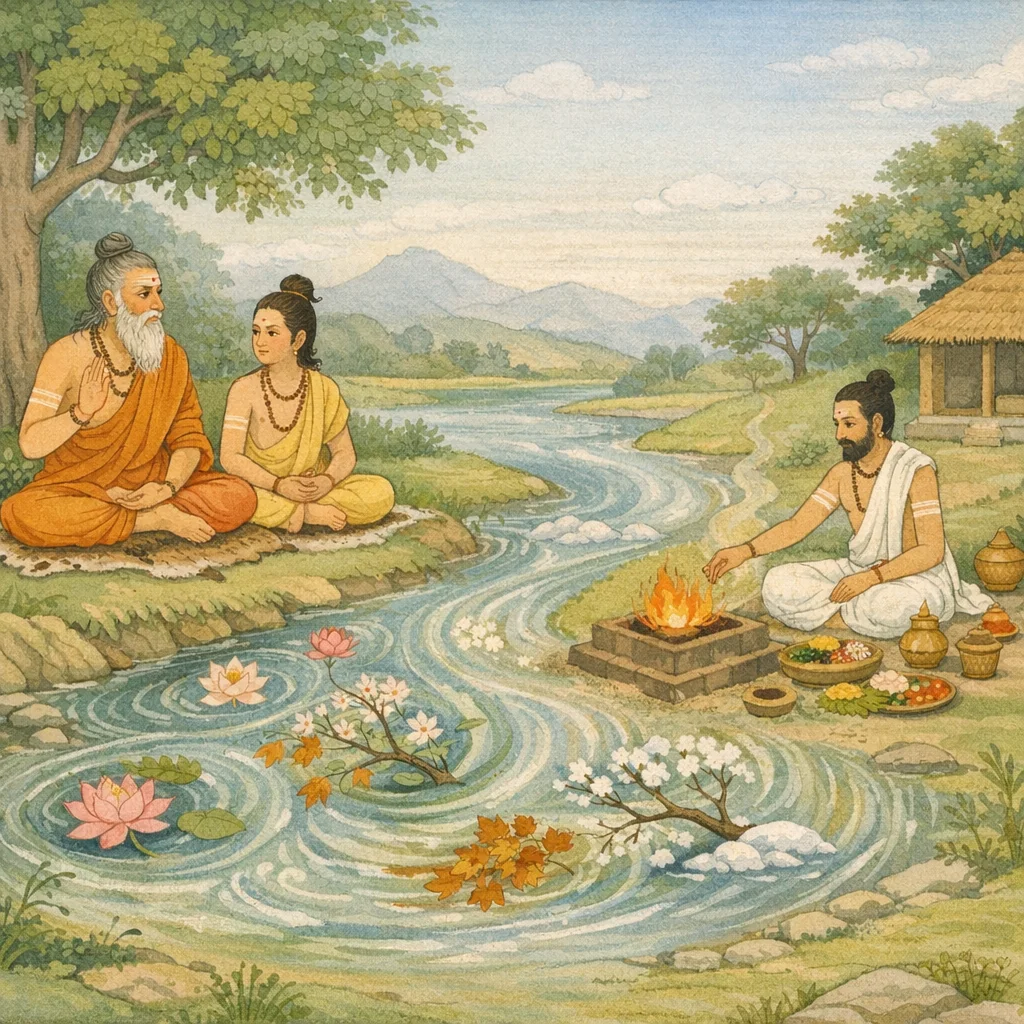
Adhyaya 235
Gṛhastha-vṛtti and Niyama: Models of Householder Livelihood and Discipline (गृहस्थवृत्ति-नियमाः)
Upa-parva: Āśrama–Gṛhastha-dharma (Householder Discipline and Livelihood Models)
Vyāsa delineates the second life-stage (gṛhastha) as a disciplined household existence supported by dharmically obtained marriage and the establishment of sacred fires. The discourse enumerates four gṛhastha livelihood modes (vṛttis)—beginning with stored-grain models (kusūladhānya, kumbhīdhānya) and moving toward more austere subsistence patterns (including kāpotī), with a graded valuation that treats greater restraint as ethically superior. It outlines differentiated ritual workloads (six, three, two, and a fourth aligned with brahmasatra-like dedication), while insisting on non-selfish cooking and avoidance of purposeless harm to beings. Behavioral restraints include avoiding daytime sleep, regulating meal timing, and sexual propriety. Hospitality is central: no guest, especially a learned brāhmaṇa, should remain unhonored; offerings (havya/kavya) are reserved for qualified recipients (śrotriya, vedapāraga, disciplined practitioners). The chapter emphasizes saṃvibhāga—sharing with all beings and with those who cook for others—and defines vighasāśin/amṛtabhojana as eating only after ritual and dependents are served. It extends dharma into domestic relations by urging non-contention with elders, children, the sick, physicians, kin, spouse, offspring, and servants, portraying these relationships as spiritually consequential. Concluding verses associate well-ordered household practice with prosperity of the realm, purification of ancestors/descendants, and attainment of auspicious posthumous states, while gesturing toward the subsequent, higher āśrama.
Chapter Arc: व्यास शुक के प्रश्न-प्रवाह में ब्राह्मण के कर्तव्य का विधान खोलते हैं और कहते हैं—कालरूपी महान् नदी बह रही है; उसे पार करने का उपाय केवल शास्त्र-दृष्टि और शुद्ध आचरण है। → काल-नदी के भीतर वर्ष-भँवर, मास-तरंग, युग-प्रवाह और यमसदन की ओर खिंचते प्राणी—यह चित्र भय और असहायता जगाता है। इसी बीच ब्राह्मण के लिए त्रयी-विद्या, वेदवाद-कौशल, अध्यात्म-निपुणता, सत्त्व-सम्पदा और शिष्टाचार का कठोर अनुशासन सामने आता है; गृहस्थ-जीवन में क्रोध, दोष-दृष्टि, लोभ, प्रतिग्रह और त्रिविध संदेह (त्रिसंदेह) से बचना चुनौती बनता है। → व्यास निर्णायक रूप से बताते हैं कि काल-नदी में ‘उन्मज्जन’ (डूबने से बचकर ऊपर उठना) प्रज्ञा से होता है—दान, वेदाध्ययन, यज्ञ, तप, लज्जा, सरलता, इन्द्रिय-निग्रह और विशेषतः काम-क्रोध पर विजय ही वह नौका है जो ब्रह्मपद की ओर ले जाती है। → गृहस्थ ब्राह्मण के लिए शिष्टों के धर्मानुसार कर्म, अहिंसक/अगर्हित आजीविका, पंचयज्ञ-भाव, विघसाशी (अतिथि-सेवा के बाद भोजन), अनसूया और अक्रोध—इनसे तेज बढ़ता है और पाप घटता है; शुद्धि के बाद स्वल्पाहार, इन्द्रिय-जय और अंततः ब्रह्मणः पद की ओर प्रस्थान का मार्ग स्थिर होता है।
Shlokas
Verse 1
अत पज्चत्रिशर्दाधिकद्वधिशततमो< ध्याय: ब्राह्मणके कर्तव्यका प्रतिपादन करते हुए कालरूप नदको पार करनेका उपाय बतलाना व्यास उवाच त्रयीं विद्यामवेक्षेत वेदेषूक्तामथाड्रत: । ऋषकसामवर्णाक्षरतो यजुषो5थर्वणस्तथा
Vyāsa said: “With disciplined attention, one should contemplate the threefold sacred knowledge as taught in the Vedas—examining it through the words and syllables of the Ṛg and Sāma, and likewise through those of the Yajus and the Atharvan. Such careful study of revealed speech is presented as a means for right conduct and for crossing the perilous ‘river’ of Time.”
Verse 2
वेदवादेषु कुशला हाध्यात्मकुशलाश्व ये,जो लोग वेदोंके प्रवचनमें निपुण, अध्यात्मज्ञानमें कुशल, सत्त्वगुणसम्पन्न और महान् भाग्यशाली हैं, वे जगत्की सृष्टि और प्रलयको ठीक-ठीक जानते हैं; अतः ब्राह्मणको इस प्रकार धर्मानुकूल बर्ताव करते हुए शिष्ट पुरुषोंकी भाँति सदाचारका पालन करना चाहिये
Vyāsa said: “Those people who are skilled in the expositions of the Veda, adept in spiritual knowledge, endowed with the quality of sattva, and greatly fortunate—such persons understand correctly the creation and dissolution of the world. Therefore a brāhmaṇa, conducting himself in accordance with dharma, should uphold good conduct in the manner of the cultured and disciplined.”
Verse 3
सत्त्ववन्तो महाभागा: पश्यन्ति प्रभवाप्ययौ | एवं धर्मेण वर्तेत क्रियां शिष्टवदाचरेत्,जो लोग वेदोंके प्रवचनमें निपुण, अध्यात्मज्ञानमें कुशल, सत्त्वगुणसम्पन्न और महान् भाग्यशाली हैं, वे जगत्की सृष्टि और प्रलयको ठीक-ठीक जानते हैं; अतः ब्राह्मणको इस प्रकार धर्मानुकूल बर्ताव करते हुए शिष्ट पुरुषोंकी भाँति सदाचारका पालन करना चाहिये
Vyāsa said: Those who are endowed with purity of being and blessed with great fortune perceive clearly the world’s arising and its dissolution. Therefore one should live in accordance with dharma, and perform one’s duties with the disciplined conduct of the cultured and exemplary.
Verse 4
असंरोधेन भूतानां वृत्तिं लिप्सेत वै द्विज: । सद्भ्य आगतविज्ञान: शिष्ट: शास्त्रविचक्षण:,ब्राह्णण किसी भी जीवको कष्ट न देकर--उसकी जीविकाका हनन न करके अपनी जीविका चलानेकी इच्छा करे। संतोंकी सेवामें रहकर तत्त्वज्ञान प्राप्त करे, सत्पुरुष बने और शास्त्रकी व्याख्या करनेमें कुशल हो
Vyāsa said: “A twice-born man should seek his livelihood without obstructing or harming living beings—without depriving them of their means of life. Dwelling in the company and service of the good, he should gain true understanding, become a cultivated and virtuous person, and be skilled in discerning and expounding the teachings of the śāstras.”
Verse 5
स्वधर्मेण क्रिया लोके कुर्वाण: सत्यसंगर: । तिषछ्ठते तेषु गृहवान् षट्सु कर्मसु स द्विज:,जगत्में अपने धर्मके अनुकूल कर्म करे, सत्यप्रतिज्ञ बने। गृहस्थ ब्राह्मणको पूर्वोक्त छः कर्मोमें ही स्थित रहना चाहिये
Vyāsa said: Performing actions in the world in accordance with one’s own dharma, and remaining firmly bound by a vow of truth, the twice-born householder should abide steadily in those six prescribed duties alone.
Verse 6
पज्चभि: सतत यज्ञैः श्रदधानो यजेत च । धृतिमानप्रमत्तश्न दान्तो धर्मविदात्मवान्,सदा श्रद्धापूर्वक पञ्च-महायज्ञोंद्वारा परमात्माका पूजन करे, सर्वदा धैर्य धारण करे। प्रमाद (अकर्तव्य कर्मको करने और कर्तव्य कर्मकी अवहेलना करने) से बचे, इन्द्रियोंको संयममें रखे, धर्मका ज्ञाता बने और मनको भी अपने अधीन रखे
Vyāsa said: With faith, one should continually worship through the five constant sacrifices. One should be steadfast and vigilant, self-restrained, a knower of dharma, and master of one’s own mind—thus honoring the Supreme through disciplined daily duty rather than through negligence or impulse.
Verse 7
वीतहर्षमदक्रोधो ब्राह्मणो नावसीदति । दानमध्ययन यज्ञस्तपो हीरार्जव॑ दम:
Vyāsa said: A brāhmaṇa who is free from elation, intoxication of pride, and anger does not sink into distress. For him, giving, study of sacred knowledge, sacrifice, austerity, modesty, straightforwardness, and self-restraint are the sustaining virtues that uphold his life and conduct.
Verse 8
धूतपाप्मा च मेधावी लघ्वाहारो जितेन्द्रिय:
Vyāsa said: “He is one whose sins have been washed away; he is intelligent, moderate in food, and master of his senses.”
Verse 9
अग्नीश्र ब्राह्म॒णांश्चार्चेद् देवता: प्रणमेत च,अग्नि, ब्राह्मण और देवताओंको प्रणाम एवं उनका पूजन करे। कड़वी बात मुँहसे न निकाले और हिंसा न करे; क्योंकि वह अधर्मसे युक्त है। यह ब्राह्मणके लिये परम्परागत वृत्ति (कर्तव्य) का विधान किया गया है
Vyāsa says: One should worship Agni, honor the Brāhmaṇas, and bow to the gods. One should not utter harsh speech, nor commit violence, for such conduct is bound up with adharma. This is laid down as the traditional, inherited mode of life—indeed the duty—of a Brāhmaṇa.
Verse 10
वर्जयेदुशतीं वाचं हिंसां चाधर्मसंहिताम् । एषा पूर्वगता वृत्तित्राह्मिणस्य विधीयते,अग्नि, ब्राह्मण और देवताओंको प्रणाम एवं उनका पूजन करे। कड़वी बात मुँहसे न निकाले और हिंसा न करे; क्योंकि वह अधर्मसे युक्त है। यह ब्राह्मणके लिये परम्परागत वृत्ति (कर्तव्य) का विधान किया गया है
Vyāsa said: “Let him refrain from harsh speech and from violence, for violence is bound up with adharma. This is the ancient, time-honored mode of conduct that is enjoined as the traditional duty of a brāhmaṇa.”
Verse 11
ज्ञानागमेन कर्माणि कुर्वन् कर्मसु सिध्यति | पज्चेन्द्रियजलां घोरां लोभकूलां सुदुस्तराम्,कर्मोके तत््वको जानकर उनका अनुष्ठान करनेसे अवश्य सिद्धि प्राप्त होती है। संसारका जीवन एक भयंकर नदीके समान है। पाँच ज्ञानेन्द्रियाँ इस नदीका जल हैं। लोभ किनारा है। क्रोध इसके भीतर कीचड़ है। इसे पार करना अत्यन्त कठिन है और इसके वेगको दबाना अत्यन्त असम्भव है, तथापि बुद्धिमान् पुरुष इसे पार कर जाता है। प्राणियोंको अत्यन्त मोहमें डालनेवाला काल सदा आक्रमण करनेके लिये उद्यत है, इस बातकी ओर सदा ही दृष्टि रखे
Vyāsa said: One who performs actions in the light of true knowledge attains success in action. This worldly life is like a dreadful river: its waters are the five senses, its banks are greed, and anger is the mire within it. It is exceedingly hard to cross and its rush is almost impossible to restrain; yet the wise person crosses it. Keeping constant watch, he remains mindful that Time—ever ready to strike—stands poised to overwhelm beings with delusion.
Verse 12
मन्युपड्कामनाधृष्यां नदीं तरति बुद्धिमान । कालमभ्युद्यतं पश्येन्नित्यमत्यन्तमोहनम्,कर्मोके तत््वको जानकर उनका अनुष्ठान करनेसे अवश्य सिद्धि प्राप्त होती है। संसारका जीवन एक भयंकर नदीके समान है। पाँच ज्ञानेन्द्रियाँ इस नदीका जल हैं। लोभ किनारा है। क्रोध इसके भीतर कीचड़ है। इसे पार करना अत्यन्त कठिन है और इसके वेगको दबाना अत्यन्त असम्भव है, तथापि बुद्धिमान् पुरुष इसे पार कर जाता है। प्राणियोंको अत्यन्त मोहमें डालनेवाला काल सदा आक्रमण करनेके लिये उद्यत है, इस बातकी ओर सदा ही दृष्टि रखे
Vyāsa said: The wise person crosses the river whose mire is anger and whose current is hard to withstand. He should constantly keep in view that Time—ever poised to strike—unceasingly casts beings into profound delusion.
Verse 13
महता विधिदृष्टेन बलेनाप्रतिघातिना । स्वभावस्रोतसा वृत्तमुहते सततं जगत्,जो महान् है, जो विधाताकी ही दृष्टिमें आ सकता है तथा जिसका बल कहीं प्रतिहत नहीं होता, उस स्वभावरूप धारा-प्रवाहमें यह सारा जगत् निरन्तर बहता जा रहा है
Vyāsa said: By a vast power, governed by ordinance—discernible only to the Creator and irresistible—this entire world is ceaselessly borne along, flowing in the current of its own nature.
Verse 14
कालोदकेन महता वर्षावर्तेन संततम् । मासोर्मिणर्तुवेगेन पक्षोलपतृणेन च,कालरूपी महान् नद बह रहा है। इसमें वर्षरूपी भँवरें सदा उठ रही हैं। महीने इसकी उत्ताल तरंगें हैं। ऋतु वेग हैं। पक्ष लता और तृण हैं। निमेष और उन्मेष फेन हैं। दिन और रात जल-प्रवाह हैं। कामदेव भयंकर ग्राह है। वेद और यज्ञ नौका हैं। धर्म प्राणियोंका आश्रयभूत द्वीप है। अर्थ और काम जल हैं। सत्यभाषण और मोक्ष दोनों किनारे हैं। हिंसारूपी वृक्ष उस कालरूपी प्रवाहमें बह रहे हैं। युग हद है तथा ब्रह्म ही उस कालनदको उत्पन्न करनेवाला पर्वत है। उसी प्रवाहमें पड़कर विधाताके रचे हुए समस्त प्राणी यमलोककी ओर खिंचे चले जा रहे हैं
Vyāsa said: “Time is a vast river. Its water is Time itself; its whirlpools are the rains that rise without cease. Months are its surging waves; the seasons are its driving currents; fortnights are its creepers and grasses. Blinking and unblinking are its foam; days and nights are its flowing stream. Desire (Kāma) is a dreadful crocodile within it. The Vedas and sacrifices are boats; Dharma is an island that gives shelter to living beings. Wealth and pleasure are its waters; truth-speaking and liberation are its two banks. Trees of violence drift along in that current. The yugas mark its limits, and Brahman is the mountain-source from which this river of Time is born. Fallen into this stream, all creatures fashioned by the Creator are drawn onward toward Yama’s realm.”
Verse 15
निमेषोन्मेषफेनेन अहोरात्रजलेन च । कामग्राहेण घोरेण वेदयज्ञप्लवेन च,कालरूपी महान् नद बह रहा है। इसमें वर्षरूपी भँवरें सदा उठ रही हैं। महीने इसकी उत्ताल तरंगें हैं। ऋतु वेग हैं। पक्ष लता और तृण हैं। निमेष और उन्मेष फेन हैं। दिन और रात जल-प्रवाह हैं। कामदेव भयंकर ग्राह है। वेद और यज्ञ नौका हैं। धर्म प्राणियोंका आश्रयभूत द्वीप है। अर्थ और काम जल हैं। सत्यभाषण और मोक्ष दोनों किनारे हैं। हिंसारूपी वृक्ष उस कालरूपी प्रवाहमें बह रहे हैं। युग हद है तथा ब्रह्म ही उस कालनदको उत्पन्न करनेवाला पर्वत है। उसी प्रवाहमें पड़कर विधाताके रचे हुए समस्त प्राणी यमलोककी ओर खिंचे चले जा रहे हैं
Vyāsa said: Time, taking the form of a vast river, flows on. Its foam is made of the blinking and opening of the eyes; its current is the stream of day and night. In it lurks the dreadful crocodile of desire, while the Vedas and sacrificial rites are like a raft for crossing.
Verse 16
तिष्ठत्ये तेषु भगवान् षट्सु कर्मसु संस्थित: । व्यासजी कहते हैं--बेटा! ब्राह्मणको चाहिये कि वेदोंमें बतायी गयी त्रयी विद्या--“अ उ म्' इन तीन अक्षरोंसे सम्बन्ध रखनेवाली प्रणवविद्याका चिन्तन एवं विचार करे। वेदके छहों अंगोंसहित ऋक्, साम, यजुष् एवं अथर्वके मन्त्रोंका स्वर-व्यंजनके सहित अध्ययन करे; क्योंकि यजन-याजन, अध्ययन-अध्यापन, दान और प्रतिग्रह--इन छ: कर्मामें विराजमान भगवान् धर्म ही इन वेदोंमें प्रतिष्ठित हैं,धर्मद्वीपेन भूतानां चार्थकामजलेन च । ऋतवाड्मोक्षतीरेण विहिंसातरुवाहिना कालरूपी महान् नद बह रहा है। इसमें वर्षरूपी भँवरें सदा उठ रही हैं। महीने इसकी उत्ताल तरंगें हैं। ऋतु वेग हैं। पक्ष लता और तृण हैं। निमेष और उन्मेष फेन हैं। दिन और रात जल-प्रवाह हैं। कामदेव भयंकर ग्राह है। वेद और यज्ञ नौका हैं। धर्म प्राणियोंका आश्रयभूत द्वीप है। अर्थ और काम जल हैं। सत्यभाषण और मोक्ष दोनों किनारे हैं। हिंसारूपी वृक्ष उस कालरूपी प्रवाहमें बह रहे हैं। युग हद है तथा ब्रह्म ही उस कालनदको उत्पन्न करनेवाला पर्वत है। उसी प्रवाहमें पड़कर विधाताके रचे हुए समस्त प्राणी यमलोककी ओर खिंचे चले जा रहे हैं
Vyāsa said: “The Blessed Lord—Dharma itself—abides established in these six duties. Therefore a brāhmaṇa should contemplate the sacred Pranava (A‑U‑M), and study the mantras of Ṛg, Sāma, Yajus, and Atharva together with the six auxiliaries of the Veda, preserving their sounds and letters. For the Lord as Dharma is firmly founded in these Vedic disciplines and in the six acts: sacrificing, officiating for others, studying, teaching, giving, and accepting gifts.” He then portrays Time as a vast river that carries all beings onward: Dharma is an island of refuge amid the waters of wealth and desire; truth-speaking and liberation are its two banks; and trees of violence drift along in that current, while creatures fashioned by the Creator are drawn toward Yama’s realm.
Verse 17
युगहदौघमध्येन ब्रह्मप्रायभवेन च । धात्रा सृष्टानि भूतानि कृष्यन्ते यमसादनम्,कालरूपी महान् नद बह रहा है। इसमें वर्षरूपी भँवरें सदा उठ रही हैं। महीने इसकी उत्ताल तरंगें हैं। ऋतु वेग हैं। पक्ष लता और तृण हैं। निमेष और उन्मेष फेन हैं। दिन और रात जल-प्रवाह हैं। कामदेव भयंकर ग्राह है। वेद और यज्ञ नौका हैं। धर्म प्राणियोंका आश्रयभूत द्वीप है। अर्थ और काम जल हैं। सत्यभाषण और मोक्ष दोनों किनारे हैं। हिंसारूपी वृक्ष उस कालरूपी प्रवाहमें बह रहे हैं। युग हद है तथा ब्रह्म ही उस कालनदको उत्पन्न करनेवाला पर्वत है। उसी प्रवाहमें पड़कर विधाताके रचे हुए समस्त प्राणी यमलोककी ओर खिंचे चले जा रहे हैं
Vyāsa said: In the midst of the great torrent whose banks are the yugas, and which arises from Brahman as its source, all beings created by the Ordainer are being dragged onward toward the abode of Yama.
Verse 18
एतत् प्रज्ञामयैर्धीरा निस्तरन्ति मनीषिण: । प्लवैरप्लववन्तो हि कि करिष्यन्त्यचेतस:,बुद्धिमान् और धीर मनुष्य प्रज्ञारूप नौकाओंद्वारा उस कालनदके पार हो जाते हैं। जो वैसी नौकाओंसे रहित हैं, वे अविवेकी मनुष्य क्या करेंगे?
Thus, the steadfast and discerning cross over (the perilous current of time and worldly danger) by means of boats made of wisdom. But those who have no such boats—men without discernment—what can they possibly do?
Verse 19
उपपन्नं हि यत् प्राज्ञो निस्तरेन्नेतरो जन: । दूरतो गुणदोषीौ हि प्राज्ञ: सर्वत्र पश्यति,विद्वान् पुरुष जो कालनदसे पार हो जाता है और अज्ञानी मनुष्य नहीं पार होता है, यह युक्तिसंगत ही है; क्योंकि ज्ञानवान् पुरुष सर्वत्र गुण और दोषोंको दूरसे ही देख लेता है
It is only reasonable that a wise person can cross over (a peril or difficulty), while an ordinary, unknowing person cannot. For the discerning see, from a distance and in every situation, both the merits and the faults—and thus choose their course with foresight.
Verse 20
संशयं स तु कामात्मा चलचित्तोडल्पचेतन: । अप्राज्ञो न तरत्येनं यो हवास्ते न स गच्छति,कामनाओंमें आसक्त, चंचलचित्त, मन्दबुद्धि एवं अज्ञानी पुरुष संदेहमें पड़ जानेके कारण कालनदको पार नहीं कर पाता तथा जो निनश्रेष्ट होकर बैठ जाता है, वह भी उसके पार नहीं जा सकता
Vyāsa said: A man driven by desire—restless in mind, of scant understanding, and lacking true discernment—falls into doubt and therefore cannot cross this river of Time. And one who merely sits down, having lost the will to strive, cannot reach the far shore either.
Verse 21
अप्लवो हि महादोषं मुहामानो नियच्छति । कामग्राहगृहीतस्य ज्ञानमप्यस्य न प्लव:,जिसके पास ज्ञानमयी नौका नहीं है, वह मोहितचित्त मूढ़ मानव महान् दोषको प्राप्त होता है। कामरूपी ग्राहसे पीड़ित होनेके कारण ज्ञान भी उसके लिये नौका नहीं बन पाता
One who lacks a raft is carried into great fault, his mind deluded and unsteady. For a person seized by the crocodile of desire, even knowledge itself cannot become a saving boat.
Verse 22
तस्मादुन्मज्जनस्यार्थे प्रयतेत विचक्षण: । एतदुन्मज्जनं तस्य यदयं ब्राह्मणो भवेत्,इसलिये बुद्धिमान् पुरुषको कालनद या भवसागरसे पार होनेका अवश्य प्रयत्न करना चाहिये। उसका पार होना यही है कि वह वास्तवमें ब्राह्मण बन जाय अर्थात् ब्रह्माज्ञान प्राप्त करे
Therefore, the discerning should strive to rise up and cross over. For him, true crossing is this: that he becomes a Brāhmaṇa in reality—that is, he attains knowledge of Brahman (Brahma-jñāna).
Verse 23
अददातेषु संजातस्त्रिसंदेहस्त्रिकर्मकृत् । तस्मादुन्मज्जने तिषछेत् प्रज्ञया निस्तरेद् यथा,उत्तम कुलमें उत्पन्न हुआ ब्राह्मण अध्यापन, याजन और प्रतिग्रह--इन तीन कर्मोंको संदेहकी दृष्टिसे देखे (के कहीं इनमें आसक्त न हो जाऊँ) और अध्ययन, यजन तथा दान --इन तीन कर्मोंका अवश्य पालन करे। वह जैसे भी हो प्रज्ञाद्वारा अपने उद्धारका प्रयत्न करे, उस कालनदसे पार हो जाय
Vyāsa said: When a Brahmin is born into a noble lineage, he should regard the three livelihood-related acts—teaching, officiating at sacrifices, and accepting gifts—with threefold caution, lest attachment arise. Yet he must faithfully perform the three duties—study, sacrifice, and giving. In whatever way is possible, he should strive for his own deliverance through discernment, so that he may cross beyond the perilous current of worldly life.
Verse 24
संस्कृतस्य हि दान्तस्य नियतस्य यतात्मन: । प्राज्ञस्यानन्तरा सिद्धिरिहलोके परत्र च,जिसके वैदिक संस्कार विधिवत् सम्पन्न हुए हैं, जो नियमपूर्वक रहकर मन और इन्द्रियोंपर विजय पा चुका है, उस विज्ञ पुरुषको इहलोक और परलोकमें कहीं भी सिद्धि प्राप्त होते देर नहीं लगती
For one whose Vedic sacraments have been duly completed, who lives under discipline, self-controlled, and has conquered mind and senses—for that wise person, attainment (siddhi) comes without delay, both in this world and in the next.
Verse 25
वर्तेत तेषु गृहवानक्रुद्धयन्ननसूयक: । पज्चभि: सततं यज्जैर्विघसाशी यजेत च,गृहस्थ ब्राह्मण क्रोध और दोष-दृष्टिका त्याग करके पूर्वोक्त नियमोंके पालनमें संलग्न रहे। नित्य पठ्चमहायज्ञोंका अनुष्ठान करे और यज्ञशिष्ट अन्नका ही भोजन करे
Vyāsa said: Let the householder live among these duties without anger and without fault-finding. He should constantly perform the five great daily sacrifices, and worship by yajña while eating only what remains after offerings—food sanctified as the residue of sacrifice.
Verse 26
सतां धर्मेण वर्तेत क्रियां शिष्टवदाचरेत् । असंरोधेन लोकस्य वृत्तिं लिप्सेदगर्हिताम्,श्रेष्ठ पुरुषोंके धर्मके अनुसार चले और शिष्टाचारका पालन करे तथा ऐसी आजीविका प्राप्त करनेकी इच्छा करे, जिससे दूसरे लोगोंकी जीविकाका हनन न हो और जिसकी लोकमें निन्दा न होती हो
Let him live by the dharma of the good and conduct his actions with the propriety of the cultured. And let him seek a blameless livelihood—one that does not obstruct or harm the living of others and is not condemned in the world.
Verse 27
श्रुतिविज्ञानतत्त्वज्ञ: शिष्टाचारो विचक्षण: । स्वधर्मेण क्रियावांक्ष॒ कर्मणा सो5प्यसंकर:,ब्राह्मणको वेदका विद्वान, तत्त्वज्ञानी, सदाचारी और चतुर होना चाहिये। वह अपने धर्मके अनुसार कार्य करे, परंतु कर्मद्वारा संकरता न फैलावे अर्थात् स्वधर्म और परधर्मका सम्मिश्रण न करे
Vyāsa said: “A brāhmaṇa should know the Veda and its meaning, understand the truth of reality, follow the conduct of the cultured, and be discerning. He should be eager to act in accordance with his own dharma, yet through his actions he must not become a cause of ‘mixture’—he should not blur the boundaries of duties by blending his dharma with that of another.”
Verse 28
क्रियावान् श्रद्दधानो हि दान्त: प्राज्ञोडअनसूयक: । धर्माधर्मविशेषज्ञ: सर्व तरति दुस्तरम्,जो अपने धर्मके अनुसार कार्य करनेवाला, श्रद्धालु, मन और इन्द्रियोंको संयममें रखनेवाला, विद्वान, किसीके दोष न देखनेवाला तथा धर्म और अधर्मका विशेषज्ञ है, वह सम्पूर्ण दुःखोंसे पार हो जाता है
Vyāsa said: One who acts in accordance with rightful duty, who is endowed with faith, who is self-controlled, wise, free from fault-finding, and discerning in the distinctions between dharma and adharma—such a person crosses over what is otherwise difficult to cross, passing beyond the whole mass of suffering.
Verse 29
धृतिमानप्रमत्तश्न दान्तो धर्मविदात्मवान् | वीतहर्षमदक्रोधो ब्राह्णो नावसीदति,जो धैर्यवान् प्रमादशून्य, जितेन्द्रिय, धर्मज्, मनस्वी तथा हर्ष, मद और क्रोधसे रहित है, वह ब्राह्मण कभी विषादको नहीं प्राप्त होता है
Vyāsa said: A Brahmin who is steadfast and vigilant, self-controlled, a knower of dharma, and possessed of inner mastery—free from elation, intoxication of pride, and anger—does not sink into dejection.
Verse 30
एषा पुरातनी वृत्तिब्रह्मिणस्य विधीयते । ज्ञानवत्त्वेन कर्माणि कुर्वन् सर्वत्र सिध्यति,यह ब्राह्मणकी प्राचीनकालसे चली आनेवाली वृत्तिका विधान किया गया है। ज्ञानपूर्वक कर्म करनेवाले ब्राह्मणको सर्वत्र सिद्धि प्राप्त होती है
Vyāsa said: “This is the ancient, time-honored mode of livelihood prescribed for a brāhmaṇa. Performing one’s duties with true understanding, a brāhmaṇa attains success and fulfillment in every sphere.”
Verse 31
अधर्म धर्मकामो हि करोति हाविचक्षण: । धर्म वाधर्मसंकाशं शोचन्निव करोति सः,जो मूढ़ है, वह धर्मकी इच्छा रखकर भी अधर्म करता है अथवा शोकमग्न-सा होकर अधर्मतुल्य धर्मका सम्पादन करता है। मूर्ख या अविवेकी मनुष्य न जाननेके कारण “मैं धर्म कर रहा हूँ” ऐसा समझकर अधर्म करता है और अधर्मकी इच्छा रखकर धर्म करता है, इस प्रकार अज्ञानपूर्वक दोनों तरहके कर्म करनेवाला देहधारी मनुष्य बारंबार जन्म लेता और मरता है
Vyāsa said: The undiscerning person, even while desiring dharma, commits adharma; and at other times, as though grieving, he performs what appears to be dharma but is in fact akin to adharma. Lacking true discernment, he mistakes wrongdoing for righteousness and, conversely, may stumble into right action even while intending wrong. Such confused, ignorance-driven action binds the embodied being to repeated birth and death.
Verse 32
धर्म करोमीति करोत्यधर्म- मधर्मकामश्न करोति धर्मम् | उभे बाल: कर्मणी न प्रजानन् स जायते म्रियते चापि देही,जो मूढ़ है, वह धर्मकी इच्छा रखकर भी अधर्म करता है अथवा शोकमग्न-सा होकर अधर्मतुल्य धर्मका सम्पादन करता है। मूर्ख या अविवेकी मनुष्य न जाननेके कारण “मैं धर्म कर रहा हूँ” ऐसा समझकर अधर्म करता है और अधर्मकी इच्छा रखकर धर्म करता है, इस प्रकार अज्ञानपूर्वक दोनों तरहके कर्म करनेवाला देहधारी मनुष्य बारंबार जन्म लेता और मरता है
Vyāsa said: A deluded person, thinking, “I am performing dharma,” may in fact commit adharma; and even one who longs for dharma may, through confusion and grief, end up doing what is contrary to it. Not truly understanding either of the two kinds of action, the childish and undiscerning embodied being acts in ignorance—sometimes calling adharma ‘dharma’ and sometimes producing dharma while intending adharma—and thus continues to be born and to die again and again.
Verse 73
एतैर्वर्धयते तेज: पाप्मानं चापकर्षति । जो ब्राह्मण हर्ष, मद और क्रोधसे रहित है, उसे कभी दुःख नहीं उठाना पड़ता है। दान, वेदाध्ययन, यज्ञ, तप, लज्जा, सरलता और इन्द्रियसंयम--इन सदगुणोंसे ब्राह्मण अपने तेजकी वृद्धि और पापका नाश करता है
Vyāsa said: By these virtues one increases one’s spiritual radiance and draws away sin. A brāhmaṇa who is free from elation, intoxication of pride, and anger does not have to endure suffering. Through good qualities such as generosity, study of the Veda, sacrifice, austerity, modesty, straightforwardness, and restraint of the senses, a brāhmaṇa strengthens his inner splendor and destroys wrongdoing.
Verse 86
कामक्रोधौ वशे कृत्वा निनीषेद् ब्रह्मण: पदम् । इस प्रकार पाप धुल जानेपर बुद्धिमान् ब्राह्मण स्वल्पाहार करते हुए इन्द्रियोंको जीते और काम तथा क्रोधको अधीन करके ब्रह्मपदको प्राप्त करनेकी इच्छा करे
Vyāsa said: Having brought desire and anger under control, one should aspire to reach the state of Brahman. Thus, when sin has been washed away, the wise brāhmaṇa—living on little food—should conquer the senses and, mastering lust and wrath, set his will on attaining the supreme Brahman-state.
Verse 235
इति श्रीमहाभारते शान्तिपर्वणि मोक्षधर्मपर्वणि शुकानुप्रश्ने पज्चत्रिंशदधिकद्विशततमो<ध्याय:
Thus ends the two-hundred-and-thirty-fifth chapter of the Mokṣadharma section within the Śānti Parva of the Śrī Mahābhārata, in the context of Śuka’s inquiry. (A colophon marking the close of the chapter.)
Frequently Asked Questions
The chapter balances domestic sustenance with non-exploitative ethics: food should not be cooked solely for oneself, and harm to animals should not be purposeless; consumption is regulated through ritual remainder and serving others first.
Adopt a disciplined livelihood mode, maintain sacred fires, practice hospitality, share provisions widely, regulate sleep/meal timing/sexual conduct, and avoid domestic disputes—treating the household as a site of public-minded dharma.
Yes in functional form: it links these household practices to purification across generations, prosperity of the polity where such householders dwell, and attainment of favorable posthumous destinations, while indicating progression toward higher āśrama ideals.