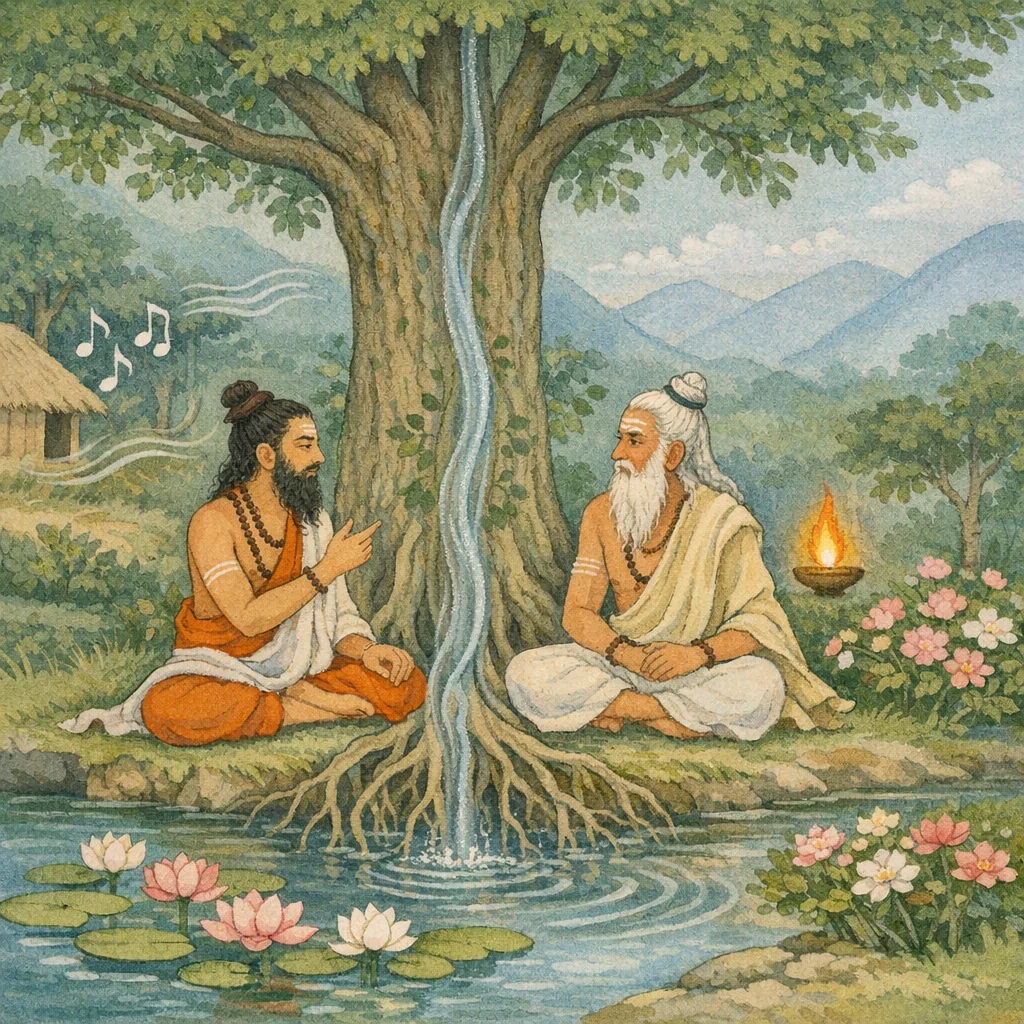
Adhyaya 185
Bhṛgu–Bharadvāja-saṃvāda: Vānaprastha-parivrājaka-ācāra, Abhaya-dharma, and Lokānāṃ Vibhāga (Śānti-parva 185)
Upa-parva: Mokṣa-dharma (Liberation-oriented discipline: vānaprastha and parivrājaka conduct; lokas and karmaphala)
The chapter opens with Bhṛgu’s descriptive catalogue of vānaprastha discipline: forest-dwellers follow ṛṣi-dharma, wander among tīrthas and secluded woods, abandon village luxuries, and subsist on regulated forest foods. Their bodily regimen is austere—ground, stone, sand, ash as bedding; bark, skin, and grasses as coverings; maintained hair and nails; timed ablutions; and ritual observances such as homa and bali performed without excess. Bhṛgu then states a normative claim: one who practices this brahmarṣi-authorized regulated conduct ‘burns’ दोष like fire and attains difficult worlds. The discourse shifts to parivrājaka (wandering renunciant) conduct: relinquishing attachments to fire, wealth, spouse, and equipment; cultivating equanimity toward clod, stone, and gold; avoiding entanglement in the three aims (trivarga) as pursuits; maintaining non-hostility in speech, mind, and action toward all classes of beings; and remaining without fixed residence. Their settlement protocol is specified—limited nights in towns and villages, seeking only life-sustaining alms from orderly households, and renouncing passions such as kāma, krodha, darpa, moha, lobha, and हिंसा. A verse asserts the reciprocity of safety: the muni who gives fearlessness to all beings is not threatened by them. Further verses internalize ritual: the renunciant’s ‘agnihotra’ is performed in the body, offering into the ‘inner fire’ through disciplined alms-practice, leading to higher worlds; and the practitioner of mokṣāśrama, pure and resolute, attains brahmaloka like a flame that is calm and unfueled. Bharadvāja then asks about a ‘beyond’ realm heard of but not seen; Bhṛgu describes a superior northern region near Himavat—pure, secure, and desire-fulfilling—where inhabitants are morally purified, free from greed and delusion, with minimal affliction and visible karmic fruit. The chapter contrasts this with the earthly realm as karmabhūmi, where anxiety, hunger, fear, and moral hazards operate; enumerates vices that diminish tapas; and concludes that knowing dharma and adharma prevents moral taint. Bhīṣma closes by noting Bharadvāja’s astonished reverence for Bhṛgu and offers the king further instruction.
Chapter Arc: भरद्वाज का प्रश्न उठता है—जब ब्रह्मा ने असंख्य प्राणियों की रचना की, तो ‘पाँच’ महाभूतों का भूतत्व कैसे सर्वव्यापक और पर्याप्त माना जाए? → भृगु उत्तर देते हैं कि ये पाँच भूत ‘अमित’ हैं—इनकी अनंतता और सर्वव्याप्ति के कारण ही समस्त सृष्टि इन्हीं के गुण-विस्तार से समझी जा सकती है। फिर वे क्रमशः महाभूतों के गुणों का विस्तार खोलते हैं: आकाश का शब्द, वायु का स्पर्श, तेज का रूप, जल का रस, पृथ्वी का गन्ध—और इनके अनेक भेद। → गुण-विस्तार का चरम तब आता है जब आकाश-सम्भव ‘शब्द’ के सप्तविध भेद (षड्ज आदि स्वर-रूप) तथा पृथ्वी-सम्भव ‘गन्ध’ के नवविध विस्तार, तेज के षोडश रूप-गुण, और वायु के स्पर्श-भेदों का सूक्ष्म वर्गीकरण सामने आता है—मानो सृष्टि का पूरा अनुभव-लोक इन्द्रियों के माध्यम से पंचभूतों में संहित हो गया हो। → अध्याय यह स्थापित करता है कि विविधता असंख्य प्राणियों में नहीं, बल्कि पंचमहाभूतों के गुणों के अनंत विस्तार में निहित है; वृक्ष द्वारा जल-आहरण और भीतर की अग्नि-वायु द्वारा ‘पाचन’ जैसे उदाहरणों से यह भी दिखता है कि भूत-गुण जीवित जगत में क्रियाशील नियम बनकर चलते हैं। → अगले प्रसंग के लिए संकेत रहता है कि इन गुणों के ज्ञान का प्रयोजन केवल वर्णन नहीं—बल्कि देह, आहार-परिणाम, इन्द्रिय-व्यवहार और आत्म-ज्ञान की ओर इसका अनुप्रयोग आगे और स्पष्ट होगा।
Shlokas
Verse 1
अपने-आप बछ। सा चतुरशीर्त्याधेकशततमो< ध्याय: पञ्चमहाभूतोंके गुणोंका विस्तारपूर्वक वर्णन भरद्वाज उवाच त एते धातव: पज्च ब्रह्मा यानसृजत् पुरा । आवूृता यैरिमे लोका महाभूताभिसंज्ञिता:,भरद्वाजने पूछा--भगवन्! लोकमें ये पाँच धातु ही “महाभूत' कहलाते हैं, जिन्हें ब्रह्माने सृष्टिके आदिमें रचा था। ये ही इन समस्त लोकोंमें व्याप्त हैं
Bharadvāja said: “These are the five elemental constituents which Brahmā created in the beginning. By them all these worlds are pervaded; therefore they are known as the ‘great elements.’”
Verse 2
यदासृजत् सहस्राणि भूतानां स महामति: । पज्चानामेव भूतत्वं कथं समुपपद्यते,परंतु जब महाबुद्धिमान् ब्रह्माजीनी और भी हजारों भूतोंकी रचना की है, तब इन पाँचको ही “भूत” कहना कहाँतक युक्तिसंगत है?
Bharadvāja said: “When that great-minded Creator brought forth thousands of beings, how can it be logically justified that only these five are singled out and called ‘the elements’ (bhūtas)?”
Verse 3
भूगुरुवाच अमितानां महाशब्दो यान्ति भूतानि सम्भवम् | ततस्तेषां महाभूतशब्दोडयमुपपद्यते,भगुजीने कहा--मुने! ये पाँच भूत ही असीम हैं, इसलिये इन्हींके साथ “महा” शब्द जोड़ा जाता है। इन्हींसे भूतोंकी उत्पत्ति होती है; अतः इन्हींके लिये “महाभूत” शब्दका प्रयोग सुसंगत है
Bhṛgu said: “O sage, these five elements are immeasurable; therefore the word ‘great’ is joined to them. From them the beings come into existence; hence the term ‘great elements’ (mahābhūtas) is rightly applied to these alone.”
Verse 4
चेष्टा वायु: खमाकाशमूष्माग्नि: सलिल द्रव: । पृथिवी चात्र संघात: शरीरं पाज्चभौतिकम्,प्राणियोंका शरीर इन पाँच महाभूतोंका ही संघात है। इसमें जो चेष्टा या गति है, वह वायुका भाग है। जो खोखलापन है, वह आकाशका अंश है। ऊष्मा (गर्मी) अग्निका अंश है। लोहू आदि तरल पदार्थ जलके अंश हैं और हड्डी, मांस आदि ठोस पदार्थ पृथ्वीके अंश हैं
Bharadvāja said: “In this body made of the five great elements, movement is the portion of Wind; the inner space and hollowness belong to Ether; heat is the share of Fire; the flowing, liquid constituents (such as blood and the like) arise from Water; and the compact, solid constituents (such as bone and flesh) are of Earth. Thus the living body is understood as a composite of the five elements, not an independent, permanent self.”
Verse 5
इत्येतै: पञ्चभि र्भूतैर्युक्ते स्थावरजजड्भमम् । श्रोत्रं ग्राणं रस: स्पर्शो दृशटिश्रेन्द्रियसंज्ञिता:,इस प्रकार सारा स्थावर-जंगम जगत् इन पाँच भूतोंसे युक्त है। इन्हींके सूक्ष्म अंश श्रोत्र (कान), प्राण (नासिका), रसना, त्वचा और नेत्र--इन पाँच इन्द्रियोंके नामसे प्रसिद्ध हैं
Bharadvāja said: “Thus, this entire world—both the immobile and the moving—is constituted by these five great elements. From their subtle portions arise what are known as the five sense-faculties: hearing (ear), smell (nose), taste (tongue), touch (skin), and sight (eye).”
Verse 6
भरद्वाज उवाच पज्चभिरययदि भूतैस्तु युक्ता: स्थावरजड़मा: । स्थावराणां न दृश्यन्ते शरीरे पजच धातव:,भरद्वाजने पूछा--भगवन्! आपके कथनानुसार यदि समस्त स्थावर-जंगम पदार्थ इन पाँच महाभूतोंसे ही संयुक्त हैं तो स्थावरोंके शरीरोंमें तो पाँच भूत नहीं दिखायी देते हैं
Bharadvāja said: “O Blessed One! If, as you declare, all things—moving and unmoving—are conjoined with the five great elements, why are the five constituents not seen in the bodies of the immobile?”
Verse 7
अनूष्मणामचेष्टानां घनानां चैव तत्त्वतः । वृक्षाणां नोपलभ्यन्ते शरीरे पजच धातव:,वृक्षोंके शरीरमें गर्मी नहीं है, कोई चेष्टा भी नहीं है तथा वास्तवमें वे घन हैं; अत: उनके शरीरमें पाँचों भूतोंकी उपलब्धि नहीं होती है
Bharadvāja said: “In trees there is no perceptible warmth, no evident activity, and in truth they are dense and inert. Therefore, within the body of a tree the five elemental constituents are not apprehended as they are in living beings.”
Verse 8
न शृण्वन्ति न पश्यन्ति न गन्धरसवेदिन: । न च स्पर्श विजानन्ति ते कथं पाउ्चभौतिका:,वे न सुनते हैं, न देखते हैं, न गन्ध और रसका ही अनुभव करते हैं और न उन्हें स्पर्शका ही ज्ञान होता है; फिर वे पाउ्चभौतिक कैसे कहे जाते हैं?
Bharadvāja said: “They do not hear; they do not see; they do not even apprehend smell and taste, nor do they recognize touch. How, then, can they be called ‘made of the five elements’?”
Verse 9
अद्रवत्वादनग्नित्वादभूमित्वादवायुत: । आकाश स्याप्रमेयत्वाद् वृक्षाणां नास्ति भौतिकम्,उनमें न तो द्रवत्व देखा जाता है, न अग्निका अंश, न पृथ्वी और वायुका ही भाग उपलब्ध होता है। आकाश तो अप्रमेय है; अतः वह भी वृक्षोंमें नहीं है, इसलिये वृक्षोंकी पाज्वभौतिकता नहीं सिद्ध होती है
Bharadvāja said: “Because trees show no liquidity, no fiery element, no share of earth, and no presence of wind—and because space is immeasurable and thus cannot be established within them—the claim that trees are constituted of the gross elements cannot be proved.”
Verse 10
भूगुरुवाच घनानामपि वृक्षाणामाकाशो<5स्ति न संशय: । तेषां पुष्पफलव्यक्तिर्नित्यं समुपपद्यते,भगुजीने कहा--मुने! यद्यपि वृक्ष ठोस जान पड़ते हैं तो भी उनमें आकाश हैं, इसमें संशय नहीं है। इसीसे उनमें नित्यप्रति फल-फूल आदिकी उत्पत्ति सम्भव हो सकती है
Bhṛgu said: “O sage! Even in trees that appear dense and solid, there is space—there is no doubt about it. Because of that inner space, the continual manifestation of their flowers and fruits becomes intelligible.”
Verse 11
ऊष्मतो म्लायते पर्ण त्वक् फल॑ पुष्पमेव च । म्लायते शीर्यते चापि स्पर्शस्तेनात्र विद्यते,वृक्षोंके भीतर जो ऊष्मा या गर्मी है, उसीसे उनके पत्ते, छाल, फल फूल, कुम्हलाते हैं, मुरझाकर झड़ जाते हैं; इससे उनमें स्पर्शका होना भी सिद्ध होता है
Bharadvāja said: “Because of the heat within the tree, its leaves, bark, fruits, and flowers wither; they droop and then fall away. From this it is also established that the tree possesses the sense of touch.”
Verse 12
वाय्वग्न्यशनिनिर्घोषै: फल पुष्पं विशीर्यते । श्रोत्रेण गृहते शब्दस्तस्माच्छुण्वन्ति पादपा:,यह भी देखा जाता है कि वायु, अग्नि और बिजलीकी कड़क आदि भीषण शब्द होनेपर वृक्षोंक फल-फ़ूल झड़कर गिर जाते हैं। शब्दका ग्रहण तो श्रवणेन्द्रियसे ही होता है; इससे यह सिद्ध हुआ कि वृक्ष भी सुनते हैं
Bharadvāja said: “By the roaring sounds of wind, fire, and thunderbolt, the fruits and flowers of trees are shaken loose and fall. Sound is apprehended through the organ of hearing; therefore it is established that trees, too, are capable of hearing.”
Verse 13
वल्ली वेष्टयते वृक्ष सर्वतश्वैव गच्छति । न हादृष्टेश्न मार्गोड$स्ति तस्मात् पश्यन्ति पादपा:,लता वृक्षको चारों ओरसे लपेट लेती है और उसके ऊपरी भागतक चढ़ जाती है। बिना देखे किसीको अपने जानेका मार्ग नहीं मिल सकता; इससे सिद्ध है कि वृक्ष देखते भी हैं
Bharadvāja said: “A creeping vine winds itself around a tree and climbs it on every side. Without sight, no being can find its path of movement; therefore it follows that trees, too, possess the power of seeing.”
Verse 14
पुण्यापुण्यैस्तथा गन्धैर्धूपैश्व विविधैरपि । अरोगाः: पुष्पिता: सन्ति तस्माज्जिप्रन्ति पादपा:,पवित्र और अपवित्र गन्धसे तथा नाना प्रकारके धूपोंकी गन्धसे वृक्ष नीरोग होकर फूलने-फलने लग जाते हैं; इससे प्रमाणित होता है कि वृक्ष भी सूँघते हैं
Bharadvāja said: “By fragrances that are deemed pure and impure, and by many kinds of incense-smoke as well, trees become free from disease and come into blossom and fruit. From this it is established that trees, too, possess the faculty of smelling.”
Verse 15
पादै: सलिलपानाच्च व्याधीनां चापि दर्शनात् । व्याधिप्रतिक्रियत्वाच्च विद्यते रसन॑ द्रुमे,वृक्ष अपनी जड़से जल पीते हैं और कोई रोग होनेपर जड़में ओषधि डालकर उनकी चिकित्सा भी की जाती है; इससे सिद्ध है कि वृक्षमें रसनेन्द्रिय भी है
Bharadvāja said: “From the fact that trees drink water through their ‘feet’ (roots), and from the observation that they also suffer diseases, and further because treatments are applied to counter those diseases, it follows that a tree possesses the faculty of taste (a tongue-like sense) within it.”
Verse 16
वक्त्रेणोत्पलनालेन यथोर्ध्व जलमाददेत् । तथा पवनसंयुक्त: पादैः: पिबति पादप:,जैसे मनुष्य कमलकी नाल मुँहमें लगाकर उसके द्वारा ऊपरको जल खींचता है, उसी तरह वायुकी सहायतासे युक्त वृक्ष अपनी जड़ोंद्वारा ऊपरकी ओर पानी खींचता है
Bharadvāja said: “Just as a person, placing a lotus-stalk to the mouth, draws water upward through it, so too a tree—assisted by the moving wind—drinks and draws water upward by its roots.”
Verse 17
सुखदु:खयोश्व ग्रहणाच्छिन्नस्य च विरोहणात् | जीवं पश्यामि वृक्षाणामचैतन्यं न विद्यते,वृक्ष कट जानेपर उनमें नया अंकुर उत्पन्न हो जाता है और वे सुख-दुःखको ग्रहण करते हैं। इससे मैं देखता हूँ कि वृक्षोंमें जीव भी हैं। वे अचेतन नहीं हैं
Bharadvāja said: “Because trees register pleasure and pain, and because a tree that has been cut sprouts again, I perceive that there is a living principle in trees. They are not insentient.”
Verse 18
तेन तज्जलमादत्तं जरयत्यग्निमारुतौ । आहारपरिणामाच्च स्नेहो वृद्धिश्व जायते,वृक्ष अपनी जड़से जो जल खींचता है, उसे उसके अंदर रहनेवाली वायु और अग्नि पचाती है। आहारका परिपाक होनेसे वृक्षमें स्निग्धता आती है और वे बढ़ते हैं
Bharadvāja explains that the water a tree draws up is ‘digested’ within it by the inner agencies of fire and wind. From the proper transformation of its intake, unctuous nourishment arises, and from that nourishment the tree’s growth is produced.
Verse 19
जड़मानां च सर्वेषां शरीरे पजडच धातव: । प्रत्येकश: प्रभिद्यन्ते यैः शरीरं विचेष्टते,समस्त जंगमोंके शरीरोंमें भी पाँच भूत रहते हैं; परंतु वहाँ उनके स्वरूपमें भेद होता है। उन पाँच भूतोंके सहयोगसे ही शरीर चेष्टाशील होता है
Bharadvāja said: “In the bodies of all beings—whether inert or living—the five elemental constituents are present. Yet their modes of manifestation differ in each case. It is through the combined operation of these five that a body becomes capable of activity and movement.”
Verse 20
त्वक् च मांसं तथास्थीनि मज्जा स्नायुश्व॒ पञजचमम् | इत्येतदिह संघातं शरीरे पृथिवीमयम्,शरीरमें त्वचा, मांस, हड्डी, मज्जा और स्नायु--इन पाँच वस्तुओंका समुदाय पृथ्वीमय है
Bharadvāja said: “Skin, flesh, bones, marrow, and—fifth—sinews: this aggregate found here in the body is of the nature of earth.”
Verse 21
तेज, क्रोध, नेत्र, ऊष्मा और जठरानल--ये पाँच वस्तुएँ देहधारियोंके शरीरमें अग्निमय हैं
Bharadvāja said: “Splendour (the inner fire), anger, the eyes, bodily heat, and the digestive fire—these five are fiery in nature within the bodies of embodied beings.”
Verse 22
श्रोत्रं प्राणं तथा55स्यं च हृदयं कोष्ठमेव च । आकाशात् प्राणिनामेते शरीरे पजच धातव:,कान, नासिका, मुख, हृदय और उदर प्राणियोंके शरीरमें ये पाँच धातुमप खोखलापन आकाशसे उत्पन्न हुए हैं--
Bharadvāja said: “The ear, the vital breath, the mouth, the heart, and the belly (the inner cavity)—these five ‘hollow’ constituents within the bodies of living beings arise from ākāśa (space).”
Verse 23
तेजो हाग्निस्तथा क्रोधश्चक्षुरूष्मा तथैव च । अग्निर्जरयते यश्नल पञज्चाग्नेया: शरीरिण:,श्लेष्मा पित्तमथ स्वेदो वसा शोणितमेव च । इत्याप: पज्चधा देहे भवन्ति प्राणिनां सदा कफ, पित्त, स्वेद, चर्बी और रुधिर--ये प्राणियोंके शरीरमें रहनेवाली पाँच गीली वस्तुएँ जलरूप हैं
Bharadvāja said: “Vital brilliance is fire; so too are anger, the eye, and bodily heat. Because fire brings about digestion and aging, embodied beings are said to possess five ‘fiery’ factors. Likewise, phlegm, bile, sweat, fat, and blood—these are the five ‘watery’ substances that are always present within the bodies of living creatures.”
Verse 24
प्राणात् प्रणीयते प्राणी व्यानाद् व्यायच्छते तथा । गच्छत्यपानो<5धश्चैव समानो हृद्यवस्थित:,प्राणसे प्राणी चलने-फिरनेका काम करता है, व्यानसे व्यायाम (बलसाध्य उद्यम) करता है, अपान वायु ऊपरसे नीचेकी ओर जाती है, समान वायु हृदयमें स्थित होती है, उदानसे पुरुष उच्छवास लेता है और कण्ठ, तालु आदि स्थानोंके भेदसे शब्दों एवं अक्षरोंका उच्चारण करता है। इस प्रकार ये पाँच वायुके परिणाम हैं, जो शरीरधारीको चेष्टाशील बनाते हैं
Bharadvāja said: “By the prāṇa the embodied being is led onward and sustained; by the vyāna he exerts himself and performs vigorous activity. The apāna moves downward, while the samāna abides in the region of the heart—thus the vital airs operate, making the living body capable of motion and function.”
Verse 25
उदानादुच्छवसिति च प्रतिभेदाच्च भाषते । इत्येते वायव: पज्च चेष्टयन्तीह देहिनम्,प्राणसे प्राणी चलने-फिरनेका काम करता है, व्यानसे व्यायाम (बलसाध्य उद्यम) करता है, अपान वायु ऊपरसे नीचेकी ओर जाती है, समान वायु हृदयमें स्थित होती है, उदानसे पुरुष उच्छवास लेता है और कण्ठ, तालु आदि स्थानोंके भेदसे शब्दों एवं अक्षरोंका उच्चारण करता है। इस प्रकार ये पाँच वायुके परिणाम हैं, जो शरीरधारीको चेष्टाशील बनाते हैं
Bharadvāja said: “By prāṇa a living being performs ordinary movement and activity; by vyāna he exerts himself in strenuous effort; apāna moves downward from above; samāna abides in the region of the heart; and by udāna a person draws the outward breath and, through the differentiations of the throat, palate, and other organs, produces speech—sounds and syllables. Thus these five vital airs operate here, setting the embodied being into action.”
Verse 26
भूमेर्गन्धगुणान् वेत्ति रसं चादभ्य: शरीरवान् । ज्योतिषा चक्षुषा रूपं स्पर्श वेत्ति च वाहिना,जीव भूमिसे ही (अर्थात् घ्राणेन्द्रियद्वारा) गन्ध गुणका अनुभव करता है, जलसम्बन्धी इन्द्रिय रसनासे शरीरधारी पुरुष रसका आस्वादन करता है, तेजोमय नेत्रके द्वारा रूपका तथा वायुसम्बन्धी त्वगिन्द्रियके द्वारा उसे स्पर्शका ज्ञान होता है
Bharadvāja said: “The embodied being apprehends fragrance through the element earth; he tastes flavour through the waters; by the luminous eye (born of fire) he perceives form; and through the wind, as the principle of touch, he knows contact. Thus the senses, grounded in the elements, disclose their respective objects.”
Verse 27
गन्ध: स्पर्शो रसो रूप॑ शब्दश्षात्र गुणा: स्मृता: । तस्य गन्धस्य वक्ष्यामि विस्तराभिहितान् गुणात्,गन्ध, स्पर्श, रस, रूप और शब्द--ये पृथ्वीके गुण माने गये हैं। इनमेंसे प्रधान गन्धके गुणोंका मैं विस्तार-पूर्वक वर्णन करता हूँ
Bharadvāja said: “Scent, touch, taste, form, and sound are remembered as the qualities apprehended by the senses. Of these, I shall now describe in detail the properties that are taught regarding scent.”
Verse 28
इष्टश्नानिष्टगन्धश्न मधुर: कटुरेव च । निहरि संहत: स्निग्धो रूक्षो विशद एव च
Bharadvāja said: “(Food) may be eaten with relish and be fragrant; it may be sweet, or again pungent. It may be thick like a stew, compact and well-bound, oily, or dry; it may also be clear and pure.”
Verse 29
ज्योति: पश्यति चक्षुर्भ्या स्पर्श वेत्ति च वायुना,मनुष्य दोनों नेत्रोंसे रूपको देखता है और त्वगिन्द्रियसे स्पर्शका अनुभव करता है। शब्द, स्पर्श, रूप और रस--ये जलके गुण माने गये हैं। उनमें प्रधान गुण रस है, उसकी जानकारीके लिये अब मैं उसके भेदोंका वर्णन करता हूँ। तुम उसे मेरे मुहसे सुनो
Bharadvāja said: “Light is apprehended by the eyes, and touch is known through the agency of air. Thus a human being sees form with both eyes and experiences touch through the skin-sense. Sound, touch, form, and taste are spoken of as the qualities associated with water; among these, taste is the chief. Therefore, in order to make taste properly understood, I shall now describe its varieties—listen to it from my mouth.”
Verse 30
शब्द: स्पर्शश्ष रूपं च रसश्वापि गुणा: स्मृता: । रसज्ञानं तु वक्ष्यामि तन््मे निगदत: शूणु,मनुष्य दोनों नेत्रोंसे रूपको देखता है और त्वगिन्द्रियसे स्पर्शका अनुभव करता है। शब्द, स्पर्श, रूप और रस--ये जलके गुण माने गये हैं। उनमें प्रधान गुण रस है, उसकी जानकारीके लिये अब मैं उसके भेदोंका वर्णन करता हूँ। तुम उसे मेरे मुहसे सुनो
Bharadvāja said: “Sound, touch, form, and taste are remembered as qualities. Now I shall explain the knowledge of taste—listen as I set it forth.”
Verse 31
रसो बहुविध: प्रोक्त ऋषिभि: प्रथितात्मभि: । मधुरो लवणस्तिक्त: कषायो<म्ल: कटुस्तथा,उदारचेता महर्षियोंने रसके अनेक भेद बताये हैं--मधुर, लवण, तिक्त, कषाय, अम्ल और कटु। इन छः रूपोंमें विस्तारको प्राप्त हुआ रस जलमय माना गया है
Bharadvāja said: “Sages of renowned and disciplined spirit have declared taste (rasa) to be of many kinds—sweet, salty, bitter, astringent, sour, and pungent. Thus, taste is understood as sixfold.”
Verse 32
एष षड्विधविस्तारो रसो वारिमय: स्मृत: । शब्द: स्पर्शश्ष॒ रूप॑ं च त्रिगुणं ज्योतिरुच्यते
Bharadvāja said: “This ‘taste’ (rasa) is remembered as having a sixfold expansion and as being of the nature of water. Sound, touch, and form are said to belong to light, which is constituted by the three guṇas.”
Verse 33
हस्वो दीर्घस्तथा स्थूलश्षतुरस्रो5णुवृत्तवान्,एवं षोडशविस्तारो ज्योतीरूपगुण: स्मृत: । हस्व दीर्घ, स्थूल, चौकोर और सब ओरसे गोल, सफेद, काला, लाल, पीला और आकाशकी भाँति नीला, कठिन, चिक्कण, अल्प, पिच्छिल, मृदु और दारुण--इस प्रकार ज्योतिर्मय रूप नामक गुण सोलह भेदोंमें विस्तारको प्राप्त हुआ है
Bharadvāja said: “Short and long, thick, four-cornered, and also minute and rounded—thus the quality called ‘luminous form’ is remembered as having a sixteenfold range of manifestation.”
Verse 34
शुक्ल: कृष्णस्तथा रक्त: पीतो नीलारुणस्तथा । कठिनश्विक्कण: श्लक्ष्ण: पिच्छिलो मृदुदारुण:
Bharadvāja said: “(They are) white, black, and also red; yellow, and likewise blue and tawny. (They are) hard; smooth and glossy; fine to the touch; sticky; soft—and also harsh.”
Verse 35
शब्दस्पर्शीं च विज्ञेयौ द्विगुणो वायुरित्युत
Bharadvāja said: “Sound and touch are to be understood as its (the wind’s) qualities; indeed, the element Wind is said to be twofold in its attributes.”
Verse 36
उष्ण: शीत: सुखो दुःख: स्निग्थो विशद एव च,उष्ण, शीत, सुख, दुःख, स्निग्ध, विशद, खर, मृदु, रूक्ष, हलका, भारी और अधिक भारी--इस प्रकार वायु-सम्बन्धी स्पर्श गुणके बारह भेद कहे जाते हैं
Bharadvāja said: “Heat and cold, comfort and pain, unctuousness and clarity; and also roughness and softness, dryness, lightness, heaviness, and extreme heaviness—these are taught as the twelve varieties of tactile qualities associated with the element of air (Vāyu). By discerning these felt qualities, one learns to read the body and the world without confusion, and to cultivate steadiness amid pleasure and pain.”
Verse 37
तथा खरो मृदू रूक्षो लघुर्गुरुतरोडपि च | एवं द्वादशधा स्पर्शों वायव्यो गुण उच्यते,उष्ण, शीत, सुख, दुःख, स्निग्ध, विशद, खर, मृदु, रूक्ष, हलका, भारी और अधिक भारी--इस प्रकार वायु-सम्बन्धी स्पर्श गुणके बारह भेद कहे जाते हैं
Bharadvāja said: “So too, touch is described as twelvefold in relation to the wind-element (Vāyu): rough and soft; dry; light and heavy (and even heavier); and likewise heat and cold, pleasure and pain, unctuousness and clarity. Thus are the twelve tactile qualities connected with Vāyu declared.”
Verse 38
तत्रैकगुणमाकाशं शब्द इत्येव तत्स्मृतम् । तस्य शब्दस्य वक्ष्यामि विस्तरं विविधात्मकम्,एष सप्तविध: प्रोक्तो गुण आकाशसम्भव: । आकाशका एकमात्र गुण शब्द ही माना गया है। उस शब्दगुणका अनेक भेदोंमें जो विस्तार हुआ है, उसका वर्णन करता हूँ--षड्ज, ऋषभ, गान्धार, मध्यम, पंचम, धैवत तथा निषाद--ये आकाशजनित शब्द गुणके सात भेद बताये गये हैं, जिन्हें जानना चाहिये
“In this regard, space (ākāśa) is remembered as having a single quality—sound. Now I shall describe in detail the many-sided expansion of that sound. This quality, born of space, is said to be sevenfold.” (It is then understood as the seven musical notes: ṣaḍja, ṛṣabha, gāndhāra, madhyama, pañcama, dhaivata, and niṣāda.)
Verse 39
षड्ज ऋषभगान्धारौ मध्यमो धैवतस्तथा । पज्चमश्नापि विज्ञेयस्तथा चापि निषादवान्
Bharadvāja said: “Know the musical notes as follows: Ṣaḍja, Ṛṣabha, and Gāndhāra; then Madhyama and Dhaivata; and also Pañcama—together with Niṣāda.” In this instruction, the sage lays out the ordered structure of sound, implying that disciplined knowledge and right arrangement (krama) are essential for any refined art and, by extension, for a well-governed life.
Verse 40
ऐश्वर्येण तु सर्वत्र स्थितोडपि पटहादिषु,अपने व्यापक स्वरूपसे तो शब्द सर्वत्र है, किंतु पटह (नगाड़े) आदिमें इसकी विशेषरूपसे अभिव्यक्ति होती है। मृदंग, भेरी, शंख, मेघ तथा रथकी घर्घराहट आदिमें जो कुछ शब्द सुना जाता है और जड या चेतनका जो कुछ भी शब्द श्रवणगोचर होता है, वह सब इन सात भेदोंके ही अन्तर्गत बताया गया है
Bharadvāja said: “Sound, by its pervasive nature, exists everywhere; yet it becomes distinctly manifest in instruments such as the kettledrum (paṭaha). Whatever sound is heard in the mṛdaṅga, the bherī, the conch, the clouds, or in the rumbling of chariots—and indeed any sound that comes within the range of hearing, whether arising from insentient things or living beings—all of it is taught to fall within these seven classifications.”
Verse 41
मृदड्भभेरीशड्खानां स्तनयित्नो रथस्य च | यः वश्चिच्छुयते शब्द: प्राणिनो5प्राणिनो5पि वा । एतेषामेव सर्वेषां विषये सम्प्रकीर्तित:,अपने व्यापक स्वरूपसे तो शब्द सर्वत्र है, किंतु पटह (नगाड़े) आदिमें इसकी विशेषरूपसे अभिव्यक्ति होती है। मृदंग, भेरी, शंख, मेघ तथा रथकी घर्घराहट आदिमें जो कुछ शब्द सुना जाता है और जड या चेतनका जो कुछ भी शब्द श्रवणगोचर होता है, वह सब इन सात भेदोंके ही अन्तर्गत बताया गया है
Bharadvāja said: “Whether it is the sound of the mṛdaṅga drum, the bherī kettle-drum, the conch, the thunder of clouds, or the rumbling of a chariot—indeed, whatever sound is heard, whether arising from living beings or from non-living things—all of it is declared to fall within the scope of these very (enumerated) categories.”
Verse 42
एवं बहुविधाकार: शब्द आकाशसम्भव: । आकाशगजं शब्दमाहुरेभिवायुगुणैः सह,इस प्रकार आकाशजनित शब्दके अनेक भेद हैं। वायुसम्बन्धी गुणोंके साथ ही आकाशजनित शब्द होता है; ऐसा विद्वान पुरुष कहते हैं
Bharadvāja said: “Sound, which arises from space (ākāśa), assumes many different forms. The learned declare that sound is the distinctive quality of space, and that it is apprehended in conjunction with the qualities associated with air (vāyu).”
Verse 43
अव्याहतैश्लेतयते न वेत्ति विषमस्थितै: । आप्याय्यन्ते च ते नित्यं धातवस्तैस्तु धातुभि:,जब वायुसम्बन्धी गुण बाधित न होकर शब्दके साथ रहता है, तब मनुष्य शब्दको सुनता और समझता है; किंतु जब वायुसम्बन्धी गुण दीवार अथवा प्रतिकूल वायुसे बाधित होकर विषम अवस्थामें स्थित हो जाते हैं, तब शब्दका ग्रहण नहीं होता है। वे शब्द आदिके उत्पादक धातु (इन्द्रियगोलक) धातुओं (इन पाँचों भूतों) द्वारा ही पोषित होते हैं
Bharadvāja said: When the (auditory) function connected with wind is unobstructed and remains properly associated with sound, a person hears and understands the sound. But when that wind-related function is impeded—by a wall or by an adverse current of air—and thus falls into an irregular condition, sound is not apprehended. Moreover, the bodily constituents that serve as the producers/supports of sound and the senses are continually nourished by those very elemental constituents (the bhūtas).
Verse 44
आपोडग्निर्मारुतश्वैव नित्यं जाग्रति देहिषु । मूलमेते शरीरस्य व्याप्य प्राणानिह स्थिता:,जल, अग्नि और वायु--ये तीन तत्त्व सदा देहधारियोंमें जाग्रत् रहते हैं। ये ही शरीरके मूल हैं और प्राणोंमें ओत-प्रोत होकर शरीरमें स्थित रहते हैं
Bharadvāja said: “Water, fire, and wind are ever awake within embodied beings. These are the very roots of the body; pervading the vital breaths, they remain established here within the living frame.”
Verse 183
इस प्रकार श्रीमह्याभारत शान्तिपर्वके अन्तर्गत गोक्षधर्मपर्वमें भुगु और भरद्वाजसंवादके प्रसंगर्में मानसभूतोंकी उत्पत्तिका वर्णणविषयक एक सौ तिरासीवाँ अध्याय पूरा हुआ
Thus ends the one-hundred-and-eighty-third chapter of the Śānti Parva in the Śrī Mahābhārata, within the section known as the Gokṣa-dharma Parva. This chapter occurs in the context of the dialogue between Bhṛgu and Bharadvāja and is devoted to describing the origin of mental (mind-born) beings. The colophon marks the completion of this unit, situating the teaching within a reflective, ethical inquiry into creation and the nature of beings.
Verse 184
इति श्रीमहाभारते शान्तिपर्वणि मोक्षधर्मपर्वणि भुगुभरद्वाजसंवादे चतुरशीत्यधिकशततमो<ध्याय:
Thus, in the Śrī Mahābhārata, within the Śānti Parva—specifically in the Mokṣa-dharma section—ends the one-hundred-and-eighty-fourth chapter, in the dialogue between Bhṛgu and Bharadvāja. This is the concluding colophon, marking the close of the chapter and placing it within the wider discourse on ethics and liberation taught in the Mokṣa-dharma.
Verse 286
एवं नवविधो ज्ञेय: पार्थिवो गन्धविस्तर: । अनुकूल, प्रतिकूल, मधुर, कट, निहरी अर्थात् दूरसे आनेवाली, तेज गन्धमिश्रित, स्निग्ध, रूक्ष और विशद--ये गन्धके नौ भेद जानने चाहिये। इस प्रकार पार्थिव गन्धका विस्तार बताया गया
Bharadvāja said: “Thus the range of earthly smell is to be understood as ninefold: agreeable, disagreeable, sweet, pungent, ‘nihārī’—a scent that seems to come from afar—mixed with a sharp, penetrating odor, unctuous, dry, and clear/pure. These are the nine varieties of smell that should be known. In this way the extent of the earth-element’s odors has been explained.”
Verse 326
ज्योतिः पश्यति रूपाणि रूप॑ च बहुधा स्मृतम् । शब्द, स्पर्श और रूप--ये अग्निके तीन गुण बताये जाते हैं। ज्योतिर्मय नेत्र रूपको देखते हैं। अग्निके प्रधान गुण रूपको भी अनेक प्रकारका माना गया है
Bharadvāja said: “Light (the luminous principle) perceives forms; and ‘form’ itself is understood in many varieties.” In this teaching on the elements and their qualities, the point is that perception depends on the appropriate faculty (here, the luminous eye), and that the same object-quality—form/appearance—manifests in diverse modes, calling for disciplined discernment rather than confusion.
Verse 343
एवं षोडशविस्तारो ज्योतीरूपगुण: स्मृत: । हस्व दीर्घ, स्थूल, चौकोर और सब ओरसे गोल, सफेद, काला, लाल, पीला और आकाशकी भाँति नीला, कठिन, चिक्कण, अल्प, पिच्छिल, मृदु और दारुण--इस प्रकार ज्योतिर्मय रूप नामक गुण सोलह भेदोंमें विस्तारको प्राप्त हुआ है
Bharadvāja said: “Thus the quality called ‘luminous form’ is understood to expand into sixteen varieties: short and long; thick; square; and spherical on all sides; white, black, red, yellow, and blue like the sky; hard and smooth; minute; slimy/viscous; soft; and harsh. In this way, the attribute termed ‘radiant form’ is described as reaching a sixteenfold differentiation.”
Verse 353
वायव्यस्तु गुण: स्पर्श: स्पर्शश्व॒ बहुधा स्मृतः । वायुके दो गुण जानने चाहिये--शब्द और स्पर्श। वायुका प्रमुख गुण स्पर्श ही है, जिसके अनेक भेद माने गये हैं--
Bharadvāja said: “In the case of the element Air (Vāyu), the defining quality is touch. And this ‘touch’ is understood to have many varieties.” In this teaching on the constituents of the world and the senses, the point is to discern how each element is known by its characteristic property, so that one may cultivate clarity and detachment rather than confusion about sensory experience.
Verse 396
एष सप्तविध: प्रोक्तो गुण आकाशसम्भव: । आकाशका एकमात्र गुण शब्द ही माना गया है। उस शब्दगुणका अनेक भेदोंमें जो विस्तार हुआ है, उसका वर्णन करता हूँ--षड्ज, ऋषभ, गान्धार, मध्यम, पंचम, धैवत तथा निषाद--ये आकाशजनित शब्द गुणके सात भेद बताये गये हैं, जिन्हें जानना चाहिये
Bharadvāja said: “This quality, born of space (ākāśa), is declared to be sevenfold. Space is held to possess a single primary attribute—sound. I shall describe how that one attribute, sound, expands into many distinctions: ṣaḍja, ṛṣabha, gāndhāra, madhyama, pañcama, dhaivata, and niṣāda. These are taught as the seven divisions of sound arising from space, and they should be understood.”
Frequently Asked Questions
The chapter addresses the ethical tension between living in society and withdrawing from it: how to sustain life with minimal dependence while maintaining non-hostility, self-restraint, and purity of intention in pursuit of higher ends.
Regulated conduct (niyata-caryā) and universal non-injury function as practical technologies of purification: they reduce दोष, stabilize the mind, and align karmic causality toward higher lokas and ultimately brahmaloka.
Yes in functional form: Bhṛgu states that disciplined practice ‘burns’ faults like fire and enables attainment of difficult worlds; later verses associate correct mokṣāśrama practice with reaching brahmaloka, framing comprehension and enactment as outcome-bearing.