Adhyaya 161
त्रिवर्गविचारः (Tri-varga Deliberation: Dharma, Artha, Kāma)
Upa-parva: Rājadharmānuśāsana (Tri-varga deliberation episode within Śānti-parva)
Vaiśaṃpāyana reports that, after Bhīṣma falls silent, Yudhiṣṭhira asks his brothers and Vidura to clarify the hierarchy among dharma, artha, and kāma, and where the self should be restrained to master the triad. Vidura answers first by recalling dharmaśāstra: inner virtues (learning, austerity, generosity, faith, ritual competence, forbearance, purity of intention, compassion, truth, self-control) are named as ‘ātma-sampad’, and dharma is declared the highest, artha the middle, kāma the least; artha is to be pursued under dharma’s primacy. Arjuna then argues from arthaśāstra logic that artha enables both dharma and kāma in practice and attracts social deference; he frames dharma and kāma as dependent upon artha’s success. Nakula and Sahadeva recommend sustained ‘artha-yoga’ (disciplined acquisition/administration), but insist that artha must be yoked to dharma; they outline an order: dharma first, artha aligned to dharma, kāma as the resultant enjoyment. Bhīma counters that kāma drives all human undertakings—ascetic, scholarly, ritual, commercial, and exploratory—thus treating kāma as the pervasive motivator. Yudhiṣṭhira concludes with a reflective, liberation-leaning statement: the person who is not attached to sin or merit, nor to artha, dharma, or kāma, and who is equipoised toward clod and gold, is released from the cycle of gain/loss and pleasure/pain; he also notes a doctrine of determinative order (vidhi) as stronger than individual impulse. The assembly responds with approval, and Yudhiṣṭhira resumes questioning Bhīṣma on higher dharma.
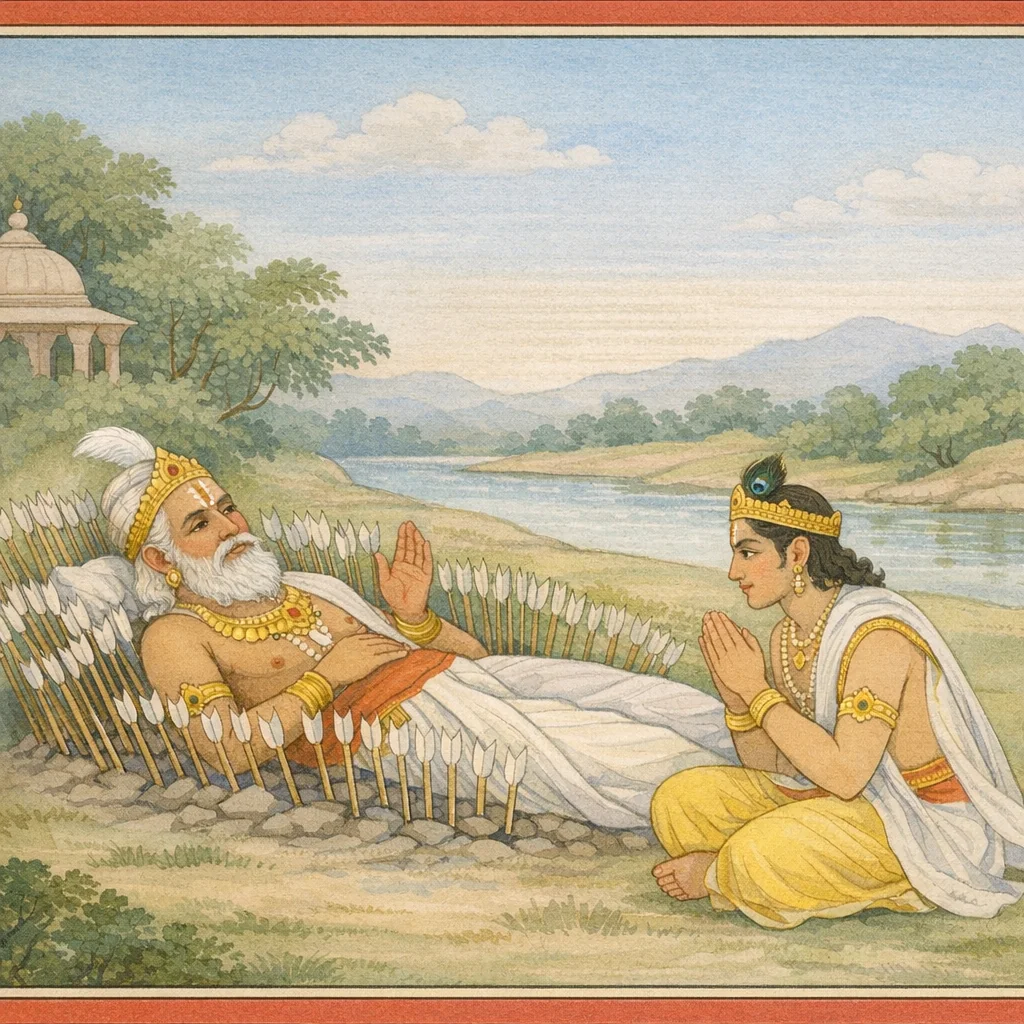
Chapter Arc: शरशय्या पर पड़े भीष्म से युधिष्ठिर पूछते हैं—लोक में अनेक दर्शन और ‘श्रेय’ के अनेक मार्ग कहे जाते हैं; फिर भी ऐसा कौन-सा धर्म है जो यहाँ और परलोक—दोनों में सबसे अधिक कल्याणकारी है? → भीष्म बताते हैं कि धर्म-पथ बहुशाखी है, पर मन और इन्द्रियों के असंयम से मनुष्य बार-बार क्लेश में पड़ता है और अपने ही दोषों से अनर्थों की सृष्टि करता है। युधिष्ठिर के प्रश्न के पीछे यह तनाव है कि बाह्य कर्म, मत-मतान्तर और प्रशंसा-निन्दा के बीच वास्तविक साधन क्या है जो मनुष्य को गिरने से बचाए। → भीष्म ‘दम’ को निर्णायक साधन के रूप में प्रतिष्ठित करते हैं—जो दान्त (संयमी) है वह ‘मैं-तुम’ के आसक्ति-बंधन, पूर्व-संबन्धों के मोह, तथा ग्राम्य-आरण्य दोनों प्रकार की प्रवृत्तियों में बहकर निन्दा-प्रशंसा का आश्रय नहीं लेता; इसी अनासक्ति और समत्व से मुक्ति का द्वार खुलता है। → वैशम्पायन के अनुसार भीष्म के वचन सुनकर युधिष्ठिर अमृत-तुल्य तृप्ति अनुभव करते हैं—उनके लिए ‘श्रेय’ का सार बाह्य विवादों में नहीं, अंतःकरण के संयम में स्थिर हो जाता है। → युधिष्ठिर पुनः भीष्म से तप (तपस्या) के विषय में पूछते हैं—अगला संवाद संयम के बाद तप के स्वरूप और साधना की ओर मुड़ता है।
Shlokas
Verse 1
अपने-आप बछ। अ--काजज षष्टर्याधिकशततमो< ध्याय: मन और इन्ट्रियोंके संयमरूप दमका माहात्म्य युधिछिर उवाच स्वाध्याये कृतयत्नस्य नरस्य च पितामह । धर्मकामस्य धर्मात्मन् कि नु श्रेय इहोच्यते,युधिष्ठिरने पूछा--धर्मात्मा पितामह! जो स्वाध्यायके लिये यत्नशील है और धर्मपालनकी इच्छा रखता है, उस मनुष्यके लिये इस संसारमें श्रेय क्या बताया जाता है?
Yudhiṣṭhira said: “O Grandfather, O righteous-souled one—when a person strives earnestly in self-study (svādhyāya) and desires to live by dharma, what is declared to be the highest good for him in this very world?”
Verse 2
बहुधा दर्शने लोके श्रेयो यदिह मन्यसे । अस्मिल्लोके परे चैव तन्मे ब्रूहि पितामह,पितामह! जगतमें श्रेयका प्रतिपादन करनेवाले अनेक प्रकारके दर्शन (मत) हैं; परंतु आप जिसे श्रेय मानते हों, जो इस लोक और परलोकमें भी कल्याण करनेवाला हो, उसे मुझे बताइये
Yudhiṣṭhira said: “In this world there are many philosophical viewpoints that claim to define what is truly beneficial. Tell me, O Grandfather, which path you yourself regard as the highest good—one that brings welfare both here in this life and also in the life to come.”
Verse 3
महानयं धर्मपथो बहुशाखश्न भारत | किंस्विदेवेह धर्माणामनुछ्ठेयतमं मतम्
Yudhiṣṭhira said: “O Bhārata, this path of dharma is vast and has many branches. In this world, which course among the duties is regarded as the most to be practiced?”
Verse 4
भारत! धर्मका यह मार्ग बहुत बड़ा है। इससे बहुत सी शाखाएँ निकली हुई हैं। इन धर्मोमेंसे कौनसा धर्म सर्वोत्तम, अवश्य पालन करनेयोग्य माना गया है? ।। धर्मस्य महतो राजन् बहुशाखस्य तत्त्वतः । यन्मूलं परमं तात तत् सर्व ब्रूहूशेषत:,राजन! बहुत-सी शाखाओंसे युक्त इस महान् धर्मका वास्तवमें परम मूल क्या है? तात! ये सब बातें मुझे पूर्णरूपसे बताइये
Yudhiṣṭhira asks: “O King, this great path of dharma is vast and spreads into many branches. In truth, what is its highest root—its supreme foundation? Dear one, tell me all of it completely, without leaving anything out.”
Verse 5
भीष्म उवाच हन्त ते कथयिष्यामि येन श्रेयो हवाप्स्यसि । पीत्वामृतमिव प्राज्ञो ज्ञानतृप्तो भविष्यसि,भीष्मजीने कहा--युधिष्ठिर! मैं बड़े हर्षके साथ तुम्हें वह उपाय बताता हूँ, जिससे तुम कल्याण प्राप्त कर लोगे। जैसे अमृतको पीकर पूर्ण तृप्ति हो जाती है, उसी प्रकार तुम ज्ञानी होकर इस ज्ञान-सुधासे पूर्णतः तृप्त हो जाओगे
Bhishma said: “Come, I shall tell you the means by which you will attain true welfare. Just as one becomes fully satisfied after drinking nectar, so too will you, becoming wise, be completely fulfilled by this knowledge.”
Verse 6
धर्मस्य विधयो नैके ये वै प्रोक्ता महर्षिभि: | स्वं स्वं विज्ञानमाश्रित्य दमस्तेषां परायणम्,महर्षियोंने अपने-अपने ज्ञानके अनुसार धर्मकी एक नहीं, अनेक विधियाँ बतायी हैं, परंतु उन सबका आधार दम (मन और इन्द्रियोंका संयम) ही है
Bhishma said: “The ordinances of dharma are not one but many, as the great seers have taught. Each has spoken in accordance with his own realization; yet the common ground and final reliance of them all is dama—self-restraint, the disciplined control of mind and senses.”
Verse 7
दमं निः:श्रेयसं प्राहुर्वद्धा निश्चितदर्शिन: । ब्राह्मणस्य विशेषेण दमो धर्म: सनातन:,धर्मके सिद्धान्तको जाननेवाले वृद्ध पुरुष दमको नि:श्रेयस (परम कल्याण) का साधन बताते हैं। विशेषतः ब्राह्मणके लिये तो दम ही सनातन धर्म है
Bhishma said: The aged seers of settled insight declare self-restraint to be the means to the highest good. For a Brahmin in particular, self-restraint itself is the eternal dharma.
Verse 8
दमात् तस्य क्रियासिद्धिर्यथावदुपलभ्यते । दमो दानं तथा यज्ञानधीतं चातिवर्तते,दमसे ही उसे अपने शुभ कर्मोकी यथावत् सिद्धि प्राप्त होती है। दम उसके लिये दान, यज्ञ और स्वाध्यायसे भी बढ़कर है
Bhishma said: Through self-restraint, a person truly attains the proper fulfillment of righteous actions. Indeed, self-control surpasses charity, sacrifice, and even sacred study, for it is the inner discipline that makes all virtuous practice effective and complete.
Verse 9
दमस्तेजो वर्धयति पवित्र च दम: परम् | विपाप्मा तेजसा युक्त: पुरुषो विन्दते महत्,दम तेजकी वृद्धि करता है, दम परम पवित्र साधन है, दमसे पापरहित हुआ तेजस्वी पुरुष परमपदको प्राप्त कर लेता है
Bhishma teaches that self-restraint (dama) increases inner radiance and strength (tejas). It is a supremely purifying discipline: when a person becomes free from sin through restraint and is endowed with spiritual vigor, he attains the highest good—greatness and the supreme state.
Verse 10
दमेन सदृशं धर्म नान्यं लोकेषु शुश्रुम ।। दमो हि परमो लोके प्रशस्त: सर्वधर्मिणाम्,हमने संसारमें दमके समान दूसरा कोई धर्म नहीं सुना। जगत्में सभी धर्मवालोंके यहाँ दमको उत्कृष्ट बताया गया है। सबने उसकी भूरि-भूरि प्रशंसा की है
Bhishma said: “We have not heard of any duty in the worlds comparable to self-restraint. Indeed, self-restraint is held to be the highest virtue in this world, praised by all who follow dharma.”
Verse 11
प्रेत्य चात्र मनुष्येन्द्र परमं विन्दते सुखम् । दमेन हि समायुक्तो महान्तं धर्ममश्लुते,नरेन्द्र! दमसे अर्थात् इन्द्रिय और मनके संयमसे युक्त पुरुषको महान धर्मकी प्राप्ति होती है। वह इहलोक और परलोकमें भी परम सुख पाता है
Bhishma said: “O best of men, one who is endowed with self-restraint attains the highest happiness both here and after death. For a person disciplined through dama—control of the senses and the mind—reaches great Dharma, O king.”
Verse 12
सुखं दान्त: प्रस्वपिति सुखं च प्रतिबुध्यते । सुखं पर्येति लोकांश्व मनश्नास्य प्रसीदति,जिसने अपने मन और इन्द्रियोंका दमन कर लिया है, वह सुखसे सोता, सुखसे ही जागता और सुखपूर्वक ही लोकोंमें विचरता है। उसका मन सदा प्रसन्न रहता है
Bhishma said: “One who has mastered the mind and restrained the senses sleeps in happiness and awakens in happiness. Moving through the worlds as well, he proceeds with ease; his mind remains continually serene and content.”
Verse 13
अदान्त: पुरुष: क्लेशमभीक्षणं प्रतिपद्यते । अनर्थाश्व बहूनन्यान् प्रसृजत्यात्मदोषजान्,जिसकी इन्द्रियाँ और मन वशमें नहीं है, वह पुरुष निरन्तर क्लेश उठाता है। साथ ही वह अपने ही दोषोंसे बहुत-से दूसरे-दूसरे अनर्थोकी भी सृष्टि कर लेता है
Bhishma said: “A person whose senses and mind are undisciplined repeatedly falls into suffering. Moreover, from his own inner faults he generates many other misfortunes, multiplying harm for himself and his life’s course.”
Verse 14
आश्रमेषु चतुर्ष्वाहुर्दममेवोत्तमं व्रतम् । तस्य लिड्डानि वक्ष्यामि येषां समुदयों दम:,चारों आश्रमोंमें दमको ही उत्तम व्रत बताया गया है। अब मैं इन्द्रिय-दमन एवं मनोनिग्रहके उन लक्षणोंको बताऊँगा, जिनका उदय होना ही दम कहा गया है
Bhishma said: “In all four stages of life, the wise declare self-restraint alone to be the highest vow. I shall now describe its distinguishing marks—those signs whose arising and steady presence are what is truly meant by ‘dama’, the disciplined mastery of the senses and the mind.”
Verse 15
क्षमा धृतिरहिंसा च समता सत्यमार्जवम् | इन्द्रियाभिजयो दाक्ष्यं मार्दव॑ हवीरचापलम्,क्षमा, धीरता, अहिंसा, समता, सत्यवादिता, सरलता, इन्द्रिय-विजय, दक्षता, कोमलता, लज्जा, स्थिरता, उदारता, क्रोधहीनता, संतोष, प्रिय वचन बोलनेका स्वभाव, किसी भी प्राणीको कष्ट न देना और दूसरोंके दोष न देखना--इन सद्गुणोंका उदय होना ही दम कहलाता है
Bhīṣma said: “Forbearance, steadfastness, non-violence, even-mindedness, truthfulness, and straightforwardness; mastery over the senses, competence, gentleness, modesty, and freedom from fickleness—when these virtues arise and become established in a person, that is what is called dama (self-restraint).”
Verse 16
अकार्पण्यमसंरम्भ: संतोष: प्रियवादिता । अविहिंसानसूया चाप्येषां समुदयो दम:,क्षमा, धीरता, अहिंसा, समता, सत्यवादिता, सरलता, इन्द्रिय-विजय, दक्षता, कोमलता, लज्जा, स्थिरता, उदारता, क्रोधहीनता, संतोष, प्रिय वचन बोलनेका स्वभाव, किसी भी प्राणीको कष्ट न देना और दूसरोंके दोष न देखना--इन सद्गुणोंका उदय होना ही दम कहलाता है
Bhishma said: “Freedom from meanness, absence of rash agitation, contentment, and the habit of speaking what is pleasing; along with non-violence and the refusal to censure others—when these virtues arise together in a person, that collective emergence is called self-restraint (dama).”
Verse 17
गुरुपूजा च कौरव्य दया भूतेष्वपैशुनम् । जनवादं मृषावादं स्तुतिनिन्दाविसर्जनम्,कुरुनन्दन! जिसने मन और इन्द्रियोंका दमन कर लिया है, उसमें गुरुजनोंके प्रति आदरका भाव, समस्त प्राणियोंके प्रति दया और किसीकी भी चुगली न करनेकी प्रवृत्ति होती है। वह जनापवाद, असत्य भाषण, निन्दा-स्तुतिकी प्रवृत्ति, काम, क्रोध, लोभ, दर्प, जडता, डींग हाँकना, रोष, ईर्ष्या और दूसरोंका अपमान--इन दुर्गुणोंका कभी सेवन नहीं करता
Bhishma said: “O Kauravya, one who has brought the mind and senses under control naturally shows reverence to teachers and elders, compassion toward all living beings, and a refusal to engage in slander. He gives up public scandal and rumor-mongering, false speech, and the habits of praising and blaming others; he does not resort to such faults as desire, anger, greed, pride, dullness, boastfulness, rancor, envy, or insulting others.”
Verse 18
काम॑ क्रोधं च लोभं॑ च दर्प स्तम्भं विकत्थनम् । रोषमीर्यावमानं च नैव दान्तो निषेवते,कुरुनन्दन! जिसने मन और इन्द्रियोंका दमन कर लिया है, उसमें गुरुजनोंके प्रति आदरका भाव, समस्त प्राणियोंके प्रति दया और किसीकी भी चुगली न करनेकी प्रवृत्ति होती है। वह जनापवाद, असत्य भाषण, निन्दा-स्तुतिकी प्रवृत्ति, काम, क्रोध, लोभ, दर्प, जडता, डींग हाँकना, रोष, ईर्ष्या और दूसरोंका अपमान--इन दुर्गुणोंका कभी सेवन नहीं करता
Bhishma said: “O joy of the Kurus, one who has mastered the mind and senses does not indulge in these vices—desire, anger, greed, pride, obstinate stiffness, boastful self-display, wrath, envy, and contempt for others.”
Verse 19
अनिन्दितो हाुकामात्मा नाल्पेष्वर्थ्यनसूयक: । समुद्रकल्प: स नरो न कथंचन पूर्यते,इन्द्रिय और मनको वशमें रखनेवाले पुरुषकी कभी निन्दा नहीं होती। उसके मनमें कोई कामना नहीं होती। वह छोटी-छोटी वस्तुओंके लिये किसीके सामने हाथ नहीं फैलाता अथवा तुच्छ विषय-सुखोंकी अभिलाषा नहीं रखता, दूसरोंके दोष नहीं देखता। वह मनुष्य समुद्रके समान अगाध गाम्भीर्य धारण करता है। जैसे समुद्र अनन्त जलराशि पाकर भी भरता नहीं है, उसी प्रकार वह भी निरन्तर धर्मसंचयसे कभी तृप्त नहीं होता
Bhīṣma said: “The self-controlled man, whose inner being is free from craving, is not blamed. He does not stretch out his hand for petty gains, does not hanker after trivial sense-pleasures, and does not look for faults in others. Such a person bears a depth like the ocean; and just as the ocean is not filled even by vast waters, so too he is never satiated—ever continuing to accumulate dharma without complacency.”
Verse 20
अहं त्वयि मयि त्वं च मयि ते तेषु चाप्यहम् । पूर्वसम्बन्धिसंयोगं नैतद् दान्तो निषेवते,“मैं तुमपर स्नेह रखता हूँ और तुम मुझपर। वे मुझमें अनुराग रखते हैं और मैं उनमें" इस प्रकार पहलेके सम्बन्धियोंके सम्बन्धका जितेन्द्रिय पुरुष चिन्तन नहीं करता
Bhishma said: “I am attached to you, and you to me; they are fond of me, and I of them”—a self-controlled person does not indulge in such brooding over the entanglements of former relationships. Within dharma’s discipline, he restrains the mind from clinging to reciprocal affections and past ties, so that judgment and conduct remain steady and unclouded.
Verse 21
सर्वग्राम्यास्तथा53रण्या याश्न लोके प्रवृत्तय: । निन्दां चैव प्रशंसां च यो नाश्रयति मुच्यते,जगतमें ग्रामीणों और वनवासियोंकी जो-जो प्रवृत्तियाँ होती हैं, उन सबका जो सेवन नहीं करता तथा दूसरोंकी निन््दा और प्रशंसासे भी दूर रहता है, उसकी मुक्ति हो जाती है
Whoever does not pursue the worldly tendencies found among villagers and forest-dwellers alike, and who relies neither on others’ blame nor on their praise, is set free.
Verse 22
मैत्रो5थ शीलसम्पन्न: प्रसन्नात्मा55त्मविच्च यः: । मुक्तस्य विविधै: सज्जैस्तस्य प्रेत्य फलं महत्,जो सबके प्रति मित्रताका भाव रखनेवाला और सुशील है, जिसका मन प्रसन्न है, जो नाना प्रकारकी आसक्तियोंसे मुक्त तथा आत्मज्ञानी है, उसे मृत्युके पश्चात् मोक्षरूप महान् फलकी प्राप्ति होती है
Bhishma said: One who is friendly toward all, endowed with good conduct, serene in mind, and a knower of the Self—freed from diverse attachments—attains, after death, a great fruit: liberation.
Verse 23
सुवृत्त: शीलसम्पन्न: प्रसन्नात्मा55त्मविद् बुध: । प्राप्पेह लोके सत्कारं सुगतिं प्रतिपद्यते,जो सदाचारी, शीलसम्पन्न, प्रसन्नचित्त और आत्मतत्त्वको जाननेवाला है, वह विद्दान् पुरुष इस लोकमें सत्कार पाकर परलोकमें परम गति पाता है
Bhishma said: A person of good conduct, endowed with virtuous character, serene in mind, and knowledgeable of the Self—such a wise one gains honor in this world and, after death, attains a blessed and auspicious state.
Verse 24
कर्म यच्छुभमेवेह सद्धिराचरितं च यत् । तदेव ज्ञानयुक्तस्य मुनेर्वर्त्म न हीयते,इस जगत्में जो केवल शुभ (कल्याणकारी) कर्म है तथा सत्पुरुषोंने जिसका आचरण किया है, वही ज्ञानवान् मुनिका मार्ग है। वह स्वभावत:ः उसका आचरण करता है। उससे कभी च्युत नहीं होता
Bhishma said: In this world, the truly auspicious deeds—those practiced by the good—are precisely the path of the sage endowed with knowledge. He follows them as a matter of his very nature, and he never falls away from that course.
Verse 25
निष्क्रम्य वनमास्थाय ज्ञानयुक्तो जितेन्द्रिय: । कालाकांक्षी चरत्येवं ब्रह्मभूयाय कल्पते,ज्ञानसम्पन्न जितेन्द्रिय पुरुष घरसे निकलकर वनका आश्रय ले वहाँ मृत्युकालकी प्रतीक्षा करता हुआ निर्द्धन्द् विचरता रहता है। इस प्रकार वह ब्रह्मभावको प्राप्त होनेमें समर्थ हो जाता है
Bhishma said: Having left the household and taken refuge in the forest, a man who is joined to true knowledge and has conquered his senses lives on, calmly awaiting the appointed time of death. Living in this manner—free from agitation and attachment—he becomes fit to attain the state of Brahman (final spiritual fulfillment).
Verse 26
अभयं यस्य भूतेभ्यो भूतानामभयं यत: । तस्य देहाद् विमुक्तस्य भयं नास्ति कुतश्चन,जिसको दूसरे प्राणियोंसे भय नहीं है तथा जिससे दूसरे प्राणी भी भय नहीं मानते, उस देहाभिमानसे रहित महात्मा पुरुषको कहींसे भी भय नहीं प्राप्त होता
Bhishma said: He who causes no fear to any living being, and from whom no living being feels fear—when such a great-souled person is freed from identification with the body, fear cannot arise for him from anywhere at all.
Verse 27
अवाचिनोति कर्माणि न च सम्प्रचिनोति ह । सम: सर्वेषु भूतेषु मैत्रायणगतिक्चरेत्,वह उपभोगद्वारा प्रारब्ध-कर्मोंकोी क्षीण करता है और कर्तृत्वाभिमान तथा फलासक्तिसे शून्य होनेके कारण नूतन कर्मोका संचय नहीं करता है। सभी प्राणियोंमें समानभाव रखकर सबको मित्रकी भाँति अभयदान देता हुआ विचरता है
Bhishma said: He merely exhausts the deeds already set in motion, and he does not accumulate new deeds. Remaining even-minded toward all beings, he moves through the world with a friendly disposition—granting fearlessness to all as to a friend.
Verse 28
शकुनीनामिवाकाशे जले वारिचरस्य च । यथा गतिने दृश्येत तथा तस्य न संशय:,जैसे आकाशमें पक्षियोंका और जलमें जलचर जन्तुओंका पदचिह्न नहीं दिखायी देता, उसी प्रकार ज्ञानीकी गति भी जाननेमें नहीं आती है। इसमें तनिक भी संशय नहीं है
Bhīṣma said: Just as the track of birds cannot be seen in the sky, and the track of creatures that move in water cannot be seen in water, so too the course of the truly wise cannot be traced or grasped by ordinary observation. Of this there is no doubt.
Verse 29
गृहानुत्सृज्य यो राजन् मोक्षमेवाभिपद्यते । लोकास्तेजोमयास्तस्य कल्पन्ते शाश्वती: समा:,राजन! जो घर-बार को छोड़कर मोक्षमार्गाका ही आश्रय लेता है, उसे अनन्त वर्षोके लिये दिव्य तेजोमय लोक प्राप्त होते हैं
Bhīṣma said: “O King, one who renounces household life and takes refuge solely in the path of liberation attains radiant, divine realms—worlds made of spiritual splendor—enduring for countless years.”
Verse 30
संन्यस्य सर्वकर्माणि संन्यस्य विधिवत् तपः । संन्यस्य विविधा विद्या: सर्व संन्यस्य चैव ह,जिसका आचार-विचार शुद्ध और अन्त:करण निर्मल है, जिसकी कामनाएँ शुद्ध हैं तथा जो भोगोंसे पराड्मुख हो चुका है, वह आत्मज्ञानी पुरुष सम्पूर्ण कर्मोका, तपस्याका तथा नाना प्रकारकी विद्याओंका विधिवत् संन्यास (त्याग) करके सर्वत्यागी संन्न्यासी होकर इहलोकमें सम्मानित हो परलोकमें अक्षय स्वर्ग (ब्रह्मधाम) को प्राप्त होता है
Bhīṣma said: “Having renounced all actions, having duly renounced austerity itself, and having renounced the many branches of learning—having thus renounced everything—one becomes a renouncer of all. Such a self-knower, with purified conduct and thought, a cleansed inner instrument, pure desires, and turned away from sense-enjoyments, is honored in this world and attains in the next an imperishable heavenly state—Brahman’s abode.”
Verse 31
कामे शुचिरनावृत्त: प्रसन्नात्मा55त्मविच्छुचि: । प्राप्पेह लोके सत्कारं स्वर्ग समभिपद्यते,जिसका आचार-विचार शुद्ध और अन्त:करण निर्मल है, जिसकी कामनाएँ शुद्ध हैं तथा जो भोगोंसे पराड्मुख हो चुका है, वह आत्मज्ञानी पुरुष सम्पूर्ण कर्मोका, तपस्याका तथा नाना प्रकारकी विद्याओंका विधिवत् संन्यास (त्याग) करके सर्वत्यागी संन्न्यासी होकर इहलोकमें सम्मानित हो परलोकमें अक्षय स्वर्ग (ब्रह्मधाम) को प्राप्त होता है
Bhishma said: One whose desires are pure, who is not entangled in sensual indulgence, whose inner self is serene, and who is a purified knower of the Self—having duly renounced ritual action, austerities, and the various branches of learning—becomes a renunciant of complete relinquishment. Such a person is honored in this world and, after death, attains the imperishable heaven, the supreme abode.
Verse 32
यच्च पैतामहं स्थान ब्रह्म॒राशिसमुद्धवम् । गुहायां पिहित॑ नित्यं तद् दमेनाभिगम्यते,ब्रह्मराशिसे उत्पन्न हुआ जो पितामह ब्रह्माजीका उत्तम धाम है, वह हृदयगुहामें छिपा हुआ है। उसकी प्राप्ति सदा दम (इन्द्रियसंयम और मनोनिग्रह) से ही होती है
Bhishma said: “That supreme, ancestral abode—born of the Brahmic source—is ever concealed within the cave of the heart. It is reached only through dama: the disciplined restraint of the senses and the steady governance of the mind.”
Verse 33
ज्ञानारामस्य बुद्धस्य सर्वभूताविरोधिन: । नावृत्तिभयमस्तीह परलोकभयं कुत:,जिसका किसी भी प्राणीके साथ विरोध नहीं है, जो ज्ञानस्वरूप आत्मामें रमता रहता है, ऐसे ज्ञानीको इस लोकमें पुन: जन्म लेनेका भय ही नहीं रहता, फिर उसे परलोकका भय कैसे हो सकता है?
Bhīṣma said: For the awakened sage who delights in the Self that is of the nature of knowledge, and who bears no hostility toward any being, there is no fear here of returning again to birth. How, then, could there be any fear of the world beyond?
Verse 34
एक एव दमे दोषो द्वितीयो नोपपद्यते । यदेनं क्षमया युक्तमशक्तं मन््यते जन:,दम अर्थात् संयममें एक ही दोष है, दूसरा नहीं। वह यह कि क्षमाशील होनेके कारण उसे लोग असमर्थ समझने लगते हैं
Bhishma said: “In self-restraint there is only one possible fault; a second does not arise. That fault is this: when a person is joined with forbearance, people take him to be powerless.”
Verse 35
एको<स्य सुमहाप्राज्ञ दोष: स्यात् सुमहान् गुण: । क्षमया विपुला लोका: सुलभा हि सहिष्णुता,महाप्राज्ञ युधिष्ठि!र| उसका यह एक दोष ही महान् गुण हो सकता है। क्षमा धारण करनेसे उसको बहुत से पुण्यलोक सुलभ होते हैं। साथ ही क्षमासे सहिष्णुता भी आ जाती है
Bhīṣma said: “O supremely wise Yudhiṣṭhira, what appears in him as a single great fault can itself become a great virtue. By cultivating forgiveness (kṣamā), abundant meritorious worlds become easily attainable; and through forgiveness, forbearance naturally arises as well.”
Verse 36
दान्तस्य किमरण्येन तथा5दान्तस्थ भारत । यत्रैव निवसेद् दान्तस्तदरण्यं स चाश्रम:,भारत! संयमी पुरुषको वनमें जानेकी क्या आवश्यकता है? और जो असंयमी है, उसको वनमें रहनेसे भी क्या लाभ है? संयमी पुरुष जहाँ रहे, वहीं उसके लिये वन और आश्रम है
Bhīṣma said: “O Bhārata, what need has a self-controlled person for the forest? And likewise, what benefit is there in a forest for one who is not self-controlled? Wherever the disciplined person dwells—there itself is his forest, and there itself is his hermitage (āśrama).”
Verse 37
वैशम्पायन उवाच एतदू भीष्मस्य वचन श्रुत्वा राजा युधिष्ठिर: । अमृतेनेव संतृप्त: प्रह्ष्ट:ः समपद्यत,वैशम्पायनजी कहते हैं--जनमेजय! भीष्मजीकी यह बात सुनकर राजा युधिष्छिर बड़े प्रसन्न हुए, मानो अमृत पीकर तृप्त हो गये हों
Vaiśampāyana said: Hearing these words of Bhīṣma, King Yudhiṣṭhira became delighted and inwardly fulfilled, as though satisfied by drinking nectar—his mind steadied by the assurance of dharma and right counsel.
Verse 38
पुनश्च परिपप्रच्छ भीष्म धर्मभूतां वरम् । तप: प्रति स चोवाच तस्मै सर्व कुरूद्गबह,कुरुश्रेष्ठ! तत्पश्चात् उन्होंने धर्मात्माओंमें श्रेष्ठ भीष्मजी से पुनः तपस्याके विषयमें प्रश्न किया। तब भीष्मजीने उन्हें उसके विषयमें सब कुछ बताना आरम्भ किया
Vaiśaṃpāyana said: Then he again questioned Bhīṣma, the foremost among the righteous, about the nature of austerity (tapas). Thereupon Bhīṣma began to explain everything to him—O bearer of the Kuru line, O best of the Kurus—setting forth the principles and purpose of tapas within dharma.
Verse 159
इस प्रकार श्रीमह्ाा भारत शान्तिपर्वके अन्तर्गत आपद्धर्मपर्वमें अज्ञानका माहात्म्यविषयक एक सौ उनसठवाँ अध्याय पूरा हुआ
Thus ends the one hundred and fifty-ninth chapter on the greatness (and significance) of ignorance, within the Āpaddharma section of the Śānti Parva of the great Mahābhārata.
Verse 160
इति श्रीमहाभारते शान्तिपर्वणि आपद्धर्मपर्वणि दमक थने षष्ट्यधिकशततमो< ध्याय:,इस प्रकार श्रीमहाभारत शान्तिपर्वके अन्तर्गत आपद्धर्मपर्वमें दमका वर्णनविषयक एक सौ साठवाँ अध्याय पूरा हुआ
Thus, in the Śrī Mahābhārata, within the Śānti Parvan—specifically the section on dharma in times of distress (Āpaddharma Parvan)—the one-hundred-and-sixtieth chapter, dealing with the account of Dama, comes to an end. This colophon marks the close of a didactic unit, situating the preceding narrative as guidance on right conduct under adversity.
Frequently Asked Questions
Yudhiṣṭhira seeks a principled ranking of dharma, artha, and kāma—whether ethical duty, material capacity, or desire should lead—and asks how self-restraint should be applied to master these aims without destabilizing conduct.
The chapter preserves multiple models: dharma as supreme norm (Vidura), artha as practical enabler (Arjuna), disciplined artha under dharma (Nakula–Sahadeva), kāma as universal impetus (Bhīma), and finally a detachment-based perspective where freedom is linked to non-attachment and equanimity (Yudhiṣṭhira).
No explicit phalaśruti is stated; the meta-commentary is functional—public approval of Yudhiṣṭhira’s synthesis and a narrative transition indicating that this tri-varga debate is preparatory to further inquiry into ‘higher dharma’ and liberation-oriented instruction.