Adhyaya 8
यमसभावर्णनम् (Yamasabhā-varṇanam) — Nārada’s Description of Dharmarāja’s Assembly
Upa-parva: Nārada–Yamasabhā-varṇana (Description of Yama’s Divine Assembly)
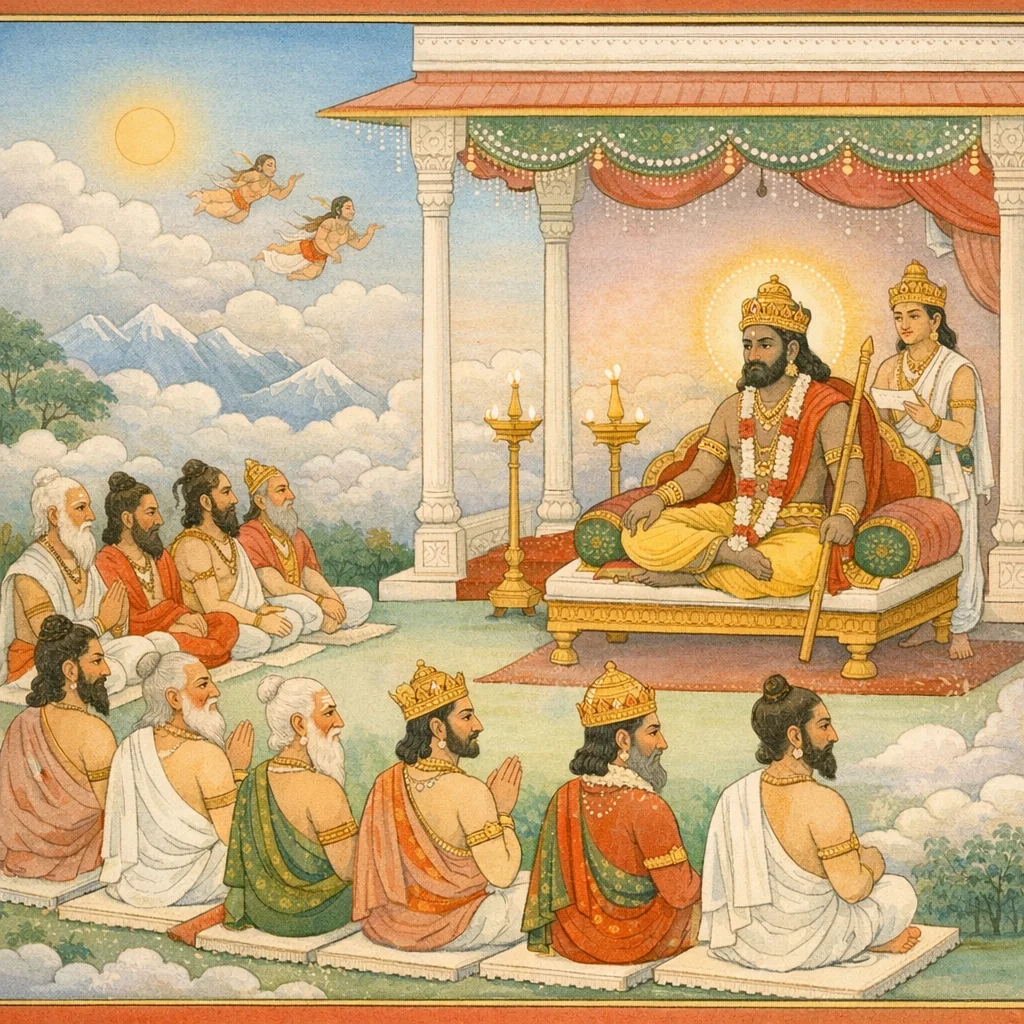
Nārada begins by instructing Yudhiṣṭhira that he will describe a divine assembly built by Viśvakarmā for Vaivasvata (Yama/Dharmarāja). The sabhā is portrayed as vast, radiant like the sun, mobile at will, and climatically balanced—neither excessively cold nor hot—producing mental delight. Within it, negative human conditions are absent: sorrow, aging, hunger, thirst, unpleasantness, humiliation, fatigue, and adversity are explicitly negated, establishing the hall as a normative space of well-being. The chapter then inventories abundance: divine and human enjoyments, plentiful and tasteful foods, fragrant garlands, ever-flowering and fruiting trees, and waters of varied temperatures. A long catalog of rājarṣis and brahmarṣis is presented as attending and honoring Vaivasvata, followed by additional cosmological attendants (pitṛs and other classes), emphasizing a structured moral universe. The description returns to the hall’s spaciousness and splendor, noting ascetics and truth-speakers who reach it through severe austerity and purified conduct. Gandharvas, apsarases, music, dance, and auspicious sensory qualities surround the assembly. The chapter concludes by affirming the greatness of Pitṛrāja’s sabhā and signals a forthcoming description of Varuṇa’s lotus-garlanded assembly.
Chapter Arc: नारद युधिष्ठिर से कहते हैं—हे राजन्, मैं तुम्हें यमराज (पितृराज) की दिव्य सभा का वर्णन सुनाता हूँ, जहाँ धर्म का तेज स्वयं आकार लेता है। → सभा का विस्तार और अद्भुत स्वभाव प्रकट होता है: वह शत-योजन विस्तीर्ण, तेजोमयी, सूर्य-प्रकाश-सी दीप्त, इच्छानुसार रूप धारण करनेवाली, न अति शीतल न अति उष्ण, और मन को हर्षित करनेवाली है। फिर वहाँ उपस्थित महापुरुषों की दीर्घ परंपरा—राजर्षि, तपस्वी, धर्मनिष्ठ—एक-एक कर गिनाई जाती है, जिससे श्रोता पर लोकातीत गरिमा का भार बढ़ता जाता है। → सभा का चरम वैभव तब उभरता है जब नारद बताते हैं कि वहाँ शान्त, संन्यासी, शुद्ध, पुण्यकर्म से पवित्र, भास्वर देह और विरज वस्त्रधारी जनों के शत-सहस्र नहीं, बल्कि ‘शतं शतसहस्राणि’—असंख्य धर्मात्मा महात्मा यम को उपासते हैं; स्वयं धर्मराज की उपस्थिति उस सभा को न्याय और मर्यादा का जीवित केंद्र बना देती है। → नारद निष्कर्ष रूप में कहते हैं—राजन्, यम की सभा ऐसी ही दिव्य और धर्म-परिपूर्ण है; वहाँ पुण्यात्मा राजर्षि और निर्मल हृदय वाले जन हर्षपूर्वक यम वैवस्वत की सेवा करते हैं। → यमसभा का वर्णन समाप्त करते हुए नारद अगली कड़ी खोलते हैं—अब मैं वरुण की पुष्करमालिनी सभा का वर्णन करूँगा।
Shlokas
Verse 1
(दाक्षिणात्य अधिक पाठके २ श्लोक मिलाकर कुल ३२ श्लोक हैं) भीकम (2 अमान अष्टमो< ध्याय: यमराजकी सभाका वर्णन नारद उवाच कथयिष्ये सभां याम्यां युधिष्ठिर निबोध ताम् । वैवस्वतस्य यां पार्थ विश्वकर्मा चकार ह,नारदजी कहते हैं--कुन्तीनन्दन युधिष्ठिर! अब मैं सूर्यपुत्र यमकी सभाका वर्णन करता हूँ, सुनो। उसकी रचना भी विश्वकर्माने ही की है
Narada said: “O Yudhiṣṭhira, listen attentively. I shall describe the assembly-hall of Yama, the son of Vivasvān. That splendid court—ordered and awe-inspiring—was fashioned by Viśvakarmā himself.”
Verse 2
तैजसी सा सभा राजन् बभूव शतयोजना । विस्तारायामसम्पन्ना भूयसी चापि पाण्डव,राजन्! वह तेजोमयी विशाल सभा लम्बाई और चौड़ाईमें भी सौ योजन है तथा पाण्डुनन्दन! सम्भव है, इससे भी कुछ बड़ी हो
Nārada said: “O King, that assembly hall was radiant and resplendent, extending a hundred yojanas. It was perfectly proportioned in both breadth and length—and, O descendant of Pāṇḍu, it may have been even larger still.”
Verse 3
अर्कप्रकाशा भ्राजिष्णु: सर्वतः कामरूपिणी । नातिशीता न चात्युष्णा मनसश्च प्रहर्षिणी,उसका प्रकाश सूर्यके समान है। इच्छानुसार रूप धारण करनेवाली वह सभा सब ओरसे प्रकाशित होती है। वह न तो अधिक शीतल है, न अधिक गर्म। मनको अत्यन्त आनन्द देनेवाली है
Nārada said: “That assembly-hall shines with a radiance like the sun. Able to assume any form at will, it appears resplendent from every side. It is neither excessively cold nor excessively hot; it delights the mind exceedingly.”
Verse 4
न शोको न जरा तसस्यां क्षुत्पिपासे न चाप्रियम् । न च दैन्यं क्लमो वापि प्रतिकूलं न चाप्युत,उसके भीतर न शोक है, न जीर्णता; न भूख लगती है, न प्यास। वहाँ कोई भी अप्रिय घटना नहीं घटित होती। दीनता, थकावट अथवा प्रतिकूलताका तो वहाँ नाम भी नहीं है
Nārada describes that realm as utterly free from the ordinary burdens of embodied life: there is no grief, no aging, no hunger or thirst, and nothing that brings displeasure. Neither poverty nor fatigue is found there, nor anything adverse at all.
Verse 5
सर्वे कामा: स्थितास्तस्यां ये दिव्या ये च मानुषा: । सारवच्च प्रभूतं च भक्ष्यं भोज्यमरिंदम,शत्रुदमन! वहाँ दिव्य और मानुष, सभी प्रकारके भोग उपस्थित रहते हैं। सरस एवं स्वादिष्ठ भक्ष्य-भोज्य पदार्थ प्रचुर मात्रामें संचित रहते हैं
Nārada said: “In that place, every kind of enjoyment—both divine and human—stands ready at hand. There is also an abundant store of rich and excellent foods, both those to be eaten and those to be served, O subduer of foes.”
Verse 6
लेहां चोष्यं च पेयं च हृद्यं स््वादु मनोहरम् । पुण्यगन्धा: स्रजस्तस्य नित्यं कामफला द्रुमा:,इसके सिवा चाटनेयोग्य, चूसनेयोग्य, पीनेयोग्य तथा हृदयको प्रिय लगनेवाली और भी स्वादिष्ठ एवं मनोहर वस्तुएँ वहाँ सदा प्रस्तुत रहती हैं। उस सभामें पवित्र सुगन्ध फैलानेवाली पुष्प-मालाएँ और सदा इच्छानुसार फल देनेवाले वृक्ष लहलहाते रहते हैं
Nārada said: “There were always at hand delicacies to be licked, sucked, and drunk—things pleasing to the heart, sweet, and enchanting. In that hall, garlands spreading a pure fragrance were ever present, and trees stood there that continually yielded fruits according to one’s desire.”
Verse 7
इस प्रकार श्रीमहाभारत सभापवके अन्तर्गत लोकपालयभाख्यानपर्वमें इन्द्रयभा-वर्णन नामक सातवाँ अध्याय पूरा हुआ,रसवन्ति च तोयानि शीतान्युष्णानि चैव हि | तस्यां राजर्षय: पुण्यास्तथा ब्रह्मर्षयो5डमला:
There, the waters are delightful and full of flavor—some cool, some warm. In that realm dwell holy royal sages, and likewise stainless brahmarṣis, pure and untainted.
Verse 8
ययातिर्नहुष: पूरुर्मान्धाता सोमको नृग:,इति श्रीमहाभारते सभापर्वणि लोकपालसभाख्यानपर्वणि यमसभावर्णन नामाष्टमोड्ध्याय:
Nārada said: “(Here are named) Yayāti, Nahuṣa, Pūru, Māndhātṛ, Somaka, and Nṛga.” Thus, in the Śrī Mahābhārata, within the Sabhā Parva, in the section called the ‘Account of the Assembly of the World-Guardians,’ ends the eighth chapter, titled ‘Description of Yama’s Assembly.’
Verse 9
त्रसहस्युश्न॒ राजर्षि: कृतवीर्य: श्रुतश्रवा: । अरिष्टनेमि: सिद्धश्च कृतवेग: कृतिर्निमि:
Narada said: “There was Trasahasyu, a royal sage; and Kṛtavīrya, famed for his might; and Śrutaśravā, renowned by report. Ariṣṭanemi too—an accomplished one—along with Kṛtavega, Kṛti, and Nimi.”
Verse 10
प्रतर्दन: शिबिर्मत्स्य:ः पृथुलाक्षो बृहद्रथ: । वार्तो मरुत्त: कुशिक: सांकाश्य: सांकृतिर्धुव
Nārada said: “Pratardana, Śibi, Matsya, Pṛthulākṣa, Bṛhadratha, Vārta, Marutta, Kuśika, Sāṅkāśya, Sāṅkṛti, and Dhruva—these are among the renowned royal figures.”
Verse 11
चतुरश्चः सदश्चोर्मि: कार्तवीर्यश्व पार्थिव: । भरत: सुरथश्वैव सुनीथो निशठो नलः
Narada continues by listing renowned kings of old—Catura, Ca, Sada, Ormi, and the royal Kartavīrya; likewise Bharata, Suratha, Sunītha, Niṣaṭha, and Nala.
Verse 12
दिवोदासश्न सुमना अम्बरीषो भगीरथ: । व्यश्वः सदश्चो वध्यश्वः पृथुवेग: पृथुअ्रवा:
Nārada said: “(Among the renowned kings of old were) Divodāsa, Sumanā, Ambarīṣa, and Bhagīratha; also Vyaśva, Sadaśva, Vadhyaśva, Pṛthuvega, and Pṛthuravā.”
Verse 13
पृषदश्चो वसुमना: क्षुपश्ष सुमहाबल: । रुषद्रुर्वषसेनश्न पुरुकुत्सो ध्वजी रथी
Nārada continued, naming renowned kings and warriors of great might: Pṛṣadaś, Vasumanā, and Kṣupa; also Ruṣadru, Vṛṣasena, and Purukutsa—along with Dhvajī, the famed chariot-fighter. The recitation underscores that even the celebrated in power and renown are gathered at last beneath the same moral horizon of time and karmic consequence, for rank and strength do not exempt one from impermanence or from accountability to dharma.
Verse 14
आर्डिषेणो दिलीपश्न महात्मा चाप्युशीनर: । औशीनरि: पुण्डरीक: शर्यातिः शरभ: शुचि:
Nārada said: “There were Ārḍiṣeṇa and Dilīpa; and also the great-souled Uśīnara. There were Auśīnari, Puṇḍarīka, Śaryāti, Śarabha, and Śuci.” Here Nārada continues a genealogical remembrance with ethical weight, invoking renowned royal figures whose remembered lives stand as exemplars of righteous kingship and moral stature.
Verse 15
अड्जोषरिष्ट श्न वेनश्व दुष्पन्त: सृजजयो जय: । भाज़ासुरि: सुनीथश्व निषधो5थ वहीनर:
Nārada said: “There were also Aḍjoṣariṣṭa, Śna, and Vena; Duṣpanta; Sṛjajaya and Jaya; Bhājāsuri and Sunītha; and then Niṣadha and Vahīnara.” In this section, Nārada continues a genealogical enumeration, placing later figures within an inherited line of kingship—implying that royal authority is not merely personal power but a trust borne through lineage and responsibility.
Verse 16
करन्धमो बाह्नविकश्न सुद्युम्नो बलवान् मधु: । ऐलो मरुत्तश्न तथा बलवान् पृथिवीपति:
Nārada said: “Karaṇdhama, Bāhnavika, and Sudyumna; the mighty Madhu; and likewise Aila and Marutta—each a powerful sovereign, a lord of the earth.” In this context, Nārada invokes a roll of renowned kings to underscore the moral lesson that even the strongest rulers and most celebrated lineages are subject to time and fate; greatness is measured not merely by power but by the dharmic use of power.
Verse 17
कपोतरोमा तृणकः सहदेवार्जुनौ तथा । व्यश्वः साशथ्वः कृशाश्वश्च शशबिन्दुश्च पार्थिव:
Nārada said: “There were kings named Kapotaromā, Tṛṇaka, and likewise Sahadeva and Arjuna; also Vyaśva, Sāśathva, Kṛśāśva, and Śaśabindu—each a ruler of the earth.”
Verse 18
राजा दशरथश्चैव ककुत्स्थो5थ प्रवर्धन: । अलर्क: कक्षसेनश्न गयो गौराश्वच एवच
Nārada said: “King Daśaratha, and also Kakutstha, then Pravardhana; Alarka, Kakṣasena, Gaya, and likewise Gaurāśva as well.”
Verse 19
जामदग्न्यश्न रामश्चन नाभागसगरौ तथा | भूरिट्युम्नो महाश्वश्व पृथाश्वो जनकस्तथा
Nārada continued by listing renowned figures of the royal and sage lineages—Jāmadagnya Rāma, Nābhāga, Sagara, Bhūridyu(m)na, Mahāśva, Pṛthāśva, and Janaka.
Verse 20
राजा वैन्यो वारिसेन: पुरुजिज्जनमेजय: । ब्रह्मदत्तस्त्रिगर्तक्ष राजोपरिचरस्तथा
Nārada continues his catalogue of notable kings, naming Vainya, Vārisena, Purujit, Janamejaya, Brahmadatta of the Trigartas, and Rājoparicara as well.
Verse 21
इन्द्रद्युम्नो भीमजानुर्गौरपृष्ठोडनघो लय: । पद्मयो5थ मुचुकुन्दश्न भूरिद्युम्न: प्रसेनजित्
Narada said: “Indradyumna, Bhīmajānu, Gaurapṛṣṭha, the sinless Laya, Padmaya, and also Mucukunda, Bhūridyumna, and Prasenajit.”
Verse 22
अरिष्टनेमि: सुद्युम्न: पृथुलाश्वोडष्टकस्तथा । शतं मत्स्या नृपतय: शतं नीपा: शतं गया:
Narada said: “(There were) Ariṣṭanemi, Sudyumna, Pṛthulāśva, and Ḍaṣṭaka; likewise a hundred kings of the Matsyas, a hundred of the Nīpas, and a hundred of the Gayas.”
Verse 23
धृतराष्ट्रश्ैकशतमशीतिर्जनमेजया: । शतं च ब्रह्मुदत्तानां वीरिणामीरिणां शतम्
Nārada said: “O Janamejaya, Dhṛtarāṣṭra had one hundred and eighty sons; and among the Brahmadattas there were a hundred—men renowned for their vigor and prowess.”
Verse 24
भीष्माणां द्वे शतेडप्यत्र भीमानां तु तथा शतम् | शतं च प्रतिविन्ध्यानां शतं नागा: शतं हया:
Nārada said: “Here, there are two hundred of the Bhīṣmas; likewise, a hundred of the Bhīmas; a hundred of the Prativindhyas; a hundred elephants; and a hundred horses.”
Verse 25
पलाशानां शतं ज्ञेयं शतं काशकुशादय: । शान्तनुश्लैव राजेन्द्र पाण्डुश्वैव पिता तव
Nārada said: “Know that there are a hundred Palāśa trees, and likewise a hundred clumps of kāśa grass, kuśa grass, and the like. And, O king, Śāntanu as well— and Pāṇḍu too— is your father.”
Verse 26
उशड्भव: शतरथो देवराजो जयद्रथ: । वृषदर्भश्न राजर्षिबुद्धिमान् सह मन्त्रिभि:
Nārada said: “Uśaḍbhava, Śataratha, Devarāja, Jayadratha, and Vṛṣadarbha—the wise royal sage—along with his ministers.”
Verse 27
अथापरे सहस््राणि ये गता: शशबिन्दव: । इष्टवाश्वमेधैर्बहुभिर्महद्धिभूरिदक्षिणै:
Nārada said: “And there were also thousands of others—men like Śaśabindu—who have passed away, though they performed many great Aśvamedha sacrifices and bestowed abundant gifts as sacrificial fees.”
Verse 28
एते राजर्षय: पुण्या: कीर्तिमन्तो बहुश्रुता: । तस्यां सभायां राजेन्द्र वैवस्चतमुपासते
Nārada said: “These are the holy royal sages—renowned and widely learned—who, O best of kings, attend upon Vaivasvata (Yama) in that assembly. Their presence proclaims that true sovereignty is measured not merely by power, but by merit, learning, and righteous conduct.”
Verse 29
ययाति, नहुष, पूरु, मान्धाता, सोमक, नृग, त्रसहस्यु, राजर्षि कृतवीर्य, श्रुतश्रवा, अरिष्टनेमि, सिद्ध, कृतवेग, कृति, निमि, प्रतर्दन, शिबि, मत्स्य, पृथुलाक्ष, बृहद्रथ, वार्त, मरुत्त, कुशिक, सांकाश्य, सांकृति, ध्रुव, चतुरश्च, सदश्वोर्मि, राजा कार्तवीर्य अर्जुन, भरत, सुरथ, सुनीथ, निशठ, नल, दिवोदास, सुमना, अम्बरीष, भगीरथ, व्यश्व, सदश्व, वध्यश्व, पृथुवेग, पृथुश्रवा, पृषदश्च, वसुमना, महाबली क्षुप, रुषट्र, वृषसेन, रथ और ध्वजासे युक्त पुरुकुत्स, आर्टिषेण, दिलीप, महात्मा उशीनर, औशीनरि, पुण्डरीक, शर्याति, शरभ, शुचि, अंग, अरिष्ट, वेन, दुष्यन्त, सुंजय, जय, भांगासुरि, सुनीथ, निषध, वहीनर, करन्धम, बाह्लिक, सुद्युम्न, बलवान् मधु, इला-नन्दन पुरूरवा, बलवान राजा मरुत्त, कपोतरोमा, तृणक, सहदेव, अर्जुन, व्यश्व, साश्व, कृशाश्व, राजा शशबिन्दु, महाराज दशरथ, ककुत्स्थ, प्रवर्धन, अलर्क, कक्षसेन, गय, गौराश्वच, जमदग्निनन्दन परशुराम, नाभाग, सगर, भूरिद्युम्न, महाश्वच, पृथाश्व, जनक, राजा पृथु, वारिसेन, पुरुजितूु, जनमेजय, ब्रह्मदत्त, त्रिगर्त, राजा उपरिचर, इन्द्रद्युम्न, भीमजानु, गौरपृष्ठ, अनघ, लय, पद्दा, मुचुकुन्द, भूरिद्युम्न, प्रसेनजित्, अरिष्टनेमि, सुद्युम्न, पृथुलाश्वच, अष्टक, एक सौ मत्स्य, एक सौ नीप, एक सौ गय, एक सौ धृतराष्ट्र, अस्सी जनमेजय, सौ ब्रह्मदत्त, सौ वीरी, सौ ईरी, दो सौ भीष्म, एक सौ भीम, एक सौ प्रतिविन्ध्य, एक सौ नाग तथा एक सौ हय, सौ पलाश, सौ काश और सौ कुश राजा एवं शान्तनु, तुम्हारे पिता पाण्डु, उशंगव, शतरथ, देवराज, जयद्रथ, मन्त्रियोंसहित बुद्धिमान् राजर्षि वृषदर्भ तथा इनके सिवा सहस्रों शशबिन्दु नामक राजा, जो अधिक दक्षिणावाले अनेक महान् अश्वमेधयज्ञोंद्वारा यजन करके धर्मराजके लोकमें गये हुए हैं। राजेन्द्र! ये सभी पुण्यात्मा, कीर्तिमान् और बहुश्रुत राजर्षि उस सभामें सूर्यपुत्र यमकी उपासना करते हैं ।। ८ --२८ || अगस्त्योडथ मतड़श्च कालो मृत्युस्तथैव च । यज्वानश्लैव सिद्धाक्ष ये च योगशरीरिण:,अगस्त्य, मतंग, काल, मृत्यु, यज्ञकर्ता, सिद्ध, योगशरीरधारी, अग्निष्वात्त पितर, फेनप, ऊष्मप, स्वधावान्, बर्हिषद् तथा दूसरे मूर्तिमान् पितर, साक्षात् कालचक्र (संवत्सर आदि कालविभागके अभिमानी देवता), भगवान् हव्यवाहन (अग्नि), दक्षिणायनमें मरनेवाले तथा सकामभावसे दुष्कर (श्रमसाध्य) कर्म करनेवाले मनुष्य, जनेश्वर कालकी अआज्ञामें तत्पर यमदूत, शिंशप एवं पलाश, काश और कुश आदिके अभिमानी देवता मूर्तिमान् होकर उस सभामें धर्मराजकी उपासना करते हैं
Narada said: “O king, in that assembly are seen many royal sages—celebrated, virtuous, and learned—such as Yayati, Nahusha, Puru, Mandhata, and countless others, including Shantanu and your father Pandu. Having performed great sacrifices—especially lavish Ashvamedhas with abundant gifts—many kings named Shashabindu and thousands besides have attained the realm of Dharmaraja. All these meritorious, renowned, and well-instructed royal seers worship Yama, the son of the Sun, in that court. There too are revered sages and cosmic powers—Agastya, Matanga, Time and Death—along with accomplished sacrificers, perfected beings, and yogins embodied in spiritual attainment; also the various classes of Pitrs and the deities presiding over sacred trees and grasses. Even Yama’s attendants, intent on carrying out the ordinance of Time, stand devotedly in service. The scene underscores that sovereignty and fame find their true completion only when yoked to dharma, sacrifice, self-discipline, and reverence for the moral order embodied by Yama.”
Verse 30
अग्निष्वात्ताश्न पितर: फेनपाश्चोष्मपाश्च ये । स्वधावन्तो बर्लहिषदो मूर्तिमन्तस्तथापरे,अगस्त्य, मतंग, काल, मृत्यु, यज्ञकर्ता, सिद्ध, योगशरीरधारी, अग्निष्वात्त पितर, फेनप, ऊष्मप, स्वधावान्, बर्हिषद् तथा दूसरे मूर्तिमान् पितर, साक्षात् कालचक्र (संवत्सर आदि कालविभागके अभिमानी देवता), भगवान् हव्यवाहन (अग्नि), दक्षिणायनमें मरनेवाले तथा सकामभावसे दुष्कर (श्रमसाध्य) कर्म करनेवाले मनुष्य, जनेश्वर कालकी अआज्ञामें तत्पर यमदूत, शिंशप एवं पलाश, काश और कुश आदिके अभिमानी देवता मूर्तिमान् होकर उस सभामें धर्मराजकी उपासना करते हैं
Narada said: “There are the Pitṛs known as the Agniṣvāttas, and also those called the Phenapas and the Ūṣmapas; there are the Svadhāvants and the Barhiṣads, and others besides who are embodied. All these venerable ancestral powers, in their distinct orders, are present in the royal assembly, honoring Dharmarāja—showing that even the unseen moral order is upheld and witnessed by the cosmic and ancestral realms.”
Verse 31
कालचक्रं च साक्षाच्च भगवान् हव्यवाहन:ः । नरा दुष्कृतकर्माणो दक्षिणायनमृत्यव:,अगस्त्य, मतंग, काल, मृत्यु, यज्ञकर्ता, सिद्ध, योगशरीरधारी, अग्निष्वात्त पितर, फेनप, ऊष्मप, स्वधावान्, बर्हिषद् तथा दूसरे मूर्तिमान् पितर, साक्षात् कालचक्र (संवत्सर आदि कालविभागके अभिमानी देवता), भगवान् हव्यवाहन (अग्नि), दक्षिणायनमें मरनेवाले तथा सकामभावसे दुष्कर (श्रमसाध्य) कर्म करनेवाले मनुष्य, जनेश्वर कालकी अआज्ञामें तत्पर यमदूत, शिंशप एवं पलाश, काश और कुश आदिके अभिमानी देवता मूर्तिमान् होकर उस सभामें धर्मराजकी उपासना करते हैं
Nārada said: “There too are seen, embodied and present, the very Wheel of Time itself and the divine Havyavāhana (Agni). Also present are those men who die in the season of the southern course (dakṣiṇāyana) and those who, driven by desire, perform arduous deeds that are ethically tainted. All these, under the ordinance of Time, attend upon Dharmarāja in his assembly.”
Verse 32
कालस्य नयने युक्ता यमस्य पुरुषाश्न ये । तस्यां शिंशपपालाशास्तथा काशकुशादय: । उपासते धर्मराजं मूर्तिमन््तो जनाधिप,अगस्त्य, मतंग, काल, मृत्यु, यज्ञकर्ता, सिद्ध, योगशरीरधारी, अग्निष्वात्त पितर, फेनप, ऊष्मप, स्वधावान्, बर्हिषद् तथा दूसरे मूर्तिमान् पितर, साक्षात् कालचक्र (संवत्सर आदि कालविभागके अभिमानी देवता), भगवान् हव्यवाहन (अग्नि), दक्षिणायनमें मरनेवाले तथा सकामभावसे दुष्कर (श्रमसाध्य) कर्म करनेवाले मनुष्य, जनेश्वर कालकी अआज्ञामें तत्पर यमदूत, शिंशप एवं पलाश, काश और कुश आदिके अभिमानी देवता मूर्तिमान् होकर उस सभामें धर्मराजकी उपासना करते हैं
Narada said: “O lord of men, those who are set as the ‘eyes’ of Time, and those who are the agents of Yama—together with the presiding divinities embodied as the śiṃśapā and palāśa trees, and likewise those of kāśa grass and kuśa and the rest—stand there in embodied form and worship Dharmarāja. In that assembly, the powers that execute cosmic order and the very forces that mark and measure life’s end are shown as reverently attending upon Dharma itself.”
Verse 33
एते चान्ये च बहव: पितृराजसभासद: । न शक््या: परिसंख्यातुं नामभि: कर्मभिस्तथा,ये तथा और भी बहुत-से लोग पितृराज यमकी सभाके सदस्य हैं, जिनके नामों और कर्मोंकी गणना नहीं की जा सकती
Nārada said: “These, and many others besides, are members of the assembly of the Lord of the Fathers (Yama). They cannot be fully enumerated—neither by their names nor by their deeds.”
Verse 34
असम्बाधा हि सा पार्थ रम्या कामगमा सभा | दीर्घकालं तपस्तप्त्वा निर्मिता विश्वकर्मणा,कुन्तीनन्दन! वह सभा बाधारहित है। वह रमणीय तथा इच्छानुसार गमन करनेवाली है। विश्वकर्माने दीर्घनकालतक तपस्या करके उसका निर्माण किया है
Nārada said: “O Pārtha, this assembly hall is truly unobstructed—spacious and free from hindrance. It is delightful, and one may move within it as one wishes. After performing austerities for a long time, Viśvakarman fashioned it.”
Verse 35
ज्वलन्ती भासमाना च तेजसा स्वेन भारत । तामुग्रतपसो यान्ति सुव्रता: सत्यवादिन:,भारत! वह सभा अपने तेजसे प्रज्वलित तथा उद्धासित होती रहती है। कठोर तपस्या और उत्तम व्रतका पालन करनेवाले, सत्यवादी, शान्त, संन्यासी तथा अपने पुण्यकर्मसे शुद्ध एवं पवित्र हुए पुरुष उस सभामें जाते हैं। उन सबके शरीर तेजसे प्रकाशित होते रहते हैं। सभी निर्मल वस्त्र धारण करते हैं
O Bhārata, that assembly hall blazes and shines with its own radiance. To it go those of fierce austerity—men of excellent vows and truthfulness—whose very presence is marked by inner purity and disciplined conduct, as if their bodies themselves were illumined by the power of their merit.
Verse 36
शान्ता: संन्यासिन: शुद्धा: पूता: पुण्येन कर्मणा । सर्वे भास्वरदेहा श्व॒ सर्वे च विरजो>म्बरा:,भारत! वह सभा अपने तेजसे प्रज्वलित तथा उद्धासित होती रहती है। कठोर तपस्या और उत्तम व्रतका पालन करनेवाले, सत्यवादी, शान्त, संन्यासी तथा अपने पुण्यकर्मसे शुद्ध एवं पवित्र हुए पुरुष उस सभामें जाते हैं। उन सबके शरीर तेजसे प्रकाशित होते रहते हैं। सभी निर्मल वस्त्र धारण करते हैं
Nārada said: “Those who enter that assembly are tranquil and self-restrained—renunciants, purified and made holy by meritorious deeds. All of them shine with radiant bodies, and all wear spotless garments.”
Verse 37
चित्राड्दाश्षित्रमाल्या: सर्वे ज्वलितकुण्डला: । सुकृतै: कर्मभि: पुण्यै: पारिबर्ैश्ष भूषिता:,सभी अद्भुत बाजूबंद, विचित्र हार और जगमगाते हुए कुण्डल धारण करते हैं। वे अपने पवित्र शुभ कर्मों तथा वस्त्राभूषणोंसे भी विभूषित होते हैं
Nārada said: “All of them wear wondrous garlands and blazing earrings. They are adorned through their meritorious, virtuous deeds, and also by fine garments and ornaments.”
Verse 38
गन्धर्वाश्व महात्मान: सड्घशश्चाप्सरोगणा: । वादित्रं नृत्यगीतं च हास्यं लास्यं च सर्वशः,कितने ही महामना गन्धर्व और झुंड-की-झुंड अप्सराएँ उस सभामें उपस्थित हो सब प्रकारके वाद्य, नृत्य, गीत, हास्य और लास्यकी उत्तम कलाका प्रदर्शन करती हैं
Nārada said: “There, noble Gandharvas and whole companies of Apsarās were present in that assembly, displaying excellence in every kind of musical instrument, dance, song, laughter, and graceful performance.”
Verse 39
पुण्याश्न गन्धा: शब्दाश्न॒ तस्यां पार्थ समन्ततः । दिव्यानि चैव माल्यानि उपतिष्ठन्ति नित्यश:,कुन्तीकुमार! उस सभामें सदा सब ओर पवित्र गन्ध, मधुर शब्द और दिव्य मालाओंके सुखद स्पर्श प्राप्त होते रहते हैं
Nārada said: “O Pārtha, all around within that hall there are ever-present pure fragrances and sweet, auspicious sounds; and divine garlands, too, are continually at hand.”
Verse 40
शतं शतसहस्राणि धर्मिणां त॑ प्रजेश्वरम् । उपासते महात्मानं रूपयुक्ता मनस्विन:,सुन्दर रूप धारण करनेवाले एक करोड़ धर्मात्मा एवं मनस्वी पुरुष महात्मा यमकी उपासना करते हैं
Nārada said: “Hundreds and hundreds of thousands of righteous, resolute men—endowed with splendid forms—worship that great-souled Lord of creatures.”
Verse 41
ईदृशी सा सभा राजन पित्राज्ञों महात्मन: । वरुणस्यापि वक्ष्यामि सभां पुष्करमालिनीम्,राजन! पितृराज महात्मा यमकी सभा ऐसी ही है। अब मैं वरुणकी मूर्तिमान् पुष्कर आदि तीर्थमालाओंसे सुशोभित सभाका भी वर्णन करूँगा
Nārada said: “O King, such indeed is the assembly hall of the great-souled Lord of the Pitṛs (Yama). Now I shall also describe to you Varuṇa’s assembly hall, adorned with garlands of sacred tīrthas such as Puṣkara.”
Verse 76
यम॑ वैवस्वतं तात प्रह्ृष्टा: पर्युपासते । वहाँ ठंडे और गर्म स्वादिष्ठ जल नित्य उपलब्ध होते हैं। तात! वहाँ बहुत-से पुण्यात्मा राजर्षि और निर्मल हृदयवाले ब्रह्मर्षि प्रसन्नतापूर्वक बैठकर सूर्यपुत्र यमकी उपासना करते हैं
Nārada said: “Dear child, there (in that blessed realm) the delighted and purified ones sit in reverent attendance, worshipping Yama Vaivasvata, the son of the Sun. Cool and warm, most pleasant waters are always available there; and many meritorious royal seers and stainless-hearted brahmarṣis remain joyfully devoted to him.”
Frequently Asked Questions
The sabhā is defined by the absence of common afflictions (sorrow, aging, hunger, thirst, fatigue, humiliation), contrasting ordinary political spaces with an idealized domain where dharma is experienced as ordered well-being.
The chapter implicitly teaches that legitimate rule should approximate dharmic order: balanced conditions, procedural fairness, cultivated restraint, and an environment that supports mental clarity rather than agitation.
No explicit phalaśruti is stated here; the meta-function is archival and exemplary—mapping dharmic authority through description, catalog, and cosmological framing rather than promising recitational rewards.