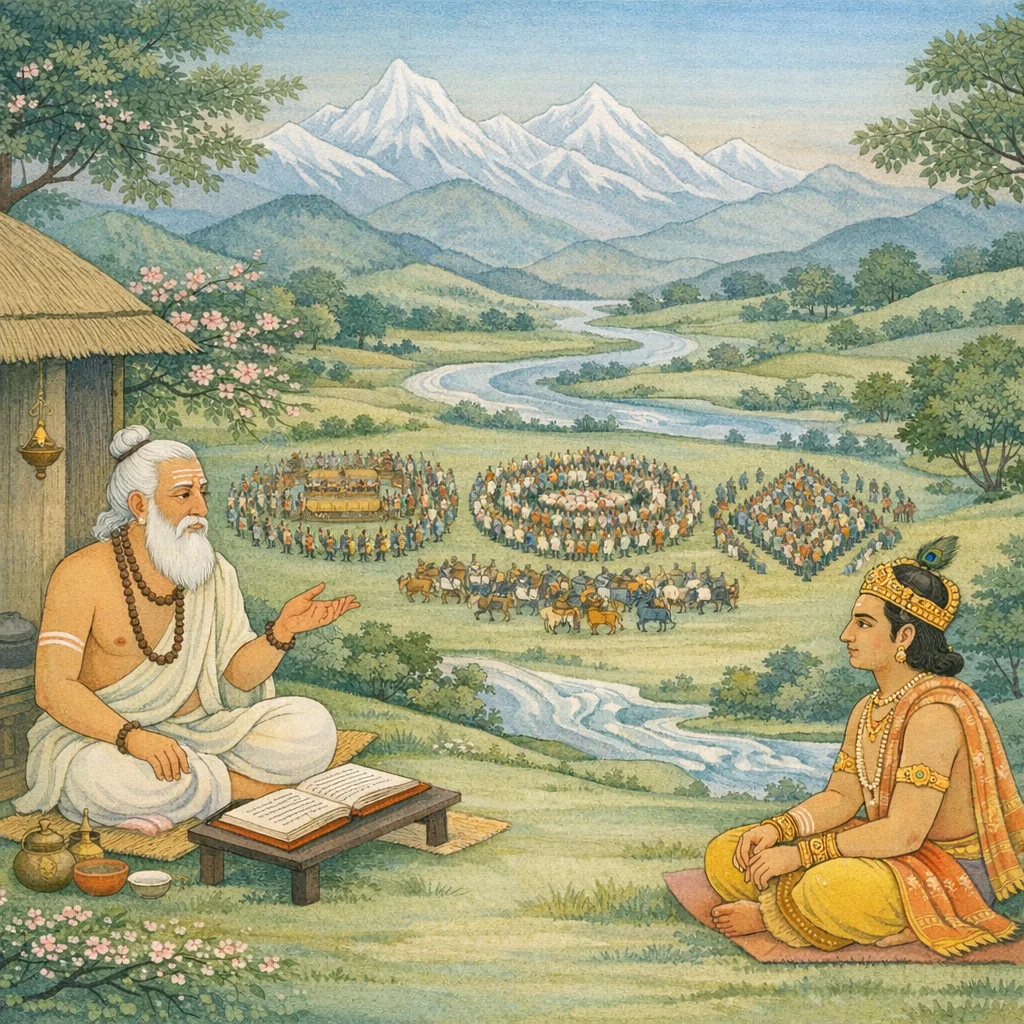
Adhyaya 7
धृतराष्ट्रस्य स्पर्शाभिलाषः — Dhṛtarāṣṭra’s Request for Touch and Permission for Tapas
Upa-parva: Dhṛtarāṣṭra–Yudhiṣṭhira Saṃvāda (Forest-retreat permissions and reconciliation episode)
Dhṛtarāṣṭra addresses Yudhiṣṭhira with an affective request: he asks to be touched again and embraced, describing the contact as life-restoring and ‘nectar-like’ (amṛta-sama). He explains his frailty—fasting intervals, exhaustion, and near-fainting—framing physical weakness as part of ascetic strain. Vaiśaṃpāyana narrates Yudhiṣṭhira’s compliant response: out of goodwill he gently touches the elder’s limbs, after which Dhṛtarāṣṭra embraces and smells the king’s head in a gesture of paternal recognition. The surrounding community—Vidura and others—break into grief; the Pāṇḍavas remain largely silent from intensity of sorrow, while Gāndhārī attempts to steady the emotional atmosphere with a restraint-oriented admonition. Dhṛtarāṣṭra then asks Yudhiṣṭhira for permission to continue tapas, and Yudhiṣṭhira replies that he values the elder’s wish above his own interests, requesting only that food be taken first. Dhṛtarāṣṭra indicates willingness to eat if permitted. The chapter closes with Vyāsa arriving, signaling an authoritative transition to the next narrative development.
Chapter Arc: वन-निवास के शांत परिवेश में भी राजधर्म का कठोर विज्ञान गूंज उठता है—राजा को राज्य-रक्षा के लिए ‘सन्धान’ कर्म, असन्धेय वर्ग, दोष और तीर्थ (उपाय/साधन) का क्रमबद्ध ज्ञान स्मरण कराया जाता है। → उपदेश युद्ध-नीति की सूक्ष्मताओं तक उतरता है: शत्रु की ‘द्विविध अवस्था’ (बल/अबल) का विचार, पर्युपासन (घेराबंदी/निगरानी) और आमर्द (आक्रमण) के समय विपरीत आचरण, तथा अनेक प्रकार की आपदाओं की पहचान—क्योंकि एक भूल प्रजा और राज्य दोनों को डुबो सकती है। → राजा के लिए शक्ति-संग्रह और सैन्य-प्रयोग का निर्णायक विधान सामने आता है—मौल बल, मित्रबल, अटवीबल, भृत्यबल, श्रेणीबल का संकलन; सेना को ‘नदी’ की तरह शत्रु-विनाश हेतु प्रवाहित करना; और उशना-नीति के अनुसार शकट, पद्म, वज्र व्यूहों की युक्तिपूर्वक रचना। → उपदेश का नैतिक निष्कर्ष स्थापित होता है: भीष्म, कृष्ण, विदुर द्वारा पहले कही गई बातों की पुनः पुष्टि करते हुए वक्ता राजा से कहता है कि न्यायानुसार आचरण, प्रजा-प्रियता और धर्म-पालन ही स्थायी कीर्ति व परलोक-सुख का मार्ग है। → यह संकेत छोड़ दिया जाता है कि यज्ञ-वैभव (हजार अश्वमेध) और धर्मपूर्वक प्रजा-पालन—दोनों का फल तुल्य है; आगे प्रश्न उठता है कि राजा वास्तविक जीवन में किस मार्ग को चुनेगा—दिखावे का यज्ञ या कठिन धर्म-पालन।
Shlokas
Verse 1
- कृषि आदि आठ सन्धान कर्म हैं। बाल आदि बीस असन्धेय हैं। नास्तिकता आदि चौदह दोष हैं और मन्त्र आदि अठारह तीर्थ हैं। उन सबका विस्तारपूर्वक वर्णन पहले आ चुका है। सप्तमो<ध्याय: युधिष्ठिरको धृतराष्ट्रके द्वारा राजनीतिका उपदेश धृतराष्ट उवाच संधिविग्रहमप्यत्र पश्येथा राजसत्तम । द्वियोनिं विविधोपायं बहुकल्पं युधिष्ठिर,धृतराष्ट्रने कहा--नृपश्रेष्ठ युधिष्ठिर! तुम्हें संधि और विग्रहपर भी दृष्टि रखनी चाहिये। शत्रु प्रबल हो तो उसके साथ संधि करना और दुर्बल हो तो उसके साथ युद्ध छेड़ना--ये संधि और विग्रहके दो आधार हैं। इनके प्रयोगके उपाय भी नाना प्रकारके हैं और इनके प्रकार भी बहुत हैं
Dhṛtarāṣṭra said: “O best of kings, Yudhiṣṭhira, you should keep your attention here even on peace-making and on conflict. These have a twofold basis—making peace with a stronger foe and initiating war against a weaker one. Their applications are manifold, their methods diverse, and their forms numerous.”
Verse 2
कौरव्य पर्युपासीथा: स्थित्वा द्वैविध्यमात्मन: । तुष्टपुष्टबल: शत्रुरात्मवानिति च स्मरेत्,कुरुनन्दन! अपनी द्विविध अवस्था--बलाबलका अच्छी तरह विचार करके शत्रुसे युद्ध या मेल करना उचित है। यदि शत्रु मनस्वी है और उसके सैनिक हृष्ट-पुष्ट एवं संतुष्ट हैं तो उसपर सहसा धावा न करके उसे परास्त करनेका कोई दूसरा उपाय सोचे
Dhṛtarāṣṭra said: “O scion of the Kuru line, having taken your stand and carefully considered the twofold condition of your own strength and weakness, decide whether it is right to fight the enemy or to seek accommodation. Remember, O joy of the Kurus: if the foe is resolute and his troops are well-fed, strong, and content, one should not rush into a sudden assault; rather, one should devise some other means to bring him down.”
Verse 3
पर्युपासनकाले तु विपरीतं विधीयते । आमर्दकाले राजेन्द्र व्यपसर्पेत् ततः परम्,आक्रमणकालमें शत्रुकी स्थिति विपरीत रहनी चाहिये अर्थात् उसके सैनिक हृष्ट-पुष्ट एवं संतुष्ट नहीं होने चाहिये। राजेन्द्र! यदि शत्रुसे अपना मान मर्दन होनेकी सम्भावना हो तो वहाँसे भागकर किसी दूसरे मित्र राजाकी शरण लेनी चाहिये
Dhṛtarāṣṭra said: “At the time of keeping watch and waiting upon (the enemy), one should adopt a contrary course—so that the foe is not left in a condition of ease and confidence. O best of kings, when there is danger that one’s honour will be crushed, one should withdraw from that place and thereafter seek refuge with another friendly king.”
Verse 4
व्यसन भेदनं चैव शत्रूणां कारयेत् ततः । कर्षणं भीषणं चैव युद्धे चैव बलक्षयम्,वहाँ यह प्रयत्न करना चाहिये कि शत्रुओंपर कोई संकट आ जाय या उनमें फूट पड़ जाय, वे क्षीण और भयभीत हो जायाँ तथा युद्धमें उनकी सेना नष्ट हो जाय
Dhṛtarāṣṭra said: “Then one should set about bringing calamity and division upon the enemies—harassing them, striking fear into them, and, in battle, wearing down and destroying their strength.”
Verse 5
प्रयास्यमानो नृपतिस्त्रिविधां परिचिन्तयेत् । आत्मनश्वैव शत्रोश्व शक्ति शास्त्रविशारद:,शत्रुपर चढ़ाई करनेवाले शास्त्रविशारद राजाको अपनी और शत्रुकी त्रिविध शक्तियोंपर भलीभाँति विचार कर लेना चाहिये
Dhṛtarāṣṭra said: “When a king is about to set out on a campaign, he—being well-versed in the science of polity and warfare—should carefully reflect on the threefold power of both himself and his enemy.”
Verse 6
इस प्रकार श्रीमह्याभारत आश्रमवासिकपवके अन्तर्गत आश्रमवासपर्वमें धृतराष्रका उपदेशविषयक छठा अध्याय पूरा हुआ,उत्साहप्रभुशक्तिभ्यां मन्त्रशक्त्या च भारत । उपपन्नो नृपो यायाद् विपरीतं च वर्जयेत् भारत! जो राजा उत्साह-शक्ति, प्रभु-शक्ति और मन्त्र-शक्तिमें शत्रुकी अपेक्षा बढ़ा-चढ़ा हो, उसे ही आक्रमण करना चाहिये। यदि इसके विपरीत अवस्था हो तो आक्रमणका विचार त्याग देना चाहिये
Dhṛtarāṣṭra instructs that a king should undertake an offensive only when he surpasses the enemy in three supports of power: personal energy and resolve, sovereign resources and authority, and the strategic strength of counsel and policy. If these advantages are lacking, he should renounce the very thought of attacking, for action taken without adequate strength and guidance leads to ruin and violates prudent kingship.
Verse 7
आददीत बल राजा मौलं मित्रबलं तथा । अटवीबल भृतं चैव तथा श्रेणीबलं प्रभो,प्रभो! राजाको अपने पास सैनिकबल, धनबल, मित्रबल, अरण्यबल, भृत्ययल और श्रेणीबलका संग्रह करना चाहिये इति श्रीमहाभारते आश्रमवासिके पर्वणि आश्रमवासपर्वणि धृतराष्ट्रोपसंवादे सप्तमो<थध्याय:
O Lord, a king should gather strength: his own standing army, the strength of wealth, the strength of allies, the strength drawn from forests and frontier tracts, the strength of hired retainers, and the strength of guilds and corporations.
Verse 8
तत्र मित्रबलं राजन् मौलं चैव विशिष्यते । श्रेणीबलं भृतं चैव तुल्ये एवेति मे मति:,राजन! इनमें मित्रबल और धनबल सबसे बढ़कर है। श्रेणीबल और भृत्यबल--ये दोनों समान ही हैं, ऐसा मेरा विश्वास है
Dhṛtarāṣṭra said: “In this matter, O King, the strength that comes from allies and the strength that comes from one’s own wealth stand out as the most decisive. As for the strength of guilds and the strength of hired retainers, in my judgment they are essentially equal.”
Verse 9
तथा चारबलं चैव परस्परसमं नृप । विज्ञेयं बहुकालेषु राज्ञा काल उपस्थिते,नरेश्वरर चारबल (दूतोंका बल) भी परस्पर समान ही है। राजाको समय आनेपर अधिक अवसरोंपर इस तत्त्वको समझे रहना चाहिये
Dhṛtarāṣṭra said: “So too, O king, the strength of envoys is balanced on both sides. Therefore, when the decisive time arrives, a ruler should keep this principle in mind again and again—knowing that diplomatic power rests on parity, prudence, and timely discernment, not on force alone.”
Verse 10
आपददश्चापि बोद्धव्या बहुरूपा नराधिप | भवन्ति राज्ञा कौरव्य यास्ता: पृथगत: शूणु,महाराज! कुरुनन्दन! राजापर आनेवाली अनेक प्रकारकी आपत्तियाँ भी होती हैं, जिन्हें जानना चाहिये। अतः उनका पृथक्-पृथक् वर्णन सुनो
Dhṛtarāṣṭra said: “O king, calamities too must be understood, for they arise in many forms. O Kauravya, such adversities befall a ruler; therefore, O great king, joy of the Kurus, listen as I describe them one by one.”
Verse 11
विकल्पा बहुधा राजन्नापदां पाण्डुनन्दन । सामादिभिरुपन्यस्य गणयेत् तान् नृप: सदा,राजन! पाण्डुनन्दन! उन आपत्तियोंके अनेक प्रकारके विकल्प हैं। राजा साम आदि उपायोंद्वारा उन सबको सामने लाकर सदा गिने
Dhṛtarāṣṭra said: “O king, O delight of the Pāṇḍus, calamities admit of many alternative courses. A ruler should continually bring those possibilities before his mind—by conciliation and the other statecraft measures—and keep them carefully reckoned.”
Verse 12
यात्रां गच्छेद् बलैर्युक्तो राजा सद्धि: परंतप । युक्तश्न देशकालाभ्यां बलैरात्मगुणैस्तथा,परंतप नरेश! देश-कालकी अनुकूलता होनेपर सैनिक-बल तथा राजोचित गुणोंसे युक्त राजा अच्छी सेना साथ लेकर विजयके लिये यात्रा करे
Dhṛtarāṣṭra said: “O scorcher of foes, a king should set out on a campaign only when supported by adequate forces and loyal allies. When the land and the time are favorable, and when he is equipped with military strength as well as his own kingly virtues, then—O mighty ruler—he should march with a good army for victory.”
Verse 13
हृष्टपुष्टबलो गच्छेद् राजा वृद्धयुदये रत: । अकृशश्वाप्यथो यायादनृतावपि पाण्डव,पाण्डुनन्दन! अपने अभ्युदयके लिये तत्पर रहनेवाला राजा यदि दुर्बल न हो और उसकी सेना हृष्ट-पुष्ट हो तो वह युद्धके अनुकूल मौसम न होनेपर भी शत्रुपर चढ़ाई करे
Dhṛtarāṣṭra said: “O Pāṇḍava, son of Pāṇḍu, a king intent on his own rise and prosperity should march forth when his forces are spirited, well-nourished, and strong. If he is not weakened, he may even set out against the enemy despite the season being unfavourable for war.”
Verse 14
तूणाश्मानं वाजिरथप्रवाहां ध्वजद्रुमै: संवृतकूलरोधसम् । पदातिनागैर्बहुकर्दमां नदीं सपत्ननाशे नृपति: प्रयोजयेत्,शत्रुओंके विनाशके लिये राजा अपनी सेनारूपी नदीका प्रयोग करे। जिसमें तरकस ही प्रस्तरखण्डके समान हैं, घोड़े और रथरूपी प्रवाह शोभा पाते हैं, जिसका कूल-किनारा ध्वजरूपी वृक्षोंसे आच्छादित है तथा पैदल और हाथी जिसके भीतर अगाध पंकके समान जान पड़ते हैं
Dhṛtarāṣṭra said: “For the destruction of rival foes, a king should deploy his army like a river—its quivers like stones, its horses and chariots forming the rushing current; its banks and barriers lined with banner-like trees; and its foot-soldiers and elephants like deep, clinging mud within. Thus should he set this ‘river’ in motion to ruin the enemy.”
Verse 15
अथोपपत्त्या शकटं पद्मवज्॑ च भारत | उशना वेद यच्छास्त्र तत्रैतद् विहितं विभो,भारत! युद्धके समय युक्ति करके सेनाका शकट, पद्म अथवा वज्र नामक व्यूह बना ले। प्रभो! शुक्राचार्य जिस शास्त्रको जानते हैं, उसमें ऐसा ही विधान मिलता है
Dhṛtarāṣṭra said: “Therefore, O Bhārata, by applying sound reasoning and strategy at the time of battle, one should array the army in the Śakaṭa (cart), Padma (lotus), or Vajra (thunderbolt) formation. O mighty one, in the treatise known to Uśanā (Śukrācārya), this very procedure is prescribed.”
Verse 16
चारयित्वा परबलं कृत्वा स्वबलदर्शनम् । स्वभूमौ योजयेद् युद्धं परभूमौ तथैव च,गुप्तचरोंद्वारा शत्रुसेनाकी जाँच-पड़ताल करके अपनी सैनिक-शक्तिका भी निरीक्षण करे। फिर अपनी या शत्रुकी भूमिपर युद्ध आरम्भ करे
Dhṛtarāṣṭra said: “Having reconnoitred the enemy’s strength through secret agents and having reviewed one’s own forces, one should then engage in battle—whether on one’s own territory or on the enemy’s land.”
Verse 17
बल॑ प्रसादयेद् राजा निक्षिपेद् बलिनो नरान् | ज्ञात्वा स्वविषयं तत्र सामादिभिरुपक्रमेत्,राजाको चाहिये कि वह पारितोषिक आदिके द्वारा सेनाको संतुष्ट रखे और उसमें बलवान मनुष्योंकी भर्ती करे। अपने बलाबलको अच्छी तरह समझकर साम आदि उपायोंके द्वारा संधि या युद्धके लिये उद्योग करे
Dhṛtarāṣṭra said: “A king should keep his army content by granting rewards and favors, and he should enlist strong and capable men. Having clearly understood his own sphere of power and resources, he should then set about his policy—beginning with conciliation and the other means—toward making peace or undertaking war.”
Verse 18
सर्वथैव महाराज शरीरं धारयेदिह । प्रेत्य चेह च कर्तव्यमात्मनि:श्रेयसं परम्,महाराज! इस जगतमें सभी उपायोंद्वारा शरीरकी रक्षा करनी चाहिये और उसके द्वारा इहलोक तथा परलोकमें भी अपने कल्याणका उत्तम साधन करना उचित है
Dhṛtarāṣṭra said: “O great king, one should, by every possible means, sustain and protect the body here. And through it, one should undertake what is to be done for one’s highest welfare—both in this world and after death.”
Verse 19
एवमेतन्महाराज राजा सम्यक् समाचरन् | प्रेत्य स्वर्गमवाप्नोति प्रजा धर्मेण पालयन्,महाराज! जो राजा इन सब बातोंका विचार करके इनके अनुसार ठीक-ठीक आचरण और प्रजाका धर्मपूर्वक पालन करता है, वह मृत्युके पश्चात् स्वर्गलोकमें जाता है
“So it is, O great king. A ruler who, having reflected on these matters, conducts himself rightly and protects his subjects in accordance with dharma, attains heaven after death.”
Verse 20
एवं त्वया कुरुश्रेष्ठ वर्तितव्यं प्रजाहितम् । उभयोर्लोकयोस्तात प्राप्तये नित्यमेव हि,तात! कुरुश्रेष्ठ) इस प्रकार तुम्हें इहलोक और परलोकमें सुख पानेके लिये सदा ही प्रजावर्गके हित-साधनमें संलग्न रहना चाहिये
Dhṛtarāṣṭra said: “O best of the Kurus, you should conduct yourself in a way that serves the welfare of the people. For, dear son, it is by constant dedication to the good of the subjects that one attains well-being in both worlds—here and hereafter.”
Verse 21
भीष्मेण सर्वमुक्तोडसि कृष्णेन विदुरेण च । मयाप्यवश्यं वक्तव्यं प्रीत्या ते नृपसत्तम,नृपश्रेष्ठ) भीष्मजी, भगवान् श्रीकृष्ण तथा विदुरने तुम्हें सभी बातोंका उपदेश कर दिया है। मेरा भी तुम्हारे ऊपर प्रेम है, इसलिये मैंने भी तुम्हें कुछ बताना आवश्यक समझा है
“O best of kings, Bhīṣma, the blessed Śrī Kṛṣṇa, and Vidura have already instructed you in every matter. Yet I too bear you affection, and so I deemed it necessary to speak to you as well.”
Verse 22
एतत् सर्व यथान्यायं कुर्वीथा भूरिदक्षिण । प्रियस्तथा प्रजानां त्वं स्वर्गे सुखमवाप्स्यसि,यज्ञमें प्रचुर दक्षिणा देनेवाले महाराज! इन सब बातोंका यथोचित रूपसे पालन करना। इससे तुम प्रजाके प्रिय बनोगे और स्वर्गमें भी सुख पाओगे
Dhṛtarāṣṭra said: “O king of abundant sacrificial gifts, carry out all this in the proper and lawful manner. By doing so you will become dear to the people, and you will also attain happiness in heaven.”
Verse 23
अश्वमेधसहस्रेण यो यजेत् पृथिवीपति: । पालयेद् वापि धर्मेण प्रजास्तुल्यं फलं लभेत्,जो राजा एक हजार अभश्वमेध-यज्ञोंका अनुष्ठान करता है अथवा दूसरा जो नरेश धर्मपूर्वक प्रजाका पालन करता है, उन दोनोंको समान फल प्राप्त होता है
Dhṛtarāṣṭra said: “A lord of the earth who performs a thousand Aśvamedha sacrifices, and another king who instead protects his subjects in accordance with dharma—both attain an equal reward.”
Frequently Asked Questions
Yudhiṣṭhira must balance governance and emotional truth with the duty to honor an elder who was previously aligned with opposing interests; the chapter frames compassionate compliance as a dharmic necessity without erasing historical harm.
The narrative presents embodied compassion as ethically meaningful: reconciliation can be enacted through nonverbal care, and ascetic aspiration should be accompanied by humane attention to bodily limits and communal emotions.
No explicit phalaśruti appears in these verses; instead, meta-authorization is implied through Vyāsa’s entrance, which functions as a narrative signal that the ensuing actions are to be read within a broader dharmic and soteriological frame.