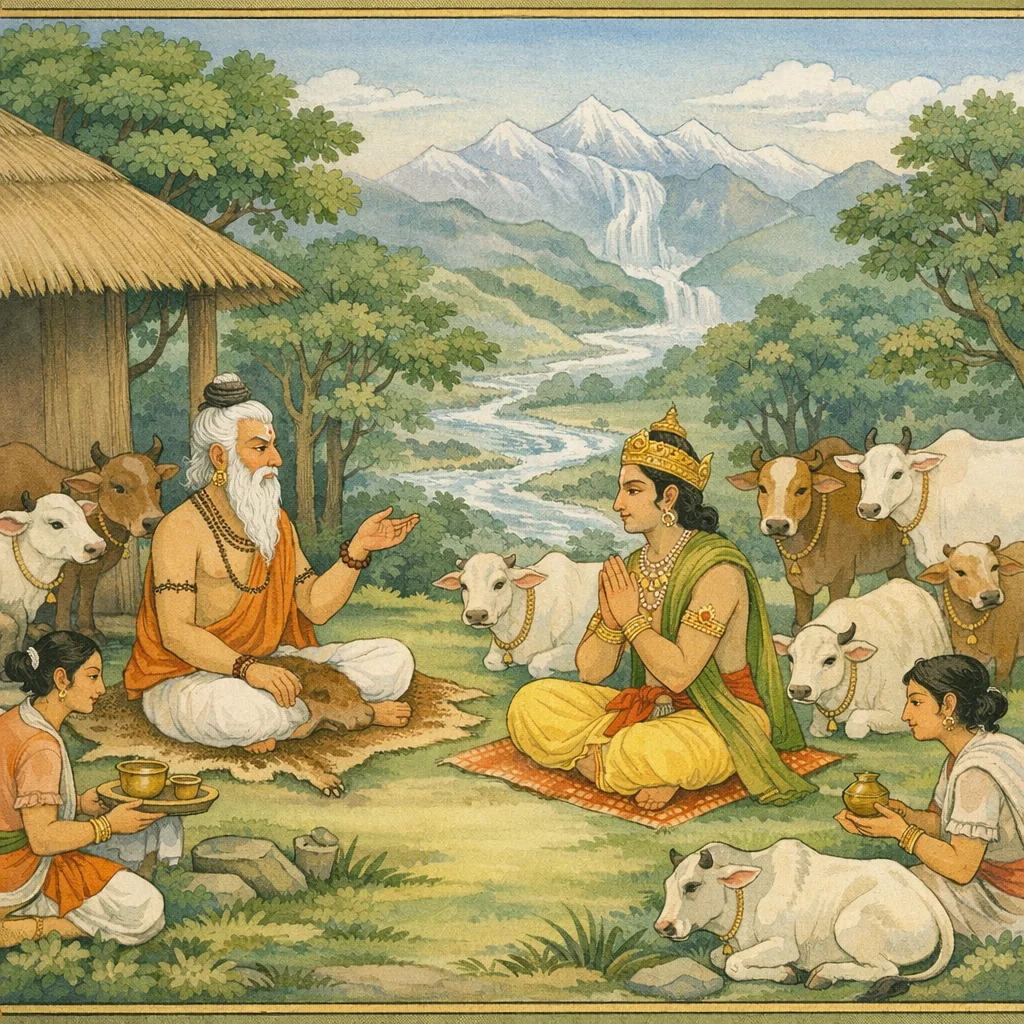
Adhyaya 83
Suvarṇa-janma and Dakṣiṇā-Māhātmya (Origin and Supremacy of Gold as Ritual Fee)
Upa-parva: Dāna-Dharma (Charity and Dakṣiṇā Instructions) — Suvarṇa-māhātmya Context
Yudhiṣṭhira, continuing a dharma-inquiry on exemplary gifts, notes prior praise of cow-gifts and land-gifts and then requests a precise account of suvarṇa: what it is, how and when it originated, its intrinsic nature, its gifting protocol, and the fruit (phala) that makes it “supreme” among dakṣiṇās. He also frames the question against the burdens of kingship and the difficulty of right conduct for rulers, implying that prescribed giving functions as a practical purificatory discipline. Bhīṣma answers by introducing a personal precedent: while performing Śaṃtanu’s śrāddha at Gaṅgādvāra with support from Jāhnavī (Gaṅgā), he witnesses an anomalous ‘hand’ as if the father were directly receiving offerings. Bhīṣma corrects his response by adhering to śāstra—placing piṇḍa offerings on kuśa/darbha rather than treating the apparition as a literal ritual recipient—after which the apparition disappears and the Pitṛs approve him in a dream, praising epistemic restraint and scriptural fidelity. They then recommend suvarṇa as a purifier offered in place of land/cows, asserting extended ancestral benefit. Bhīṣma proceeds to an older itihāsa: Paraśurāma’s grand rite and Vasiṣṭha’s doctrinal explanation that gold is identified with Agni and, by extension, with the totality of deities—thereby making gold-giving a comprehensive offering. The chapter then begins an etiological mythic sequence (Rudra-Umā context and subsequent cosmological events) to further ground suvarṇa’s sacred origin and ritual centrality.
Chapter Arc: भीष्म के उपदेश-प्रवाह में वसिष्ठ का वचन उठता है—गायें घृत-क्षीर की जननी हैं; उनके स्मरण-मात्र से गृह, मन और कर्म पवित्र हो सकते हैं। → वसिष्ठ राजन् को नित्य-आचरण का विधान बताते हैं: प्रातः-सायं आचमन कर ‘गावो ममाग्रतो…’ जैसे जप से अपने चारों ओर गो-रक्षा का कवच रचो; प्रश्न यह बनता है कि क्या दान केवल वस्तु-त्याग है या जीवन-शुद्धि का अनुशासन? → गोदान की परम-फलश्रुति उद्घोषित होती है—सहस्र गौओं का दान स्वर्ग के दिव्य लोकों तक ले जाता है; दाता अपने माता-पिता की पीढ़ियों को भी पुण्यलोक देता और कुल को पवित्र करता है; ‘धेनु-प्रमाण’ तिल-धेनु/पानीय-दान जैसे दानों से यमलोक की यातना से मुक्ति का आश्वासन मिलता है। → भीष्म वसिष्ठ-वचन को ‘वरम्’ मानकर भूमि-दान/गो-दान की श्रेष्ठता पर विचार करते हुए नियतात्मा होकर द्विजों को बहुत-सा गोधन दान करते हैं और पुण्यलोकों की प्राप्ति का निष्कर्ष स्थापित होता है।
Shlokas
Verse 1
अप-#-रा+ अशीतितमो< ध्याय: गौओं तथा गोदानकी महिमा वसिष्ठ उवाच घृतक्षीरप्रदा गावो घृतयोन्यो घृतोद्धवा: । घृतनद्यो घृतावर्तास्ता मे सनन््तु सदा गृहे,वसिष्ठजी कहते हैं--राजन्! मनुष्यको चाहिये कि सदा सबेरे और सायंकाल आचमन करके इस प्रकार जप करे--“'घी और दूध देनेवाली, घीकी उत्पत्तिका स्थान, घीको प्रकट करनेवाली, घीकी नदी तथा घीकी भवँररूप गौएँ मेरे घरमें सदा निवास करें। गौका घी मेरे हृदयमें सदा स्थित रहे। घी मेरी नाभिमें प्रतिष्ठित हो। घी मेरे सम्पूर्ण अंगोंमें व्याप्त रहे और घी मेरे मनमें स्थित हो। गौएँ मेरे आगे रहें। गौंएँ मेरे पीछे भी रहें। गौएँ मेरे चारों ओर रहें और मैं गौओंके बीचमें निवास करूँ।” इस प्रकार प्रतिदिन जप करनेवाला मनुष्य दिनभरमें जो पाप करता है, उससे छुटकारा पा जाता है
Vasiṣṭha said: “May the cows—givers of ghee and milk, the very source from which ghee arises and by which it is brought forth—like rivers of ghee with swirling eddies of ghee, dwell always in my home.”
Verse 2
घृतं मे हृदये नित्यं घृतं नाभ्यां प्रतिष्ठितम् । घृतं सर्वेषु गात्रेषु घृते मे मनसि स्थितम्,वसिष्ठजी कहते हैं--राजन्! मनुष्यको चाहिये कि सदा सबेरे और सायंकाल आचमन करके इस प्रकार जप करे--“'घी और दूध देनेवाली, घीकी उत्पत्तिका स्थान, घीको प्रकट करनेवाली, घीकी नदी तथा घीकी भवँररूप गौएँ मेरे घरमें सदा निवास करें। गौका घी मेरे हृदयमें सदा स्थित रहे। घी मेरी नाभिमें प्रतिष्ठित हो। घी मेरे सम्पूर्ण अंगोंमें व्याप्त रहे और घी मेरे मनमें स्थित हो। गौएँ मेरे आगे रहें। गौंएँ मेरे पीछे भी रहें। गौएँ मेरे चारों ओर रहें और मैं गौओंके बीचमें निवास करूँ।” इस प्रकार प्रतिदिन जप करनेवाला मनुष्य दिनभरमें जो पाप करता है, उससे छुटकारा पा जाता है
Vasiṣṭha said: “Ghee ever abides in my heart; ghee is established in my navel. Ghee pervades all my limbs, and in ghee my mind is set.”
Verse 3
गावो ममाग्रतो नित्यं गाव: पृष्ठत एव च । गावो मे सर्वतश्वैव गवां मध्ये वसाम्यहम्,वसिष्ठजी कहते हैं--राजन्! मनुष्यको चाहिये कि सदा सबेरे और सायंकाल आचमन करके इस प्रकार जप करे--“'घी और दूध देनेवाली, घीकी उत्पत्तिका स्थान, घीको प्रकट करनेवाली, घीकी नदी तथा घीकी भवँररूप गौएँ मेरे घरमें सदा निवास करें। गौका घी मेरे हृदयमें सदा स्थित रहे। घी मेरी नाभिमें प्रतिष्ठित हो। घी मेरे सम्पूर्ण अंगोंमें व्याप्त रहे और घी मेरे मनमें स्थित हो। गौएँ मेरे आगे रहें। गौंएँ मेरे पीछे भी रहें। गौएँ मेरे चारों ओर रहें और मैं गौओंके बीचमें निवास करूँ।” इस प्रकार प्रतिदिन जप करनेवाला मनुष्य दिनभरमें जो पाप करता है, उससे छुटकारा पा जाता है
Vasiṣṭha said: “O King, may cows ever be before me, and cows indeed behind me as well. May cows surround me on every side; and may I dwell in the very midst of cows.”
Verse 4
इत्याचम्य जपेत् सायं प्रातश्न॒ पुरुष: सदा । यदल्ला कुरुते पापं तस्मात् स परिमुच्यते,वसिष्ठजी कहते हैं--राजन्! मनुष्यको चाहिये कि सदा सबेरे और सायंकाल आचमन करके इस प्रकार जप करे--“'घी और दूध देनेवाली, घीकी उत्पत्तिका स्थान, घीको प्रकट करनेवाली, घीकी नदी तथा घीकी भवँररूप गौएँ मेरे घरमें सदा निवास करें। गौका घी मेरे हृदयमें सदा स्थित रहे। घी मेरी नाभिमें प्रतिष्ठित हो। घी मेरे सम्पूर्ण अंगोंमें व्याप्त रहे और घी मेरे मनमें स्थित हो। गौएँ मेरे आगे रहें। गौंएँ मेरे पीछे भी रहें। गौएँ मेरे चारों ओर रहें और मैं गौओंके बीचमें निवास करूँ।” इस प्रकार प्रतिदिन जप करनेवाला मनुष्य दिनभरमें जो पाप करता है, उससे छुटकारा पा जाता है
Vasiṣṭha said: “O King, a man should always perform ācamana and recite this formula in the morning and in the evening. Whatever sin he commits during the day, from that he is completely released.” The teaching frames daily purification and reverent recitation—especially connected with the sanctity of the cow and ghee—as a disciplined practice of atonement and moral cleansing.
Verse 5
प्रासादा यत्र सौवर्णा वसोर्धारा च यत्र सा । गन्धर्वाप्सरसो यत्र तत्र यान्ति सहसत्रदा:
Vasiṣṭha said: “Where there are golden palaces, and where that famed stream of wealth (Vasudhārā) is found—where Gandharvas and Apsarases gather—toward that place they go in their thousands.”
Verse 6
सहस्र गौओंका दान करनेवाले मनुष्य जहाँ सोनेके महल हैं, जहाँ स्वर्गगंगा बहती हैं तथा जहाँ गन्धर्व और अप्सराएँ निवास करती हैं, उस स्वर्गलोकमें जाते हैं ।। नवनीतपडु-का: क्षीरोदा दधिशैवलसंकुला: । वहन्ति यत्र वै नद्यस्तत्र यान्ति सहस्रदा:,सहस्र गौओंका दान करनेवाले पुरुष जहाँ दूधके जलसे भरी हुई, दहीके सेवारसे व्याप्त हुई तथा मक्खनरूपी कीचड़से युक्त हुई नदियाँ बहती हैं, वहीं जाते हैं
Vasiṣṭha said: Those who give away a thousand cows attain that heavenly realm where golden palaces stand, where the celestial Gaṅgā flows, and where Gandharvas and Apsarases dwell. Indeed, they go to the region where rivers run with milk for water, are thick with curds like floating algae, and have butter as their very mire—such is the reward described for the great gift of a thousand cows.
Verse 7
गवां शतसहसं्रं तु यः प्रयच्छेद् यथाविधि । परां वृद्धिमवाप्याथ स्वर्गलोके महीयते,जो विधिपूर्वक एक लाख गौओंका दान करता है, वह अत्यन्त अभ्युदयको पाकर स्वर्गलोकमें सम्मानित होता है
Vasiṣṭha said: “Whoever, following the prescribed rite, gives in charity a hundred thousand cows attains the highest prosperity and is thereafter honored in the world of heaven.”
Verse 8
दश चोभयत: पुत्रो मातापित्रो: पितामहान् । दधाति सुकृतान् लोकान् पुनाति च कुलं नर:,वह मनुष्य अपने माता और पिताकी दस-दस पीढ़ियोंको पवित्र करके उन्हें पुण्यमय लोकोंमें भेजता है और अपने कुलको भी पवित्र कर देता है
Vasiṣṭha teaches that a worthy son becomes a spiritual benefactor to his lineage: by his meritorious conduct he uplifts ten generations on both sides—those of his mother and those of his father—settling them in auspicious, merit-born realms, and he also purifies the family line itself. The ethical emphasis is on how personal dharma and virtue radiate outward, transforming not only the individual but the ancestral community connected to him.
Verse 9
धेन्वा: प्रमाणेन समप्रमाणां धेनुं तिलानामपि च प्रदाय । पानीयदाता च यमस्य लोके न यातनां काज्चिदुपैति तत्र,जो गायके बराबर तिलकी गाय बनाकर उसका दान करता है, अथवा जो जलधेनुका दान करता है, उसे यमलोकमें जाकर वहाँकी कोई यातना नहीं भोगनी पड़ती है
Vasiṣṭha said: One who donates a cow made of sesame seeds, fashioned to the same measure as a real cow, and likewise one who gives the gift of drinking-water—such a donor, upon reaching Yama’s realm, does not undergo any torment there.
Verse 10
पवित्रमग्रयं जगत: प्रतिष्ठा दिवौकसां मातरो<थाप्रमेया: । अन्वालभेद् दक्षिणतो व्रजेच्च दद्याच्च पात्रे प्रसमीक्ष्य कालम्,गौ सबसे अधिक पवित्र, जगत्का आधार और देवताओंकी माता है। उसकी महिमा अप्रमेय है। उसका सादर स्पर्श करे और उसे दाहिने रखकर चले तथा उत्तम समय देखकर उसका सुपात्र ब्राह्मणको दान करे
Vasiṣṭha said: “The cow is supremely pure, the foremost support of the world, and a mother even to the dwellers of heaven; her greatness is beyond measure. One should respectfully touch her, walk keeping her on one’s right, and—having considered the proper time—give her in donation to a worthy recipient, a deserving brāhmaṇa.”
Verse 11
धेनुं सवत्सां कपिलां भूरिश्गीं कांस्योपदोहां वसनोत्तरीयाम् । प्रदाय तां गाहति दुर्विगाह्ां याम्यां सभां वीतभयो मनुष्य:,जो बड़े-बड़े सींगोंवाली कपिला धेनुको वस्त्र ओढ़ाकर उसे बछड़े और काँसीकी दोहनीसहित ब्राह्मणको दान करता है, वह मनुष्य यमराजकी दुर्गम सभामें निर्भय होकर प्रवेश करता है
Vasiṣṭha said: A person who donates to a brāhmaṇa a tawny (kapilā) cow together with her calf—large-horned, provided with a bronze milking-vessel, and covered with cloth—enters without fear the difficult-to-enter assembly of Yama.
Verse 12
सुरूपा बहूरूपाश्च विश्वरूपाश्व मातर: । गावो मामुपतिष्ठन्तामिति नित्यं प्रकीर्तयेत्,प्रतिदिन यह प्रार्थना करनी चाहिये कि सुन्दर एवं अनेक प्रकारके रूप-रंगवाली विश्वरूपिणी गोमाताएँ सदा मेरे निकट आयें
Vasiṣṭha said: “One should daily recite this prayer: ‘May the cows—mothers of beautiful form, of many forms and colors, and of universal form—ever come near me and stand by me.’”
Verse 13
नात: पुण्यतरं दानं॑ नात: पुण्यतरं फलम् | नातो विशिष्ट लोकेषु भूतं॑ भवितुमरहति,गोदानसे बढ़कर कोई पवित्र दान नहीं है। गोदानके फलसे श्रेष्ठ दूसरा कोई फल नहीं है तथा संसारमें गौसे बढ़कर दूसरा कोई उत्कृष्ट प्राणी नहीं है
Vasiṣṭha said: “There is no gift more meritorious than the gifting of a cow; there is no fruit more meritorious than the fruit that arises from such a gift. In all the worlds, no being is fit to be regarded as more excellent than the cow.”
Verse 14
त्वचा लोम्नाथशंगैर्वा वालै: क्षीरेण मेदसा । यज्ञ वहति सम्भूय किमस्त्यभ्यधिकं ततः,त्वचा, रोम, सींग, पूँछके बाल, दूध और मेदा आदिके साथ मिलकर गौ (दूध, दही, घी आदिके द्वारा) यज्ञका निर्वाह करती है; अतः उससे श्रेष्ठ दूसरी कौन-सी वस्तु है
Vasiṣṭha said: “With her hide, hair, bones and horns, with her tail-hairs, with her milk and her fat—bringing all these together—the cow sustains the sacrificial order (yajña). What, then, could be superior to her?”
Verse 15
यया सर्वमिदं व्याप्तं जगत् स्थावरजंगमम् । तां धेनुं शिरसा वन्दे भूतभव्यस्य मातरम्,जिसने समस्त चराचर जगतको व्याप्त कर रखा है, उस भूत और भविष्यकी जननी गौको मैं मस्तक झुकाकर प्रणाम करता हूँ
Vasiṣṭha said: “I bow my head to that Cow who pervades this entire universe—both the immovable and the moving—who is the mother of what has been and what is yet to be.”
Verse 16
गुणवचनसमुच्चयैकदेशो नृवर मयैष गवां प्रकीर्तितस्ते । न च परमिह दानमस्ति गोभ्यो भवति न चापि परायणं तथान्यत्,नरश्रेष्ठ यह मैंने तुमसे गौओंके गुणवर्णनसम्बन्धी साहित्यका एक लघु अंशमात्र बताया है--दिग्दर्शनमात्र कराया है। गौओंके दानसे बढ़कर इस संसारमें दूसरा कोई दान नहीं है, तथा उनके समान दूसरा कोई आश्रय भी नहीं है
Vasiṣṭha said: “O best of kings, I have recounted to you only a small portion of the collected praises of cows—merely an indication of their virtues. In this world there is no gift higher than the gift of cows, and there is likewise no other refuge comparable to them.”
Verse 17
भीष्म उवाच वरमिदमिति भूमिदो विचिन्त्य प्रवरमृषेर्वचनं ततो महात्मा । व्यसृजत नियतात्मवान् द्विजेभ्य: सुबहु च गोधनमाप्तवांश्व लोकान्,भीष्मजी कहते हैं--महर्षि वसिष्ठके ये वचन सुनकर भूमिदान करनेवाले संयतात्मा महामना राजा सौदासने “यह बहुत उत्तम पुण्यकार्य है” ऐसा सोचकर ब्राह्मणोंको बहुत-सी गौएँ दान दी। इससे उन्हें उत्तम लोकोंकी प्राप्ति हुई
Bhishma said: Reflecting, “This indeed is an excellent act,” the great-souled giver of land, having considered the eminent words of the sage, and being self-restrained, bestowed abundant wealth in the form of cattle upon the Brahmins. By that meritorious gift he attained auspicious (higher) worlds.
Verse 79
इस प्रकार श्रीमह्या भारत अनुशासनपर्वके अन्तर्गत दानधर्मपर्वमें गोदानविषयक उन्यासीवाँ अध्याय पूरा हुआ
Thus ends the eighty-ninth chapter on the gift of cows, within the section on the dharma of giving in the Anuśāsana Parva of the great Mahābhārata.
Verse 80
इति श्रीमहा भारते अनुशासनपर्वणि दानधर्मपर्वणि गोप्रदानिके अशीतितमो<ध्याय:
Thus ends the eightieth chapter, entitled “The Section on the Gift of Cows,” within the Donation-and-Dharma portion of the Anuśāsana Parva of the sacred Mahābhārata. This closing formula frames the teaching as a completed unit of instruction on righteous giving—especially the ethically charged merit of donating cows as an act of dharma.
Frequently Asked Questions
Bhīṣma confronts a conflict between an extraordinary appearance (as if the father’s hand receives the offering) and the prescribed śāstric method; he chooses procedural correctness over literalizing the apparition.
Dharma is maintained through disciplined adherence to validated norms (śāstra-pramāṇa) and reflective judgment; ritual efficacy is tied to correct method, not to sensational or emotionally compelling signs.
Yes in functional form: the Pitṛs state that those who give suvarṇa “carry across” (benefit) multiple generations (ten prior and ten subsequent), presenting an explicit ancestral fruit that motivates gold-giving as a purifier.