Adhyaya 59
Adhyāya 59: On Giving to the Asker and Supporting the Non-asking (याचक-अयाचक-दाने धर्मः)
Upa-parva: Dāna-Dharma (Instruction on Giving) — discourse segment within Anuśāsana Parva
Yudhiṣṭhira asks Bhīṣma to distinguish the superior recipient when two persons are comparable in conduct, learning, and birth—one requests aid and the other does not. Bhīṣma replies that giving to one who asks is praised because it addresses immediate need, yet he identifies the truly most worthy as the person endowed with dhṛti (self-restraint), contrasted with the distressed and unsteady petitioner. He explains that solicitation is associated with powerlessness and can cause social unease, whereas the act of giving revives both recipient and giver in ethical terms. Bhīṣma then elevates compassion (ānṛśaṃsya) as a paramount dharma: one should invite and support those who are silently suffering and do not ask. He advises the king to recognize learned brāhmaṇas living discreetly—likened to fires covered in ash—whose tapas and knowledge command reverence. The chapter outlines practical patronage: hospitality, dwellings, attendants, gifts (cows, gold, garments), and respectful invitations. It reframes daily giving as an extended “yajña,” culminating in virtues—ahiṃsā, sharing, self-control, renunciation, fortitude, truth—as the effective completion (avabhṛtha) of that ongoing sacrifice.
Chapter Arc: भीष्म युधिष्ठिर को भृगुवंशी ब्राह्मणों और कुशिकवंशी क्षत्रियों के बीच अद्भुत, भाग्य-प्रेरित सम्बन्ध का कारण सुनाने का संकल्प करते हैं—एक ऐसा सम्बन्ध जो आगे चलकर वंश-धर्म और वर्ण-धर्म की सीमाएँ हिला देगा। → च्यवन/भृगुवंशी परम्परा और कुशिकवंश के बीच यज्ञ-सेवा, अधिकार और प्रतिशोध की छाया उभरती है: भविष्यवाणी होती है कि दैव-युक्त कारण से भेद पड़ेगा, और क्षत्रिय भृगुओं का संहार करेंगे—यहाँ तक कि गर्भस्थ शिशुओं तक पर दैवदण्ड का दबाव होगा। → और्व मुनि द्वारा प्रतिशोधाग्नि/विनाश-शक्ति को रोककर उसे समुद्र के वडवामुख में प्रविष्ट कराना—वंश-विनाश की ज्वाला को विश्व-विनाश बनने से पहले ही धर्म-नियंत्रण में बाँध देना। → भीष्म कुशिकों और भृगुओं के सम्बन्ध-कारण को समग्र रूप से बाँधते हैं: ऋचीक मुनि का गाधि की पुत्री/पौत्री से सम्बन्ध, क्षत्रधर्म-युक्त ब्राह्मण पुत्र की उत्पत्ति, और आगे की पीढ़ियों में ब्राह्मणत्व/सम्बन्ध का स्थापन—जिससे दोनों वंशों का ऐतिहासिक-सांस्कृतिक गठजोड़ स्पष्ट होता है। → यह सम्बन्ध आगे चलकर वंश-परिवर्तन, तेजस्वी संतति और धर्म-संकटों को जन्म देगा—और श्रोता के मन में प्रश्न छोड़ता है कि ‘वंश’ और ‘धर्म’ का अंतिम निर्णायक कौन: जन्म, कर्म, या दैव?
Shlokas
Verse 1
ऑपनआ प्रात बछ। अं क्ााज षट्पज्चाशत्तमो< ध्याय: च्यवन ऋषिका भृगुवंशी और कुशिकवंशियोंके सम्बन्धका कारण बताकर तीर्थयात्राके लिये प्रस्थान व्यववन उवाच अवश्यं कथनीयं मे तवैतन्नरपुंगव । यदर्थ त्वाहमुच्छेत्तुं सम्प्राप्तो मनुजाधिप,च्यवन कहते हैं--नरपुंगव! मनुजेश्वर! मैं जिस उददेश्यसे तुम्हारा मूलोच्छेद करनेके लिये यहाँ आया था, वह मुझे तुमसे अवश्य बता देना चाहिये
Vyavāna said: “O best of men, O lord among men, I must certainly tell you this: the purpose for which I have come here—to uproot you—should indeed be declared to you.”
Verse 2
भृगूणां क्षत्रिया याज्या नित्यमेतज्जनाधिप । ते च भेदं गमिष्यन्ति दैवयुक्तेन हेतुना
O lord of men, the Kṣatriyas are ever to be served in sacrifice by the Bhṛgus—this is the established rule. Yet even they will come to rupture and division, driven by a cause bound up with destiny.
Verse 3
क्षत्रियाश्व भूगून् सर्वान् वधिष्यन्ति नराधिप । आ गर्भादनुकृन्तन्तो दैवदण्डनिपीडिता:
Vyavavana said: “O king, the Kṣatriyas will slay all the Bhṛgus. Driven by the pressure of divine retribution, they will cut them down relentlessly—even from the womb.”
Verse 4
जनेश्वर! क्षत्रियलोग सदासे ही भृगुवंशी ब्राह्मणोंके यजमान हैं; किंतु प्रारब्धवश आगे चलकर उनमें फूट हो जायगी। इसलिये वे दैवकी प्रेरणासे समस्त भृगुवंशियोंका संहार कर डालेंगे। नरेश्वर! वे दैवदण्डसे पीड़ित हो गर्भके बच्चेतकको काट डालेंगे ।। तत उत्पत्स्यतेडस्माकं कुले गोत्रविवर्धन: । ऊर्वो नाम महातेजा ज्वलनार्कसमद्युति:,तदनन्तर मेरे वंशमें ऊर्व नामक एक महातेजस्वी बालक उत्पन्न होगा, जो भार्गव गोत्रकी वृद्धि करेगा। उसका तेज अग्नि और सूर्यके समान दुर्धर्ष होगा
O lord of men, the Kṣatriyas are indeed the customary yajamānas—the sponsors of sacrifice—for the Brahmins of the Bhṛgu line; yet, by the force of destiny, a schism will arise between them in time. Therefore, driven by divine impulse, they will slaughter the Bhṛgus. O king, afflicted by the rod of fate, they will even cut down children in the womb. Then, in our lineage, there will be born a mighty child named Ūrva, an increaser of the Bhārgava gotra, whose radiance will be irresistible—like fire and the sun.
Verse 5
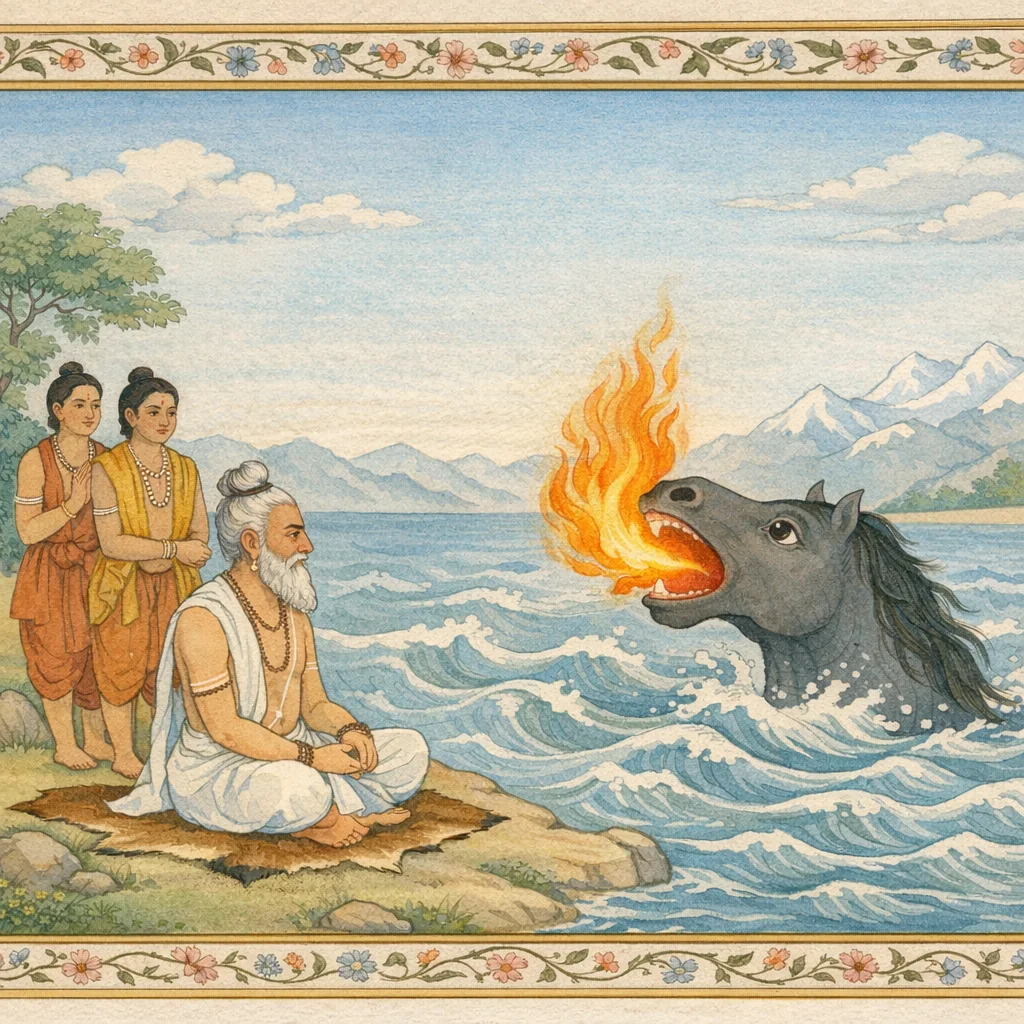
स त्रैलोक्यविनाशाय कोपारग्नि जनयिष्यति । महीं सपर्वतवनां यः करिष्यति भस्मसात्,वह तीनों लोकोंका विनाश करनेके लिये क्रोधजनित अग्निकी सृष्टि करेगा। वह अग्नि पर्वतों और वनोंसहित सारी पृथ्वीको भस्म कर डालेगी
He will, for the destruction of the three worlds, bring forth a fire born of wrath. That fire will reduce to ashes the entire earth—together with its mountains and forests.
Verse 6
कंचित् काल तु वलह्लि च स एव शमयिष्यति । समुद्रे वडवावक्त्रे प्रक्षिप्प मुनिसत्तम:,कुछ कालके बाद मुनिश्रेष्ठ और्व ही उस अग्निको समुद्रमें स्थित हुई बड़वानलमें डालकर बुझा देंगे
After some time, that very sage—foremost among ascetics—will himself bring that fire to rest by casting it into the mare-faced submarine fire (Vaḍavānala) in the ocean.
Verse 7
पुत्रं तस्थ महाराज ऋचीकं भृगुनन्दनम् । साक्षात् कृत्स्नो धरनुर्वेद: समुपस्थास्यतेडनघ,निष्पाप महाराज! उन्हीं और्वके पुत्र भूगुकुलनन्दन ऋचीक होंगे, जिनकी सेवामें सम्पूर्ण धरनुर्वेद मूर्तिमानू होकर उपस्थित होगा
O King, there will be a son—Ṛcīka, the delight of the Bhṛgu lineage. To that blameless one, the entire science of archery will present itself in embodied form, as if standing before him in service—signifying mastery gained through innate merit and disciplined conduct rather than mere instruction.
Verse 8
क्षत्रियाणामभावाय दैवयुक्तेन हेतुना । सतुतंप्रतिगृहौव पुत्रे संक्रामयिष्यति,वे क्षत्रियोंका संहार करनेके लिये दैववश उस थधरनुर्वेदको ग्रहण करके तपस्यासे शुद्ध अन्तःकरणवाले अपने पुत्र महाभाग जमदग्निको उसकी शिक्षा देंगे। भृगुश्रेष्ठ जमदग्नि उस धनुर्वेदको धारण करेंगे
Vyavavana said: “For the extinction of the Kṣatriyas, by a cause joined with destiny, he will accept that science of archery and transmit it to his son. With an inner being purified by austerity, he will, under the compulsion of fate, teach that Dhanurveda to his illustrious son Jamadagni. Jamadagni, the foremost of the Bhṛgus, will then bear and preserve that knowledge.”
Verse 9
जमदग्नौ महाभागे तपसा भावितात्मनि । स चापि भृगुशार्दूलस्तं वेदं धारयिष्यति,वे क्षत्रियोंका संहार करनेके लिये दैववश उस थधरनुर्वेदको ग्रहण करके तपस्यासे शुद्ध अन्तःकरणवाले अपने पुत्र महाभाग जमदग्निको उसकी शिक्षा देंगे। भृगुश्रेष्ठ जमदग्नि उस धनुर्वेदको धारण करेंगे
Vyāsa said: “To the illustrious Jamadagni—whose inner self has been refined by austerity—this sacred science (of the bow) will be entrusted; and that tiger among the Bhṛgus will preserve and uphold that Veda. Thus, by the force of destiny, the knowledge of arms is transmitted for the impending destruction of the kṣatriyas, even as it is placed in the hands of one purified by tapas.”
Verse 10
कुलात् तु तव धर्मात्मन् कन्यां सोडथिगमिष्यति । उद्धावनार्थ भवतो वंशस्य नृपसत्तम,धर्मात्मन्! नृपश्रेष्ठी वे ऋचीक तुम्हारे कुलकी उन्नतिके लिये तुम्हारे वंशकी कन्याका पाणिग्रहण करेंगे
“O righteous one, from your lineage a maiden will be obtained in marriage. O best of kings, it is for the uplift and advancement of your family line that (the sage) Ṛcīka will take a bride from your house.”
Verse 11
गाधे्दुहितरं प्राप्य पौत्रीं तव महातपा: । ब्राह्माणं क्षत्रधर्माणं पुत्रमुत्पादयिष्यति,तुम्हारी पौत्री एवं गाधिकी पुत्रीकों पाकर महातपस्वी ऋचीक क्षत्रियधर्मवाले ब्राह्मणजातीय पुत्रको उत्पन्न करेंगे (अपनी पत्नीकी प्रार्थनासे ऋचीक क्षत्रियत्वको अपने पुत्रसे हटाकर भावी पौत्रमें स्थापित कर देंगे)
Having obtained Gādhi’s daughter—who is also your granddaughter—the great ascetic Ṛcīka will beget a son who is a Brahmin by birth yet possesses the conduct and spirit of a Kṣatriya. The passage points to the ethical tension between birth (jāti/varṇa) and disposition (dharma/saṁskāra), foreshadowing how a requested transfer of ‘kṣatriya-nature’ will affect the lineage across generations.
Verse 12
क्षत्रियं विप्रकर्माणं बृहस्पतिमिवौजसा । विश्वामित्रं तव कुले गाधे: पुत्र सुधार्मिकम्
In your lineage was born Viśvāmitra—Gādhi’s son—righteous in conduct: a Kṣatriya by birth, yet performing the works of a Brāhmaṇa, and in spiritual power resembling Bṛhaspati himself.
Verse 13
स्त्रियां तु कारणं तत्र परिवर्ते भविष्यत:
But in that reversal of circumstances, the woman will be the decisive cause—she will become the determining factor behind the change of course.
Verse 14
पितामहनियोगाद् वै नान्यथैतद् भविष्यति । ब्रह्माजीकी प्रेरणासे गाधिकी पत्नी और पुत्री--ये स्त्रियाँ इस महान् परिवर्तनमें कारण बनेंगी, यह अवश्यम्भावी है। इसे कोई पलट नहीं सकता ।। १३ $ || तृतीये पुरुषे तुभ्यं ब्राह्मणत्वमुपैष्यति
By the ordinance of the Grandsire, it cannot turn out otherwise. Moved by Brahmā’s prompting, Gādhikā’s wife and daughter—these women—will become the instruments of this great reversal; it is inevitable, and no one can undo it. In the third generation, you will attain the status of a brāhmaṇa.
Verse 15
भीष्म उवाच कुशिकस्तु मुनेर्वाक्यं च्यवनस्य महात्मन:
Bhīṣma said: Kuśika, however, accepted and acted upon the words of the sage Cyavana, that great-souled ascetic.
Verse 16
श्रुत्वा हृष्टो> भवद् राजा वाक्यं चेदमुवाच ह । एवमस्त्विति धर्मात्मा तदा भरतसत्तम
Hearing this, the king became delighted and then spoke these words: “So be it.” Thus did that righteous-souled, best of the Bharatas respond at that time, affirming the counsel in a spirit of dharma.
Verse 17
भीष्मजी कहते हैं--भरतश्रेष्ठ! महात्मा च्यवन मुनिका यह वचन सुनकर धर्मात्मा राजा कुशिक बड़े प्रसन्न हुए और बोले, 'भगवन्! ऐसा ही हो” ।। च्यवनस्तु महातेजा: पुनरेव नराधिपम् । वरार्थ चोदयामास तमुवाच स पार्थिव:,महातेजस्वी च्यवनने पुनः राजा कुशिकको वर माँगनेके लिये प्रेरित किया। तब वे भूपाल इस प्रकार बोले--
Bhishma said: “O best of the Bharatas! Hearing these words of the great sage Cyavana, the righteous King Kuśika was filled with joy and replied, ‘Revered sir, let it be exactly so.’ Then the radiant Cyavana again urged the lord of men to ask for a boon; and the king spoke to him as follows.”
Verse 18
बाढमेवं करिष्यामि काम त्वत्तो महामुने । ब्रह्मभूतं कुलं मे5स्तु धर्मे चास्य मनो भवेत्,“महामुने! बहुत अच्छा, मैं आपसे अपना मनोरथ प्रकट करूँगा। मुझे यही वर दीजिये कि मेरा कुल ब्राह्मण हो जाय और उसका धर्ममें मन लगा रहे”
“So be it; I shall do exactly so. Yet, O great sage, I ask one boon from you: may my lineage become truly Brahmin-like in character, and may its mind remain devoted to dharma.”
Verse 19
एवमुक्तस्तथेत्येवं प्रत्युकत्वा च्यवनो मुनि: । अभ्यनुज्ञाय नृपतिं तीर्थयात्रां ययौ तदा,कुशिकके ऐसा कहनेपर च्यवन मुनि बोले “तथास्तु”। फिर वे राजासे विदा ले वहाँसे तत्काल तीर्थयात्राके लिये चले गये
Thus addressed, the sage Cyavana replied, “So be it.” Having taken leave of the king, he then set out at once on a pilgrimage to the sacred fords (tīrthas).
Verse 20
एतत् ते कथितं सर्वमशेषेण मया नृप । भृगूणां कुशिकानां च अभिसम्बन्धकारणम्,नरेश्वर! इस प्रकार मैंने तुमसे भूगुवंशी और कुशिकवंशियोंके परस्पर सम्बन्धका सब कारण पूर्णरूपसे बताया है
Bhishma said: O king, I have now told you, without omission, the entire account of the cause behind the mutual connection between the Bhṛgu lineage and the Kuśika lineage. Thus, O lord of men, the reason for their interrelationship has been fully explained to you.
Verse 21
यथोक्तमृषिणा चापि तदा तदभवन्नूप । जन्म रामस्य च मुनेर्विश्वामित्रस्य चैव हि,युधिष्ठिर!| उस समय च्यवन ऋषिने जैसा कहा था, उसके अनुसार ही आगे चलकर भगुकुलमें परशुरामका और कुशिकवंशमें विश्वामित्रका जन्म हुआ
Bhishma said: “O king Yudhiṣṭhira, just as the sage had foretold, so it came to pass in due course: Rāma (Paraśurāma) was born in the Bhṛgu lineage, and the sage Viśvāmitra was born in the Kuśika line. Thus the word of a seer proves true, and the order of dharma unfolds through destined births.”
Verse 55
इस प्रकार श्रीमह्याभारत अनुशासनपर्वके अन्तर्गत दानधर्मपर्वमें च्यवन और कुशिकका संवादविषयक पचपनवाँ अध्याय पूरा हुआ
Thus ends the fifty-fifth chapter of the Dāna-dharma section within the Anuśāsana Parva of the Śrī Mahābhārata, concerning the dialogue between Cyavana and Kuśika.
Verse 56
इति श्रीमहाभारते अनुशासनपर्वणि दानधर्मपर्वणि च्यवनकुशिकसंवादे षट्पज्चाशत्तमो<ध्याय:
Thus, in the Śrī Mahābhārata, within the Anuśāsana Parva—specifically in the Dāna-dharma section—ends the dialogue between Cyavana and Kuśika: the fifty-sixth chapter.
Verse 126
तपसा महता युक्त प्रदास्यति महाद्युते । महान् तेजस्वी नरेश! वे ऋचीक मुनि तुम्हारे कुलमें राजा गाधिको एक महान् तपस्वी और परम धार्मिक पुत्र प्रदान करेंगे, जिसका नाम होगा विश्वामित्र। वह बृहस्पतिके समान तेजस्वी तथा ब्राह्मणोचित कर्म करनेवाला क्षत्रिय होगा
O king of great splendor! Endowed with mighty austerity (tapas), the sage Ṛcīka will grant to King Gādhi in your line a son—a great ascetic and supremely righteous—whose name will be Viśvāmitra. He will shine like Bṛhaspati, and though a kṣatriya, he will perform deeds befitting a brāhmaṇa.
Verse 146
भविता त्वं च सम्बन्धी भूगूणां भावितात्मनाम् | तुमसे तीसरी पीढ़ीमें तुम्हें ब्राह्मणत्व प्राप्त हो जायगा और तुम शुद्ध अन्तः:करणवाले भगुवंशियोंके सम्बन्धी होओगे
You will indeed become a kinsman of the Bhṛgus—those of purified and disciplined inner nature. In due course (even across generations), you will attain the standing of a brāhmaṇa, and your lineage will be joined in relationship with that stainless Bhṛgu line.
Frequently Asked Questions
How to rank charitable giving when two recipients are equally qualified, but one asks for aid and the other remains silent—balancing urgency of need against the virtue of self-restraint.
Give with compassion and foresight: relieve the petitioner’s distress, but actively seek out restrained, discreetly suffering recipients and support them respectfully without requiring solicitation.
Yes in functional form: Bhīṣma frames sustained giving with śraddhā as a superior, ongoing “vitata yajña,” whose completion is expressed through virtues (ahiṃsā, sharing, self-control, renunciation, fortitude, truth), implying enduring ethical fruit rather than a single ritual payoff.