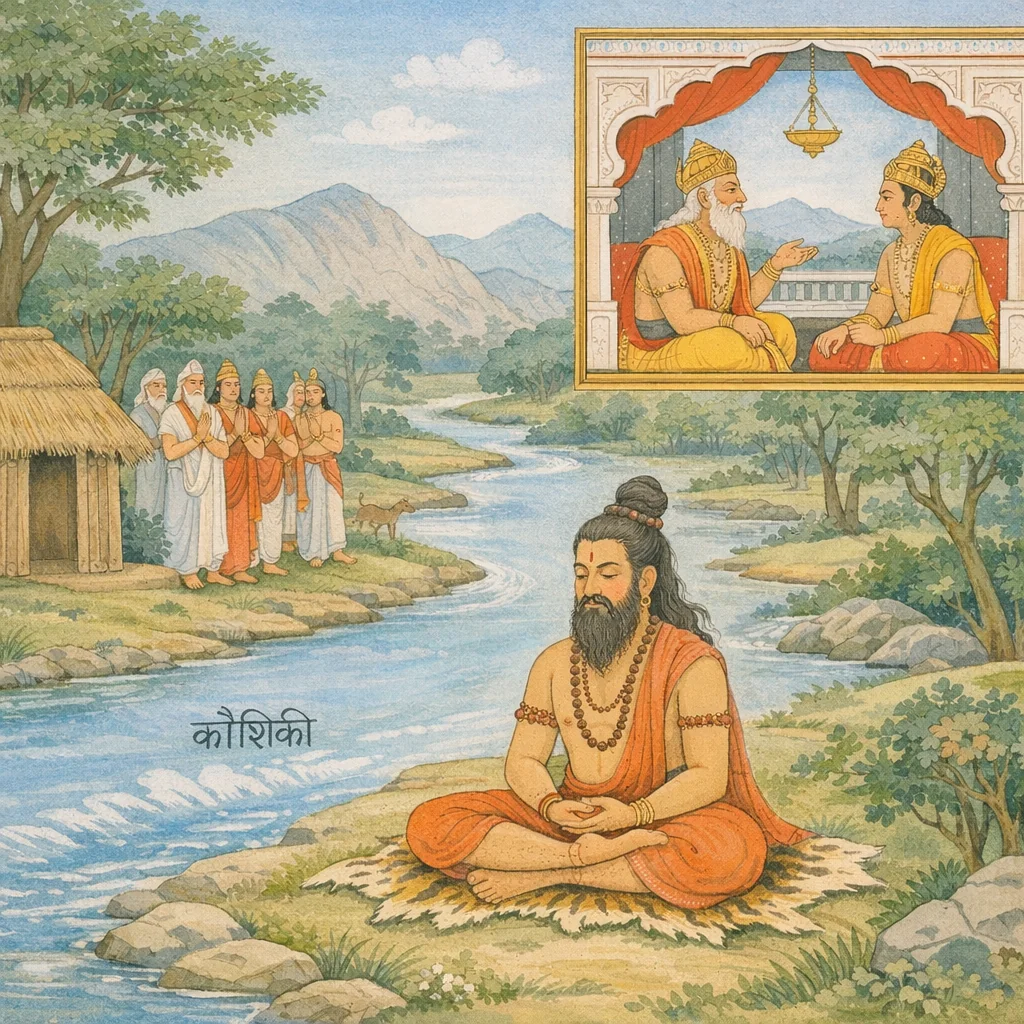
Adhyaya 3
युधिष्ठिरप्रश्नः—विश्वामित्रस्य ब्राह्मणत्वकौतूहलम् | Yudhiṣṭhira’s Inquiry on Viśvāmitra’s Attainment of Brāhmaṇya
Upa-parva: Viśvāmitra–Brāhmaṇatva (Transformation and the Question of Brāhmaṇya)
This adhyāya is structured as Yudhiṣṭhira’s interrogative brief to Bhīṣma. He frames brāhmaṇya as ‘difficult to obtain’ and asks how the kṣatriya Viśvāmitra attained it without bodily change (dehāntara). To motivate the question, Yudhiṣṭhira enumerates a dossier of Viśvāmitra-associated deeds and linked traditions: the destructive potency of tapas against Vasiṣṭha’s lineage; the projection/creation of fierce beings under anger; the establishment and renown of the Kuśika line; Śunaḥśepa’s release from sacrificial animal-status and subsequent affiliation as a son; the cursing of many sons to become outcaste groups for failing to honor Devarāta; Triśaṅku’s extraordinary ascent oriented to the southern direction; the sanctification of the Kauśikī river; the interruption of austerity by Rambhā and her transformation; Vasiṣṭha’s attempted drowning and the river Vipāśā becoming famed; and a release from a curse through praise (stuti) addressed to a divine leader. The chapter ends by sharpening the doctrinal request: explain the ‘tattva’ (principle) behind such transformations, and reconcile this with the case of Mataṅga, who is said not to obtain brāhmaṇya despite aspiration. The adhyāya thus functions as a curated set of narrative indices preparing for Bhīṣma’s explanatory response on dharma, tapas, and status.
Chapter Arc: कौरव-सभा में एक विस्मय जागता है—क्षत्रिय विश्वामित्र के ऐसे-ऐसे तपोबल-जनित कर्म कैसे हुए कि देव, ऋषि और नदियाँ तक उनके नाम से पवित्र हो उठीं; और क्या सचमुच बिना देह-परिवर्तन के ब्राह्मणत्व प्राप्त हो सकता है? → वर्णन विश्वामित्र के अद्भुत पराक्रम और तपस्या की ओर बढ़ता है—वसिष्ठ के पुत्रशत का तपोबल से विनाश, कौशिकी जैसी देवर्षि-सेवित नदी का पावन होना, विपाशा का कर्म-प्रसिद्ध होना; साथ ही एक चेतावनी भी उभरती है कि ये चरित्र असाधारण हैं, सामान्य जन को इनका अनुकरण नहीं करना चाहिए। → प्रश्न तीक्ष्ण हो उठता है—‘देहान्तरमनासाद्य कथं स ब्राह्मणोऽभवत्?’ विश्वामित्र के ब्राह्मणत्व-प्राप्ति का रहस्य और मतंग के प्रसंग का विरोधाभास (मतंग को ब्राह्मणत्व न मिलना, चाण्डाल-योनि में जन्म) एक ही बिंदु पर टकराते हैं: क्या ब्राह्मणत्व जन्म है या तप/धर्म का फल? → वक्ता संकेत देता है कि मतंग का ब्राह्मणत्व न पाना ‘स्थाने’ (उचित) था—अर्थात केवल तप नहीं, अपितु आचरण, संस्कार, और धर्म-निष्ठा की सूक्ष्म शर्तें निर्णायक हैं; विश्वामित्र के कर्मों की महत्ता स्वीकारते हुए भी उनके अनुकरण से सावधान किया जाता है। → मतंग के तप और उसके ‘यथातत्त्व’ कारणों का पूर्ण उद्घाटन अभी शेष है—किस नियम से किसी को ब्राह्मणत्व मिलता है और किसी को नहीं?
Shlokas
Verse 1
35१७" श्जु अीस-न्#सस - इस अध्यायमें वर्णित चरित्र असाधारण शक्तिसम्पन्न पुरुषोंके हैं। आजकलके साधारण मनुष्योंको इसके उस अंशका अनुकरण नहीं करना चाहिये जिसमें स्त्रीके लिये अपने शरीर-प्रदानकी बात कही गयी है। अतिथिको अन्न, जल, बैठनेके लिये आसन, रहनेके लिये स्थान, सोनेके लिये बिस्तर और वस्त्र आदि वस्तुएँ अपनी शक्तिके अनुसार समर्पित करनी चाहिये। मीठे वचनोंद्वारा उसका आदर-सत्कार भी करना चाहिये। इतना ही इस अध्यायका तात्पर्य है। तृतीयो<थध्याय: विश्वामित्रको ब्राह्मणत्वकी प्राप्ति कैसे हुई--इस विषयमें युधिष्ठिरका प्रश्न युधिछिर उवाच ब्राह्माण्यं यदि दुष्प्राप्यं त्रिभिर्वर्ण्नराधिप । कथें प्राप्तं महाराज क्षत्रियेण महात्मना,युधिष्ठिरने पूछा--महाराज! नरेश्वर! यदि अन्य तीन वर्णोके लिये ब्राह्मणत्व प्राप्त करना अत्यन्त कठिन है तो क्षत्रियकुलमें उत्पन्न महात्मा विश्वामित्रने कैसे ब्राह्मणत्व प्राप्त कर लिया? धर्मात्मन्! नरश्रेष्ठ पितामह! इस बातको मैं यथार्थरूपसे सुनना चाहता हूँ, आप मुझे बताइये
Yudhiṣṭhira said: “O lord of kings, O great king—if the attainment of Brahminhood is exceedingly difficult for the other three social orders, how did the great-souled Viśvāmitra, though born a Kṣatriya, come to obtain Brahminhood? I wish to hear the truth of this; please tell me.”
Verse 2
इस प्रकार श्रीमह्याभारत अनुशासनपर्वके अन्तर्गत दानधर्मपर्वमें सुदर्शनका उपाख्यानविषयक दूसरा अध्याय पूरा हुआ,विश्वामित्रेण धर्मात्मन् ब्राह्मणत्वं नरर्षभ | श्रोतुमिच्छामि तत्त्वेन तन्मे ब्रूहि पितामह युधिष्ठिरने पूछा--महाराज! नरेश्वर! यदि अन्य तीन वर्णोके लिये ब्राह्मणत्व प्राप्त करना अत्यन्त कठिन है तो क्षत्रियकुलमें उत्पन्न महात्मा विश्वामित्रने कैसे ब्राह्मणत्व प्राप्त कर लिया? धर्मात्मन्! नरश्रेष्ठ पितामह! इस बातको मैं यथार्थरूपसे सुनना चाहता हूँ, आप मुझे बताइये
Yudhiṣṭhira asks: “O righteous grandsire, O bull among men—how did the great Viśvāmitra, though born in a Kṣatriya lineage, attain true Brahminhood, when such attainment is exceedingly difficult for the other three social orders? I wish to hear the reality of it; please tell me, Grandfather.”
Verse 3
तेन हामितवीर्येण वसिष्ठस्य महात्मन: । हतं॑ पुत्रशतं सद्यस्तपसापि पितामह,पितामह! अमित पराक्रमी विश्वामित्रने अपनी तपस्याके प्रभावसे महात्मा वसिष्ठके सौ पुत्रोंको तत्काल नष्ट कर दिया था इति श्रीमहाभारते अनुशासनपर्वणि दानधर्मपर्वणि विश्वामित्रोपाख्याने तृतीयो5ध्याय:
O Grandsire! By the power of that man of immeasurable prowess—Viśvāmitra—through the force of his austerities (tapas), the hundred sons of the great-souled Vasiṣṭha were destroyed at once. The passage underscores how tapas, when driven by rivalry and anger, can become a fearsome instrument of harm rather than a means of self-mastery and dharma.
Verse 4
यातुधानाश्व बहवो राक्षसास्तिग्मतेजस: । मन्युना5<विष्टदेहेन सृष्टा: कालान्तकोपमा:,उन्होंने क्रोधके आवेशमें आकर बहुत-से प्रचण्ड तेजस्वी यातुधान एवं राक्षस रच डाले थे जो काल और यमराजके समान भयानक थे
Yudhiṣṭhira said: “In a surge of wrath, he brought forth many fierce, blazing yātudhānas and rākṣasas—beings whose terror resembled Kāla (Time/Death) and Antaka (the Ender, i.e., Death).”
Verse 5
महान् कुशिकवंशकश्र ब्रह्मर्षिशतसंकुल: । स्थापितो नरलोके<स्मिन् विद्वद्ब्राह्मणसंस्तुत:
He is a great one, descended from the Kuśika line, and surrounded by hundreds of brahmarṣis. Established here in the world of men, he is praised by learned brāhmaṇas.
Verse 6
इतना ही नहीं, इस मनुष्य-लोकमें उन्होंने उस महान् कुशिक-वंशको स्थापित किया जो अब सैकड़ों ब्रह्मर्षियोंसे व्याप्त और दिद्वान ब्राह्मणोंसे प्रशंसित है ।। ऋचीकस्यात्मजश्नैव शुन:शेपो महातपा: । विमोक्षितो महासत्रात् पशुतामप्युपागत:,ऋचीक (अजीगर्त) का महातपस्वी पुत्र शुनःशेप एक यज्ञमें यज्ञ-पशु बनाकर लाया गया था; किंतु विश्वामित्रजीने उस महायज्ञसे उसको छुटकारा दिला दिया
Yudhiṣṭhira said: “And Śunaḥśepa, R̥cīka’s son, the great ascetic—though he had even been brought to the great sacrificial session as a victim—was released from that mighty rite.” The passage recalls how a human being, reduced to the status of a sacrificial animal, is restored to dignity through the intervention of a righteous sage, highlighting compassion and the protection of life as higher ethical imperatives than ritual completion.
Verse 7
हरिश्रन्द्रक्रतौ देवांस्तोषयित्वा55त्मतेजसा । पुत्रतामनुसम्प्राप्तो विश्वामित्रस्य धीमत:,हरिश्वन्द्रके उस यज्ञमें अपने तेजसे देवताओंको संतुष्ट करके विश्वामित्रने शुन:शेपको छुड़ाया था; इसलिये वह बुद्धिमान विश्वामित्रके पुत्रभावको प्राप्त हो गया
In Hariścandra’s sacrifice, Viśvāmitra, by the radiance of his own power, satisfied the gods and set Śunaḥśepa free. Therefore Śunaḥśepa attained the status of son to the wise Viśvāmitra.
Verse 8
नाभिवादयते ज्येष्ठं देवरातं नराधिप । पुत्रा: पज्चाशदेवापि शप्ता: श्वपचतां गता:,नरेश्वर! शुनः:शेप देवताओंके देनेसे देवरात नामसे प्रसिद्ध हो विश्वामित्रका ज्येष्ठ पुत्र हुआ। उसके छोटे भाई--विश्वामित्रके अन्य पचास पुत्र उसे बड़ा मानकर प्रणाम नहीं करते थे; इसलिये विश्वामित्रके शापसे वे सब-के-सब चाण्डाल हो गये
Yudhiṣṭhira said: “O king, they did not bow to Devarāta, the eldest. Therefore even those fifty sons, having been cursed, fell into the condition of śvapacas (outcastes).” The passage underscores the ethical weight placed on honoring elders and rightful precedence within the family; refusal of due respect is portrayed as a breach of dharma with grave social and spiritual consequences.
Verse 9
त्रिशड्कुर्बन्धुभिमक्त ऐक्ष्वाक: प्रीतिपूर्वकम् । अवाक्शिरा दिवं नीतो दक्षिणामाश्रितो दिशम्,जिस इक्ष्वाकुवंशी त्रिशंकुको भाई-बन्धुओंने त्याग दिया था और जब वह स्वर्गसे भ्रष्ट होकर दक्षिण दिशामें नीचे सिर किये लटक रहा था, तब विश्वामित्रजीने ही उसे प्रेमपूर्वक स्वर्गलोकमें पहुँचाया था
Yudhiṣṭhira said: “Triśaṅku, the Ikṣvāku prince, was cast off by his own kinsmen. When he had fallen from heaven and was hanging head-down, suspended toward the southern quarter, it was Viśvāmitra alone who, out of affectionate resolve, restored him and conveyed him again to the heavenly world.”
Verse 10
विश्वामित्रस्यथ विपुला नदी देवर्षिसेविता । कौशिकी च शिवा पुण्या ब्रद्मर्षिसुरसेविता,देवर्षियों, ब्रह्मर्षियों और देवताओंसे सेवित, पवित्र, मंगलकारिणी एवं विशाल कौशिकी नदी विश्वामित्रके ही प्रभावसे प्रकट हुई है
Yudhiṣṭhira said: “That broad river, attended by divine seers, is indeed Viśvāmitra’s; it is the Kauśikī—auspicious and holy—honoured by brahmarṣis and by the gods. It is said to have manifested through the very spiritual power of Viśvāmitra.”
Verse 11
तपोविधघ्नकरी चैव पञ्चचूडा सुसम्मता । रम्भा नामाप्सरा: शापाद् यस्य शैलत्वमागता,पाँच चोटीवाली लोकप्रिय रम्भा नामक अप्सरा विश्वामित्रजीकी तपस्यामें विघ्न डालने गयी थी, जो उनके शापसे पत्थर हो गयी
Yudhiṣṭhira said: “There is also the well-known apsaras named Rambhā, famed as ‘Pañcacūḍā’ (the five-crested one), who went to obstruct the austerities of the sage Viśvāmitra; but by his curse she became stone.”
Verse 12
तथैवास्य भयाद् बद्ध्वा वसिष्ठ: सलिले पुरा । आत्मानं मज्जयन् श्रीमान् विपाश: पुनरुत्थित:,पूर्वकालमें विश्वामित्रके ही भयसे अपने शरीरको रस्सीसे बाँधकर श्रीमान् वसिष्ठजी अपने-आपको एक नदीके जलमें डुबो रहे थे; परंतु उस नदीके द्वारा पाशरहित (बन्धनमुक्त) हो पुन: ऊपर उठ आये। महात्मा वसिष्ठके उस महान् कर्मसे विख्यात हो वह पवित्र नदी उसी दिनसे “विपाशा” कहलाने लगी
Yudhiṣṭhira said: “So too, long ago, out of fear of him, the illustrious Vasiṣṭha bound his own body with a rope and tried to sink himself in the water. Yet he rose up again—freed from the noose—through the power of that river. Because of that renowned deed of the great-souled Vasiṣṭha, the holy river became celebrated from that very day by the name ‘Vipāśā’ (‘the Noose-less’).”
Verse 13
तदाप्रभृति पुण्या हि विपाशाभून्महानदी । विख्याता कर्मणा तेन वसिष्ठस्य महात्मन:,पूर्वकालमें विश्वामित्रके ही भयसे अपने शरीरको रस्सीसे बाँधकर श्रीमान् वसिष्ठजी अपने-आपको एक नदीके जलमें डुबो रहे थे; परंतु उस नदीके द्वारा पाशरहित (बन्धनमुक्त) हो पुन: ऊपर उठ आये। महात्मा वसिष्ठके उस महान् कर्मसे विख्यात हो वह पवित्र नदी उसी दिनसे “विपाशा” कहलाने लगी
From that very time, the great river became holy and came to be known as Vipāśā. It gained this fame because of that extraordinary deed of the noble sage Vasiṣṭha—when, in fear of Viśvāmitra, he had bound his body with a rope and entered the river to drown himself, yet the river released him from the bonds and he rose up again. Owing to this act, the river was thereafter celebrated as “Vipāśā,” the ‘bondless’ one.
Verse 14
वाम्भिश्न भगवान् येन देवसेनाग्रग: प्रभु: । स्तुतः प्रीतमना श्चासीच्छापाच्चैनममुज्चत,वाणीद्वारा स्तुति करनेपर उन विश्वामित्रपर सामर्थ्य शाली भगवान् इन्द्र प्रसन्न हो गये थे और उनको शापमुक्त कर दिया था
Yudhiṣṭhira said: “By the very words with which that mighty Lord Indra—foremost leader of the hosts of gods—was praised, he became pleased at heart and released him from the curse.”
Verse 15
ध्रुवस्यौत्तानपादस्य ब्रद्मर्षीणां तथैव च । मध्यं ज्वलति यो नित्यमुदीचीमाश्रितो दिशम्,जो विश्वामित्र उत्तानपादके पुत्र ध्रुव तथा ब्रह्मर्षियों (सप्तर्षियों)-के बीचमें उत्तर दिशाके आकाशका आश्रय ले तारारूपसे सदा प्रकाशित होते रहते हैं, वे क्षत्रिय ही रहे हैं। कुरुनन्दन! उनके ये तथा और भी बहुत-से अदभुत कर्म हैं, उन्हें याद करके मेरे हृदयमें यह जाननेका कौतूहल उत्पन्न हुआ है कि वे ब्राह्मण कैसे हो गये?
Yudhiṣṭhira said: “Dhruva, the son of Uttānapāda, shines eternally as a star in the northern quarter, stationed between Dhruva and the Brahmarṣis (the Seven Sages). Yet he remained a kṣatriya. O best of the Kurus, recalling these and many other wondrous deeds of his, a question arises in my heart: how did he come to be regarded as a brāhmaṇa?”
Verse 16
तस्यैतानि च कर्माणि तथान्यानि च कौरव । क्षत्रियस्येत्यतो जातमिदं कौतूहलं मम,जो विश्वामित्र उत्तानपादके पुत्र ध्रुव तथा ब्रह्मर्षियों (सप्तर्षियों)-के बीचमें उत्तर दिशाके आकाशका आश्रय ले तारारूपसे सदा प्रकाशित होते रहते हैं, वे क्षत्रिय ही रहे हैं। कुरुनन्दन! उनके ये तथा और भी बहुत-से अदभुत कर्म हैं, उन्हें याद करके मेरे हृदयमें यह जाननेका कौतूहल उत्पन्न हुआ है कि वे ब्राह्मण कैसे हो गये?
Yudhiṣṭhira said: “O Kaurava, remembering these deeds of his—and many others—performed while he was a kṣatriya, a deep curiosity has arisen in me. Viśvāmitra, and Dhruva, the son of Uttānapāda, who, taking their station in the northern sky among the Brahmarṣis (the Seven Sages), shine forever in the form of stars—these were kṣatriyas indeed. O joy of the Kurus, recalling these and many other wondrous acts of theirs, my heart longs to know: how did they become brāhmaṇas?”
Verse 17
किमेतदिति तत्त्वेन प्रब्रूहि भरतर्षभ । देहान्तरमनासाद्य कथं स ब्राह्मणो&भवत्,भरतश्रेष्ठ) यह क्या बात है? इसे ठीक-ठीक बताइये। विश्वामित्रजी दूसरा शरीर धारण किये बिना ही कैसे ब्राह्मण हो गये?
Yudhiṣṭhira said: “O bull among the Bharatas, tell me the truth of this matter precisely. Without taking on another body, how did he become a brāhmaṇa?”
Verse 18
एतत् तत्त्वेन मे तात सर्वमाख्यातुमर्हसि । मतड़स्य यथातत्त्वं तथैवैतद् वदस्व मे,तात! यह सब आप यथार्थरूपसे बतानेकी कृपा करें। जैसे मतड़को तपस्या करनेसे भी ब्राह्मणत्व नहीं प्राप्त हुआ, वैसी ही बात विश्वामित्रके लिये क्यों नहीं हुई? यह मुझे बताइये
Yudhiṣṭhira said: “Dear father-figure, you ought to explain all this to me in accordance with the truth. Tell me precisely: just as Mataṅga did not attain Brahminhood even through austerities, why did the same not apply in the case of Viśvāmitra? Please explain this to me.”
Verse 19
स्थाने मतड़ो ब्राह्म॒ण्यं नालभद् भरतर्षभ । चण्डालयोनौ जातो हि कथं ब्राह्मण्यमाप्तवान्,भरतश्रेष्ठ! मतड़को जो ब्राह्मणत्व नहीं प्राप्त हुआ, वह उचित ही था; क्योंकि उसका जन्म चाण्डालकी योनिमें हुआ था; परंतु विश्वामित्रने कैसे ब्राह्मणत्व प्राप्त कर लिया?
Yudhiṣṭhira said: “O bull among the Bharatas, it was only fitting that Mataṅga did not attain Brahminhood, for he was born in a Caṇḍāla lineage. But how did Viśvāmitra attain the status of a brāhmaṇa?”
Frequently Asked Questions
Whether brāhmaṇya is an immutable status tied to birth or a realizable attainment through tapas, intention, and conduct—especially when a kṣatriya (Viśvāmitra) is portrayed as becoming a brāhmaṇa without bodily change.
The list functions as an evidentiary index: it aggregates diverse motifs (curse, praise, austerity, adoption, extraordinary ascent, river sanctification) to justify the question and delimit the explanatory scope Bhīṣma is asked to provide.
No explicit phalaśruti appears in this adhyāya; it operates as a problem-statement and narrative catalog, preparing for subsequent doctrinal clarification rather than concluding with promised merits.