Adhyaya 64
देवादिसृष्टिकथनम् (वसिष्ठशोकः, पराशरजन्म, एकलिङ्गपूजा, रुद्रदर्शनम्)
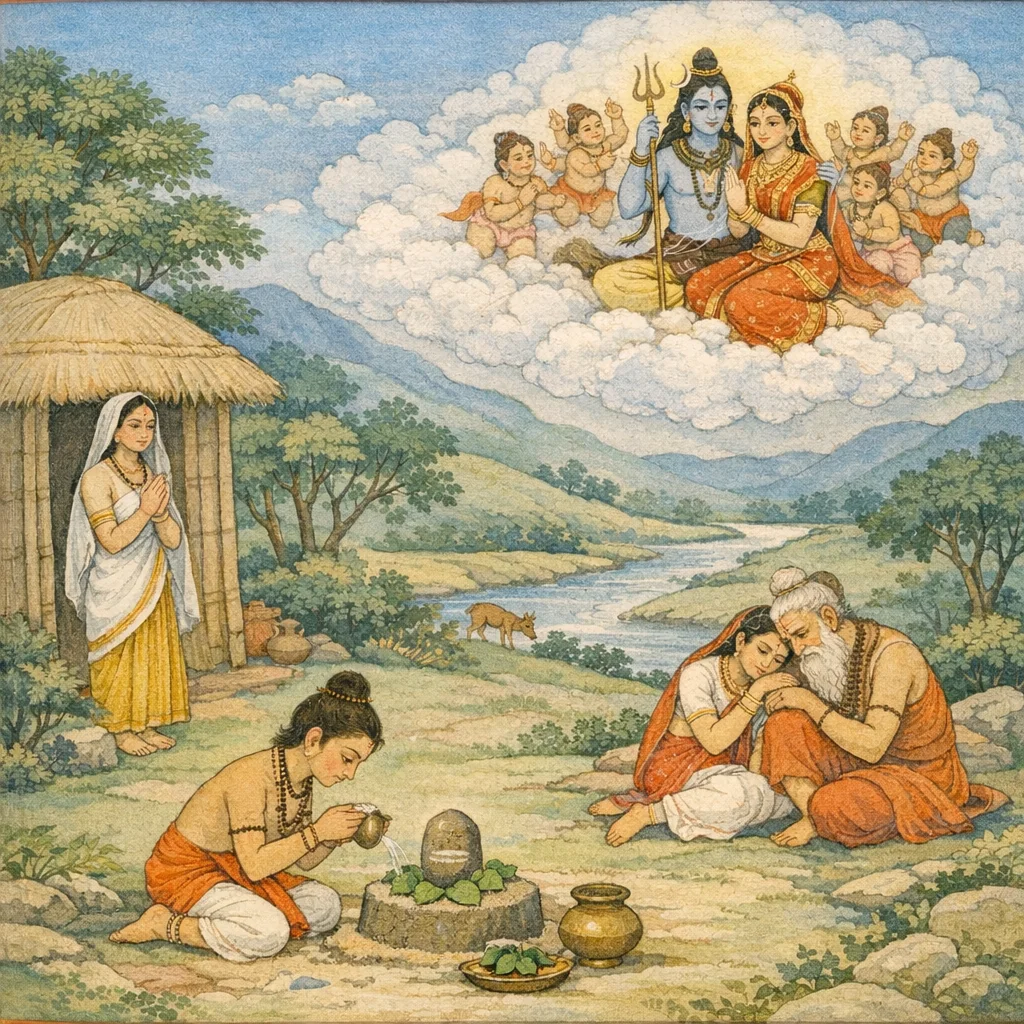
The sages ask Sūta how Śakti, son of Vasiṣṭha, was devoured by a rākṣasa. Sūta recounts that, urged by Viśvāmitra, a blood-drinking rākṣasa in the Kalmāṣapāda episode tormented Vasiṣṭha’s line and ate Śakti along with his brothers. Stricken with grief, Vasiṣṭha and Arundhatī resolve to give up life, but their daughter-in-law Adṛśyantī begs him to sustain his body so she may behold the child in her womb. From within the womb Parāśara reveals the Ṛg-voice; Viṣṇu appears and counsels Vasiṣṭha to abandon sorrow: “This unborn one is a devotee of Rudra and will save the family.” In the tenth month Parāśara is born, and Adṛśyantī laments, remembering Śakti. Parāśara fashions an “Eka-liṅga” from dust and worships Śiva using Rudra-sūkta, Tvarita-rudra, Nīla-rudra, Pañca-brahma, Liṅga-sūkta, and Atharvaśiras rites; Śiva, with Umā and the Gaṇas, grants darśana and gives him a vision of his father. Parāśara then seeks to burn the rākṣasa clan, but Vasiṣṭha teaches the dharma of forgiveness and stops the rite. With Pulastya’s arrival, Parāśara receives the boon of being a Purāṇa-author, establishing in later chapters the flow of the Dharma–Purāṇa tradition.
Shlokas
Verse 1
इति श्रीलिङ्गमहापुराणे पूर्वभागे देवादिसृष्टिकथनं नाम त्रिषष्टितमो ऽध्यायः ऋषय ऊचुः कथं हि रक्षसा शक्तिर् भक्षितः सो ऽनुजैः सह वासिष्ठो वदतां श्रेष्ठ सूत वक्तुमिहार्हसि
Thus, in the Śrī Liṅga Mahāpurāṇa, in the Pūrva-bhāga, begins the sixty-third chapter called “The account of creation beginning with the Devas.” The sages said: “How was Śakti, the son of Vasiṣṭha, devoured by a Rākṣasa—he together with his younger brothers? O Sūta, best among speakers, you are fit to recount it here.”
Verse 2
सूत उवाच शक्ति किल्लेद् ब्य् रुधिर राक्षसो रुधिरो नाम वसिष्ठस्य सुतं पुरा शक्तिं स भक्षयामास शक्तेः शापात्सहानुजैः
Sūta said: In former times, the rākṣasa named Rudhira killed Śakti, the son of Vasiṣṭha. He devoured that Śakti; and by Śakti’s curse, Rudhira too—along with his younger brothers—fell into ruin.
Verse 3
वसिष्ठयाज्यं विप्रेन्द्रास् तदादिश्यैव भूपतिम् कल्माषपादं रुधिरो विश्वामित्रेण चोदितः
O best of brāhmaṇas, instigated by Viśvāmitra, the rākṣasa Rudhira directed King Kalmāṣapāda toward the sacrificial rite to be officiated by Vasiṣṭha.
Verse 4
भक्षितः स इति श्रुत्वा वसिष्ठस्तेन रक्षसा शक्तिः शक्तिमतां श्रेष्ठो भ्रातृभिः सह धर्मवित्
Hearing the report, “He has been devoured,” Vasiṣṭha—along with his brothers—came to know that Śakti, the foremost among the mighty and a knower of dharma, had been eaten by that rākṣasa.
Verse 5
हा पुत्र पुत्र पुत्रेति क्रन्दमानो मुहुर्मुहुः अरुन्धत्या सह मुनिः पपात भुवि दुःखितः
Crying again and again, “Alas, my son—my son!”, the sage, overwhelmed with sorrow, fell upon the ground together with Arundhatī.
Verse 6
वसिष्ठ wअन्त्स् तो चोम्मित् सुइचिदे नष्टं कुलमिति श्रुत्वा मर्तुं चक्रे मतिं तदा स्मरन्पुत्रशतं चैव शक्तिज्येष्ठं च शक्तिमान्
Hearing the words, “The lineage is ruined,” Vasiṣṭha then resolved to abandon his life. Remembering his hundred sons—and above all his eldest, Śakti—the mighty sage was overwhelmed by grief.
Verse 7
न तं विनाहं जीविष्ये इति निश्चित्य दुःखितः
Sorrow-stricken, he resolved, “Without him, I shall not live.”
Verse 8
आरुह्य मूर्धानम् अजात्मजो ऽसौ तयात्मवान् सर्वविद् आत्मविच्च धराधरस्यैव तदा धरायां पपात पत्न्या सह साश्रुदृष्टिः
Climbing upon the head of that mighty ‘mountain-bearer’, the unborn one’s son—self-possessed, all-knowing, and established in Self-knowledge—then caused him to fall upon the earth, together with his wife, his gaze filled with tears.
Verse 9
धराधरात्तं पतितं धरा तदा दधार तत्रापि विचित्रकण्ठी करांबुजाभ्यां करिखेलगामिनी रुदन्तमादाय रुरोद सा च
When he had fallen from the mountain-bearer, the Earth then bore him up. There too, the wondrous-throated Lady—moving with the majestic gait of an elephant—lifted the weeping one with her lotus-hands; and, taking him up, she herself wept as well.
Verse 10
तदा तस्य स्नुषा प्राह पत्नी शक्तेर्महामुनिम् वसिष्ठं वदतां श्रेष्ठं रुदन्ती भयविह्वला
Then his daughter-in-law—the wife of Śakti—fear-stricken and weeping, addressed the great sage Vasiṣṭha, foremost among speakers, seeking refuge in dharma amid her trembling distress.
Verse 11
भगवन्ब्राह्मणश्रेष्ठ तव देहम् इदं शुभम् पालयस्व विभो द्रष्टुं तव पौत्रं ममात्मजम्
O Blessed one, foremost among brāhmaṇas! Preserve this auspicious body of yours, O all-pervading lord, so that you may behold your grandson—my own son.
Verse 12
न त्याज्यं तव विप्रेन्द्र देहमेतत्सुशोभनम् गर्भस्थो मम सर्वार्थसाधकः शक्तिजो यतः
O best of Brāhmaṇas, you must not abandon this most auspicious body. For the one dwelling in the womb is the accomplisher of all my aims, since he is born of Śakti.
Verse 13
एवमुक्त्वाथ धर्मज्ञा कराभ्यां कमलेक्षणा उत्थाप्य श्वशुरं नत्वा नेत्रे संमृज्य वारिणा
Having spoken thus, the lotus-eyed lady—knowing dharma—raised her father-in-law with both hands. Bowing to him, she gently wiped his eyes with water, restoring composure through righteous, compassionate service.
Verse 14
दुःखितापि परित्रातुं श्वशुरं दुःखितं तदा अरुन्धतीं च कल्याणीं प्रार्थयामास दुःखिताम्
Though she herself was afflicted with sorrow, she then sought to rescue her grief-stricken father-in-law; and, in her distress, she implored the auspicious Arundhatī—herself moved with compassion.
Verse 15
स्नुषावाक्यं ततः श्रुत्वा वसिष्ठ उत्थाय भूतलात् संज्ञामवाप्य चालिङ्ग्य सा पपात सुदुःखिता
Hearing the words of his daughter-in-law, Vasiṣṭha rose from the ground; regaining consciousness, he embraced her—yet she, overwhelmed by grievous sorrow, collapsed once more.
Verse 16
अरुन्धती कराभ्यां तां संस्पृश्यास्राकुलेक्षणाम् रुरोद मुनिशार्दूलो भार्यया सुतवत्सलः
Arundhatī touched her with both hands and saw her eyes clouded with tears; and that tiger among sages, tender with love for his child, wept together with his wife. In such worldly sorrow the paśu (bound soul) is seen beneath pāśa (bondage), until refuge is taken in Pati—Lord Śiva, the liberator.
Verse 17
पराशर रेचितेस् वेदिच् ह्य्म्न्स् अस् अन् एम्ब्र्यो अथ नाभ्यंबुजे विष्णोर् यथा तस्याश्चतुर्मुखः आसीनो गर्भशय्यायां कुमार ऋचमाह सः
Even while still in the womb, Parāśara uttered Vedic hymns. Just as four-faced Brahmā, seated upon the lotus sprung from Viṣṇu’s navel, spoke the sacred ṛk-verses from his own womb-like resting place, so too did that sage-child proclaim the mantras—showing that mantra-jñāna arises by divine grace and prior saṃskāra, ultimately under the Lordship of Pati (Śiva) who empowers all revelation.
Verse 18
ततो निशम्य भगवान् वसिष्ठ ऋचमादरात् केनोक्तमिति संचिन्त्य तदातिष्ठत्समाहितः
Then the venerable sage Vasiṣṭha, having respectfully heard that sacred ṛk-verse, reflected, “By whom was this uttered?” and, with a collected mind, remained poised in attentive contemplation.
Verse 19
व्योमाङ्गणस्थो ऽथ हरिः पुण्डरीकनिभेक्षणः वसिष्ठमाह विश्वात्मा घृणया स घृणानिधिः
Then Hari, stationed in the open expanse of the sky—lotus-eyed, the indwelling Self of the universe—spoke to Vasiṣṭha with compassion, for he is a very treasury of mercy.
Verse 20
भो वत्स वत्स विप्रेन्द्र वसिष्ठ सुतवत्सल तव पौत्रमुखाम्भोजाद् ऋग् एषाद्य विनिःसृता
O dear child—O best of Brahmins, O one who cherishes the sons of Vasiṣṭha—this very Ṛg‑vedic hymn has now issued forth from the lotus of your grandson’s mouth.
Verse 21
मत्समस्तव पौत्रो ऽसौ शक्तिजः शक्तिमान्मुने तस्मादुत्तिष्ठ संत्यज्य शोकं ब्रह्मसुतोत्तम
O sage, he is your grandson, born of Śakti—mighty in spiritual power. Therefore arise; abandon grief, O best of Brahmā’s sons.
Verse 22
रुद्रभक्तश् च गर्भस्थो रुद्रपूजापरायणः रुद्रदेवप्रभावेण कुलं ते संतरिष्यति
Even the child in the womb becomes a devotee of Rudra, wholly intent on Rudra-worship; by the very power (prabhāva) of Lord Rudra, your entire lineage will cross beyond bondage and misfortune.
Verse 23
एवमुक्त्वा घृणी विप्रं भगवान् पुरुषोत्तमः वसिष्ठं मुनिशार्दूलं तत्रैवान्तरधीयत
Having spoken thus to the compassionate brāhmaṇa-sage Vasiṣṭha, that Blessed Lord—the Supreme Person (Puruṣottama)—vanished from that very place.
Verse 24
ततः प्रणम्य शिरसा वसिष्ठो वारिजेक्षणम् अदृश्यन्त्या महातेजाः पस्पर्शोदरमादरात्
Then Vasiṣṭha, the great-splendoured sage, bowed his head in reverence to the lotus‑eyed Lord; and though the Lord was not visible, he respectfully touched His abdomen—affirming that Pati (Śiva) is present even beyond sight, and that bhakti reaches Him through inner recognition rather than mere perception.
Verse 25
हा पुत्र पुत्र पुत्रेति पपात च सुदुःखितः ललापारुन्धती प्रेक्ष्य तदासौ रुदतीं द्विजाः
Crying, “Alas, my son—my son!” he fell down, overwhelmed by grief. Seeing Arundhatī weeping, the brāhmaṇas too began to wail aloud.
Verse 26
स्वपुत्रं च स्मरन् दुःखात् पुनरेह्येहि पुत्रक तव पुत्रमिमं दृष्ट्वा भो शक्ते कुलधारणम्
Remembering his own son in grief, he cried, “Return—return, dear child! O Śakti, behold this son of yours, the very support that sustains the lineage.”
Verse 27
तवान्तिकं गमिष्यामि तव मात्रा न संशयः सूत उवाच एवमुक्त्वा रुदन्विप्र आलिङ्ग्यारुन्धतीं तदा
“I shall go to your presence—there is no doubt, by your mother’s own word.” Sūta said: Having spoken thus, the brāhmaṇa, weeping, then embraced Arundhatī.
Verse 28
पपात ताडयन्तीव स्वस्य कुक्षी करेण वै अदृश्यन्ती जघानाथ शक्तिजस्यालयं शुभा
The auspicious Goddess suddenly fell, as though striking her own belly with her hand; then, becoming invisible, she shattered the abode of Śaktija.
Verse 29
स्वोदरं दुःखिता भूमौ ललाप च पपात च अरुन्धति तदा भीता वसिष्ठश् च महामतिः
Stricken with sorrow, Arundhatī beat upon her own belly; she wailed and collapsed onto the ground. At that moment the great-souled sage Vasiṣṭha too was seized with fear.
Verse 30
समुत्थाप्य स्नुषां बालाम् ऊचतुर्भयविह्वलौ
Lifting up their young daughter-in-law, the two—overwhelmed by fear—spoke to her.
Verse 31
विचारमुग्धे तव गर्भमण्डलं करांबुजाभ्यां विनिहत्य दुर्लभम् कुलं वसिष्ठस्य समस्तमप्यहो निहन्तुमार्ये कथमुद्यता वद
O noble one, deluded by anxious thoughts—having struck the lotus of your womb with your lotus-hands and destroyed what is so hard to obtain—how have you become resolved to annihilate the entire lineage of Vasiṣṭha? Speak!
Verse 32
तवात्मजं शक्तिसुतं च दृष्ट्वा चास्वाद्य वक्त्रामृतम् आर्यसूनोः त्रातुं यतो देहमिमं मुनीन्द्रः सुनिश्चितः पाहि ततः शरीरम्
Having seen your son and also the son of Śakti, and having tasted the nectar of speech from the noble one’s son, the lordly sage—resolved to save this very body—sets forth. Therefore, protect this body from that danger.
Verse 33
सूत उवाच एवं स्नुषामुपालभ्य मुनिं चारुन्धती स्थिता अरुन्धती वसिष्ठस्य प्राह चार्तेति विह्वला
Sūta said: Having thus reproached her daughter-in-law, the noble Arundhatī stood before the sage. Then Arundhatī—overwhelmed by anguish—spoke to Vasiṣṭha, crying, “Alas, I am afflicted!”
Verse 34
त्वय्येव जीवितं चास्य मुनेर् यत् सुव्रते मम जीवितं रक्ष देहस्य धात्री च कुरु यद्धितम्
O virtuous one, the very life of this sage rests in you alone. Protect my life; become the sustainer of this body and do what is truly beneficial.
Verse 35
अदृश्यन्त्युवाच मया यदि मुनिश्रेष्ठस् त्रातुं वै निश्चितं स्वकम् ममाशुभं शुभं देहं कथंचित् पालयाम्यहम्
Adṛśyantī said: “If you, O best of sages, have truly resolved to guard your own vow and purpose, then I too shall, somehow, preserve this body of mine—though impure, yet capable of auspiciousness—so that your saving act may be fulfilled.”
Verse 36
प्रियदुःखमहं प्राप्ता ह्य् असती नात्र संशयः मुने दुःखादहं दग्धा यतः पुत्री मुने तव
I have fallen into the grief of separation from what is dear; I am truly “asatī” (one deprived of auspiciousness)—of this there is no doubt, O sage. I am burned by sorrow, for I am your daughter, O muni.
Verse 37
अहो ऽद्भुतं मया दृष्टं दुःखपात्री ह्यहं विभो दुःखत्राता भव ब्रह्मन् ब्रह्मसूनो जगद्गुरो
Ah—how wondrous is what I have seen! Yet I have become a vessel of sorrow, O mighty one. Become the rescuer from my suffering, O Brahman—O son of Brahmā, O Guru of the worlds.
Verse 38
तथापि भर्तृरहिता दीना नारी भवेदिह पाहि मां तत आर्येन्द्र परिभूता भविष्यति
“Even so, if I am left without a husband, I shall become a helpless woman in this world. Protect me then, O noble lord; otherwise I will be dishonoured and oppressed.”
Verse 39
पिता माता च पुत्राश्च पौत्राः श्वशुर एव च एते न बान्धवाः स्त्रीणां भर्ता बन्धुः परा गतिः
For a woman, father, mother, sons, grandsons, and even the father-in-law are not held to be her final refuge; her husband alone is declared her true kinsman and her supreme course of life. (In Shaiva understanding, this points to steadiness in one’s ordained bond, while the highest refuge remains Pati—Śiva—beyond all worldly ties.)
Verse 40
आत्मनो यद्धि कथितम् अप्यर्धमिति पण्डितैः तदप्यत्र मृषा ह्यासीद् गतः शक्तिरहं स्थिता
Even what the learned proclaim as “half” of the account of the Self proved false here as well; for Power—Śakti—has not departed. I alone remain firmly established as the abiding potency.
Verse 41
अहो ममात्र काठिन्यं मनसो मुनिपुङ्गव पतिं प्राणसमं त्यक्त्वा स्थिता यत्र क्षणं यतः
Alas—how hard my mind has become here, O best of sages! Having abandoned my Lord, dear as my very life-breath, how have I remained in this place even for a moment, and for what cause?
Verse 42
वसिष्ठाश्वत्थमाश्रित्य ह्य् अमृता तु यथा लता निर्मूलाप्यमृता भर्त्रा त्यक्ता दीना स्थिताप्यहम्
As a creeper clings to Vasiṣṭha’s sacred aśvattha-tree, so I, Amṛtā, clung for support. Yet though I bear the name “Amṛtā,” I have been uprooted—abandoned by my husband—and I remain, wretched, still standing on.
Verse 43
स्नुषावाक्यं निशम्यैव वसिष्ठो भार्यया सह तदा चक्रे मतिं धीमान् यातुं स्वाश्रममाश्रमी
Hearing the words of his daughter-in-law, the wise sage Vasiṣṭha—together with his wife—then resolved in his mind to depart for his own āśrama, intent on returning to the discipline of āśrama life.
Verse 44
कृच्छ्रात्सभार्यो भगवान् वसिष्ठः स्वाश्रमं क्षणात् अदृश्यन्त्या च पुण्यात्मा संविवेश स चिन्तयन्
With difficulty, the blessed sage Vasiṣṭha—together with his wife—returned in an instant to his own āśrama. Yet, as she had vanished from sight, that pure-souled one entered the āśrama, absorbed in anxious contemplation.
Verse 45
सा गर्भं पालयामास कथंचिन्मुनिपुङ्गवाः कुलसंधारणार्थाय शक्तिपत्नी पतिव्रता
O best of sages, she somehow sustained and protected the pregnancy—she, the devoted wife (pativratā) endowed with Śakti—solely to preserve the continuity of the family line.
Verse 46
ततः सासूत तनयं दशमे मासि सुप्रभम् शक्तिपत्नी यथा शक्तिं शक्तिमन्तमरुन्धती
Thereafter, in the tenth month, Arundhatī gave birth to a radiant son—just as the consort of Śakti brings forth potency itself, so too did she bring forth one endowed with power.
Verse 47
असूत सा दितिर्विष्णुं यथा स्वाहा गुहं सुतम् अग्निं यथारणिः पत्नी शक्तेः साक्षात्पराशरम्
She (Diti) brought forth Viṣṇu—just as Svāhā bore Guha as her son, and just as the araṇi-sticks generate Agni; likewise the wife of Śakti gave birth to Parāśara in person. Thus, through unions ordained by dharma, mighty beings manifest in the world’s unfolding.
Verse 48
यदा तदा शक्तिसूनुर् अवतीर्णो महीतले शक्तिस्त्यक्त्वा तदा दुःखं पितॄणां समतां ययौ
Then, at that very time, the son of Śakti descended upon the earth. And when Śakti departed, the sorrow of the Pitṛs (ancestral beings) subsided and returned to an even, settled state.
Verse 49
भ्रातृभिः सह पुण्यात्मा आदित्यैर् इव भास्करः रराज पितृलोकस्थो वासिष्ठो मुनिपुङ्गवाः
Dwelling in the world of the Pitṛs, the supremely meritorious Vāsiṣṭha—foremost among sages—shone together with his brothers, like the Sun amid the Ādityas.
Verse 50
जगुस्तदा च पितरो ननृतुश् च पितामहाः प्रपितामहाश् च विप्रेन्द्रा ह्य् अवतीर्णे पराशरे
Then the Pitṛs sang, and the grandfathers and great-grandfathers danced, O best of Brahmins, for Parāśara had descended into the world.
Verse 51
ये ब्रह्मवादिनो भूमौ ननृतुर् दिवि देवताः पुष्कराद्याश् च ससृजुः पुष्पवर्षं च खेचराः
Those devoted to brahma-vidyā danced upon the earth; in heaven the Devas rejoiced. Puṣkara and other celestial beings sent down a rain of flowers, and the sky-roaming hosts showered blossoms in celebration—honouring the triumph of dharma and Pati, Lord Śiva, who frees the paśus (souls) from the bonds of pāśa.
Verse 52
पुरेषु राक्षसानां च प्रणादं विषमं द्विजाः आश्रमस्थाश् च मुनयः समूहुर्हर्षसंततिम्
O twice-born ones, when the Rākṣasas in the cities raised a harsh and uneven roar, the sages dwelling in their hermitages gathered together in an unbroken surge of joy, taking the tumult as an auspicious sign that Pati—Lord Śiva—would soon subdue the forces of pāśa and protect the paśus (souls).
Verse 53
अवतीर्णो यथा ह्यण्डाद् भानुः सो ऽपि पराशरः अदृश्यन्त्याश्चतुर्वक्त्रो मेघजालाद्दिवाकरः
Just as the Sun seems to emerge from the cosmic egg, so too did Parāśara appear. And as the four-faced Brahmā becomes visible when the net of clouds parts and the day-maker is revealed, so was he seen—radiant and unobstructed.
Verse 54
सुखं च दुःखमभवद् अदृश्यन्त्यास्तथा द्विजाः दृष्ट्वा पुत्रं पतिं स्मृत्वा अरुन्धत्या मुनेस्तथा
For Arundhatī, who had become unseen, both joy and sorrow arose. The twice-born, on beholding her son and remembering her husband—the sage—were likewise stirred within.
Verse 55
दृष्ट्वा च तनयं बाला पराशरमतिद्युतिम् ललाप विह्वला बाला सन्नकण्ठी पपात च
Seeing her son Parāśara, radiant with extraordinary splendor, the young woman—overcome by anguish—began to lament; her throat choked with emotion, she fell to the ground.
Verse 56
सा पराशरमहो महामतिं देवदानवगणैश् च पूजितम् जातमात्रम् अनघं शुचिस्मिता बुध्य साश्रुनयना ललाप च
She—pure in smile and awakened in understanding—beheld that great-souled, supremely intelligent one of Parāśara’s line, revered by hosts of Devas and Dānavas alike; and seeing the newborn as faultless, she lamented, her eyes brimming with tears.
Verse 57
हा वसिष्ठसुत कुत्रचिद्गतः पश्य पुत्रमनघं तवात्मजम् त्यज्य दीनवदनां वनान्तरे पुत्रदर्शनपरामिमां प्रभो
Alas, O son of Vasiṣṭha—where have you gone? Behold your blameless son, your own child. Do not abandon in this forest this sorrow-faced one, wholly intent on seeing her son, O lord.
Verse 58
शक्ते स्वं च सुतं पश्य भ्रातृभिः सह षण्मुखम् यथा महेश्वरो ऽपश्यत् सगणो हृषिताननः
“O Śakti, behold your own son—Ṣaṇmukha—together with his brothers. Even so did Maheśvara behold him, surrounded by his gaṇas, his face radiant with delight.”
Verse 59
अथ तस्यास्तदालापं वसिष्ठो मुनिसत्तमः श्रुत्वा स्नुषामुवाचेदं मा रोदीर् इति दुःखितः
Then Vasiṣṭha—the foremost among sages—having heard her lament, compassionately addressed his daughter-in-law: “Do not weep,” he said, though he himself was sorrow-stricken.
Verse 60
पराशर: छिल्धोओद् अन्द् योउथ् आज्ञया तस्य सा शोकं वसिष्ठस्य कुलाङ्गना त्यक्त्वा ह्यपालयद्बालं बाला बालमृगेक्षणा
Parāśara said: In his childhood and youth, by his command, that young woman—born in Vasiṣṭha’s noble lineage—set aside her grief and carefully protected the child, she whose eyes were like those of a fawn.
Verse 61
दृष्ट्वा तामबलां प्राह मङ्गलाभरणैर् विना आसीनामाकुलां साध्वीं बाष्पपर्याकुलेक्षणाम्
Seeing that helpless, virtuous woman seated in agitation—bereft of her auspicious ornaments, her eyes clouded and trembling with tears—he spoke to her.
Verse 62
शाक्तेय उवाच अम्ब मङ्गलविभूषणैर् विना देहयष्टिरनघे न शोभते वक्तुमर्हसि तवाद्य कारणं चन्द्रबिंबरहितेव शर्वरी
Śākteya said: “O Mother, O sinless one—without auspicious ornaments your slender body does not shine. Please tell me the reason for your present state; you appear like the night deprived of the moon’s orb.”
Verse 63
मातर्मातः कथं त्यक्त्वा मङ्गलाभरणानि वै आसीना भर्तृहीनेव वक्तुमर्हसि शोभने
O mother, revered mother—how is it that, having cast aside your auspicious ornaments, you sit as though bereft of your lord? O beautiful one, you should tell me what has happened.
Verse 64
अदृश्यन्ती तदा वाक्यं श्रुत्वा तस्य सुतस्य सा न किंचिद् अब्रवीत् पुत्रं शुभं वा यदि वेतरत्
Then she, revealing nothing, heard the words of her son; yet she said nothing at all—neither that it was auspicious for her child nor that it was otherwise.
Verse 65
अदृश्यन्तीं पुनः प्राह शाक्तेयो भगवान्मम मातः कुत्र महातेजाः पिता वद वदेति ताम्
Seeing that she did not manifest, the blessed Śākteya spoke again: “O Mother, where is my father of great splendor? Tell me—tell me,” he implored.
Verse 66
श्रुत्वा रुरोद सा वाक्यं पुत्रस्यातीव विह्वला भक्षितो रक्षसा तातस् तवेति निपपात च
Hearing her son’s words, she wept, utterly shaken by grief; and crying, “My child—your father has been devoured by a rākṣasa!”, she collapsed upon the ground.
Verse 67
श्रुत्वा वसिष्ठो ऽपि पपात भूमौ पौत्रस्य वाक्यं स रुदन्दयालुः अरुन्धती चाश्रमवासिनस्तदा मुनेर्वसिष्ठस्य मुनीश्वराश् च
Hearing his grandson’s words, the compassionate sage Vasiṣṭha fell upon the ground, weeping. Then Arundhatī too, and the hermitage-dwellers—along with the great seers connected with Vasiṣṭha—also sank into lamentation.
Verse 68
भक्षितो रक्षसा मातुः पिता तव मुखादिति श्रुत्वा पराशरो धीमान् प्राह चास्राविलेक्षणः
Hearing from his mother’s own mouth that his father had been devoured by a rākṣasa, the wise Parāśara spoke, his eyes overflowing with tears.
Verse 69
पराशर wइल्ल् सेइनेन् वतेर् र्äछेन् पराशर उवाच अभ्यर्च्य देवदेवेशं त्रैलोक्यं सचराचरम् क्षणेन मातः पितरं दर्शयामीति मे मतिः
Parāśara said: “Having duly worshipped the Lord of lords—He who pervades the three worlds with all that moves and does not move—this is my resolve: ‘In a single moment, O Mother, I shall cause you to behold my father.’”
Verse 70
सा निशम्य वचनं तदा शुभं सस्मिता तनयमाह विस्मिता तथ्यम् एतदिति तं निरीक्ष्य सा पुत्र पुत्र भवमर्चयेति च
Hearing those auspicious words, she smiled in gentle wonder and, gazing upon her son, said: “This is indeed true. O son, my son—worship Bhava (Lord Śiva).”
Verse 71
ज्ञात्वा शक्तिसुतस्यास्य संकल्पं मुनिपुङ्गवः वसिष्ठो भगवान्प्राह पौत्रं धीमान् घृणानिधिः
Knowing the resolve of this son of Śakti, the bull among sages—Bhagavān Vasiṣṭha, wise and a treasury of compassion—addressed his grandson.
Verse 72
स्थाने पौत्र मुनिश्रेष्ठ संकल्पस्तव सुव्रत तथापि शृणु लोकस्य क्षयं कर्तुं न चार्हसि
“O grandson, best of sages, your resolve is fitting, O you of noble vows. Yet listen: you ought not bring about the destruction of the worlds; saṃhāra (dissolution) belongs to Pati—Lord Śiva alone.”
Verse 73
राक्षसानामभावाय कुरु सर्वेश्वरार्चनम् त्रैलोक्यं शृणु शाक्तेय अपराध्यति किं तव
“To make the Rākṣasas disappear, perform arcana—worship of Sarveśvara (Śiva), the Lord of all. Hear, O son of Śakti: even if the three worlds offend you, what real harm can they do to one who takes refuge in Pati through His worship?”
Verse 74
ततस्तस्य वसिष्ठस्य नियोगाच्छक्तिनन्दनः राक्षसानामभावाय मतिं चक्रे महामतिः
Then, by Vasiṣṭha’s injunction, the son of Śakti—great-souled and discerning—set his mind upon a course that would bring about the disappearance of the Rākṣasas.
Verse 75
अदृश्यन्तीं वसिष्ठं च प्रणम्यारुन्धतीं ततः कृत्वैकलिङ्गं क्षणिकं पांसुना मुनिसन्निधौ
Then Arundhatī, without turning her gaze away from Vasiṣṭha, bowed to him; and in the sage’s presence she swiftly shaped from dust a single, momentary Liṅga—showing that even the simplest Liṅga-worship, when done with unwavering devotion to Pati (Śiva), bears spiritual power.
Verse 76
सम्पूज्य शिवसूक्तेन त्र्यंबकेन शुभेन च जप्त्वा त्वरितरुद्रं च शिवसंकल्पमेव च
Having duly worshipped with the Śiva-sūkta, and also with the auspicious Tryambaka mantra, one should then recite the Tvarita-Rudra and likewise the Śiva-saṅkalpa—thus completing the mantra-limb of Śiva-worship that leads the paśu (bound soul) toward the Pati (Lord).
Verse 77
नीलरुद्रं च शाक्तेयस् तथा रुद्रं च शोभनम् वामीयं पवमानं च पञ्चब्रह्म तथैव च
One should also recite the hymn of Nīlarudra, the Śākteya hymn, the auspicious Rudra hymn, the Vāmīya, the Pavamāna, and likewise the Pañcabrahma—Vedic invocations that establish the Pati (Lord) as purifier and sovereign of all beings.
Verse 78
होतारं लिङ्गसूक्तं च अथर्वशिर एव च अष्टाङ्गमर्घ्यं रुद्राय दत्त्वाभ्यर्च्य यथाविधि
Reciting the Hotṛ invocation, the Liṅga-sūkta, and the Atharvaśiras, one should offer to Rudra the eightfold arghya and worship Him according to the prescribed rite. Thus the paśu (bound soul) approaches the Pati (Lord) through mantra and proper worship, and by Śiva’s grace the bonds (pāśa) are loosened.
Verse 79
पराशर उवाच भगवन्रक्षसा रुद्र भक्षितो रुधिरेण वै पिता मम महातेजा भ्रातृभिः सह शङ्कर
Parāśara said: “O Blessed Lord, O Rudra—my father, of mighty splendor, was devoured by a rākṣasa, and his blood was consumed as well, O Śaṅkara—together with my brothers.”
Verse 80
द्रष्टुमिच्छामि भगवन् पितरं भ्रातृभिः सह एवं विज्ञापयांल्लिङ्गं प्रणिपत्य मुहुर्मुहुः
“O Blessed Lord, I long to behold my father together with my brothers.” Thus, bowing again and again before the Liṅga, he made an earnest supplication—seeking Pati, the Lord whose grace loosens the pāśa, the bond that binds the paśu, the soul.
Verse 81
हा रुद्र रुद्र रुद्रेति रुरोद निपपात च तं दृष्ट्वा भगवान्रुद्रो देवीमाह च शङ्करः
Crying, “Ha Rudra! Rudra! Rudra!”, she wept and fell down. Seeing her thus, the Blessed Lord Rudra—Śaṅkara—spoke to the Goddess.
Verse 82
पश्य बालं महाभागे बाष्पपर्याकुलेक्षणम् ममानुस्मरणे युक्तं मदाराधनतत्परम्
O most fortunate one, behold this child—his eyes are clouded with tears. He is absorbed in remembrance of Me and wholly intent on My worship, steadfast in devotion to Pati, the Lord who frees the paśu, the soul, from the bondage of pāśa.
Verse 83
सा च दृष्ट्वा महादेवी पराशरमनिन्दिता दुःखात् संक्लिन्नसर्वाङ्गम् अस्राकुलविलोचनम्
And the blameless Great Goddess, on seeing Parāśara—his whole body drenched in sorrow and his eyes brimming with tears—was moved by that sight.
Verse 84
लिङ्गार्चनविधौ सक्तं हर रुद्रेति वादिनम् प्राह भर्तारमीशानं शङ्करं जगतामुमा
Seeing her Lord wholly absorbed in the prescribed rite of Liṅga-worship, uttering, “Hara! Rudra!”, Umā addressed her husband, Īśāna Śaṅkara, the auspicious Lord of the worlds.
Verse 85
ईप्सितं यच्छ सकलं प्रसीद परमेश्वर निशम्य वचनं तस्याः शङ्करः परमेश्वरः
“O Parameśvara, be gracious—grant in full whatever is desired.” Hearing her words, Śaṅkara, the Supreme Lord (Pati), was pleased.
Verse 86
भार्यामार्यामुमां प्राह ततो हालाहलाशनः रक्षाम्येनं द्विजं बालं फुल्लेन्दीवरलोचनम्
Then Hālāhala-Āśana (Śiva, the consumer of the cosmic poison) spoke to his noble consort Umā: “I shall protect this young Brahmin boy, whose eyes are like fully-bloomed blue lotuses.”
Verse 87
ददामि दृष्टिं मद्रूपदर्शनक्षम एष वै एवमुक्त्वा गणैर् दिव्यैर् भगवान्नीललोहितः
“I grant you the vision capable of beholding My own form.” Having spoken thus, the Blessed Lord Nīlalohita, attended by His divine gaṇas, bestowed that grace.
Verse 88
ब्रह्मेन्द्रविष्णुरुद्राद्यैः संवृतः परमेश्वरः ददौ च दर्शनं तस्मै मुनिपुत्राय धीमते
Surrounded by Brahmā, Indra, Viṣṇu, Rudra and the other deities, Parameśvara—the Pati who loosens the bonds (pāśa) of the paśu—granted His direct vision to that wise son of the sage.
Verse 89
सो ऽपि दृष्ट्वा महादेवम् आनन्दास्राविलेक्षणः निपपात च हृष्टात्मा पादयोस्तस्य सादरम्
Seeing Mahādeva, his eyes brimming with tears of bliss, he fell down with a heart filled with joy and, with reverence, prostrated at His feet.
Verse 90
पुनर्भवान्याः पादौ च नन्दिनश् च महात्मनः सफलं जीवितं मे ऽद्य ब्रह्माद्यांस्तांस्तदाह सः
Then, beholding again the sacred feet of Bhavānī and of the great-souled Nandin, he said to Brahmā and the other gods: “Today my life has become fruitful.”
Verse 91
रक्षार्थमागतस्त्वद्य मम बालेन्दुभूषणः को ऽन्यः समो मया लोके देवो वा दानवो ऽपि वा
“Today, for my protection, you have come—O Lord adorned with the crescent moon. Who else in this world is equal to me—whether a god or even a demon?”
Verse 92
अथ तस्मिन्क्षणादेव ददर्श दिवि संस्थितम् पितरं भ्रातृभिः सार्धं शाक्तेयस्तु पराशरः
Then, in that very instant, Parāśara—the son of Śakti—beheld his father established in the heavenly realm, together with his brothers. In this vision the ordering power of Dharma is affirmed: the Pitṛs abide in their ordained station, and the embodied paśu (soul) receives a direct glimpse of the subtle worlds through divine dispensation.
Verse 93
सूर्यमण्डलसंकाशे विमाने विश्वतोमुखे भ्रातृभिः सहितं दृष्ट्वा ननाम च जहर्ष च
Seeing, together with his brothers, that all-facing celestial vimāna—radiant like the orb of the sun—he bowed down in reverence, and his heart surged with joy.
Verse 94
तदा वृषध्वजो देवः सभार्यः सगणेश्वरः वसिष्ठपुत्रं प्राहेदं पुत्रदर्शनतत्परम्
Then the Blessed Lord, the Bull-bannered One (Śiva), together with His Śakti (consort) and attended by the Gaṇa-lords, spoke these words to Vasiṣṭha’s son, who was intent on obtaining the vision of a son.
Verse 95
श्रीदेव उवाच शक्ते पश्य सुतं बालम् आनन्दास्राविलेक्षणम् अदृश्यन्तीं च विप्रेन्द्र वसिष्ठं पितरं तव
Śrīdeva said: “O Śakti, behold the child—your son—his eyes streaming with tears of bliss. And you too, O best of brahmins, see: your father Vasiṣṭha is no longer visible.”
Verse 96
अरुन्धतीं महाभागां कल्याणीं देवतोपमाम् मातरं पितरं चोभौ नमस्कुरु महामते
O wise one, bow in reverence to the greatly fortunate Arundhatī—auspicious and godlike—and also offer homage to both your mother and your father.
Verse 97
तदा हरं प्रणम्याशु देवदेवमुमां तथा वसिष्ठं च तदा श्रेष्ठं शक्तिर् वै शङ्कराज्ञया
Then, by Śaṅkara’s command, Śakti swiftly bowed to Hara—the God of gods—along with Umā, and also to the excellent sage Vasiṣṭha.
Verse 98
मातरं च महाभागां कल्याणीं पतिदेवताम् अरुन्धतीं जगन्नाथनियोगात्प्राह शक्तिमान्
By the command of Jagannātha (the Lord of the universe), the powerful one spoke of Arundhatī—his revered mother, the greatly fortunate and auspicious lady, who regarded her husband as her very deity.
Verse 99
वासिष्ठ उवाच भो वत्स वत्स विप्रेन्द्र पराशर महाद्युते रक्षितो ऽहं त्वया तात गर्भस्थेन महात्मना
Vasiṣṭha said: “O dear child—O best of brāhmaṇas, Parāśara of great splendor—dear one, I was protected by you, that great-souled one, even while you were still abiding in the womb.”
Verse 100
अणिमादिगुणैश्वर्यं मया वत्स पराशर लब्धमद्याननं दृष्टं तव बाल ममाज्ञया
“O dear child Parāśara, by my command you have now attained the lordly yogic excellences beginning with aṇimā; today, by that very power, I have beheld your face again, O boy.”
Verse 101
अदृश्यन्तीं महाभागां रक्ष वत्स महामते अरुन्धतीं च पितरं वसिष्ठं मम सर्वदा
Protect, dear child—O great-minded one—my most fortunate Arundhatī, who is now unseen; and protect my father Vasiṣṭha as well, always.
Verse 102
अन्वयः सकलो वत्स मम संतारितस्त्वया पुत्रेण लोकाञ्जयतीत्य् उक्तं सद्भिः सदैव हि
O dear child, through you my entire lineage has been carried across (the ocean of saṃsāra). Indeed, the righteous ever declare that a son conquers the worlds—by upholding dharma and leading his forebears toward auspiciousness.
Verse 103
ईप्सितं वरयेशानं जगतां प्रभवं प्रभुम् गमिष्याम्यभिवन्द्येशं भ्रातृभिः सह शङ्करम्
I shall seek the boon I desire from Īśāna—Śaṅkara, the Lord and source of the worlds. I will go and bow to that adorable Supreme Lord, together with my brothers.
Verse 104
एवं पुत्रमुपामन्त्र्य प्रणम्य च महेश्वरम् निरीक्ष्य भार्यां सदसि जगाम पितरं वशी
Thus, after addressing his son, bowing to Mahēśvara, and casting a glance toward his wife in the assembly, the self-controlled one went into the gathering to his father.
Verse 105
गतं दृष्ट्वाथ पितरं तदाभ्यर्च्यैव शङ्करम् तुष्टाव वाग्भिर् इष्टाभिः शाक्तेयः शशिभूषणम्
Seeing that his father had departed, Śākteya duly worshipped Śaṅkara and praised the Moon-crested Lord with cherished, well-chosen words.
Verse 106
ततस्तुष्टो महादेवो मन्मथान्धकमर्दनः अनुगृह्याथ शाक्तेयं तत्रैवान्तरधीयत
Then Mahādeva—slayer of Manmatha and Andhaka—being fully pleased, bestowed His grace upon Śākteya; and right there, He vanished from sight.
Verse 107
गते महेश्वरे सांबे प्रणम्य च महेश्वरम् ददाह राक्षसानां तु कुलं मन्त्रेण मन्त्रवित्
When Maheśvara had departed—together with Sāmbā (Śakti)—the knower of mantras bowed to Lord Maheśvara and, by the power of mantra, burned up the entire lineage of the Rākṣasas.
Verse 108
तदाह पौत्रं धर्मज्ञो वसिष्ठो मुनिभिर् वृतः अलम् अत्यन्तकोपेन तात मन्युमिमं जहि
Then Vasiṣṭha, knower of dharma and surrounded by sages, said to his grandson: “Enough, dear child, with this extreme anger; abandon this wrath.”
Verse 109
राक्षसा नापराध्यन्ति पितुस् ते विहितं तथा मूढानामेव भवति क्रोधो बुद्धिमतां न हि
“The Rākṣasas have not committed an offence; they acted exactly as your father had ordained. Anger arises only in the deluded—never in the wise.”
Verse 110
हन्यते तात कः केन यतः स्वकृतभुक्पुमान् संचितस्यातिमहता वत्स क्लेशेन मानवैः
Dear child—who is truly slain by whom? For the embodied soul (paśu) inevitably tastes the fruit of its own deeds; and the vast hoard of karma amassed by human beings is exhausted only through intense suffering.
Verse 111
यशसस्तपसश्चैव क्रोधो नाशकरः स्मृतः अलं हि राक्षसैर् दग्धैर् दीनैर् अनपराधिभिः
Anger is taught to be the destroyer of both fame and austerity (tapas). Enough—let there be no more burning of the Rakṣasas, who are wretched and yet without offence.
Verse 112
सत्रं ते विरमत्वेतत् क्षमासारा हि साधवः एवं वसिष्ठवाक्येन शाक्तेयो मुनिपुङ्गवः
“Let this satra, your sacrificial session, come to an end; for true sādhus are rooted in kṣamā—patient forbearance.” Thus, by Vasiṣṭha’s counsel, the eminent sage Śākteya was guided toward restraint.
Verse 113
उपसंहृतवान् सत्रं सद्यस्तद्वाक्यगौरवात् ततः प्रीतश् च भगवान् वसिष्ठो मुनिसत्तमः
Honouring the weight of that command, he immediately concluded the satra-sacrifice. Thereupon the venerable Vasiṣṭha, foremost among sages, became pleased—his mind settled in reverence for the Lord (Pati) who guides all rites.
Verse 114
सम्प्राप्तश् च तदा सत्रं पुलस्त्यो ब्रह्मणः सुतः वसिष्ठेन तु दत्तार्घ्यः कृतासनपरिग्रहः
Then Pulastya, the son of Brahmā, arrived at that sacrificial session (satra). Vasiṣṭha offered him the arghya in reverence, and Pulastya accepted a seat and took his place.
Verse 115
पराशरमुवाचेदं प्रणिपत्य स्थितं मुनिः वैरे महति यद्वाक्याद् गुरोर् अद्याश्रिता क्षमा
Parāśara said: Having bowed down, the sage stood firm and spoke: “Though the enmity is great, today—by the Guru’s command—I have taken refuge in kṣamā (forbearance).”
Verse 116
त्वया तस्मात्समस्तानि भवाञ्छास्त्राणि वेत्स्यति संततेर्मम न छेदः क्रुद्धेनापि यतः कृतः
Therefore, through you, you will come to know all the śāstras. For the continuity of my lineage has not been cut off—though an act was done in anger.
Verse 117
त्वया तस्मान्महाभाग ददाम्यन्यं महावरम् पुराणसंहिताकर्ता भवान्वत्स भविष्यति
Therefore, O greatly fortunate one, I grant you another supreme boon: dear child, you shall become the composer and redactor of the Purāṇa-saṃhitā. Through this, the Śaiva teaching will be preserved and transmitted for the liberation of paśu (bound souls) by the grace of the Lord, Paśupati.
Verse 118
देवतापरमार्थं च यथावद्वेत्स्यते भवान् प्रवृत्तौ वा निवृत्तौ वा कर्मणस् ते ऽमला मतिः
You will rightly understand the highest truth concerning the Deity; and whether you engage in pravṛtti (worldly action) or in nivṛtti (withdrawal), your discernment regarding karma will be stainless—fit to lead paśu beyond pāśa toward the Lord, Pati.
Verse 119
मत्प्रसादादसंदिग्धा तव वत्स भविष्यति ततश् च प्राह भगवान् वसिष्ठो वदतां वरः
“By my grace, dear child, what you seek will surely come to pass without doubt.” Thereupon the blessed Vasiṣṭha—foremost among eloquent speakers—spoke further.
Verse 120
पराशर बेचोमेस् औथोर् ओफ़् विष्णुपुराण पुलस्त्येन यदुक्तं ते सर्वमेतद्भविष्यति अथ तस्य पुलस्त्यस्य वसिष्ठस्य च धीमतः
Pulastya declared: “Parāśara shall become the composer of the Viṣṇu Purāṇa. Whatever Pulastya has spoken to you—indeed all of it—shall come to pass.” Thereafter, the account proceeds concerning Pulastya and the wise Vasiṣṭha.
Verse 121
प्रसादाद्वैष्णवं चक्रे पुराणं वै पराशरः षट्प्रकारं समस्तार्थसाधकं ज्ञानसंचयम्
By divine grace, Parāśara indeed composed the Vaiṣṇava Purāṇa—set forth in six modes—an accumulation of liberating knowledge, able to accomplish the full range of human aims; and in Śaiva understanding, such scriptural grace ultimately ripens into devotion to Pati (Śiva), who removes the paśa from the paśu.
Verse 122
षट्साहस्रमितं सर्वं वेदार्थेन च संयुतम् चतुर्थं हि पुराणानां संहितासु सुशोभनम्
This entire text, measured as six thousand verses, is joined with the meaning of the Vedas; and among the Purāṇas it stands as the fourth, beautifully resplendent within the Purāṇic compendia (saṃhitās).
Verse 123
एष वः कथितः सर्वो वासिष्ठानां समासतः प्रभवः शक्तिसूनोश् च प्रभावो मुनिपुङ्गवाः
O foremost of sages, I have thus briefly narrated to you the entire origin of the Vasiṣṭhas, and also the greatness and spiritual power of Śakti’s son—whose tapas and Śaiva grace became renowned.
Frequently Asked Questions
The chapter lists Shiva-sukta/tryambaka usage and multiple Rudra recitations: त्वरितरुद्र, नीलरुद्र, पञ्चब्रह्म, लिङ्गसूक्त, अथर्वशिरस्, and अष्टाङ्ग-अर्घ्य offering—framing a Vedic-Shaiva liturgical sequence around an ekalinga.
Vasistha teaches that uncontrolled anger destroys tapas and yasha, and that karmic consequence (स्वकृतभुक्) governs beings; therefore, the dharmic response is restraint and forgiveness (क्षमा), not indiscriminate annihilation—aligning Shaiva spirituality with inner conquest.
Shiva appears with Uma and divine ganas, grants Parashara a special ‘dृष्टि’ (capacity for vision), and immediately enables the sight of Shakti with his brothers in a celestial vimana—showing darshan as a transformative bestowal of perception and restoration of cosmic order.