Adhyaya 21
Genealogies from Purūravas to the Haihayas; Jayadhvaja’s Vaiṣṇava Resolve, Sage-Adjudication, and the Slaying of Videha
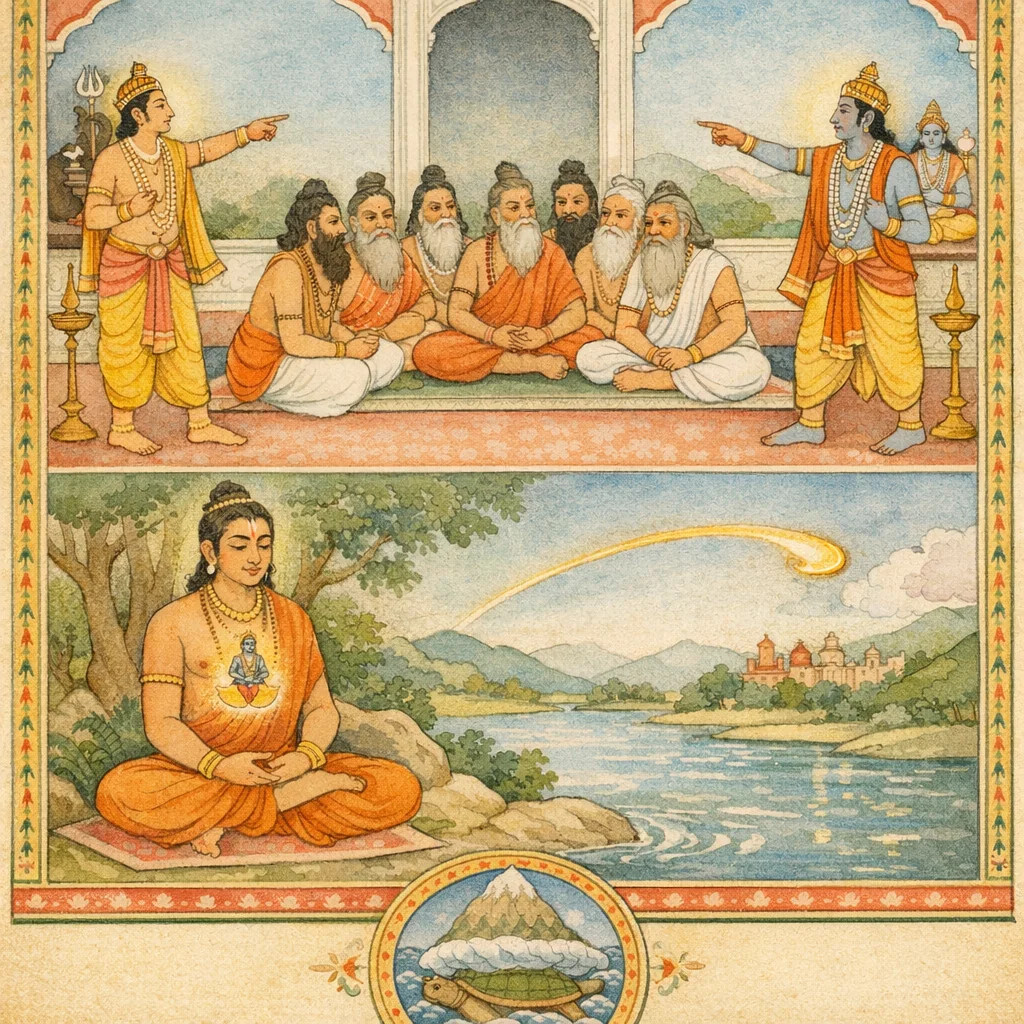
Continuing the dynastic account, Romaharṣaṇa traces the lunar line from Aila Purūravas through Āyu and Nahusha to Yayāti, whose division of realms among Yadu, Turvasu, Druhyu, and Pūru establishes a dharmic model of kingship. The narrative then follows the Yādava/Haihaya branch down to Kārtavīrya Arjuna (Sahasrabāhu) and his descendants, introducing a doctrinal dispute among royal brothers over whether a king should chiefly worship Rudra or Viṣṇu. Framed in guṇa-theology (sattva–rajas–tamas), the issue is settled by the Seven Sages, who honor one’s chosen iṣṭa-devatā yet prescribe presiding deities by social role—especially Viṣṇu (and Indra) for rulers. The verdict is tested when the Dānava Videha attacks; Jayadhvaja remembers Nārāyaṇa, receives divine aid as the cakra manifests, and defeats the enemy. Viśvāmitra then teaches Viṣṇu’s supremacy and worship through varṇāśrama-duty and desirelessness, while other brothers perform Rudra-sacrifices. The chapter closes with an explicit phalaśruti promising purification and ascent to Viṣṇu’s world for those who hear, preparing further instruction on right worship and disciplined devotion.
Shlokas
Verse 1
इति श्रीकूर्मपुराणे षट्साहस्त्र्यां संहितायां पूर्वविभागे विशो ऽध्यायः रोमहर्षण उवाच ऐलः पुरूरवाश्चाथ राजा राज्यमपालयत् / तस्य पुत्रा बभूवुर्हि षडिन्द्रसमतेजसः
Thus, in the Śrī Kūrma Purāṇa, in the six-thousand-verse compendium, in the Pūrva-bhāga, in the twenty-first chapter, Romaharṣaṇa said: “Aila Purūravas then ruled and protected the kingdom. Indeed, he had six sons, whose splendor was equal to that of Indra.”
Verse 2
आयुर्मायुरमावायुर्विश्वायुश्चैव वीर्यवान् / शतायुश्च श्रुतायुश्च दिव्याश्चैवोर्वशीसुताः
Āyu, Māyu, Amāvāyu, and Viśvāyu—the valiant one—as well as Śatāyu, Śrutāyu, and Divya: these, indeed, were the sons of Urvaśī.
Verse 3
आयुषस्तनया वीराः पञ्चैवासन् महौजसः / स्वर्भानुतनयायां वै प्रभायामिति नः श्रुतम्
We have heard that Āyuṣa had five heroic sons, all of mighty vigor, born of Prabhā, the daughter of Svarbhānu.
Verse 4
नहुषः प्रथमस्तेषां धर्मज्ञो लोकविश्रुतः / नहुषस्य तु दायादाः षडिन्द्रोपमतेजसः
Of them, Nahusha was the first—knower of dharma and renowned throughout the world. And Nahusha’s heirs were six in number, each possessed of splendor comparable to Indra.
Verse 5
उत्पन्नाः पितृकन्यायां विरजायां महाबलाः / यतिर्ययातिः संयातिरायातिः पञ्चको ऽश्वकः
From Virajā, the daughter of the Pitṛs, were born mighty sons—Yati, Yayāti, Saṁyāti, Āyāti, and Pañcaka (also called Aśvaka).
Verse 6
तेषां ययातिः पञ्चानां महाबलपराक्रमः / देवयानीमुखनसः सुतां भार्यामवाप सः / शर्मिष्ठामासुरीं चैव तनयां वृषपर्वणः
Among those five, Yayāti—mighty in strength and valor—took as his wife Devayānī, the daughter of Śukra (Uśanas); and he also took Śarmiṣṭhā, the Asura maiden, the daughter of Vṛṣaparvan.
Verse 7
यदुं च तुर्वसुं चैव देवयानी व्यजायत / द्रुह्युं चानुं च पूरुं च शर्मिष्ठा चाप्यजीजनत्
Devayānī gave birth to Yadu and Turvasu; and Śarmiṣṭhā, too, bore Druhyu, Anu, and Pūru.
Verse 8
सो ऽभ्यषिञ्चदतिक्रम्य ज्येष्ठं यदुमनिन्दितम् / पुरुमेव कनीयासं पितुर्वचनपालकम्
He performed the royal consecration, passing over the blameless elder Yadu, and anointed only Puru, the younger son, for he faithfully upheld his father’s command.
Verse 9
दिशि दक्षिणपूर्वस्यां तुर्वसुं पुत्रमादिशत् / दक्षिणापरयो राजा यदुं ज्येष्ठं न्ययोजयत् / प्रतीच्यामुत्तारायां च द्रुह्युं चानुमकल्पयत्
In the south‑eastern quarter the king appointed his son Turvasu; in the south‑western region he assigned Yadu, the eldest; and in the western and northern directions he duly allotted Druhyu as well.
Verse 10
तैरियं पृथिवी सर्वा धर्मतः परिपालिता / राजापि दारसहितो नवं प्राप महायशाः
By them the whole earth was protected in accordance with dharma; and the illustrious king too, together with his queen, attained a new state of prosperity and renown.
Verse 11
यदोरप्यभवन् पुत्राः पञ्च देवसुतोपमाः / सहस्त्रजित् तथाज्येष्ठः क्रोषटुर्नालो ऽजितोरघुः
And to Yadu also were born five sons, comparable to the sons of the gods: Sahastrajit; and the eldest, Kroṣaṭu; Nāla; Ajita; and Raghu.
Verse 12
सहस्त्रजित्सुतस्तद्वच्छतजिन्नाम पार्थिवः / सुताः शतजितो ऽप्यासंस्त्रयः परमधार्मिकाः
Sahastrajit likewise had a son—a king named Śatajīt. And Śatajīt too had three sons, all supremely devoted to dharma.
Verse 13
हैहयश्च हयश्चैव राजा वेणुहयः परः / हैहयस्याभवत् पुत्रो धर्म इत्यभिविश्रुतः
There were the kings Haihaya and Haya, and also the eminent ruler Veṇuhaya. From Haihaya was born a son renowned by the name Dharma.
Verse 14
तस्य पुत्रो ऽभवद् विप्रा धर्मनेत्रः प्रतापवान् / धर्मनेत्रस्य कीर्तिस्तु संजितस्तत्सुतो ऽभवत्
O Brahmins, his son was the mighty Dharmanetra; and of Dharmanetra, Kīrti was born—whose son, in turn, was Saṃjita.
Verse 15
महिष्मान् संजितस्याभूद् भद्रश्रेण्यस्तदन्वयः / भद्रश्रेण्यस्य दायादो दुर्दमो नाम पार्थिवः
From Saṃjita was born Mahiṣmān; in his lineage arose Bhadrashreṇya. And Bhadrashreṇya’s heir was a king named Durdama.
Verse 16
दुर्दमस्य सुतो धीमान् धनको नाम वीर्यवान् / धनकस्य तु दायादाश्चत्वारो लोकसम्मताः
Durdama had a wise and valiant son named Dhanaka. And Dhanaka, indeed, had four heirs—renowned and approved among the people.
Verse 17
कृतवीर्यः कृताग्निश्च कृतवर्मा तथैव च / कृतौजाश्च चतुर्थो ऽभूत् कार्तवीर्योर्ऽजुनो ऽभवत्
There were Kṛtavīrya, Kṛtāgni, and likewise Kṛtavarmā; and Kṛtaujā was the fourth. From Kārtavīrya was born Arjuna (Kartavīrya Arjuna).
Verse 18
सहस्त्रबाहुर्द्युतिमान् धनुर्वेदविदां वरः / तस्य रामो ऽभवन्मृत्युर्जामदग्न्यो जनार्दनः
Sahasrabāhu was radiant and foremost among those who knew the Dhanurveda, the science of archery; yet for him, Rāma—Jāmadagnya Janārdana—became Death itself.
Verse 19
तस्य पुत्रशतान्यासन् पञ्च तत्र महारथाः / कृतास्त्रा बलिनः शूरा धर्मात्मानो नमस्विनः
He had hundreds of sons; among them were five great chariot-warriors—masters of weapons, mighty and valiant, righteous in spirit, and worthy of reverent homage.
Verse 20
शूरश्च शूरसेनश्च धृष्णः कृष्णस्तथैव च / जयध्वजश्च बलवान् नारायणपरो नृपः
There were kings named Śūra and Śūrasena, and also Dhṛṣṇa and Kṛṣṇa; and Jayadhvaja too—mighty in strength—who was a ruler devoted to Nārāyaṇa.
Verse 21
शूरसेनादयः सर्वे चत्वारः प्रथितौजसः / रुद्रभक्ता महात्मानः पूजयन्ति स्म शङ्करम्
All four—beginning with the Śūrasenas—renowned for their might, were great-souled devotees of Rudra, and they used to worship Śaṅkara (Śiva).
Verse 22
जयध्वजस्तु मतिमान् देवं नारायणं हरिम् / जगाम शरणं विष्णुं दैवतं धर्मतत्परः
But Jayadhvaja, wise in counsel and devoted to dharma, went for refuge to the divine Hari—Nārāyaṇa, Viṣṇu—holding Him alone as his chosen deity.
Verse 23
तमूचुरितरे पुत्रा नायं धर्मस्तवानघ / ईश्वराराधनरतः पितास्माकमभूदिति
Then the other sons said, “O sinless one, this is not your dharma; for our father was devoted to the worship of the Lord, Īśvara.”
Verse 24
तानब्रवीन्महातेजा एष धर्मः परो मम / विष्णोरंशेन संभूता राजानो यन्महीतले
The greatly radiant one said to them: “This is My highest Dharma—that the kings upon the earth are born from a portion of Viṣṇu.”
Verse 25
राज्यं पालयतावश्यं भगवान् पुरुषोत्तमः / पूजनीयो यतो विष्णुः पालको जगतो हरिः
For one who governs a kingdom, the Blessed Supreme Person, Puruṣottama, must certainly be upheld as the guiding Lord. Viṣṇu is to be worshipped, since Hari is the protector of the world.
Verse 26
सात्त्विकी राजसी चैव तामसी च स्वयंभुवः / तिस्त्रस्तु मूर्तयः प्रोक्ताः सृष्टिस्थित्यन्तहेतवः
Svayaṃbhu (the Self-born Lord) is said to have three forms—sāttvika, rājasika, and tāmasika—declared as the causes of creation, maintenance, and dissolution.
Verse 27
सत्त्वात्मा भगवान् विष्णुः संस्थापयति सर्वदा / सृजेद् ब्रह्मा रजोमूर्तिः संहरेत् तामसो हरः
Bhagavān Viṣṇu, whose nature is sattva, ever upholds and stabilizes the cosmos. Brahmā, embodied as rajas, brings forth creation; and Hara (Śiva), embodied as tamas, withdraws it in dissolution.
Verse 28
तस्मान्महीपतीनां तु राज्यं पालयतामयम् / आराध्यो भगवान् विष्णुः केशवः केशिमर्दनः
Therefore, for kings who uphold and protect their realms, this is the proper course: the Blessed Lord Viṣṇu—Keśava, the slayer of Keśī—should be worshipped as the supreme object of devotion.
Verse 29
निशम्य तस्य वचनं भ्रातरो ऽन्ये मनस्विनः / प्रोचुः संहारकृद् रुद्रः पूजनीयो मुमुक्षुभिः
Hearing his words, the other high-minded brothers replied: “Rudra, the agent of dissolution, is to be worshipped by those who seek liberation.”
Verse 30
अयं हि भगवान् रुद्रः सर्वं जगदिदं शिवः / तमोगुणं समाश्रित्य कल्पान्ते संहरेत् प्रभुः
For this indeed is Bhagavān Rudra—Śiva himself—who is the very entirety of this universe. Resorting to the guṇa of tamas, the Lord withdraws the cosmos at the end of a kalpa.
Verse 31
या सा घोरतरा मूर्तिरस्य तेजामयी परा / संहरेद् विद्यया सर्वं संसारं शूलभृत् तया
That supremely radiant, most awe-inspiring Form of his—made of pure spiritual splendor—by the power of sacred knowledge, the Trident-bearer withdraws the entire round of saṃsāra.
Verse 32
ततस्तानब्रवीद् राजा विचिन्त्यासौ जयध्वजः / सत्त्वेन मुच्यते जन्तुः सत्त्वात्मा भगवान् हरिः
Then King Jayadhvaja, having reflected, spoke to them: “A living being is released through sattva; for Bhagavān Hari is of the very nature of sattva.”
Verse 33
तमूचुर्भ्रातरो रुद्रः सेवितः सात्त्विकैर्जनैः / मोचयेत् सत्त्वसंयुक्तः पूजयेशं ततो हरम्
Then the brothers said: “Rudra is worshipped by those of sāttvika nature. United with sattva, he bestows liberation; therefore one should worship Īśa (Śiva) first, and then Hari (Viṣṇu).”
Verse 34
अथाब्रवीद् राजपुत्रः प्रहसन् वै जयध्वजः / स्वधर्मो मुक्तये पन्था नान्यो मुनिभिरष्यते
Then the prince Jayadhvaja, smiling, said: “Svadharma—one’s own prescribed duty—is the path to liberation; no other way is approved by the sages.”
Verse 35
तथा च वैष्णवी शक्तिर्नृपाणां देवता सदा / आराधनं परो धर्मो पुरारेरमितौजसः
Thus, the Vaiṣṇavī divine power is ever the presiding deity for kings; and the highest dharma is devoted worship of the Lord of immeasurable might, the vanquisher of Tripura (the Supreme).
Verse 36
तमब्रवीद् राजपुत्रः कृष्णो मतिमतां वरः / यदर्जुनो ऽस्मज्जनकः स्वधर्मं कृतवानिति
Then the prince Kṛṣṇa, foremost among the wise, said: “Because Arjuna—our forefather—fulfilled his own svadharma.”
Verse 37
एवं विवादे वितते शूरसेनो ऽब्रवीद् वचः / प्रमाणमृषयो ह्यत्र ब्रूयुस्ते यत् तथैव तत्
Thus, as the dispute grew intense, Śūrasena said: “Here the ṛṣis are the very standard of authority; whatever they declare to be so—indeed, that alone is so.”
Verse 38
ततस्ते राजशार्दूलाः पप्रच्छुर्ब्रह्मवादिनः / गत्वा सर्वे सुसंरब्धाः सप्तर्षोणां तदाश्रमम्
Then those tiger-like kings, each stirred by intense resolve, went together to the hermitage of the Seven Sages; and there they questioned the brahma-vādins, the expounders of sacred truth.
Verse 39
तानब्रुवंस्ते मुनयो वसिष्ठाद्या यथार्थतः / या यस्याभिमता पुंसः सा हि तस्यैव देवता
Then the sages—Vasiṣṭha and the others—spoke to them truthfully: “Whatever deity a person holds as most dear and chosen, that indeed becomes his very divinity, his iṣṭa-devatā.”
Verse 40
किन्तु कार्यविशेषेण पूजिताश्चेष्टदा नृणाम् / विशेषात् सर्वदा नायं नियमो ह्यन्यथा नृपाः
But when a specific purpose is to be accomplished, the deities are worshipped according to people’s needs and endeavours. Therefore, this rule is not absolute at all times; in special cases it is otherwise, O kings.
Verse 41
नृपाणां दैवतं विष्णुस्तथैव च पुरन्दरः / विप्राणामग्निरादित्यो ब्रह्मा चैव पिनाकधृक्
For kings, the divine guardians are Viṣṇu, and likewise Purandara (Indra). For brahmins, the deities to be revered are Agni, Āditya (the Sun), Brahmā, and also the bearer of the Pināka bow (Śiva).
Verse 42
देवानां दैवतं विष्णुर्दानवानां त्रिशूलभृत् / गन्धर्वाणां तथा सोमो यक्षाणामपि कथ्यते
For the Devas, the presiding divinity is Viṣṇu; for the Dānavas, it is the Trident-bearer (Śiva). For the Gandharvas, it is Soma; and for the Yakṣas also, it is said, a presiding deity is appointed.
Verse 43
विद्याधराणां वाग्देवी साध्यानां भगवान्रविः / रक्षसां शङ्करो रुद्रः किंनराणां च पार्वती
For the Vidyādharas, the presiding deity is Vāgdevī, Goddess of Speech; for the Sādhyas, the blessed Sun, Ravi. For the Rākṣasas, it is Śaṅkara—Rudra; and for the Kiṁnaras, it is Pārvatī.
Verse 44
ऋषीणां दैवतं ब्रह्मा महादेवश्च शूलभृत् / मनूनां स्यादुमा देवी तथा विष्णुः सभास्करः
For the seers (Ṛṣis), the presiding deity is Brahmā, and also Mahādeva, bearer of the trident. For the Manus, the presiding goddess is Umā; likewise, their presiding Lord is Viṣṇu together with Bhāskara, the Sun.
Verse 45
गृहस्थानां च सर्वे स्युर्ब्रह्मा वै ब्रह्मचारिणाम् / वैखानसानामर्कः स्याद् यतीनां च महेश्वरः
For householders (gṛhasthas), all the gods are to be regarded as present; for brahmacārins, Brahmā indeed is the presiding deity. For the Vaikhānasa ascetics, the Sun (Arka) is said to preside; and for renunciants (yatins), Maheśvara (Śiva) is the Lord.
Verse 46
भूतानां भगवान् रुद्रः कूष्माण्डानां विनायकः / सर्वेषां भगवान् ब्रह्मा देवदेवः प्रजापतिः
Among all beings, the Blessed Lord is Rudra; among the Kūṣmāṇḍas, it is Vināyaka. For all beings, the Blessed Lord is Brahmā—the God of gods, Prajāpati, Lord of progeny.
Verse 47
इत्येवं भगवान् ब्रह्मा स्वयं देवो ऽभ्यभाषत / तस्माज्जयध्वजो नूनं विष्ण्वाराधनमर्हति
Thus did the Blessed Lord Brahmā—himself a god—speak and declare: “Therefore, Jayadhvaja is surely worthy of the worship of Viṣṇu.”
Verse 48
तान् प्रणम्याथ ते जग्मुः पुरीं परमशोभनाम् / पालयाञ्चक्रिरे पृथ्वीं जित्वा सर्वरिपून् रणे
Having bowed in reverence to them, they departed for their exceedingly splendid city; and, having conquered all enemies in battle, they governed and protected the earth.
Verse 49
ततः कदाचिद् विप्रेन्द्रा विदेहो नाम दानवः / भीषणः सर्वसत्त्वानां पुरीं तेषां समाययौ
Then, at a certain time, O best of Brahmins, a Dānava named Videha—terrifying to all living beings—came to their city.
Verse 50
दंष्ट्राकरालो दीप्तात्मा युगान्तदहनोपमः / शूलमादाय सूर्याभं नादयन् वै दिशो दश
Terrible with protruding fangs, radiant in spirit like the fire at the end of an age, he seized a trident blazing like the sun and, roaring, made the ten directions resound.
Verse 51
तन्नादश्रवणान्मर्त्यास्तत्र ये निवसन्ति ते / तत्यजुर्जोवितं त्वन्ये दुद्रुवुर्भयविह्वलाः
On hearing that dreadful sound, the mortals who lived there—some gave up their very lives, while others, overwhelmed by fear, fled in panic.
Verse 52
ततः सर्वे सुसंयत्ताः कार्तवीर्यात्मजास्तदा / युयुधुर्दानवं शक्तिगिरिकूटासिमुद्गरैः
Then all the sons of Kārtavīrya, fully armed and prepared, engaged that Dānava in battle, striking with spears, mountain-peaks as weapons, swords, and maces.
Verse 53
तान् सर्वान् दानवो विप्राः शूलेन प्रहसन्निव / वारयामास घोरात्मा कल्पान्ते भैरवो यथा
O Brahmins, that Dānava—terrible-souled—checked them all with his trident, as though laughing, like Bhairava at the end of a kalpa.
Verse 54
शूरसेनादयः पञ्च राजानस्तु महाबलाः / युद्धाय कृतसंरम्भा विदेहं त्वभिदुद्रुवुः
Five mighty kings—beginning with the Śūrasenas—having roused themselves for battle, rushed straight toward the land of Videha.
Verse 55
शूरो ऽस्त्रं प्राहिणोद् रौद्रं शूरसेनस्तु वारुणम् / प्राजापत्यं तथा कृष्णो वायव्यं धृष्ण एव च
Śūra launched the Rudra-astra; Śūrasena, the Varuṇa-astra. Likewise Kṛṣṇa set forth the Prajāpati-astra, and Dhṛṣṇa released the Vāyu-astra.
Verse 56
जयध्वजश्च कौबेरमैन्द्रमाग्नेयमेव च / भञ्जयामास शूलेन तान्यस्त्राणि स दानवः
Jayadhvaja—the Dānava—shattered with his trident the Kaubera weapon, the Indra-weapon, and the Agni-weapon as well, breaking those missiles apart.
Verse 57
ततः कृष्णो महावीर्यो गदामादाय भीषणाम् / स्पृष्ट्वा मन्त्रेण तरसा चिक्षेप न ननाद च
Then Kṛṣṇa, the mighty hero, took up the dreadful mace; after touching it with a mantra, he hurled it with great speed—yet he did not roar aloud.
Verse 58
संप्राप्य सा गादास्योरो विदेहस्य शिलोपमम् / न दानवं चालयितुं शशाकान्तकसंनिभम्
That mace struck the chest of the Daitya of Videha—hard as stone—yet it could not so much as shake the demon, whose firmness was sharp and unyielding, like a piercing thorn.
Verse 59
दुद्रुवुस्ते भयग्रस्ता दृष्ट्वा तस्यातिपौरुषम् / जयध्वजस्तु मतिमान् सस्मार जगतः पतिम्
Stricken with fear, they fled on beholding his extraordinary prowess; but the wise Jayadhvaja, steadfast in mind, remembered the Lord of the worlds.
Verse 60
विष्णुं ग्रसिष्णुं लोकादिमप्रमेयमनामयम् / त्रातारं पुरुषं पूर्वं श्रीपतिं पीतवाससम्
I take refuge in Viṣṇu—the all-consuming Lord—the primeval source of the worlds, immeasurable and free from affliction; the Protector, the Primal Person, Śrī’s consort, clad in yellow garments.
Verse 61
ततः प्रादुरभूच्चक्रं सूर्यायुतसमप्रभम् / आदेशाद् वासुदेवस्य भक्तानुग्रहकारणात्
Then the cakra manifested, radiant like ten thousand suns—arising by Vāsudeva’s command, for the very purpose of bestowing grace upon His devotees.
Verse 62
जग्राह जगतां योनिं स्मृत्वा नारायणं नृपः / प्राहिणोद् वै विदेहाय दानवेभ्यो यथा हरिः
Remembering Nārāyaṇa—the womb and source of the worlds—the king took up his charge and indeed dispatched his command toward Videha against the Dānavas, just as Hari does.
Verse 63
संप्राप्य तस्य घोरस्य स्कन्धदेशं सुदर्शनम् / पृथिव्यां पातयामास शिरो ऽद्रिशिखराकृति
Reaching the shoulder-region of that dreadful foe, the splendid stroke hurled his head—shaped like a mountain-peak—down upon the earth.
Verse 64
तस्मिन् हते देवरिपौ शीराद्या भ्रातरो नृपाः / समाययुः पुरीं रम्यां भ्रातरं चाप्यपूजयन्
When that enemy of the gods had been slain, the royal brothers—Śīra and the others—gathered in the beautiful city and duly honored their brother as well.
Verse 65
श्रुत्वाजगाम भगवान् जयध्वजपराक्रमम् / कार्तवीर्यसुतं द्रष्टुं विश्वामित्रो महामुनिः
Hearing of the prowess of Jayadhvaja, the venerable great sage Viśvāmitra set forth, wishing to behold the son of Kārtavīrya.
Verse 66
तमागतमथो दृष्ट्वा राजा संभ्रान्तमानसः / समावेश्यासने रम्ये पूजयामास भावतः
Seeing him arrive, the king—his mind filled with reverent eagerness—seated him upon a splendid seat and honored him with heartfelt devotion.
Verse 67
उवाच भगवान् घोरः प्रसादाद् भवतो ऽसुरः / निपातितो मया संख्ये विदेहो दानवेश्वरः
The Blessed Ghora spoke: “By your gracious favor, O Lord, I have struck down in battle that Asura Videha, sovereign of the Dānavas.”
Verse 68
त्वद्वाक्याच्छिन्नसंदेहो विष्णुं सत्यपराक्रमम् / प्रपन्नः शरणं तेन प्रसादो मे कृतः शुभः
By your words my doubts have been cut away. I have taken refuge in Viṣṇu, whose valor is unfailingly true; through that surrender, an auspicious grace has been bestowed upon me.
Verse 69
यक्ष्यामि परमेशानं विष्णुं पद्मदलेक्षणम् / कथं केन विधानेन संपूज्यो हरिरीश्वरः
I wish to worship the Supreme Lord—Viṣṇu, lotus-eyed. By what means, and according to which rite, should Hari, the Lord, be perfectly worshipped?
Verse 70
को ऽयं नारायणो देवः किंप्रभावश्च सुव्रत / सर्वमेतन्ममाचक्ष्व परं कौतूहलं हि मे
“Who is this Lord Nārāyaṇa? What is His power and majesty, O you of noble vows? Tell me all of this clearly, for a great curiosity has arisen in me.”
Verse 71
विश्वामित्र उवाच यतः प्रवृत्तिर्भूतानां यस्मिन् सर्वमिदं जगत् / स विष्णुः सर्वभूतात्मा तमाश्रित्य विमुच्यते
Viśvāmitra said: From whom the activity and arising of all beings proceeds, and in whom this entire universe abides—He is Viṣṇu, the Self within all beings. Taking refuge in Him, one is set free.
Verse 72
स्ववर्णाश्रमधर्मेण पूज्यो ऽयं पुरुषोत्तमः / अकामहतभावेन समाराध्यो न चान्यथा
This Supreme Person (Puruṣottama) is to be worshipped through one’s own duties of varṇa and āśrama. He is to be truly propitiated only with a mind not struck down by desire—never in any other way.
Verse 73
एतावदुक्त्वा भगवान विश्वामित्रो महामुनिः / शूराद्यैः पूजितो विप्रा जगामाथ स्वमालयम्
Having spoken thus much, the revered great sage Viśvāmitra—honoured by Śūra and the others, O brāhmaṇas—then departed for his own abode.
Verse 74
अथ शूरादयो देवमयजन्त महेश्वरम् / यज्ञेन यज्ञगम्यं तं निष्कामा रुद्रमव्ययम्
Then Śūra and the others worshipped the Great Lord Maheśvara—Rudra, the imperishable—through sacrifice, and they did so without selfish desire, for He is truly attained by yajña.
Verse 75
तान् वसिष्ठस्तु भगवान् याजयामास सर्ववित् / गौतमो ऽत्रिरगस्त्यश्च सर्वे रुद्रपरायणाः
Then the venerable Vasiṣṭha—omniscient and divine—conducted the sacrifices for them; and Gautama, Atri, and Agastya as well, all wholly devoted to Rudra.
Verse 76
विश्वामित्रस्तु भगवान् जयध्वजमरिन्दमम् / याजयामास भूतादिमादिदेवं जनार्दनम्
Then the revered sage Viśvāmitra caused Jayadhvaja—the subduer of foes—to perform a sacrifice to Janārdana, the primordial source of beings, the Primeval God.
Verse 77
तस्य यज्ञे महायोगी साक्षाद् देवः स्वयं हरिः / आविरासीत् स भगवान् तदद्भुतमिवाभवत्
In his sacrifice, the Great Yogin—Hari himself, the God manifest in person—appeared. That Blessed Lord’s revelation was as though a wonder had come to pass.
Verse 78
य इमं शृणुयान्नित्यं जयध्वजपराक्रमम् / सर्वपापविमुक्तात्मा विष्णुलोकं स गच्छति
Whoever regularly listens to this account of Jayadhvaja’s heroic prowess is freed from all sins; purified in self, he attains the world of Viṣṇu.
Frequently Asked Questions
The chapter uses guṇa-based cosmology (Viṣṇu-sattva as sustainer; Brahmā-rajas as creator; Rudra-tamas as dissolver) and the sages’ role-based prescriptions: kings are especially guarded by Viṣṇu (and Indra), while other stations and aims may emphasize other deities; iṣṭa-devatā remains valid, but context governs priority.
Viśvāmitra and Jayadhvaja emphasize liberation through sattva and through worship aligned with one’s varṇa–āśrama duties, performed without desire; devotion (śaraṇāgati/smaraṇa) to Nārāyaṇa is shown as efficacious in crisis and as a path to Viṣṇu-loka.
Indirectly: it anticipates Ishvara Gītā-style synthesis by harmonizing Hari and Hara through functional theology, and it gestures toward disciplined, desireless practice (a yogic ethic). Explicit Pāśupata Yoga technicalities are not foregrounded here, but Rudra-sacrifice and Shaiva orientation are acknowledged within the broader samanvaya.