Adhyaya 22
Durjaya, Urvaśī, and the Expiation at Vārāṇasī (Genealogy and Sin-Removal through Viśveśvara)
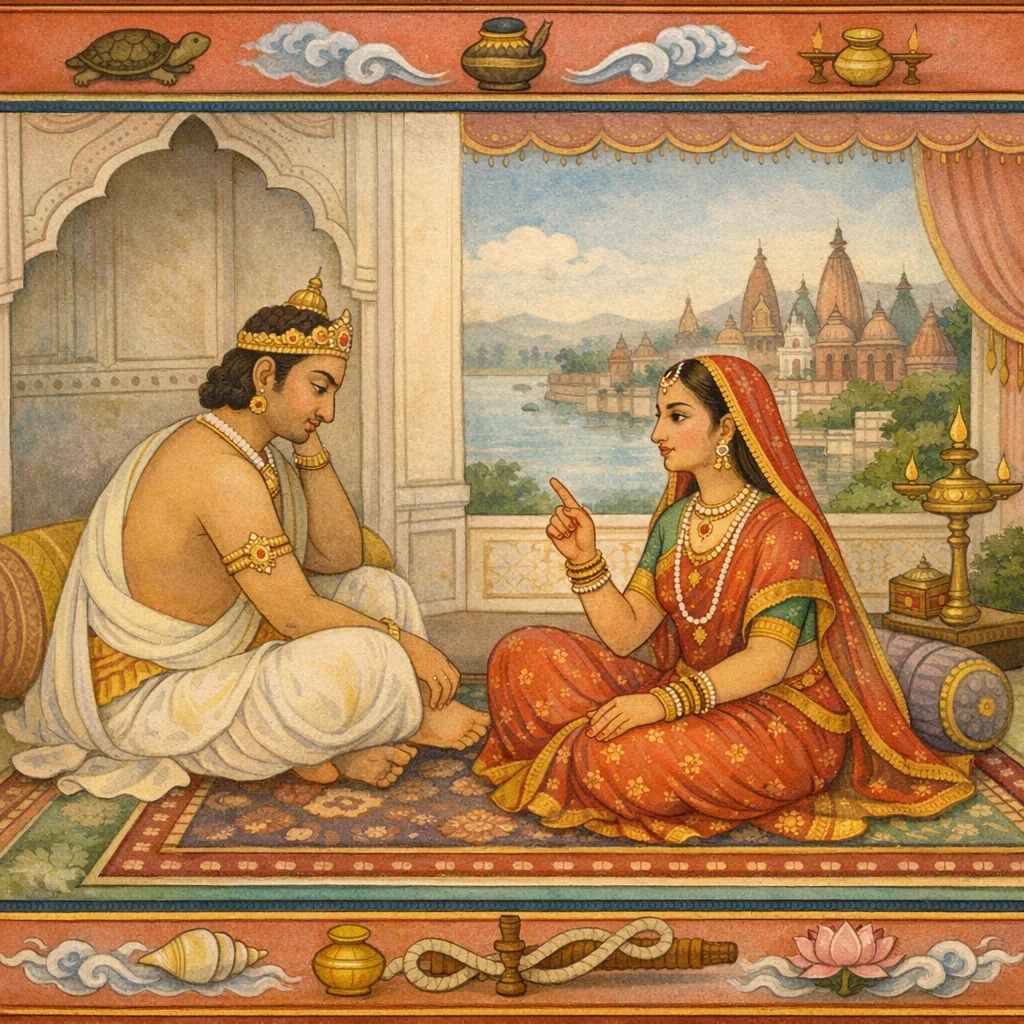
Sūta continues the dynastic account from Jayadhvaja through Tālajaṅgha and the Yādava branches, tracing Vītihotra’s line down to Ananta and Durjaya. The chapter then turns to instruction through story: on the banks of the Kāliṇdī, Durjaya becomes enamored of the apsaras Urvaśī and repeatedly falls into attachment. Returning to his capital, his pativratā wife perceives his inward shame and guides him toward purification rather than fear, urging him to seek Sage Kaṇva for prāyaścitta. Durjaya relapses—marked by violently seizing a Gandharva’s garland and wandering in obsession—until renewed entanglement gives way to awakening and long tapas. Pleased with his austerity, Kaṇva prescribes the decisive remedy: pilgrimage to sacred Vārāṇasī, bathing in the Gaṅgā, offerings to devas and pitṛs, and darśana of the Viśveśvara-liṅga, which destroys sin. Purified, Durjaya returns to rule, begets Supratīka, and the narrative shifts toward Kroṣṭu’s lineage, praised as sin-removing for those who listen.
Shlokas
Verse 1
इति श्रीकूर्मपुराणे षट्साहस्त्र्यां संहितायां पूर्वविभागे एकविशो ऽध्यायः सूत उवाच जयध्वजस्य पुत्रो ऽभूत् तालाजङ्घ इति स्मृतः / शतपुत्रास्तु तस्यासन् तालजङ्घाः प्रकीर्तिताः
Thus, in the Śrī Kūrma Purāṇa, in the six-thousand-verse Saṃhitā, in the Pūrva-bhāga, the twenty-first chapter concludes. Sūta said: “Jayadhvaja had a son remembered by the name Tālajaṅgha. He had a hundred sons, who are celebrated as the Tālajaṅghas.”
Verse 2
तेषां ज्येष्ठो महावीर्यो वीतिहोत्रो ऽभवन्नृपः / वृषप्रभृतयश्चान्ये यादवाः पुण्यकर्मिणः
Among them, the eldest was Vītihotra, a king of great valor. And others too—beginning with Vṛṣa—were Yādavas, performers of meritorious deeds.
Verse 3
वृषो वंशकरस्तेषां तस्य पुत्रो ऽभवन्मधुः / मधोः पुत्रशतं त्वासीद् वृषणस्तस्य वंशभाक्
Among them, Vṛṣa became the establisher of the lineage. His son was Madhu. Madhu had a hundred sons; among them Vṛṣaṇa inherited and carried forward that family line.
Verse 4
वीतिहोत्रसुतश्चापि विश्रुतो ऽनन्त इत्युत / दुर्जयस्तस्य पुत्रो ऽबूत् सर्वशास्त्रविशारदः
And Vītihotra’s son was renowned by the name Ananta. His son was Durjaya—one thoroughly proficient in all the śāstras.
Verse 5
तस्य भार्या रूपवती गुणैः सर्वैरलङ्कृता / पतिव्रतासीत् पतिना स्वधर्मपरिपालिका
His wife was radiant in beauty, adorned with every virtue; steadfast as a pativratā, devoted to her husband, she upheld her own sacred dharma together with her lord.
Verse 6
स कदाचिन्महाभागः कालिन्दीतीरसंस्थिताम् / अपश्यदुर्वशीं देवीं गायन्तीं मधुरस्वनाम्
Once, that illustrious one beheld the goddess Urvaśī standing upon the bank of the Kāliṇdī (Yamunā), singing with a voice of exquisite sweetness.
Verse 7
ततः कामाहतमनास्तत्समीपमुपेत्य वै / प्रोवाच सुचिरं कालं देवि रन्तुं मयार्ऽहसि
Then, his mind smitten by desire, he drew near and spoke: “O Goddess, consent to delight with me for a long time.”
Verse 8
सा देवी नृपतिं दृष्ट्वा रूपलावण्यसंयुतम् / रेमे तेन चिरं कालं कामदेवमिवापरम्
Seeing the king endowed with beauty and charm, that divine maiden delighted in him for a long time, as though he were another Kāma-deva.
Verse 9
कालात् प्रबुद्धो राजा तामुर्वशीं प्राह शोभनाम् / गमिष्यामि पुरीं रम्यां हसन्ती साब्रवीद् वचः
When the time had come, the king awoke and said to radiant Urvaśī, “I shall go to the lovely city.” Smiling, she replied with these words.
Verse 10
न ह्यनेनोपभोगेन भवता राजसुन्दर / प्रीतिः संजायते मह्यं स्थातव्यं वत्सरं पुनः
O handsome king, by such enjoyment with you no true affection arises in me; therefore you must remain apart for another year.
Verse 11
तामब्रवीत् स मतिमान् गत्वा शीघ्रतरं पुरीम् / आगमिष्यामि भूयो ऽत्र तन्मे ऽनुज्ञातुमर्हसि
The wise one said to her, “I shall go swiftly to the city and return here again; therefore, you should grant me permission.”
Verse 12
तमब्रवीत् सा सुभगा तथा कुरु विशांपते / नान्ययाप्सरसा तावद् रन्तव्यं भवत् पुनः
That fortunate apsaras said to him, “So be it—do thus, O lord of the people; but until then you must not sport again with any other apsaras.”
Verse 13
ओमित्युक्त्वा ययौ तूर्णं पुरीं परमशोभनाम् / गत्वा पतिव्रतां पत्नीं दृष्ट्वा बीतो ऽभवन्नृपः
Saying “Om,” he swiftly departed for the supremely splendid city; there, seeing his wife—steadfast in the dharma of pativratā—the king became afraid.
Verse 14
संप्रेक्ष्य सा गुणवती भार्या तस्य पतिव्रता / भीतं प्रसन्नया प्राह वाचा पीनपयोधरा
Seeing him afraid, that virtuous wife—steadfast as a pativratā—spoke to her husband in calm, reassuring words.
Verse 15
स्वामिन् किमत्र भवतो भीतिरद्य प्रवर्तते / तद् ब्रूहि मे यथा तत्त्वं न राज्ञां कीर्तये त्विदम्
O Lord, why has fear arisen in you here today? Tell me the truth exactly as it is; I ask not to praise kings, but to understand the real tattva, the true principle.
Verse 16
स तस्या वाक्यमाकर्ण्य लज्जावनतचेतनः / नोवाच किञ्चिन्नृपतिर्ज्ञानदृष्ट्या विवेद सा
Hearing her words, the king—his mind bowed down in shame—spoke nothing at all; but she, with the eye of true knowledge, understood his inner state.
Verse 17
न भेतव्यं त्वया स्वामिन् कार्यं पापविशोधनम् / भीते त्वयि महाराज राष्ट्रं ते नाशमेष्यति
O Lord, you must not be afraid; the work to be done is the purification of sin. If you, O great king, fall into fear, your kingdom will go to ruin.
Verse 18
तदा स राजा द्युतिमान् निर्गत्य तु पुरात् ततः / गत्वा कण्वाश्रमं पुण्यं दृष्ट्वा तत्र महामुनिम्
Then that radiant king departed from his city; going to the holy hermitage of Kaṇva, he beheld the great sage there.
Verse 19
निशम्य कण्ववदनात् प्रायश्चित्तविधिं शुभम् / जगाम हिमवत्पृष्ठं समुद्दिश्य महाबलः
Having heard from Kaṇva’s own mouth the auspicious procedure of expiation (prāyaścitta), the mighty one set out, fixing his course toward the high back of the Himālaya.
Verse 20
सो ऽपश्यत् पथि राजेन्द्रो गन्धर्ववरमुत्तमम् / भ्राजमानं श्रिया व्योम्नि भूषितं दिव्यमालया
Then the lordly king saw upon the road an excellent, foremost Gandharva—shining with splendor in the sky, adorned with a divine garland.
Verse 21
वीक्ष्य मालाममित्रघ्नः सस्माराप्सरसां वराम् / उर्वशीं तां मनश्चक्रे तस्या एवेयमर्हति
Seeing the garland, the slayer of foes remembered the foremost of the Apsarases. He fixed his mind upon Urvaśī, thinking, “This garland is fit for her alone.”
Verse 22
सो ऽतीव कामुको राजा गन्धर्वेणाथ तेन हि / चकार सुमहद् युद्धं मालामादातुमुद्यतः
That king, exceedingly inflamed with desire, then indeed fought a very great battle with that Gandharva, intent on taking the garland.
Verse 23
विजित्य समरे मालां गृहीत्वा दुर्जयो द्विजाः / जगाम तामप्सरसं कालिन्दीं द्रष्टुमादरात्
Having conquered in battle and taken the garland, the hard-to-defeat brahmin Durjaya went with eagerness to see that apsaras, Kālindī.
Verse 24
अदृष्ट्वाप्सरसं तत्र कामबाणाभिपीडितः / बभ्राम सकलां पृथ्वीं सप्तद्वीपसमन्विताम्
Not seeing the apsaras there, tormented by the arrows of Kāma, he wandered over the entire earth—together with its seven continents (sapta-dvīpa).
Verse 25
आक्रम्य हिमवत्पार्श्वमुर्वशीदर्शनोत्सुकः / जगाम शैलप्रवरं हेमकूटमिति श्रुतम्
Eager to behold Urvaśī, he traversed the flank of the Himālaya and went to Hemakūṭa, the foremost of mountains—so it is heard in tradition.
Verse 26
तत्र तत्राप्सरोवर्या दृष्ट्वा तं सिंहविक्रमम् / कामं संदधिरे घोरं भूषितं चित्रमालया
Here and there, the foremost of the Apsarases, seeing him whose prowess was like a lion’s, were seized by a fierce desire, as he stood adorned with a wondrous garland.
Verse 27
संस्मरन्नुर्वशीवाक्यं तस्यां संसक्तमानसः / न पश्यति स्मताः सर्वागिरिशृङ्गाणिजग्मिवान्
Remembering Urvaśī’s words, with his mind clinging to her, he no longer noticed anything at all; he went on, passing even the mountain-peaks without seeing them.
Verse 28
तत्राप्यप्सरसं दिव्यामदृष्ट्वा कामपीडितः / देवलोकं महामेरुं ययौ देवपराक्रमः
Even there, when he did not behold the radiant celestial apsaras, tormented by desire, Deva-parākrama went on to the world of the gods—toward mighty Meru.
Verse 29
स तत्र मानसं नाम सरस्त्रैलोक्यविश्रुतम् / भेजे शृङ्गाण्यतिक्रम्य स्वबाहुबलभावितः
There he reached the lake called Mānasa, renowned throughout the three worlds; crossing beyond the mountain peaks, he arrived there, relying on the strength of his own arms.
Verse 30
स तस्य तीरे सुभगां चरन्तीमतिलालसाम् / दृष्टवाननवद्याङ्गीं तस्यै मालां ददौ पुनः
There, upon the bank of those waters, he beheld a woman of auspicious beauty wandering, her longing intense. Seeing her limbs flawless, he once again offered her a garland.
Verse 31
स मालया तदा देवीं भूषितां प्रेक्ष्य मोहितः / रेमे कृतार्थमात्मानं जानानः सुचिरं तया
Then, seeing the Goddess adorned with the garland, he was utterly captivated. With her he delighted for a long while, deeming himself fulfilled and his purpose accomplished.
Verse 32
अथोर्वशी राजवर्यं रतान्ते वाक्यमब्रवीत् / किं कृतं भवता पूर्वं पुरीं गत्वा वृथा नृप
Then Urvaśī addressed that best of kings at the close of their amorous sport: “O King, what did you accomplish before, when you went to the city in vain?”
Verse 33
स तस्यै सर्वमाचष्ट पत्न्या यत् समुदीरितम् / कण्वस्य दर्शनं चैव मालापहरणं तथा
He told her everything his wife had spoken—both the meeting with the sage Kaṇva and the incident of the garland being taken away.
Verse 34
श्रुत्वैतद् व्याहृतं तेन गच्छेत्याह हितैषिणी / शापं दास्यति ते कण्वो ममापि भवतः प्रिया
Hearing his words, the well-wishing woman said, “Go.” She added, “The sage Kaṇva will surely lay a curse upon you—though I too am dear to you.”
Verse 35
तयासकृन्महाराजः प्रोक्तो ऽपि मदमोहितः / न तत्यजाथ तत्पार्श्वं तत्र संन्यस्तमानसः
Though she addressed and counseled him again and again, the great king—bewildered by pride and delusion—did not forsake her side; his mind was set down there, wholly bound in attachment.
Verse 36
ततोर्वशी कामरूपा राज्ञे स्वं रूपमुत्कटम् / सुरोमशं पिङ्गलाक्षं दर्शयामास सर्वदा
Then Urvaśī, who could assume forms at will, continually revealed to the king her own striking beauty—hair bristling, and eyes tawny, yellow-brown in hue.
Verse 37
तस्यां विरक्तचेतस्कः स्मृत्वा कण्वाभिभाषितम् / धिङ्मामिति विनिश्चित्यतपः कर्तुं समारभत्
There, his heart turning to detachment, he recalled the words spoken by Sage Kaṇva; deciding, “Shame upon me!”, he began to undertake austerity (tapas).
Verse 38
संवत्सरद्वादशकं कन्दमूलफलाशनः / भूय एव द्वादशकं वायुभक्षो ऽभवन्नृपः
For twelve years the king lived on bulbs, roots, and fruits; and for another twelve years thereafter, he became one who subsisted on air alone.
Verse 39
गत्वा कण्वाश्रमं भीत्या तस्मै सर्वं न्यवेदयत् / वासमप्सरसा भूयस्तपोयोगमनुत्तमम्
Then, in fear, he went to Sage Kaṇva’s hermitage and disclosed everything to him—how the apsaras had come again to dwell there, and how his unsurpassed discipline of tapas and yogic restraint was being put to the test.
Verse 40
वीक्ष्य तं राजशार्दूलं प्रसन्नो भगवानृषिः / कर्तुकामो हि निर्बोजं तस्याघमिदमब्रवीत्
Seeing that king, a tiger among rulers, the blessed sage was pleased; and, wishing to make the king’s sin “seedless,” unable to sprout again, he spoke these words to him.
Verse 41
गच्छ वाराणसीं दिव्यामीश्वराध्युषितां पुरीम् / आस्ते मोचयितुं लोकं तत्र देवो महेश्वरः
Go to divine Vārāṇasī, the city inhabited by Īśvara. There Maheśvara (Hara) abides, to liberate the world.
Verse 42
स्नात्वा संतर्प्य विधिवद् गङ्गायान्देवताः पितॄन् / दृष्ट्वा विश्वेश्वरं लिङ्गङ्किल्बिषान्मोक्ष्यसे ऽखिलात्
Having bathed in the Gaṅgā and, by proper rite, satisfied the deities and the ancestors with offerings, then by beholding the Liṅga of Viśveśvara you will be released entirely from all sins.
Verse 43
प्रणम्य शिरसा कण्वमनुज्ञाप्य च दुर्जयः / वाराणस्यां हरं दृष्ट्वा पापान्मुक्तो ऽभवत् ततः
Bowing his head to Sage Kaṇva and taking his leave, Durjaya went to Vārāṇasī; and upon beholding Hara (Śiva) there, he was freed from his sins.
Verse 44
जगाम स्वपुरीं शुभ्रां पालयामास मेदिनीम् / याजयामास तं कण्वो याचितो घृणया मुनिः
He returned to his radiant capital and governed the earth. Then Sage Kaṇva—moved by compassion when entreated—performed the sacrificial rites (yajña) for him as his officiating priest.
Verse 45
तस्य पुत्रो ऽथ मतिमान् सुप्रतीक इति श्रुतः / बभूव जातमात्रं तं राजानमुपतस्थिरे
Then his son was born—wise and renowned by the name Supratīka. The moment he was born, they drew near and attended upon him, honoring him as their king.
Verse 46
उर्वश्यां च महावीर्याः सप्त देवसुतोपमाः / कन्या जगृहिरे सर्वा जन्धर्वदयिता द्विजाः
And in Urvaśī were born seven daughters of great potency, like the children of the gods. All of them were taken in marriage by the twice-born sages (dvija), beloved of the Gandharvas.
Verse 47
एष व कथितः सम्यक् सहस्त्रजित उत्तमः / वंशः पापहरो नृणां क्रोष्टोरपि निबोधत
Thus the excellent Sahasrajit has been properly described. Now understand also the lineage of Kroṣṭu—this dynasty is said to remove the sins of men.
Frequently Asked Questions
Desire-driven transgression leads to instability, but sin can be rendered “seedless” through a sequence of remorse, guided prāyaścitta, sustained tapas, and culminating tīrtha practice—especially Gaṅgā bathing and Viśveśvara-liṅga darśana at Vārāṇasī.
It is described as Īśvara’s own city where Maheśvara abides for world-liberation; ritual purity (snāna, tarpaṇa) paired with direct darśana of Viśveśvara functions as the decisive purifier that removes all sins.
After concluding Durjaya’s purification and succession (Supratīka), the text explicitly signals a transition: it has described Sahasrajit properly and now turns to the lineage of Kroṣṭu, continuing the dynastic framework.