Adhyaya 11
Devī-tattva, Śakti–Śaktimān doctrine, Kāla–Māyā cosmology, and Māheśvara Yoga instruction
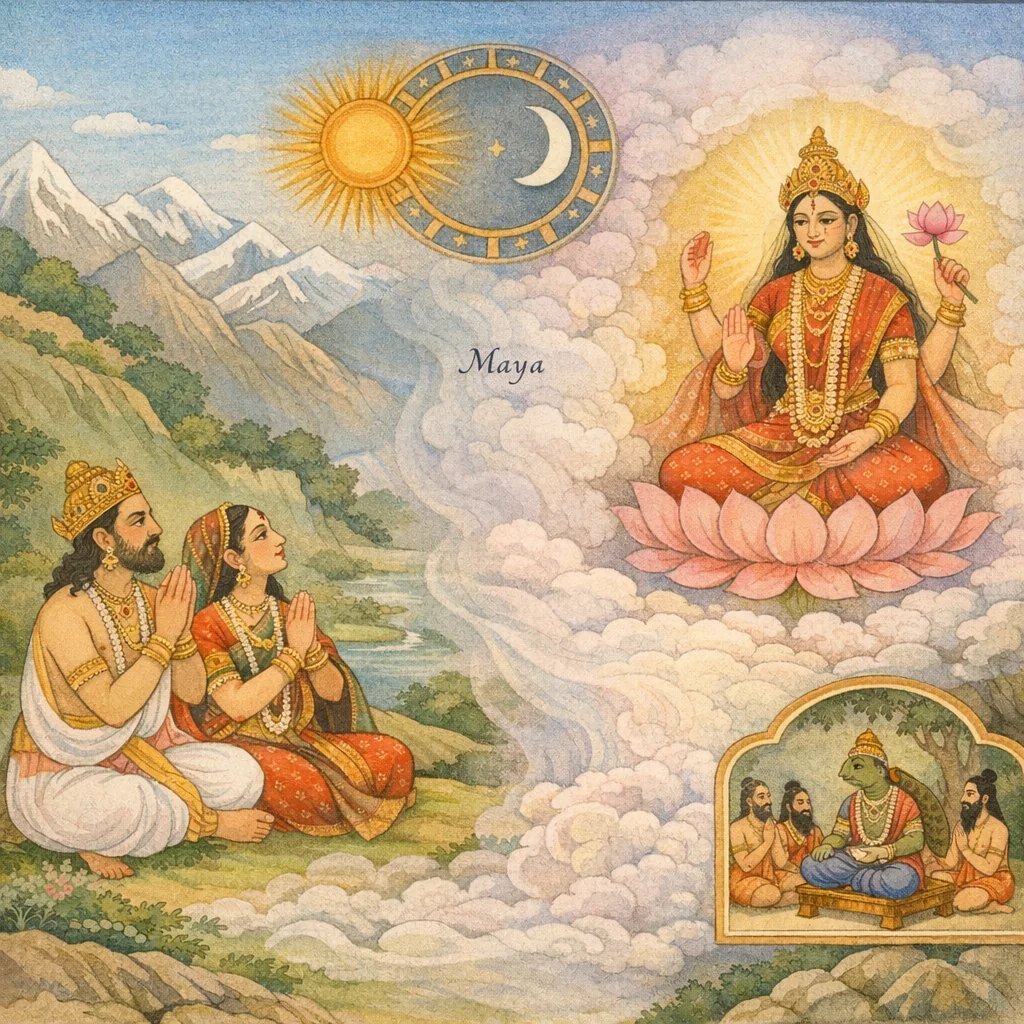
Continuing Lord Kūrma’s teaching to the assembled sages, the chapter opens with a cosmogonic scene: Brahmā’s austerity brings forth Rudra, the masculine and feminine principles are distinguished, and the eleven Rudras are appointed. The narrative then turns to Devī’s descent—Satī and later Pārvatī—establishing her as Mahēśvarī, sharing Śaṅkara’s very being. In response to the sages’ questions, Kūrma imparts a guarded higher doctrine: Devī is the one, partless, all-pervading Śakti (Vyoma), working through upādhis and expressed as peace, knowledge, establishment, and withdrawal. Kāla (Time) is exalted as the operative governor of manifestation and pralaya, while Māyā is identified as the Lord’s power by which the universe revolves in delusion. Himavān’s vision of Devī’s terrifying sovereign form and her gentle lotus-like form frames an extensive hymn of names and attributes, mapping her across Vedic, Sāṃkhya, Yogic, and Purāṇic registers. The closing instruction urges exclusive refuge in Īśvara, affirms the Veda as the sole authority for dharma and varṇāśrama, critiques heterodox systems as delusive, and outlines meditation, karma-yoga, devotion, and liberating knowledge leading to non-return. The chapter ends by foreshadowing the next topic: genealogies and creation-lineages beginning with Bhṛgu and other primordial seers.
Shlokas
Verse 1
इति श्रीकूर्मपुराणे षट्साहस्त्र्यां संहितायां पूर्वविभागे देशमो ऽध्यायः श्रीकूर्म उवाच एवं सृष्ट्वा परीच्यादीन् देवदेवः पितामहः / सहैव मानसैः पुत्रैस्तताप परमं तपः
Thus, in the Śrī Kūrma Purāṇa, in the six-thousand-verse Saṃhitā, in the Pūrva-bhāga—here begins the chapter. Lord Kūrma said: Having thus created Parīci and the other sages, the Grandfather Brahmā, the God of gods, together with his mind-born sons, undertook the highest austerity (tapas).
Verse 2
तस्यैवं तपतो वक्त्राद् रुद्रः कालाग्निसन्निभः / त्रिशूलपाणिरीशानः प्रदुरासीत् त्रिलोचनः
As he continued his austerities in this manner, Rudra—resembling the fire of Kāla, the cosmic blaze of Time—manifested from his very face: the three-eyed Lord Īśāna, bearing the trident in his hand.
Verse 3
अर्धनारीनरवपुः दुष्प्रेक्ष्यो ऽतिभयङ्करः / विभजात्मानमित्युक्त्वा ब्रह्मा चान्तर्दधे भयात्
Bearing a form half woman and half man—hard to behold and exceedingly terrifying—he said, “Divide yourself,” and then Brahmā, out of fear, vanished from sight.
Verse 4
तथोक्तो ऽसौ द्विधा स्त्रीत्वं पुरुषत्वमथाकरोत् / बिभेद पुरुषत्वं च दशधा चैकधा पुनः
Thus instructed, He made creation twofold as femininity and masculinity; and again He further differentiated the masculine principle—into tenfold and also into a single, unitary form.
Verse 5
एकादशैते कथिता रुद्रास्त्रिभुवनेश्वराः / कपालोशादयो विप्रा देवकार्ये नियोजिताः
These eleven Rudras are declared to be the lords of the three worlds. Beginning with Kapālośa and the others, O brahmins, they are appointed for the work of the gods—the divine administration.
Verse 6
सौम्यासौम्यैस्तथा शान्ताशान्तैः स्त्रीत्वं च स प्रभुः / बिभेद बहुधा देवः स्वरूपैरसितैः सितैः
That sovereign Lord diversified Himself in many ways—into gentle and non-gentle, peaceful and non-peaceful, and even into the feminine condition—manifesting as the Deity through forms that are dark and bright.
Verse 7
ता वै विभूतयो विप्रा विश्रुताः शक्तयो भुवि / लक्ष्म्यादयो याभिरीशा विश्वंव्याप्नोति शाङ्करी
O Brahmins, these indeed are the famed manifest powers (vibhūtis) on earth—beginning with Lakṣmī—through which the Supreme Goddess, the Śāṅkarī (consort and power of Śaṅkara), pervades the entire universe.
Verse 8
विभज्य पुररीशानी स्वात्मानं शङ्कराद् विभोः / महादेवनियोगेन पितामहमुपस्थिता
Having separated her own essence from Śaṅkara—the all-pervading Lord—Purarīśānī, by Mahādeva’s command, approached Pitāmaha (Brahmā).
Verse 9
तामाह भगवान् ब्रह्मा दक्षस्य दुहिता भव / सापि तस्य नियोगेन प्रादुरासीत् प्रजापतेः
The Blessed Lord Brahmā said to her, “Become the daughter of Dakṣa.” And she, by his appointment, manifested as the offspring of the Prajāpati.
Verse 10
नियोगाद् ब्रह्मणो देवीं ददौ रुद्राय तां सतीम् / दक्षाद् रुद्रो ऽपि जग्राह स्वकीयामेव शूलभृत्
By Brahmā’s injunction, Dakṣa gave that goddess Satī to Rudra; and Rudra, the bearer of the trident, accepted her from Dakṣa as his own rightful consort.
Verse 11
प्रजापतिं विनिन्द्यैषा कालेन परमेश्वरी / मेनायामभवत् पुत्री तदा हिमवतः सती
In due course, the Supreme Goddess—having censured Prajāpati (Dakṣa)—was born as Menā’s daughter, becoming Satī once more as the child of Himavat.
Verse 12
स चापि पर्वतवरो ददौ रुद्राय पार्वतीम् / हिताय सर्वदेवानां त्रिलोकस्यात्मनो ऽपि च
That foremost of mountains, Himālaya, gave Pārvatī to Rudra in marriage—for the welfare of all the gods, for the good of the three worlds, and indeed for his own highest good as well.
Verse 13
सैषा माहेश्वरी देवी शङ्करार्धशरीरिणी / शिवा सती हैमवती सुरासुरनमस्कृता
She indeed is the Maheshvarī Goddess, sharing half the body of Śaṅkara. She is Śiva’s auspicious Power—Satī, Haimavatī (Pārvatī), bowed to by gods and asuras alike.
Verse 14
तस्याः प्रभावमतुलं सर्वे देवाः सवासवाः / विन्दन्ति मुनयो वेत्ति शङ्करो वा स्वयं हरिः
All the gods—Indra included—recognize her incomparable power; the sages perceive it as well. Yet it is fully known only to Śaṅkara (Śiva), or to Hari (Viṣṇu) Himself.
Verse 15
एतद् वः कथितं विप्राः पुत्रत्वं परमेष्ठिनः / ब्रह्मणः पद्मयोनित्वं शङ्करस्यामितौजसः
O Brāhmaṇa sages, I have thus explained to you the sonship of Parameṣṭhin (Brahmā), Brahmā’s lotus-born nature, and the immeasurable splendour of Śaṅkara.
Verse 16
सूत उवाच इत्याकर्ण्याथ मुनयः कूर्मरूपेण भाषितम् / विष्णुना पुनरेवैनं प्रणता हरिम्
Sūta said: Having thus heard the words spoken by Viṣṇu in the form of the Tortoise, the sages once again bowed down in reverence to that Lord Hari.
Verse 17
ऋषय ऊचुः कैषा भगवती देवी शङ्करार्धशरीरिणी / शिवा सती हैमवती यथावद् ब्रूहि पृच्छताम्
The sages said: “Who indeed is that blessed Goddess—the one who is half the body of Śaṅkara—known as Śivā, as Satī, and as Haimavatī? Explain her correctly to us who are asking.”
Verse 18
तेषां तद् वचनं श्रुत्वा मुनीनां पुरुषोत्तमः / प्रत्युवाच महायोगी ध्यात्वा स्वं परमं पदम्
Having heard the words of those sages, the Supreme Person—the great Yogin—replied, after contemplating His own highest abode (the transcendent state).
Verse 19
श्रीकूर्म उवाच पुरा पितामहेनोक्तं मेरुपृष्ठे सुशोभनम् / रहस्यमेतद् विज्ञानं गोपनीयं विशेषतः
Śrī Kūrma said: “Long ago this was taught by the Grandfather (Brahmā) upon the splendid slopes of Mount Meru. This is secret, higher knowledge, and it must be guarded with special care.”
Verse 20
सांख्यानां परमं सांख्यं ब्रह्मविज्ञानमुत्तमम् / संसारार्णवमग्नानां जन्तूनामेकमोचनम्
Among all systems of Sāṃkhya, the highest Sāṃkhya is the supreme knowledge of Brahman; it alone is the single liberation for beings sunk in the ocean of worldly becoming (saṃsāra).
Verse 21
या सा माहेश्वरी शक्तिर्ज्ञानरूपातिलालसा / व्योमसंज्ञा परा काष्ठा सेयं हैमवती मता
That supreme Power of Maheshvara, ever yearning toward the form of Knowledge, is called “Vyoma”—the all-pervading expanse—the highest limit and final state; she is revered as Haimavatī.
Verse 22
शिवा सर्वगतानान्ता गुणातीता सुनिष्कला / एकानेकविभागस्था ज्ञानरूपातिलालसा
She—Śivā, the supremely auspicious—pervades all and is endless; she transcends the guṇas and is perfectly partless. Though one, she stands as the ground of the many divisions, and her very nature is consciousness, ever intent on awakening true knowledge.
Verse 23
अनन्या निष्कले तत्त्वे संस्थिता तस्य तेजसा / स्वाभाविकी च तन्मूला प्रभा भानोरिवामला
Non-different from Him, she abides in the partless Reality through His radiance; natural to Him and rooted in Him, she is the stainless splendor—like the pure light of the sun.
Verse 24
एका माहेश्वरी शक्तिरनेकोपाधियोगतः / परावरेण रूपेण क्रीडते तस्य सन्निधौ
The Maheshvarī Power of Śiva is one; yet, through association with many upādhis (limiting adjuncts), she plays her līlā—manifesting in higher and lower forms—in the very presence of the Supreme Lord.
Verse 25
सेयं करोति सकलं तस्याः कार्यमिदं जगत् / न कार्यं नापि करणमीश्वरस्येति सूरयः
She, the Divine Power, accomplishes everything; this entire universe is her effect. The wise declare that Īśvara has no task to be done, nor any instrument by which it is done.
Verse 26
चतस्त्रः शक्तयो देव्याः स्वरूपत्वेन संस्थिताः / अधिष्ठानवशात् तस्याः शृणुध्वं मुनिपुङ्गवाः
The Goddess bears four powers (śaktis), established as her very own essential nature. According to the distinction of her seats of manifestation, hear them, O best of sages.
Verse 27
शान्तिर्विद्या प्रतिष्ठा च निवृत्तिश्चेतिताः स्मृतः / चतुर्व्यूहस्ततो देवः प्रोच्यते परमेश्वरः
Peace (śānti), sacred knowledge (vidyā), firm establishment (pratiṣṭhā), and withdrawal in renunciation (nivṛtti)—these are remembered as His divine powers; therefore Parameśvara is taught as the Lord of the fourfold manifestation (catur-vyūha).
Verse 28
अनया परया देवः स्वात्मानन्दं समश्नुते / चतुर्ष्वपि च वेदेषु चतुर्मूर्तिर्महेश्वरः
Through this supreme devotion, the Divine attains the bliss of His own Self. Indeed, throughout all four Vedas, Maheśvara is proclaimed as four-formed (catur-mūrti).
Verse 29
अस्यास्त्वनादिसंसिद्धमैश्वर्यमतुलं महत् / तत्सम्बन्धादनन्ताया रुद्रेण परमात्मना
Her incomparable, vast sovereignty is beginningless and eternally accomplished; and through her relation with Rudra, the Supreme Self (Paramātman), she is known as Anantā—the Infinite.
Verse 30
सैषा सर्वेश्वरी देवी सर्वभूतप्रवर्तिका / प्रोच्यते भगवान् कालो हरिः प्राणो महेश्वरः
She indeed is the Sovereign Goddess, the Impeller of all beings. She is also spoken of as the Blessed Lord (Bhagavān): as Time (Kāla), as Hari, as the Life-breath (Prāṇa), and as Maheśvara.
Verse 31
तत्र सर्वमिदं प्रोतमोतं चैवाखिलं जगत् / स कालो ऽग्निर्हरो रुद्रो गीयते वेदवादिभिः
In Him this entire universe is woven and interwoven—indeed, all the worlds. That very One is praised by the expounders of the Veda as Time, as Fire, as Hara, and as Rudra.
Verse 32
कालः सृजति भूतानि कालः संहरते प्रजाः / सर्वे कालस्य वशगा न कालः कस्यचिद् वशे
Time brings beings into manifestation; Time again withdraws all creatures. All are subject to Time’s governance, but Time itself is not subject to anyone.
Verse 33
प्रधानं पुरुषस्तत्त्वं महानात्मा त्वहङ्कृतिः / कालेनान्यानि तत्त्वानि समाविष्टानि योगिना
Pradhāna (primordial Nature) and Puruṣa (Consciousness) are the fundamental principles; from them arise Mahat (the Great Principle, cosmic intelligence) and then Ahaṅkāra (the sense of “I”). In due course, through Time, the other tattvas too are drawn back and merged—by the Yogin who knows the way of reabsorption.
Verse 34
तस्य सर्वजगत्सूतिः शक्तिर्मायेति विश्रुता / तयेदं भ्रामयेदीशो मायावी पुरुषोत्तमः
His power—by which the entire universe is generated—is renowned as Māyā. By that very Māyā, the Lord, the wondrous wielder of illusion, the Supreme Person, causes this world to revolve in delusion.
Verse 35
सैषा मायात्मिका शक्तिः सर्वाकारा सनातनी / वैश्वरूप्यं महेशस्य सर्वदा संप्रकाशयेत्
This is that eternal Power (Śakti), whose very nature is Māyā and who assumes all forms; she ever makes manifest the universal form of Mahādeva (Maheśvara).
Verse 36
अन्याश्च शक्तयो मुख्यास्तस्य देवस्य निर्मिताः / ज्ञानशक्तिः क्रियाशक्तिः प्राणशक्तिरिति त्रयम्
Other principal powers too are manifested from that Lord: the power of knowledge, the power of action, and the power of vital life-breath (prāṇa)—these three.
Verse 37
सर्वासामेव शक्तीनां शक्तिमन्तो विनिर्मिताः / माययैवाथ विप्रेन्द्राः सा चानादिरनन्तया
All the possessors of power are fashioned from the totality of powers—indeed, by Māyā alone, O best of Brahmins; and that Māyā is beginningless, sustained by the Infinite.
Verse 38
सर्वशक्त्यात्मिका माया दुर्निवारा दुरत्यया / मायावी सर्वशक्तीशः कालः कालकारः प्रभुः
Māyā—whose very nature is constituted of all powers—is irresistible and difficult to cross. The Lord, the wielder of Māyā, the sovereign of all powers—Time (Kāla) itself—is the master who fashions time.
Verse 39
करोति कालः सकलं संहरेत् काल एव हि / कालः स्थापयते विश्वं कालाधीनमिदं जगत्
Time (Kāla) accomplishes everything; indeed, Time alone withdraws (all things). Time establishes the universe, and this entire world exists under the governance of Time.
Verse 40
लब्ध्वा देवाधिदेवस्य सन्निधिं परमेष्ठिनः / अनन्तस्याखिलेशस्य शंभोः कालात्मनः प्रभोः
Having attained the immediate presence of the God of gods—the Supreme Lord, the Infinite, the ruler of all—Śambhu, who is the very Self of Time (Kāla), the sovereign Master.
Verse 41
प्रधानं पुरुषो माया माया चैवं प्रपद्यते / एका सर्वगतानन्ता केवला निष्कला शिवा
Pradhāna (primordial Nature), Puruṣa (the conscious principle), and Māyā—Māyā is spoken of in this very way. Yet She is One: all-pervading and endless, absolute and partless—Śivā, the auspicious Supreme Reality.
Verse 42
एका शक्तिः शिवैको ऽपि शक्तिमानुच्यते शिवः / शक्तयः शक्तिमन्तो ऽन्ये सर्वशक्तिसमुद्भवाः
There is one Power (Śakti); and the one Śiva is also called the Possessor of Power (Śaktimān). All other powers and their possessors arise from that totality of Power.
Verse 43
शक्तिशक्तिमतोर्भेदं वदन्ति परमार्थतः / अभेदं चानुपश्यन्ति योगिनस्तत्त्वचिन्तकाः
In ultimate truth, they speak of a distinction between Śakti (divine Power) and the Śaktimat (the Possessor of Power); yet the yogins—contemplators of reality—directly perceive their non-difference as well.
Verse 44
शक्तयो गिरजा देवी शक्तिमन्तो ऽथ शङ्करः / विशेषः कथ्यते चायं पुराणे ब्रह्मवादिभिः
The powers (śaktis) are Girijā Devī (Pārvatī), while the possessor of those powers (śaktimān) is Śaṅkara. This particular distinction is taught in the Purāṇa by the expounders of Brahman.
Verse 45
भोग्या विश्वेश्वरी देवी महेश्वरपतिव्रता / प्रोच्यते भगवान् भोक्ता कपर्दे नीललोहितः
The Goddess—Viśveśvarī, devoted to Maheśvara as her lord—is declared to be the ‘enjoyed’ (bhogyā); while the Blessed Lord—Kapardin, the blue-and-red-hued (Nīlalohita)—is proclaimed the ‘enjoyer’ (bhoktā).
Verse 46
मन्ता विश्वेश्वरो देवः शङ्करो मन्मथान्तकः / प्रोच्यते मतिरीशानी मन्तव्या च विचारतः
He is the Inner Guide (the Thinker), the Lord of the universe—God; Śaṅkara, the slayer of Manmatha (Kāma). This understanding is taught as the insight born of Īśānī (the Lord’s power, Śakti), and it is to be contemplated with discerning reflection.
Verse 47
इत्येतदखिलं विप्राः शक्तिशक्तिमदुद्भवम् / प्रोच्यते सर्ववेदेषु मुनिभिस्तत्त्वदर्शिभिः
Thus, O Brahmins, this entire doctrine—arising from Śakti and the Śaktimān (the Power and its Lord)—is taught throughout all the Vedas by sages who are seers of truth.
Verse 48
एतत् प्रदर्शितं दिव्यं देव्या माहात्म्यमुत्तमम् / सर्ववेदान्तवेदेषु निश्चितं ब्रह्मवादिभिः
Thus has been set forth the divine and unsurpassed greatness of the Goddess (Devī), established with certainty in all the Vedāntic teachings by the knowers of Brahman.
Verse 49
एकं सर्वगतं सूक्ष्मं कूटस्थमचलं ध्रुवम् / योगिनस्तत् प्रपश्यन्ति महादेव्याः परं पदम्
That supreme state of Mahādevī—one, all-pervading, subtle, immutable, unmoving, and eternal—this the yogins directly behold in contemplative vision.
Verse 50
आनन्दमक्षरं ब्रह्म केवलं निष्कलं परम् / योगिनस्तत् प्रपश्यन्ति महादेव्याः परं पदम्
That Brahman is bliss itself—imperishable (akṣara), absolute, partless, and supreme. Yogins directly behold That as the highest state: the supreme abode of the Great Goddess (Mahādevī).
Verse 51
परात्परतरं तत्त्वं शाश्वतं शिवमच्युतम् / अनन्तप्रकृतौ लीनं देव्यास्तत् परमं पदम्
That Reality, higher than the highest, is eternal—Śiva, the Unfailing (Acyuta). Merged into boundless Prakṛti, that is the Goddess Devī’s Supreme Abode.
Verse 52
शुभं निरञ्जनं शुद्धं निर्गुणं द्वैतवर्जितम् / आत्मोपलब्धिविषयं देव्यास्तत् परमं पदम्
Auspicious, stainless, pure, beyond the guṇas and free of all duality—this is Devī’s supreme state, knowable only through direct realization of the Self (Ātman).
Verse 53
सैषा धात्री विधात्री च परमानन्दमिच्छताम् / संसारतापानखिलान् निहन्तीश्वरसंश्रया
This teaching and discipline is both sustainer and ordainer; for those who seek supreme bliss, it destroys all the burnings of saṃsāra—being grounded in refuge in the Lord, Īśvara.
Verse 54
तस्माद् विमुक्तिमन्विच्छन् पार्वतीं परमेश्वरीम् / आश्रयेत् सर्वभावानामात्मभूतां शिवात्मिकाम्
Therefore, one who seeks final liberation should take refuge in Pārvatī, the Supreme Goddess (Parameśvarī)—she who is the very Self of all beings and whose essence is Śiva.
Verse 55
लब्ध्वा च पुत्रीं शर्वाणीं तपस्तप्त्वा सुदुश्चरम् / सभार्यः शरं यातः पार्वतीं परमेश्वरीम्
And having obtained a daughter named Śarvāṇī—after performing extremely difficult tapas (austerities)—he, together with his wife, went to take refuge in Pārvatī, the Supreme Goddess (Parameśvarī).
Verse 56
तां दृष्ट्वा जायमानां च स्वेच्छयैव वराननाम् / मेना हिमवतः पत्नी प्राहेदं पर्वतेश्वरम्
Seeing that lovely-faced maiden being born of her own accord, Menā—the wife of Himavat—spoke these words to the Lord of the mountains.
Verse 57
मेनोवाच पश्य बालामिमां राजन् राजीवसदृशाननाम् / हिताय सर्वभूतानां जाता च तपसावयोः
Menā said: “Behold this young girl, O King—her face is like a lotus. For the welfare of all beings, she has been born from the austerities of us two.”
Verse 58
सो ऽपि दृष्ट्वा ततः पुत्रीं तरुणादित्यसन्निभाम् / कपर्दिनीं चतुर्वक्त्रां त्रिनेत्रामतिलालसाम्
Then he too, seeing that daughter—radiant like the newly risen sun—beheld her with matted hair, four-faced, three-eyed, and exceedingly enchanting.
Verse 59
अष्टहस्तां विशालाक्षीं चन्द्रावयवभूषणाम् / निर्गुणां सगुणां साक्षात् सदसद्व्यक्तिवर्जिताम्
I beheld Her with eight arms and wide, expansive eyes, adorned with lunar ornaments—yet in truth She is both Nirguṇa and Saguṇa, directly present, and free from all manifestation as either being or non-being.
Verse 60
प्रणम्य शिरसा भूमौ तेजसा चातिविह्वलः / भीतः कृताञ्जलिस्तस्याः प्रोवाच परमेश्वरीम्
Bowing with his head to the ground, overwhelmed by Her radiance and trembling with awe, he—hands joined in reverence—addressed that Supreme Goddess.
Verse 61
हीमवानुवाच का त्वं देवि विशालाक्षि शशाङ्कावयवाङ्किते / न जाने त्वामहं वत्से यथावद् ब्रूहि पृच्छते
Himavān said: “Who are you, O Goddess of wide eyes, adorned and marked with the moon? I do not know you, dear child. Speak rightly and clearly, for I ask.”
Verse 62
गिरीन्द्रवचनं श्रुत्वा ततः सा परमेश्वरी / व्याजहार महाशैलं योगिनामभयप्रदा
Having heard the words of Girīndra, Lord of the mountains, the Supreme Goddess, Parameśvarī, then addressed the great mountain—she who grants fearlessness to yogins.
Verse 63
देव्युवाच मां विद्ध परमां शक्तिं परमेश्वरसमाश्रयाम् / अनन्यामव्ययामेकां यां पश्यन्ति मुमुक्षवः
The Goddess said: “Know Me as the Supreme Power (Śakti), abiding in and supported by the Supreme Lord. I am the One, imperishable, non-dual Śakti, beheld by those who seek liberation.”
Verse 64
अहं वै सर्वभावानात्मा सर्वान्तरा शिवा / शाश्वतैश्वर्यविज्ञानमूर्तिः सर्वप्रवर्तिका
“I alone am the Self (Ātman) of all beings—Śivā, dwelling within all as the inner presence. I am the embodiment of eternal sovereignty and true knowledge, the one who sets all in motion and impels every activity.”
Verse 65
अनन्तानन्तमहिमा संसारार्णवतारिणी / दिव्यं ददामि ते चक्षुः पश्य मे रूपमैश्वरम्
“Of endless, boundless majesty, I ferry beings across the ocean of saṃsāra. I grant you divine sight—behold now My sovereign (aiśvara) form.”
Verse 66
एतावदुक्त्वा विज्ञानं दत्त्वा हिमवते स्वयम् / स्वं रूपं दर्शयामास दिव्यं तत् पारमेश्वरम्
Thus having spoken, and having bestowed true discernment upon Himavat, the Lord Himself then revealed His own form—divine, transcendent, and supremely sovereign, the Parameśvara.
Verse 67
कोटिसूर्यप्रितीकाशं तेजोबिम्बं निराकुलम् / ज्वालामालासहस्त्राढ्यं कालानलशतोपमम्
He beheld a flawless orb of divine radiance, shining like ten million suns—untroubled and perfectly serene—adorned with thousands of garlands of flame, comparable to a hundred cosmic fires of Time (kālāgni).
Verse 68
दंष्ट्राकरालं दुर्धर्ष जटामण्डलमण्डितम् / त्रिशूलवरहस्तं च घोररूपं भयानकम्
“(He beheld Him) with fearsome fangs, unassailable, adorned with a circling mass of matted locks; holding the trident in His hand—of dreadful form, terrifying.”
Verse 69
प्रशान्तं सौम्यवदनमनन्ताश्चर्यसंयुतम् / चन्द्रावयवलक्ष्माणं चन्द्रकोटिसमप्रभम्
He was utterly serene, with a gentle and gracious face, endowed with endless, wondrous excellences—marked with the beauty of moonlike features, and shining with a radiance equal to ten million moons.
Verse 70
किरीटिनं गदाहस्तं नूपुरैरुपशोभितम् / दिव्यमाल्याम्बरधरं दिव्यगन्धानुलेपनम्
Crowned with a diadem, holding a mace (gadā) in His hand, and adorned with anklets—wearing celestial garlands and robes, and anointed with divine fragrances.
Verse 71
शङ्खचक्रधरं काम्यं त्रिनेत्रं कृत्तिवाससम् / अण्डस्थं चाण्डबाह्यस्थं बाह्यमाभ्यन्तरं परम्
He is to be contemplated as the beloved Lord bearing conch and discus; as the three‑eyed One clad in a hide; present within the cosmic egg and also beyond it—supreme, outwardly manifest and inwardly indwelling.
Verse 72
सर्वशक्तिमयं शुभ्रं सर्वाकारं सनातनम् / ब्रह्मोन्द्रोपेन्द्रयोगीन्द्रैर्वन्द्यमानपदाम्बुजम्
He is the embodiment of all powers, radiant and pure; the eternal One who assumes every form—whose lotus-feet are worshipped by Brahmā, Indra, Upendra (Viṣṇu), and the greatest of yogins.
Verse 73
सर्वतः पाणिपादान्तं सर्वतो ऽक्षिशिरोमुखम् / सर्वमावृत्य तिष्ठन्तं ददर्श परमेश्वरम्
He beheld the Supreme Lord—whose hands and feet are everywhere, whose eyes, heads, and faces are on all sides—standing while enveloping and pervading the whole of existence.
Verse 74
दृष्ट्वा तदीदृशं रूपं देव्या माहेश्वरं परम् / भयेन च समाविष्टः स राजा हृष्टमानसः
Beholding that very form—the Goddess’s supreme manifestation, majestic like Maheśvara—the king was seized by awe-fear, yet his mind was filled with joy.
Verse 75
आत्मन्याधाय चात्मानमोङ्कारं समनुस्मरन् / नाम्नामष्टसहस्त्रेण तुष्टाव परमेश्वरीम्
Placing his own self within the Self, and steadily recollecting the syllable Oṁ, he praised the Supreme Goddess, Parameśvarī, with the eight thousand sacred Names.
Verse 76
हीमवानुवाच शिवोमा परमा शक्तिरनन्ता निष्कलामला / शान्ता माहेश्वरी नित्या शाश्वती परमाक्षरा
Himavān said: “Śivā-Umā is the supreme Śakti—endless, partless, and stainless. She is Peace itself; the sovereign energy of Maheśvara, the Great Lord; eternal, everlasting, the supreme Imperishable Reality.”
Verse 77
अचिन्त्या केवलानन्त्या शिवात्मा परमात्मिका / अनादिरव्यया शुद्धा देवात्मा सर्वगाचला
She is inconceivable—absolute and endless; her very Self is Śiva, her essence the Supreme Self. Beginningless, imperishable, and pure, she is of divine nature—all-pervading and unmoving.
Verse 78
एकानेकविभागस्था मायातीता सुनिर्मला / महामाहेश्वरी सत्या महादेवी निरञ्जना
She abides as the One and also as the many in all differentiated states; she is beyond Māyā, utterly pure. She is Mahāmāheśvarī, the great power of Maheśvara—the Truth itself, Mahādevī, stainless and untainted.
Verse 79
काष्ठा सर्वान्तरस्था च चिच्छक्तिरतिलालसा / नन्दा सर्वात्मिका विद्या ज्योतीरूपामृताक्षरा
She is Kāṣṭhā, abiding within all; she is cicchakti, the power of Consciousness, intensely eager to manifest. She is Nandā, the all-pervading Vidyā that is the Self of all; she is of the form of Light, and her syllables are immortal nectar.
Verse 80
शान्तिः प्रतिष्ठा सर्वेषां निवृत्तिरमृतप्रदा / व्योममूर्तिर्व्योमलया व्योमाधाराच्युतामरा
She is Peace itself—the sure foundation of all; the power of nivṛtti, withdrawal, that bestows immortality. Her form is like the vast sky; she dissolves into the sky-like Absolute; she is supported by vyoma, pure space-consciousness—the imperishable, deathless Divine.
Verse 81
अनादिनिधनामोघा कारणात्मा कलाकला / क्रतुः प्रथमजा नाभिरमृतस्यात्मसंश्रया
Beginningless and endless, unfailing—He is the very Self of causality, the source of all parts and their powers. He is the sacred rite (kratu), the first-born principle; the navel from which immortality (amṛta) arises—resting in His own Self alone.
Verse 82
प्राणेश्वरप्रिया माता महामहिषघातिनी / प्राणेश्वरी प्राणरूपा प्रधानपुरुषेश्वरी
She is beloved of the Lord of life, the universal Mother, the slayer of the great buffalo-demon. She is the sovereign Lady of prāṇa, the very form of the life-breath, and the Supreme Mistress of Pradhāna (Prakṛti) and Puruṣa.
Verse 83
सर्वशक्तिकलाकारा ज्योत्स्ना द्योर्महिमास्पदा / सर्वकार्यनियन्त्री च सर्वभूतेश्वरेश्वरी
She is the very form and embodiment of all powers (śakti) and their arts; the moonlight that is the seat of heaven’s splendor. She is the regulator of every action, and the sovereign Mistress of the Lord of all beings.
Verse 84
अनादिरव्यक्तगुहा महानन्दा सनातनी / आकाशयोनिर्योगस्था महायोगेश्वरेश्वरी
She is without beginning, hidden in the unmanifest as the secret depth of all; the Great Bliss, eternal. Born of the vast expanse of ākāśa, established in Yoga, she is the Supreme Mistress of Mahāyoga, the sovereign Yogēśvarī.
Verse 85
महामाया सुदुष्पूरा मूलप्रकृतिरीश्वरी / संसारयोनिः सकला सर्वशक्तिसमुद्भवा
She is Mahāmāyā, unfathomable and hard to transcend; the Sovereign Root-Nature itself (Mūla-Prakṛti). She is the womb of saṃsāra, complete in every aspect, and the very source from which all powers arise.
Verse 86
संसारपारा दुर्वारा दुर्निरोक्ष्या दुरासदा / प्राणशक्तिः प्रणविद्या योगिनी परमा कला
She is the far shore beyond saṃsāra—hard to cross, unreachable, difficult to behold, and not easily approached. She is the power of the life-breath, the wisdom of the Pranava (Oṃ), the Yoginī, and the supreme kalā, the highest creative potency.
Verse 87
महाविभूतिर्दुर्धर्षा मूलप्रकृतिसंभवा / अनाद्यनन्तविभवा परार्था पुरुषारणिः
She is Mahā-vibhūti, the great cosmic power—irresistible and unconquerable—born of the root-Prakṛti. Beginningless and of endless capacities, she exists for the sake of Puruṣa and is the churning-stick that brings forth Puruṣa’s manifestation.
Verse 88
सर्गस्थित्यन्तकरणी सुदुर्वाच्या दुरत्यया / शब्दयोनिः शब्दमयी नादाख्या नादविग्रहा
She is the power that brings about creation, preservation, and dissolution—most difficult to describe and impossible to pass beyond. She is the very source of sound, made of the sacred Word; she is called Nāda, and Nāda itself is her form.
Verse 89
प्रधानपुरुषातीता प्रधानपुरुषात्मिका / पुराणी चिन्मयी पुंसामादिः पुरुषरूपिणी
She transcends both Pradhāna, primordial Nature, and Puruṣa, the conscious principle, yet she is also the very essence of Pradhāna and Puruṣa. She is the Ancient One, pure consciousness itself; for embodied beings she is the first cause, and she assumes the form of the Cosmic Person.
Verse 90
भूतान्तरात्मा कूटस्था महापुरुषसंज्ञिता / जन्ममृत्युजरातीता सर्वशक्तिसमन्विता
She is the Inner Self dwelling within all beings, the Kūṭastha, the immutable ground; she is renowned as the Mahāpuruṣa. Beyond birth, death, and old age, she is endowed with all powers.
Verse 91
व्यापिनी चानवच्छिन्ना प्रधानानुप्रवेशिनी / क्षेत्रज्ञशक्तिरव्यक्तलक्षणा मलवर्जिता
She is all-pervading and unbroken; she enters into Pradhāna, primordial Nature. She is the Śakti of the Kṣetrajña, the Knower of the field—marked as the Unmanifest (Avyakta) and free from every taint.
Verse 92
अनादिमायसंभिन्ना त्रितत्त्वा प्रकृतिर्गुहा / महामायासमुत्पन्ना तामसी पौरुषी ध्रुवा
Prakṛti—the hidden, cave-like ground of manifestation—is interwoven with beginningless Māyā and constituted of the three principles. Born of the Great Māyā, she is tamasic in nature, bound to Puruṣa, and enduring in her function.
Verse 93
व्यक्ताव्यक्तात्मिकाकृष्णा रक्ताशुक्ला प्रसूतिका / अकार्या कार्यजननी नित्यं प्रसवधर्मिणी
She is of the nature of both the manifest and the unmanifest; dark-hued, yet bearing the red and the white—she is the generative source. Though herself unproduced, she gives birth to all effects, and her very nature is ceaseless creation.
Verse 94
सर्गप्रलयनिर्मुक्ता सृष्टिस्थित्यन्तधर्मिणी / ब्रह्मगर्भा चतुर्विशा पद्मनाभाच्युतात्मिका
She is untouched by creation and dissolution, yet she bears the functions of creation, preservation, and withdrawal. She is the womb of Brahmā; she is the twenty-fourfold principle; she is Padmanābhā, the lotus-naveled, and her very essence is Acyuta, the Imperishable.
Verse 95
वैद्युती शाश्वती योनिर्जगन्मातेश्वरप्रिया / सर्वाधारा महारूपा सर्वैश्वर्यसमन्विता
She shines like lightning, the eternal womb from which all arises—the Mother of the universe, beloved of Īśvara. She is the support of all, vast in form, and endowed with every aiśvarya: divine sovereignty and prosperity.
Verse 96
विश्वरूपा महागर्भा विश्वेशेच्छानुवर्तिनी / महीयसी ब्रह्मयोनिर्महालक्ष्मीसमुद्भावा
She is the very form of the whole cosmos, the great womb of all beings, moving in harmony with the will of the Lord of the universe. Most exalted, she is the source from which Brahmā is born, arising as Mahālakṣmī.
Verse 97
महाविमानमध्यस्था महानिद्रात्महेतुका / सर्वसाधारणी सूक्ष्मा ह्यविद्या पारमार्थिका
Avidyā (ignorance), abiding in the midst of the great cosmic “vehicle” of manifested order, is the Self-rooted cause that brings about the Great Sleep (mahānidrā). Common to all beings and exceedingly subtle, it must, in ultimate inquiry, be known as the fundamental principle to be transcended.
Verse 98
अनन्तरूपानन्तस्था देवी पुरुषमोहिनी / अनेकाकारसंस्थाना कालत्रयविवर्जिता
The Goddess—of endless forms and established in the Infinite—bewilders embodied beings. She abides in manifold configurations, yet remains free from the threefold division of time: past, present, and future.
Verse 99
ब्रह्मजन्मा हरेर्मूर्तिर्ब्रह्मविष्णुशिवात्मिका / ब्रह्मेशविष्णुजननी ब्रह्माख्या ब्रह्मसंश्रया
She is the very embodiment of Hari, from whom Brahmā is born; she is of the essence of Brahmā, Viṣṇu, and Śiva. She is the mother of Brahmā, Īśa (Śiva), and Viṣṇu—known as “Brahman” and abiding in (and as) Brahman itself.
Verse 100
व्यक्ता प्रथमजा ब्राह्मी महती ज्ञानरूपिणी / वैराग्यैश्वर्यधर्मात्मा ब्रह्ममूर्तिर्हृदिस्थिता / अपांयोनिः स्वयंभूतिर्मानसी तत्त्वसंभवा
She is the Manifest Power, the first-born, Brahmī; she is the Great Principle (Mahat), whose very form is knowledge. Her nature is renunciation (vairāgya), divine lordship (aiśvarya), and dharma; as the embodiment of Brahman she abides within the heart. Born from the cosmic waters, self-arisen, mind-born, she is brought forth from tattva, the fundamental Reality.
Verse 101
ईश्वराणी च शर्वाणी शङ्करार्धशरीरिणी / भवानी चैव रुद्राणी महालक्ष्मीरथाम्बिका
She is Īśvarāṇī and Śarvāṇī—the Goddess whose very form is half of Śaṅkara; she is Bhavānī and Rudrāṇī, and also Mahālakṣmī, Ambikā, the Supreme Mother.
Verse 102
महेश्वरसमुत्पन्ना भुक्तिमुक्तिफलप्रदा / सर्वेश्वरी सर्ववन्द्या नित्यं मुदितमानसा
Born of Maheśvara, the Great Lord, she bestows the fruits of both worldly enjoyment and liberation. She is the sovereign of all, revered by all, and ever abides with a joyful mind.
Verse 103
ब्रह्मेन्द्रोपेन्द्रनमिता शङ्करेच्छानुवर्तिनी / ईश्वरार्धासनगता महेश्वरपतिव्रता
Revered by Brahmā, Indra, and Upendra (Viṣṇu), she moves in harmony with Śaṅkara’s will. Seated upon half the throne of the Lord, she is the devoted, steadfast consort of Maheśvara.
Verse 104
सकृद्विभाविता सर्वा समुद्रपरिशोषिणी / पार्वती हिमवत्पुत्री परमानन्ददायिनी
Even when remembered just once, she is wholly invoked—she who can dry up even the ocean; Pārvatī, the daughter of Himavat, the bestower of supreme bliss.
Verse 105
गुणाढ्या योगजा योग्या ज्ञानमूर्तिर्विकासिनी / सावित्रीकमला लक्ष्मीः श्रीरनन्तोरसि स्थिता
Abounding in virtues, born of Yoga and fit for Yoga, she is the very embodiment of knowledge, ever unfolding and radiant. She is Sāvitrī, the lotus-born Kamalā—Lakṣmī, Śrī herself—dwelling upon the chest of Ananta (Viṣṇu).
Verse 106
सरोजनिलया मुद्रा योगनिद्रा सुरार्दिना / सरस्वती सर्वविद्या जगज्ज्येष्ठा सुमङ्गला
She abides upon the lotus; she is the mudrā of spiritual realization; she is Yoga-nidrā; the afflicter of the gods’ foes. She is Sarasvatī—all knowledge, the world’s eldest, and the supremely auspicious One.
Verse 107
वाग्देवी वरदा वाच्या कीर्तिः सर्वार्थसाधिका / योगीश्वरी ब्रह्मविद्या महाविद्या सुशोभना
She is Vāgdevī, Goddess of sacred speech; the bestower of boons; the very power expressed and invoked through words; and the fame that accomplishes every human aim. She is Yogīśvarī, sovereign Lady of yogins; Brahma-vidyā, knowledge of Brahman; Mahāvidyā, radiant and supremely beautiful.
Verse 108
गुह्यविद्यात्मविद्या च धर्मविद्यात्मभाविता / स्वाहा विश्वंभरा सिद्धिः स्वधा मेधा धृतिः श्रुतिः
She is the secret lore and the knowledge of the Self; she is the knowledge of dharma, suffused with inner realization. She is Svāhā, sustainer of the universe, and siddhi—accomplishment. She is Svadhā; she is medhā, intelligence; dhṛti, steadfastness; and śruti, sacred revelation.
Verse 109
नीतिः सुनीतिः सुकृतिर्माधवी नरवाहिनी / अजा विभावरी सौम्या भोगिनी भोगदायिनी
She is Nīti and Sunīti—right conduct and noble discipline; she is Sukṛti, meritorious virtue. She is Mādhavī, the beloved power of Mādhava; she is borne and revered by humankind. Unborn, she is Night itself, gentle and auspicious—she is the Enjoyer and the Giver of enjoyments.
Verse 110
शोभा वंशकरी लोला मालिनी परमेष्ठिनी / त्रैलोक्यसुन्दरी रम्या सुन्दरी कामचारिणी
O Goddess, you are Śobhā—splendour itself; the increaser of noble lineages; Lolā, ever-playful; Mālinī, bearer of garlands; Parameṣṭhinī, the Most Exalted Lady. You are Trailokya-sundarī, the beauty of the three worlds—delightful, supremely fair, and moving freely according to your own will.
Verse 111
महानुभावा सत्त्वस्था महामहिषमर्दनी / पद्ममाला पापहरा विचित्रा मुकुटानना
She is of great majesty, established in the purity of sattva, the mighty slayer of the great buffalo-demon; wearing a garland of lotuses, the remover of sins—wondrous in form, with a face adorned by a crown.
Verse 112
निर्यन्त्रा यन्त्रवाहस्था नन्दिनी भद्रकालिका / आदित्यवर्णा कौमारी मयूरवरवाहिनी
She is unrestrained and self-governing, yet established upon the cosmic mechanism of ordered power. She is Nandinī, the auspicious Kālikā. Radiant like the Sun, she is Kaumārī, the Virgin Goddess, riding upon the excellent peacock.
Verse 113
निर्यन्त्रा यन्त्रवाहस्था नन्दिनी भद्रकालिका / आदित्यवर्णा कौमारी मयूरवरवाहिनी
She is the unrestrained, sovereign Power, yet also the One who abides upon and directs the sacred vehicle and its mechanisms. She is Nandinī, the auspicious Kālikā. Radiant with the splendor of the Sun, she is Kaumārī, who rides upon the excellent peacock.
Verse 114
वृषासनगता गौरो महाकाली सुरार्चिता / अदितिर्नियता रौद्री पद्मगर्भा विवाहना
She who is seated upon the bull, the fair Gaurī; She who is Mahākālī, worshipped by the gods; She who is Aditi, disciplined and self-restrained; She who is Raudrī; She who bears the lotus within, as the womb of creation; and She who is the sacred vehicle of all beings—to Her this praise is offered.
Verse 115
विरूपाक्षी लेलिहाना महापुरनिवासिनी / महाफलानवद्याङ्गी कामपूरा विभावरी
She of wondrous, manifold eyes; the all-devouring Power; the great Ancient One abiding in the supreme city—she who grants immense fruits, whose limbs are faultless, who fulfills desires: the radiant Night.
Verse 116
विचित्ररत्नमुकुटा प्रणतार्तिप्रभञ्जनी / कौशिकी कर्षणी रात्रिस्त्रिदशार्तिविनाशिनी
She wears a wondrous crown of jewels; she shatters the sorrows of those who bow to her; the radiant Kauśikī; the Enchantress who draws all beings toward herself; the Night who grants a protective covering; and the Destroyer of the distress of the gods.
Verse 117
बहुरूपा सुरूपा च विरूपा रूपवर्जिता / भक्तार्तिशमनी भव्या भवभावविनाशनी
You are of many forms, and also of perfect form; you appear as the formless and yet are beyond all form. You quell the distress of devotees; you are auspicious and gracious; you destroy the very disposition that binds beings to worldly becoming.
Verse 118
निर्गुणा नित्यविभवा निः सारा निरपत्रपा / यशस्विनी सामगीतिर्भवाङ्गनिलयालया
She is beyond the guṇas, eternally sovereign; devoid of any hollow essence and free from shame. She is glorious; she is the chant of the Sāman hymns; she is the abode within the very body of Bhava (Śiva), and herself the supreme Abode.
Verse 119
दीक्षा विद्याधरी दीप्ता महेन्द्रविनिपातिनी / सर्वातिशायिनी विद्या सर्वसिद्धिप्रदायिनी
She is Initiation (Dīkṣā), the Bearer of sacred knowledge, radiant and blazing; the power that can even bring down the greatness of Mahendra (Indra). She is the Knowledge that surpasses all, bestowing every attainment and spiritual perfection (siddhi).
Verse 120
सर्वेश्वरप्रिया तार्क्ष्या समुद्रान्तरवासिनी / अकलङ्का निराधारा नित्यसिद्धा निरामया
Beloved of the Lord of all, O Tārkṣyā, dwelling within the ocean’s depths—spotless, without any external support, ever-perfect, and free from all affliction.
Verse 121
कामधेनुर्बृहद्गर्भा धीमती मोहनाशिनी / निः सङ्कल्पा निरातङ्का विनया विनयप्रदा
She is Kāmadhenu, the wish-fulfilling cow, great-wombed, the source of vast creation; the wise One who destroys delusion. Free from mental constructions, free from fear, she is humility itself and the bestower of humility—right discipline.
Verse 122
ज्वालामालासहस्त्राढ्या देवदेवी मनोन्मनी / महाभगवती दुर्गा वासुदेवसमुद्भवा
Adorned with thousands of garlands of flame, the Goddess of gods—Manonmanī—she is the Great Bhagavatī, Durgā, sprung forth from Vāsudeva.
Verse 123
महेन्द्रोपेन्द्रभगिनी भक्तिगम्या परावरा / ज्ञानज्ञेया जरातीता वेदान्तविषया गतिः
She is the sister of Mahendra (Indra) and Upendra (Viṣṇu); approachable through bhakti; the Supreme, beyond both higher and lower. To be realized by spiritual knowledge, she transcends decay and old age, and is the final Goal taught in Vedānta.
Verse 124
दक्षिणा दहना दाह्या सर्वभूतनमस्कृता / योगमाया विभावज्ञा महामाया महीयसी
She is Dakṣiṇā, the auspicious sacred gift; the burning power and that which is to be burned. Revered by all beings, she is Yogamāyā, knower of all manifestations—Mahāmāyā, the supremely great and most venerable Power.
Verse 125
संध्या सर्वसमुद्भूतिर्ब्रह्मवृक्षाश्रयानतिः / बीजाङ्कुरसमुद्भूतिर्महाशक्तिर्महामतिः
She is Sandhyā, the sacred juncture of time and worship; the universal arising of all things. She is the humble bowing that takes refuge at the Brahma-tree. She is the sprouting forth of seed and shoot; the Great Power, the Great Intelligence.
Verse 126
ख्यातिः प्रज्ञा चितिः संवित् महाभोगीन्द्रशायिनी / विकृतिः शांसरी शास्त्री गणगन्धर्वसेविता
She is Renown, Wisdom, Consciousness, and Pure Awareness; she reclines upon the great Lord of Serpents, Śeṣa. She is also Transforming Nature, the One who moves through saṃsāra, the Mistress of the śāstras, and the One served by the hosts of Gaṇas and Gandharvas.
Verse 127
वैश्वानरी महाशाला देवसेना गुहप्रिया / महारात्रिः शिवानन्दा शची दुः स्वप्ननाशिनी
She is Vaiśvānarī, the great and spacious abode; Devasenā, beloved of Guha (Skanda); Mahārātri, the Great Night; Śivānandā, the bliss of Śiva; Śacī; and the destroyer of evil dreams.
Verse 128
इज्या पूज्या जगद्धात्री दुर्विज्ञेया सुरूपिणी / गुहाम्बिका गुणोत्पत्तिर्महापीठा मरुत्सुता
She is the One to be worshipped in sacrifice and revered in devotion; the Sustainer of the world, difficult to be fully known, yet of perfect form. She is Guhāmbikā, the Mother of the hidden mystery; the source from which the guṇas arise; Mahāpīṭhā, the Great Seat of power; and the Daughter of the Maruts.
Verse 129
हव्यवाहान्तरागादिः हव्यवाहसमुद्भवा / जगद्योनिर्जगन्माता जन्ममृत्युजरातिगा
She is the very inner radiance and primal beginning within the sacrificial Fire, and she is born of that Fire; she is the womb of the universe and the Mother of the worlds—she transcends birth, death, and old age.
Verse 130
बुद्धिमाता बुद्धिमती पुरुषान्तरवासिनी / तरस्विनी समाधिस्था त्रिनेत्रा दिविसंस्थिता
She is the Mother of intelligence and herself supremely intelligent; she dwells within the inner person as the indwelling consciousness. Powerful and swift in energy, she is established in samādhi; three-eyed, she abides in the heavenly realm.
Verse 131
सर्वेन्द्रियमनोमाता सर्वभूतहृदि स्थिता / संसारतारिणी विद्या ब्रह्मवादिमनोलया
She is the Mother of all the senses and the mind, abiding in the heart of every being. She is the liberating Vidyā that bears one across saṃsāra, and she dissolves the minds of the Brahmavādins—seekers of Brahman—into the Supreme Reality.
Verse 132
ब्रह्माणी बृहती ब्राह्मी ब्रह्मभूता भवारणिः / हिरण्मयी महारात्रिः संसारपरिवर्तिका
She is Brahmāṇī, the Vast One, the Brāhmī power—herself become Brahman; the very fire of becoming. Golden-radiant, she is the Great Night (Mahārātri) and the power that turns the wheel of worldly existence.
Verse 133
सुमालिनी सुरूपा च भाविनी तारिणी प्रभा / उन्मीलनी सर्वसहा सर्वप्रत्ययसाक्षिणी
She is well-garlanded and fair of form—the power of becoming, the savioress who carries one across, and radiant splendor. She is the awakener who opens consciousness, all-enduring, and the witness of every cognition and certitude.
Verse 134
सुसौम्या चन्द्रवदना ताण्डवासक्तमानसा / सत्त्वशुद्धिकरी शुद्धिर्मलत्रयविनाशिनी
She is most gentle, moon-faced, her mind absorbed in the divine tāṇḍava. She purifies even sattva itself—Purity embodied—and destroys the threefold impurities.
Verse 135
जगत्प्रिया जगन्मूर्तिस्त्रिमूर्तिरमृताश्रया / निराश्रया निराहारा निरङ्कुरवनोद्भवा
Beloved of the world, whose very form is the universe; the One appearing as the threefold deity (Trimūrti). Established in immortality—yet dependent on none; needing no support, requiring no nourishment; uncaused, like a forest that arises without seed.
Verse 136
चन्द्रहस्ता विचित्राङ्गी स्त्रग्विणी पद्मधारिणी / परावरविधानज्ञा महापुरुषपूर्वजा
Her hand bears the crescent moon; her form is wondrous; she is adorned with garlands and holds a lotus. She knows the ordinances of the higher and the lower realms, and she is the primordial Śakti who precedes the Mahāpuruṣa, the Supreme Person.
Verse 137
विद्येश्वरप्रिया विद्या विद्युज्जिह्वा जितश्रमा / विद्यामयी सहस्त्राक्षी सहस्त्रवदनात्मजा
She is Vidyā—Knowledge itself—beloved of Vidyeśvara, the Lord of Knowledge; her tongue is like lightning, and she is free from fatigue. She is made of pure wisdom, thousand-eyed, and the daughter of the Thousand-faced One.
Verse 138
सहस्त्ररश्मिः सत्त्वस्था महेश्वरपदाश्रया / क्षालिनी सन्मयी व्याप्ता तैजसी पद्मबोधिका
She is the thousand-rayed Radiance, established in sattva; she abides in the supreme station of Maheśvara. She is the Purifier, formed of pure Being, all-pervading; she is Tejasī, fiery Splendour, who awakens lotus-like inner knowledge.
Verse 139
महामायाश्रया मान्या महादेवमनोरमा / व्योमलक्ष्मीः सिहरथा चेकितानामितप्रभा
She abides in the Great Māyā, the venerable One worthy of worship, the delight of Mahādeva. She is the sky-born Lakṣmī, the Goddess with the lion-chariot, awe-inspiring, of immeasurable radiance.
Verse 140
वीरेश्वरी विमानस्था विशोकाशोकनाशिनी / अनाहता कुण्डलिना नलिनी पद्मवासिनी
O Vīreśvarī, Sovereign Goddess of the heroic, seated in the celestial vimāna; you are sorrowless and the destroyer of sorrow. You are Anāhata, the unstruck inner sound; you are Kuṇḍalinī, the coiled Power; the lotus-stalk, and the One who abides in the lotus of the heart.
Verse 141
सदानन्दा सदाकीर्तिः सर्वभूताश्रयस्थिता / वाग्देवता ब्रह्मकला कलातीता कलारणिः
She is ever-bliss and ever-glorious, established as the refuge of all beings. She is Vāgdevatā, the presiding Goddess of Speech, the divine artistry of Brahman; she transcends all phases of time and is the very source from which those phases arise.
Verse 142
ब्रह्मश्रीर्ब्रह्महृदया ब्रह्मविष्णुशिवप्रिया / व्योमशक्तिः क्रियाशक्तिर्ज्ञानशक्तिः परागतिः
She is the radiant, auspicious splendor of Brahman, the very heart of Brahman, dear alike to Brahmā, Viṣṇu, and Śiva. She is the Power of all-pervading ether, the Power of action, the Power of knowledge, and the Supreme Goal.
Verse 143
क्षोभिका बन्धिका भेद्या भेदाभेदविवर्जिता / अभिन्नाभिन्नसंस्थाना वंशिनी वंशहारिणी
She is the stirrer of all manifestation, the binder through limiting conditions, yet also that which may be broken open as bondage is cut. She transcends both difference and non-difference. Her form appears as both undivided and divided; she fashions lineages and also withdraws them, bringing continuities to their end.
Verse 144
गुह्यशक्तिर्गुणातीता सर्वदा सर्वतोमुखी / भगिनी भगवत्पत्नी सकला कालकारिणी
She is the secret inner Power, beyond the guṇas, ever-present and facing all directions. She is the Sister and also the Consort of the Lord; she is the All-complete One, the very agent of Time.
Verse 145
सर्ववित् सर्वतोभद्रा गुह्यातीता गुहारणिः / प्रक्रिया योगमाता च गङ्गा विश्वेश्वरेश्वरी
She is the All-knowing, auspicious in every way; she transcends all secrecy and hidden doctrine, and is the fire-stick that kindles the cave-like inner mystery. She is the sacred method (prakriyā) of realization, the Mother of Yoga; she is Gaṅgā herself, the Sovereign Lady of the Lord of the universe (Viśveśvareśvarī).
Verse 146
कपिला कापिला कान्ताकनकाभाकलान्तरा / पुण्या पुष्करिणी भोक्त्री पुरन्दरपुरस्सरा
Kapilā, Kāpilā—the Radiant One whose beauty gleams like gold; the holy Puṇyā, the lotus-lake Puṣkariṇī, bestower of enjoyment and sustenance, and She who leads before the city of Purandara (Indra).
Verse 147
पोषणी परमैश्वर्यभूतिदा भूतिभूषणा / पञ्चब्रह्मसमुत्पत्तिः परमार्थार्थविग्रहा
She is the Nourisher; the giver of supreme lordly prosperity, and the very adornment of all prosperity. From Her arises the manifestation of the fivefold Brahman; She is the embodied form of the highest Truth and its ultimate meaning.
Verse 148
धर्मोदया भानुमती योगिज्ञेय मनोजवा / मनोहरा मनोरक्षा तापसी वेदरूपिणी
She is the dawning of Dharma and the Radiant One; knowable to yogins and swift as thought. She is enchanting, the protector of the mind; ascetic in power, and the very embodiment of the Veda.
Verse 149
वेदशक्तिर्वेदमाता वेदविद्याप्रकाशिनी / योगेश्वरेश्वरी माता महाशक्तिर्मनोमयी
She is the power within the Vedas, the Mother of the Vedas, the illuminator of Vedic knowledge. She is the Mother, the sovereign Goddess of the Lords of Yoga—Mahāśakti herself—pervading and shaping the mind.
Verse 150
विश्वावस्था वियन्मूर्तिर्विद्युन्माला विहायसी / किंनरी सुरभी वन्द्या नन्दिनी नन्दिवल्लभा
She is the sustaining ground of the universe, her form as vast as the sky; she is the garland of lightning, the heavenly one. She is the Kinnarī, Surabhī, the venerable and worship-worthy; she is Nandinī, beloved of Nandin (Śiva’s bull).
Verse 151
भारती परमानन्दा परापरविभेदिका / सर्वप्रहरणोपेता काम्या कामेश्वरेश्वरी
She is Bhāratī (Vāc/Sarasvatī), the Supreme Bliss, who discerns the higher and the lower realities. Armed with every weapon and power, she is the longed-for Bestower of boons—the sovereign Lady of Kāmeśvara.
Verse 152
अचिन्त्याचिन्त्यविभवा हृल्लेखा कनकप्रभा / कूष्माण्डी धनरत्नाढ्या सुगन्धा गन्धायिनी
She is inconceivable, and her sovereign might is likewise beyond thought. She engraves herself upon the heart and shines with golden radiance. She is Kūṣmāṇḍī, abundant in wealth and jewels—fragrant, and the very source that diffuses fragrance.
Verse 153
त्रिविक्रमपदोद्भूता धनुष्पाणिः शिवोदया / सुदुर्लभा धनाद्यक्षा धन्या पिङ्गललोचना
She arose from the footprint of Trivikrama; she bears the bow in her hand. Her manifestation brings auspiciousness through Śiva—she is exceedingly hard to attain. She is the Yakṣa-queen presiding over wealth and the rest, blessed and fortunate, with tawny-golden eyes.
Verse 154
शान्तिः प्रभावती दीप्तिः पङ्कजायतलोचना / आद्या हृत्कमलोद्भूता गवां मता रणप्रिया
She is Śānti—Peace—Prabhāvatī the Radiant, and Dīpti the Splendour, lotus-eyed. She is Ādyā, the Primordial, born from the lotus of the heart; she is revered as the Mother of cattle and delights in the battlefield.
Verse 155
सत्क्रिया गिरिजा शुद्धा नित्यपुष्टा निरन्तरा / दुर्गाकात्यायनीचण्डी चर्चिका शान्तविग्रहा
She is Satkriyā itself—the right and sacred rite; Girijā, the Mountain-born, pure—ever nourishing and unceasing. She is Durgā, Kātyāyanī, Caṇḍī, and Carcikā, whose very form is tranquil and auspicious.
Verse 156
हिरण्यवर्णा रजनी जगद्यन्त्रप्रवर्तिका / मन्दराद्रिनिवासा च शारदा स्वर्णमालिनी
Golden-hued is the Night, she who sets the universe’s mechanism in motion; dwelling on Mount Mandara—Śāradā, adorned with a garland of gold.
Verse 157
रत्नमाला रत्नगर्भा पृथ्वी विश्वप्रमाथिनी / पद्मानना पद्मनिभा नित्यतुष्टामृतोद्भवा
She is the garland of jewels, the womb of jewels; she is the Earth, the power that churns and transforms the universe. Lotus-faced, lotus-radiant, ever content, she arises as Amṛta itself—the nectar of immortality.
Verse 158
धुन्वती दुः प्रकम्प्या च सूर्यमाता दृषद्वती / महेन्द्रभगिनी मान्या वरेण्या वरदर्पिता
Dhunvatī, Duḥ, Prakampyā, Sūryamātā, and Dṛṣadvatī; also Mahendrabhaginī, the revered Mānyā, the excellent Vareṇyā, and Varadarpitā—these are the sacred rivers and tīrthas to be remembered.
Verse 159
कल्याणी कमला रामा पञ्चभूता वरप्रदा / वाच्या वरेश्वरी वन्द्या दुर्जया दुरतिक्रमा
She is Kalyāṇī—Auspiciousness itself; she is Kamalā (Lakṣmī), she is Rāmā, the Delightful One. She abides as the five great elements and bestows boons. Invoked by sacred speech, she is Vareśvarī, the Sovereign Lady, worthy of reverence—unconquerable and beyond all surpassing.
Verse 160
कालरात्रिर्महावेगा वीरभद्रप्रिया हिता / भद्रकाली जगन्माता भक्तानां भद्रदायिनी
She is Kālarātri, swift with irresistible force; benevolent and dear to Vīrabhadra. She is Bhadrakālī, the Mother of the universe, bestowing auspiciousness upon her devotees.
Verse 161
कराला पिङ्गलाकारा नामभेदामहामदा / यशस्विनी यशोदा च षडध्वपरिवर्तिका
She is Karālā, of tawny piṅgala form; she is the Great Pride born of the distinctions of names. She is Yaśasvinī and Yaśodā, and she is the Power that turns and governs the sixfold cosmic path (ṣaḍadhvā).
Verse 162
शङ्खिनी पद्मिनी सांख्या सांख्ययोगप्रवर्तिका / चैत्रा संवत्सरारूढा जगत्संपूरणीन्द्रजा
She is Śaṅkhinī; she is Padminī; she is Sāṃkhyā, the very initiatrix of Sāṃkhya and Yoga. She is Caitrā, mounted upon the cycle of the year; she plenishes the universe, and she is Indrajā—the power born of Indra.
Verse 163
शुम्भारिः खेचरीस्वस्था कम्बुग्रीवा कलिप्रिया / खगध्वजी खगारूढा परार्घ्या परमालिनी
O Goddess, you are the slayer of Śumbha; ever at ease in the celestial realms, moving through the sky. With a conch-like neck, you are beloved even in the age of Kali. Bearing the bird-banner and mounted upon the bird (Garuḍa), you are supremely worthy of worship, adorned with the highest garlands.
Verse 164
ऐश्वर्यवर्त्मनिलया विरक्ता गरुडासना / जयन्ती हृद्गुहा रम्या गह्विरेष्ठा गणाग्रणीः
She abides in the path of divine sovereignty (aiśvarya) and is herself detached; she is seated upon Garuḍa. She is Jayantī—ever-victorious; the secret cave of the heart; the Lovely One; the most excellent among the deep and hidden realities; and the foremost leader of the divine hosts.
Verse 165
संकल्पसिद्धा साम्यस्था सर्वविज्ञानदायिनी / कलिकल्पषहन्त्री च गुह्योपनिषदुत्तमा
She is Saṅkalpa-siddhā, the fulfiller of sacred resolve; established in perfect equanimity, the bestower of all true knowledge. She is also the destroyer of the age of Kali and its contrivances, the supreme secret Upaniṣad-teaching.
Verse 166
निष्ठा दृष्टिः स्मृतिर्व्याप्तिः पुष्टिस्तुष्टिः क्रियावती / विश्वामरेश्वरेशाना भुक्तिर्मुक्तीः शिवामृता
She is Steadfastness (Niṣṭhā), True Vision (Dṛṣṭi), and Sacred Memory (Smṛti); she is all-pervasion, nourishment, contentment, and effective divine action. She is the sovereign Lady of the universe and of the gods—the nectar of Śiva—granting both bhukti (worldly enjoyment) and mukti (final liberation).
Verse 167
लोहिता सर्पमाला च भीषणी वनमालिनी / अनन्तशयनानन्या नरनारायणोद्भवा
She is ruddy-hued; she wears a garland of serpents; awe-inspiring, she is adorned with a forest-garland. She is none other than the One who reposes upon Ananta, the cosmic serpent, and she arises from Nara and Nārāyaṇa.
Verse 168
नृसिंही दैत्यमथनी शङ्खचक्रगदाधरा / संकर्षणसमुत्पत्तिरम्बिकापादसंश्रया
She is Narasiṃhī, the crusher of the demons, bearing the conch, discus, and mace. She is said to arise from Saṅkarṣaṇa, and she abides in refuge at the feet of Ambikā, the Supreme Mother.
Verse 169
महाज्वाला महामूर्तिः सुमूर्तिः सर्वकामधुक् / सुप्रभा सुस्तना गौरी धर्मकामार्थमोक्षदा
She is the Great Flame, the Vast Cosmic Form, and the Beautiful Form; she is the fulfiller of all desires. She is Radiance itself, full-breasted and fair—Gaurī—who bestows Dharma, Kāma, Artha, and Mokṣa.
Verse 170
भ्रूमध्यनिलया पूर्वा पुराणपुरुषारणिः / महाविभूतिदा मध्या सरोजनयना समा
Abiding in the space between the eyebrows, she is the Primal One—the fire-stick that kindles the Ancient Puruṣa. In the middle she bestows great vibhūti, divine powers; she is lotus-eyed, and ever even-minded and tranquil.
Verse 171
अष्टादशभुजानाद्या नीलोत्पलदलप्रभा / सर्वशक्त्यासनारूढा धर्माधर्मार्थवर्जिता
Primordial, with eighteen arms, radiant like a petal of the blue lotus, she is enthroned upon the seat of all śakti; she stands beyond dharma and adharma, untouched by worldly aims and calculations.
Verse 172
वैराग्यज्ञाननिरता निरालोका निरिन्द्रिया / विचित्रगहनाधारा शाश्वतस्थानवासिनी
She abides in dispassion (vairāgya) and true knowledge (jñāna); beyond all light and objectification, beyond the senses. Her support is wondrous and unfathomably deep, and she dwells in the eternal abode.
Verse 173
स्थानेश्वरी निरानन्दा त्रिशूलवरधारिणी / अशेषदेवतामूर्तिर्देवता वरदेवता / गणाम्बिका गिरेः पुत्री निशुम्भविनिपातिनी
She is Sthāneśvarī, beyond ordinary delight; bearer of the trident and the boon-bestowing hand. She is the embodiment of all the gods—the Devī, supreme and granting blessings. She is Gaṇāmbikā, the Mountain’s daughter, the slayer of Niśumbha.
Verse 174
अवर्ण वर्णरहिता निवर्णा बीजसंभवा / अनन्तवर्णानन्यस्था शङ्करी शान्तमानसा
She is beyond all classification, devoid of limiting attributes; yet she is the source of the primordial seed. Though manifesting in infinite forms and colors, she remains established in the One alone—Śaṅkarī, whose very mind is perfect peace.
Verse 175
अगोत्रा गोमती गोप्त्री गुह्यरूपा गुणोत्तरा / गौर्गोर्गव्यप्रिया गौणी गणेश्वरनमस्कृता
She is beyond lineage and clan; rich in auspicious power, she is the Protectress. Her form is secret and inward; she is supreme in virtues. She is Gaurī, delighting in the cow and all that pertains to cows; she is Gauṇī, the very principle of ‘gau’. Even Gaṇeśvara (Gaṇeśa) bows to her.
Verse 176
सत्यमात्रा सत्यसंधा त्रिसंध्या संधिवर्जिता / सर्ववादाश्रया संख्या संख्ययोगसमुद्भवा
She is Truth alone, steadfast in truth; present at the three junctures of time, yet free from all junctions and divisions. She is the ground on which all doctrines rest—Sāṃkhyā, born from the confluence of Sāṃkhya and Yoga.
Verse 177
असंख्येयाप्रमेयाख्या शून्या शुद्धकुलोद्भवा / बिन्दुनादसमुत्पत्तिः शंभुवामा शशिप्रभा
She is called the innumerable and the immeasurable; she is the Void beyond all determinations, born of the pure lineage. From her arise bindu and nāda—the seed-point and the primordial sound. She is Śambhu’s Vāmā, radiant like the moon.
Verse 178
विसङ्गा भेदरहिता मनोज्ञा मधुसूदनी / महाश्रीः श्रीसमुत्पत्तिस्तमः पारे प्रतिष्ठिता
She is unattached and stainless, free from all division, captivating and the slayer of Madhu. She is the Great Splendour—the very source from which auspicious Śrī arises—established beyond the darkness of ignorance.
Verse 179
त्रितत्त्वमाता त्रिविधा सुसूक्ष्मपदसंश्रया / शान्त्यतीता मलातीता निर्विकारा निराश्रया
She is the Mother of the three principles, threefold in manifestation, established in the supremely subtle state. She transcends even peace, is beyond all impurity, changeless, and dependent on nothing whatsoever.
Verse 180
शिवाख्या चित्तनिलया शिवज्ञानस्वरूपिणी / दैत्यदानवनिर्मात्री काश्यपी कालकल्पिका
She is called Śivā; she abides in consciousness itself; she is the very form of Śiva-knowledge. She is the progenitress of the Daityas and Dānavas; she is Kāśyapī, and she is the power that fashions Time and its cycles.
Verse 181
शास्त्रयोनिः क्रियामूर्तिश्चतुर्वर्गप्रदर्शिका / नारायणी नरोद्भूतिः कौमुदी लिङ्गधारिणी
She is the womb-source of the Śāstras, the embodied form of sacred rite, and the revealer of the four aims of human life. She is Nārāyaṇī; the power that arises within humanity; Kaumudī, radiant as moonlight; and the bearer of the Liṅga.
Verse 182
कामुकी ललिता भावा परापरविभूतिदा / परान्तजातमहिमा बडवा वामलोचना
She is enchanting and playful, the very ground of all states of being; she bestows both transcendent and worldly vibhūtis. Her greatness is born of the Supreme Beyond; she is Baḍavā-energy, the subterranean fire, and the beautiful one with graceful, sidelong eyes.
Verse 183
सुभद्रा देवकी सीता वेदवेदाङ्गपारगा / मनस्विनी मन्युमाता महामन्युसमुद्भवा
She is Subhadrā, Devakī, and Sītā—she who has crossed beyond the Vedas and their Vedāṅgas. Steadfast in mind, she is the Mother of Manyu, sacred wrath, and born of the Great Manyu—the cosmic force that subdues evil.
Verse 184
अमृत्युरमृता स्वाहा पुरुहूता पुरुष्टुता / अशोच्या भिन्नविषया हिरण्यरजतप्रिया
O Goddess, you are Amṛtyu, deathlessness, and Amṛtā, the Immortal; you are Svāhā, the sacred cry of oblation. You are Puruhūtā, “much-invoked,” and Puruṣṭutā, “praised by many.” Beyond lamentation, your sphere is manifold and all-encompassing, and you delight in gold and silver.
Verse 185
हिरण्या राजती हैमी हेमाभरणभूषिता / विभ्राजमाना दुर्ज्ञेया ज्योतिष्टोमफलप्रदा
She appears as gold and silver—wrought of gold and adorned with golden ornaments. Radiant yet hard to fathom, she bestows the fruit of the Jyotiṣṭoma sacrifice.
Verse 186
महानिद्रासमुद्भूतिरनिद्रा सत्यदेवता / दीर्घाककुद्मिनी हृद्या शान्तिदा शान्तिवर्धिनी
She who arises from the Great Sleep (Mahānidrā); she who is ever-wakeful, never sleeping—the true Divinity. Long-eyed, full-breasted, heart-delighting, she bestows peace and increases peace.
Verse 187
लक्ष्म्यादिशक्तिजननी शक्तिचक्रप्रवर्तिका / त्रिशक्तिजननी जन्या षडूर्मिपरिर्जिता
She is the Mother who brings forth the powers beginning with Lakṣmī; she sets in motion the wheel of divine śakti. She is the source of the threefold śakti, yet herself the unconditioned origin, having transcended the six waves of worldly experience.
Verse 188
सुधामा कर्मकरणी युगान्तदहनात्मिका / संकर्षणी जगद्धात्री कामयोनिः किरीटिनी
She is Sudhāmā, the doer of deeds and the power behind action; she is the very essence of the conflagration at the end of the age. She is Saṃkarṣaṇī, the drawing-in power; the sustainer of the worlds; the source of desire itself; and the crowned Sovereign.
Verse 189
ऐन्द्री त्रैलोक्यनमिता वैष्णवी परमेश्वरी / प्रद्युम्नदयिता दान्ता युग्मदृष्टिस्त्रिलोचना
She is Aindrī, Indra’s power, bowed to by the three worlds; she is Vaiṣṇavī, the Supreme Sovereign. Beloved of Pradyumna, self-controlled and serene, she beholds with paired vision and is three-eyed.
Verse 190
मदोत्कटा हंसगतिः प्रचण्डा चण्डविक्रमा / वृषावेशा वियन्माता विन्ध्यपर्वतवासिनी
She is exultant in divine intoxication, moving with the graceful gait of a swan; fiercely formidable, with terrible prowess. Clad in the guise of the Bull (Vṛṣa), she is the Mother of the heavens and the One who dwells upon the Vindhya mountain.
Verse 191
हिमवन्मेरुनिलया कैलासगिरिवासिनी / चाणूरहन्तृतनया नीतिज्ञा कामरूपिणी
She who abides upon Himavat and Meru, who dwells on Mount Kailāsa; the daughter of the slayer of Cāṇūra; the knower of righteous nīti—right order and conduct; and she who assumes forms at will.
Verse 192
वेदविद्याव्रतस्नाता धर्मशीलानिलाशना / वीरभद्रप्रिया वीरा महाकालसमुद्भवा
Purified by Vedic knowledge and sacred observances, steadfast in dharma and consuming the very life-breath. Beloved of Vīrabhadra, the heroic one, she is born from Mahākāla.
Verse 193
विद्याधरप्रिया सिद्धा विद्याधरनिराकृतिः / आप्यायनी हरन्ती च पावनी पोषणी खिला
Beloved of the Vidyādharas, she herself is the Siddhā, the Accomplished One; she removes the faults of the Vidyādharas. She nourishes and makes all thrive, and also takes away sins and suffering. She is the Purifier, the Sustainer, and the all-pervading Totality.
Verse 194
मातृका मन्मथोद्भूता वारिजा वाहनप्रिया / करीषिणी सुधावाणी वीणावादनतत्परा
She is Mātṛkā, the Mother of all beings; she arose as the power behind Kāma, desire. Lotus-born, she delights in her divine vehicle; she is the sacred Cow, whose speech is nectar-sweet, ever intent on playing the vīṇā.
Verse 195
सेविता सेविका सेव्या सिनीवाली गरुत्मती / अरुन्धती हिरण्याक्षी मृगाङ्का मानदायिनी
You are the One who is worshipped, the One who serves as the divine attendant, and the One worthy of worship; you are Sinīvālī, Garutmatī; Arundhatī; the golden‑eyed one; the moon‑marked one; and the giver of honor and dignity.
Verse 196
वसुप्रदा वसुमती वसोर्धारा वसुंधरा / धाराधरा वरारोहा वरावरसहस्त्रदा
She is the bestower of wealth, rich in treasures, the flowing stream of riches, the bearer of the earth. She upholds every support, ascends to the supreme excellence, and grants thousands of boons—both higher and lower.
Verse 197
श्रीफला श्रीमती श्रीशा श्रीनिवासा शिवप्रिया / श्रीधरा श्रीकरी कल्या श्रीधरार्धशरीरिणी
She grants auspicious fruits; she is glorious and fortunate, the sovereign of prosperity, the very abode of Śrī, beloved of Śiva. She upholds Śrī, bestows prosperity, is the auspicious benefactress, and is the One whose body is half that of Śrīdhara, the Lord who bears Śrī.
Verse 198
अनन्तदृष्टिरक्षुद्रा धात्रीशा धनदप्रिया / निहन्त्री दैत्यसङ्घानां सिहिका सिहवाहना
Her vision is endless and unobstructed; she is never petty; the sovereign Lady who upholds and sustains, dear to Dhanada (Kubera). She destroys the hosts of the Daityas; she is Sihikā; and she rides upon a lion.
Verse 199
सुषेणा चन्द्रनिलया सुकीर्तिश्छिन्नसंशया / रसज्ञा रसदा रामा लेलिहानामृतस्त्रवा
You are Suṣeṇā, the radiance abiding in the moon; you are noble renown, the cutter of doubt. You know the spiritual essence and bestow that essence; you are Rāmā (Śrī), ever delighting—as though your tongue were tasting and pouring forth amṛta, the nectar of immortality.
Verse 200
नित्योदिता स्वयञ्ज्योतिरुत्सुका मृतजीवनी / वज्रदण्डा वज्रजिह्वा वैदेवी वज्रविग्रहा
Ever-risen and eternally manifest, self-luminous, eager to protect and uplift, she revives even the dead. Bearing a vajra-like staff, with a vajra-like tongue, she is the divine Lady whose very form is adamantine like the vajra.
Frequently Asked Questions
It teaches one ultimate Power (Śakti) and one possessor of Power (Śiva/Śaktimān). Distinction is admitted for instruction, but yogins perceive their non-difference in realized truth; Devī is the all-pervading, partless consciousness that appears through upādhis.
Bondage persists due to Māyā’s subtle darkness; liberation arises through one-pointed devotion and right knowledge culminating in direct realization of the partless Brahman/Śiva. The liberated knower abides in Brahman, attains ‘no return,’ and sees the Self in all beings.
Kāla is presented as the sovereign governor that manifests and withdraws beings; under Kāla, tattvas arise and are reabsorbed. Pralaya is the cosmic withdrawal in which principles merge back, with liberation framed as transcending the cycle governed by time.
It prescribes refuge in Īśvara, meditation, japa, karma-yoga, devotion, and liberating knowledge; it also details recitation of Devī’s names (with worship offerings) for purification, protection from afflictions and graha-doṣas, prosperity (śrī), and final union (sāyujya) with Śiva.