Adhyaya 10
Madhu–Kaiṭabha, Nārāyaṇa’s Yoga-Nidrā, Rudra’s Manifestation, and the Aṣṭamūrti–Trimūrti Teaching
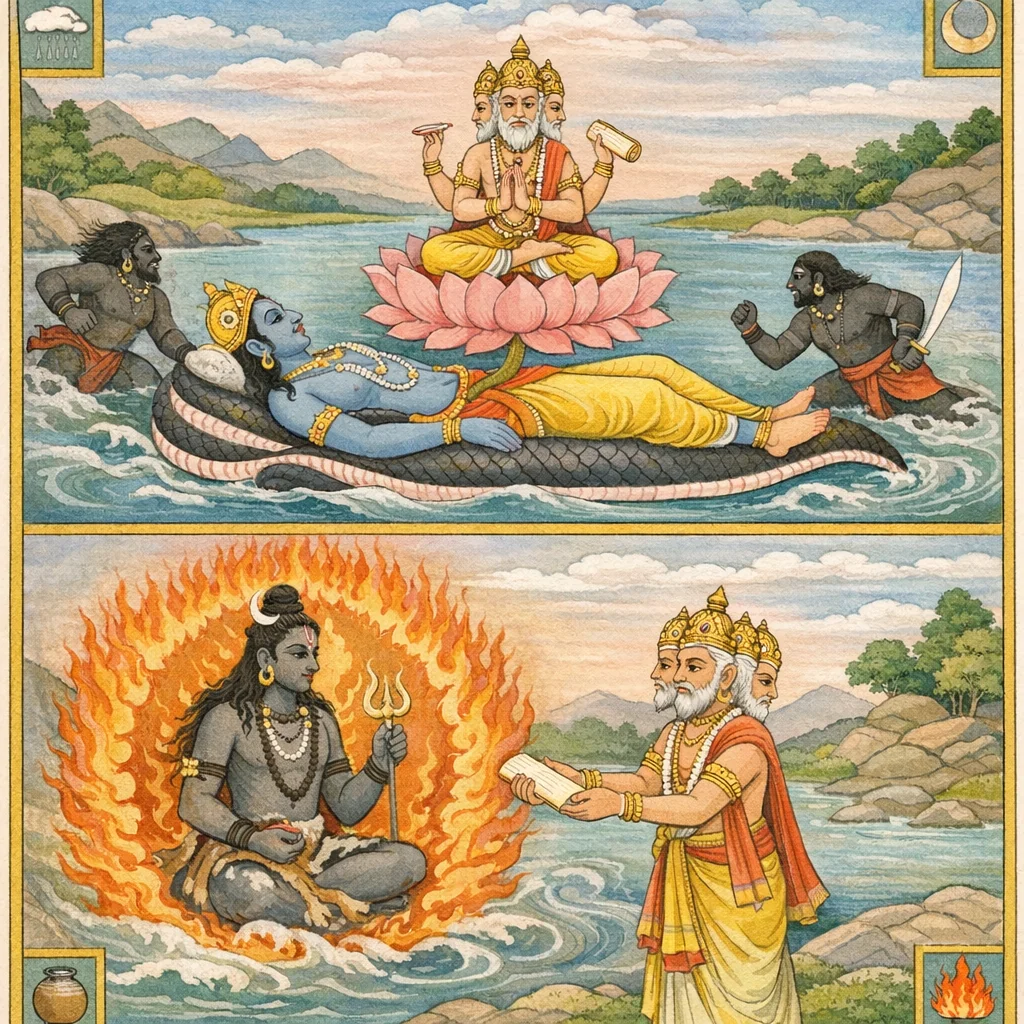
Picking up from the previous chapter’s close, Brahmā sits upon the lotus sprung from the cosmic Lord’s navel. The mighty asuras Madhu and Kaiṭabha arise; at Brahmā’s urging Nārāyaṇa (Viṣṇu) subdues them. Brahmā is then called to descend and is absorbed into Viṣṇu as the Vaiṣṇavī power of sleep—Yoga-Nidrā—begins to operate. Nārāyaṇa’s yogic slumber culminates in realization of the non-dual Brahman, and at dawn Brahmā commences creation in a Vaiṣṇava, sustaining mode. The first mind-born sages refuse worldly creation; Brahmā’s bewilderment and wrath shed tears that become bhūtas and pretas. From Rudra’s fierce manifestation, Brahmā assigns names, forms (Aṣṭamūrti), consorts, sons, and cosmic stations. A major stotra follows in which Brahmā praises Mahādeva as Brahman, Time, the essence of the Veda, and the inner ruler of all. Śiva grants Brahmā divine yoga, sovereignty, a Brahman-grounded disposition, and dispassion, then teaches the harmony of the Trimūrti—one Lord appearing threefold through the guṇas—before vanishing. Brahmā resumes creation, producing the nine great progenitors and preparing for the cosmological details to come.
Shlokas
Verse 1
इति श्रीकूर्मपुराणे षट्साहस्त्र्यां संहितायां पूर्वविभागे नवमो ऽध्यायः श्रीकूर्म उवाच गते महेश्वरे देवे स्वाधिवासं पितामहः / तदेव सुमहत् पद्मं भेजे नाभिसमुत्थितम्
Thus, in the Śrī Kūrma Purāṇa, in the Ṣaṭsāhasrī Saṃhitā, in the Pūrvavibhāga, the ninth chapter concludes. Śrī Kūrma said: When the Lord Maheśvara departed to His own abode, Pitāmaha (Brahmā) then took his place upon that very vast lotus which had arisen from the navel.
Verse 2
अथ दीर्घेण कालेन तत्राप्रतिमपौरुषौ / महासुरौ समायातौ भ्रातरौ मधुकैटभौ
Then, after a long lapse of time, there arrived there two mighty Asuras of incomparable prowess—the brothers Madhu and Kaiṭabha.
Verse 3
क्रोधेन महताविष्टौ महापर्वतविग्रहौ / कर्णान्तरसमुद्भूतौ देवदेवस्य शार्ङ्गिणः
Possessed by tremendous wrath and having bodies like mighty mountains, they arose from within the ear-cavity of Śārṅgin—the bow-bearing Lord of lords.
Verse 4
तावागतौ समीक्ष्याह नारायणमजो विभुः / त्रैलोक्यकण्टकावेतावसुरौ हन्तुमर्हसि
Seeing that the two had arrived, the Unborn, all-pervading Lord addressed Nārāyaṇa: “These two Asuras are thorns to the three worlds—slay them; it is fitting for you to do so.”
Verse 5
तस्य तद् वचनं श्रुत्वा हरिर्नारायणः प्रभुः / आज्ञापयामास तयोर्वधार्थं पुरुषावुभौ
Hearing those words of his, Hari—Nārāyaṇa, the Lord—issued a command that both those divine agents should proceed for the purpose of slaying the two foes.
Verse 6
तदाज्ञया महद्युद्धं तयोस्ताभ्यामभूद् द्विजाः / व्यनयत् कैटभं विष्णुर्जिष्णुश्च व्यनयन्मधुम्
O twice-born ones, by His command a mighty battle arose between those two. Viṣṇu overcame Kaiṭabha, and the victorious one (Jiṣṇu) likewise overcame Madhu.
Verse 7
ततः पद्मासनासीनं जगन्नाथं पितामहम् / बभाषे मधुरं वाक्यं स्नेहाविष्टमना हरिः
Then Hari, his mind suffused with affection, spoke sweet words to the Grandfather of the worlds—Jagannātha—who was seated upon the lotus-seat.
Verse 8
अस्मान्मयोच्यमानस्त्वं पद्मादवतर प्रभो / नाहं भवन्तं शक्नोमि वोढुं तेजामयं गुरुम्
O Lord, since you are being addressed by me, descend from the lotus. I am not able to bear you—so weighty and composed of blazing divine splendor.
Verse 9
ततो ऽवतीर्य विश्वात्मा देहमाविश्य चक्रिणः / अवाच वैष्णवीं निद्रामेकीभूयाथ विष्णुना
Then the All-Self descended, entered the body of the discus-bearing Lord; and, becoming one with Viṣṇu, invoked and set in motion the Vaiṣṇavī Power of Sleep.
Verse 10
सहस्त्रशीर्षनयनः शङ्खचक्रगदाधरः / ब्रह्मा नारायणाख्यो ऽसौ सुष्वाप सलिले तदा
Then that Brahmā—known as Nārāyaṇa—endowed with a thousand heads and eyes, bearing the conch, discus, and mace, slept upon the cosmic waters.
Verse 11
सो ऽनुभूय चिरं कालमानन्दं परमात्मनः / अनाद्यनन्तमद्वैतं स्वात्मानं ब्रह्मसंज्ञितम्
Having thus experienced for a long time the bliss of the Supreme Self, he realized his own Self—called “Brahman”—as non-dual, beginningless, and endless.
Verse 12
ततः प्रभाते योगात्मा भूत्वा देवश्चतुर्मुखः / ससर्ज सृष्टिं तद्रूपां वैष्णवं भावमाश्रितः
Then, at daybreak, the four-faced god (Brahmā), established in yogic consciousness, set forth creation in accord with that form, taking refuge in a Vaiṣṇava disposition—the sustaining power of Nārāyaṇa.
Verse 13
पुरस्तादसृजद् देवः सनन्दं सनकं तथा / ऋभुं सनत्कुमारं च पुर्वजं तं सनातनम्
In the beginning, the Lord created Sananda and Sanaka, and also Ṛbhu and Sanatkumāra—those primordial, ancient ones, the first-born and everlasting.
Verse 14
ते द्वन्द्वमोहनिर्मुक्ताः परं वैराग्यमास्थिताः / विदित्वा परमं भावं न सृष्टौ दधिरे मतिम्
Freed from the delusion of dualities, they abided in supreme dispassion. Having realized the highest state of Being, they no longer set their minds upon worldly creation and becoming.
Verse 15
तेष्वेवं निरपेक्षेषु लोकसृष्टौ पितामहः / बभूव नष्टचेता वै मायया परमेष्ठिनः
When the creation of the worlds thus proceeded as if unaided, the Grandsire Brahmā became truly bewildered—his mind obscured by the Māyā of the Supreme Lord (Parameṣṭhin).
Verse 16
ततः पुराणपुरुषो जगन्मूर्तिर्जनार्दनः / व्याजहारात्मनः पुत्रं मोहनाशाय पद्मजम्
Then Janārdana—the primeval Cosmic Person whose form is the universe—addressed his own son, the lotus-born Brahmā, to dispel delusion.
Verse 17
विष्णुरुवाच कच्चिन्न विस्मृतो देवः शूलपाणिः सनातनः / यदुक्तवानात्मनो ऽसौ पुत्रत्वे तव शङ्करः
Viṣṇu said: “Have you forgotten the eternal God, the trident-bearing Lord—Śaṅkara who, speaking of his own Self, declared that he stands to you in the relation of sonship?”
Verse 18
अवाप्य संज्ञां गोविन्दात् पद्मयोनिः पितामहः / प्रजाः स्त्रष्टुमनास्तेपे तपः परमदुश्चरम्
Having received even his very designation from Govinda, the lotus-born Grandsire Brahmā, intent on creating beings, performed tapas—an austerity supremely difficult to practice.
Verse 19
तस्यैवं तप्यमानस्य न किञ्चित् समवर्तत / ततो दीर्घेण कालेन दुः खात् क्रोधो ऽभ्यजायत
Though he continued his austerities in this manner, nothing whatsoever came to pass. Then, after a long time, from suffering, anger arose within him.
Verse 20
क्रोधाविष्टस्य नेत्राभ्यां प्रापतन्नश्रुबिन्दवः / ततस्तेभ्यो ऽश्रुबिन्दुभ्यो भूताः प्रेतास्तथाभवन्
When wrath seized him, tear-drops fell from his eyes; and from those very drops there arose the beings known as bhūtas and pretas, restless spirits.
Verse 21
सर्वांस्तानश्रुजान् दृष्ट्वा ब्रह्मात्मानमनिन्दन / जहौ प्राणांश्च भगवान् क्रोधाविष्टः प्रजापतिः
Seeing them all—born of tears—lamenting, and beholding Brahmā, the blameless Self of the world, the blessed Prajāpati (Dakṣa), overcome by rage, abandoned his life-breaths.
Verse 22
तदा प्राणमयो रुद्रः प्रादुरसीत् प्रभीर्मुखात् / सहस्त्रादित्यसंकाशो युगान्तदहनोपमः
Then Rudra, formed of vital breath itself, manifested from the awe-inspiring mouth (of the Cosmic Being); he shone like a thousand suns, resembling the consuming fire at the end of an age.
Verse 23
रुरोद सुस्वरं घोरं देवदेवः स्वयं शिवः / रोदमानं ततो ब्रह्मा मा रोदीरित्यभाषत / रोदनाद् रुद्र इत्येवं लोके ख्यातिं गमिष्यसि
Lord Śiva himself—the God of gods—cried out in a dreadful yet clear-toned voice. Then Brahmā spoke to him as he wept: “Do not cry.” Thus, from that crying, you will become renowned in the world by the name “Rudra.”
Verse 24
अन्यानि सप्त नामानि पत्नीः पुत्रांश्चशाश्वतान् / स्थानानि चैषामष्टानां ददौ लोकपितामहः
The Grandfather of the worlds, Brahmā, bestowed upon those eight their other seven sacred names, their consorts, their eternal sons, and also the stations and cosmic offices allotted to them.
Verse 25
भवः शर्वस्तथेशानः पशूनां पतिरेव च / भीमश्चोग्रो महादेवस्तानि नामानि सप्त वै
Bhava, Śarva, Īśāna, and indeed Paśupati, Lord of all beings; also Bhīma, Ugra, and Mahādeva—these are truly the seven names.
Verse 26
सूर्यो जलं मही वह्निर्वायुराकाशमेव च / दीक्षितो ब्राह्मणश्चन्द्र इत्येता अष्टमूर्तयः
The Sun, Water, Earth, Fire, Wind, and also Space; the initiated ascetic, the Brāhmaṇa, and the Moon—these are declared to be the Lord’s eight forms (Aṣṭamūrti).
Verse 27
स्थानेष्वेतेषु ये रुद्रं ध्यायन्ति प्रणमन्ति च / तेषामष्टतनुर्देवो ददाति परमं पदम्
Those who, in these sacred places, meditate upon Rudra and bow in reverence—unto them the God of eightfold form bestows the supreme state, liberation.
Verse 28
सुवर्चला तथैवोमा विकेशी च तथा शिवा / स्वाहा दिशश्च दीक्षा च रोहिणी चेति पत्नयः
Suvarcalā and likewise Umā; Vikeśī and also Śivā; Svāhā; the Directions (Diśaḥ); Dīkṣā, sacred initiation; and Rohiṇī—these are declared to be the consorts.
Verse 29
शनैश्चरस्तथा शुक्रो लोहिताङ्गो मनोजवः / स्कन्दः सर्गो ऽथ सन्तानो बुधश्चैषां सुताः स्मृताः
Śanaiścara (Saturn) and also Śukra (Venus), Lohitāṅga (the red-limbed one) and Manojava (swift as the mind)—and likewise Skanda, Sarga, Santāna, and Budha (Mercury): these are remembered as their sons.
Verse 30
एवंप्रकारो भगवान् देवदेवो महेश्वरः / प्रजाधर्मं च काम च त्यक्त्वा वैराग्यमाश्रितः
Thus is the Blessed Lord Maheśvara, the God of gods: having renounced both the duties connected with worldly governance and the pursuit of desire, he abides established in dispassion (vairāgya).
Verse 31
आत्मन्याध्य चात्मानमैश्वरं भावमास्थितः / पीत्वा तदक्षरं ब्रह्म शाश्वतं परमामृतम्
Having meditated upon the Self within the Self, and abiding in the sovereign (aiśvara) state of being, one drinks in that Imperishable Brahman—eternal, and the supreme nectar of immortality.
Verse 32
प्रजाः सृजेति चादिष्टो ब्रह्मणा नीललोहितः / स्वात्मना सदृशान् रुद्रान् ससर्ज मनसा शिवः
Commanded by Brahmā, Nīlalohita (Rudra) was told, “Create the beings.” Then Śiva, by the power of his own will, mentally brought forth Rudras resembling his own Self.
Verse 33
कपर्दिनो निरातङ्कान् नीलकण्ठान् पिनाकिनः / त्रिशूलहस्तानृष्टिघ्नान् महानन्दांस्त्रिलोचनान्
I worship those matted-haired Lords—fearless and free from all affliction—blue-throated, bearing the Pināka bow; holding the trident in hand, destroyers of hostile forces, ever-abiding in great bliss, and three-eyed.
Verse 34
जरामरणनिर्मुक्तान् महावृषभवाहनान् / वीतरागांश्च सर्वज्ञान् कोटिकोटिशतान् प्रभुः
The Lord beheld hundreds of crores upon crores—beings freed from old age and death, mounted upon mighty bulls, devoid of attachment, and perfected in all-knowing wisdom.
Verse 35
तान् दृष्ट्वा विविधान् रुद्रान निर्मलान् नीललोहितान् / जरामरणनिर्मुक्तान् व्याजहरा हरं गुरुः
Seeing those many forms of Rudra—pure, blue-and-reddish in hue, and freed from old age and death—the venerable Guru addressed Hara (Śiva) with reverent words.
Verse 36
मा स्त्राक्षीरीदृशीर्देव प्रजा मृत्युविवर्जिताः / अन्याः सृजस्व भूतेश जन्ममृत्युसमन्विताः
“Do not create, O God, such beings who are free from death. Create instead, O Lord of beings, other creatures who are endowed with both birth and death.”
Verse 37
ततस्तमाह भगवान् कपर्दे कामशासनः / नास्ति मे तादृशः सर्गः सृज त्वमशुभाः प्रजाः
Then the Blessed Lord, the restrainer of Kāma, said to Kapardin (Rudra): “Such a creation is not possible for me; you yourself bring forth the inauspicious progeny.”
Verse 38
ततः प्रभृति देवो ऽसौ न प्रसूते ऽशुभाः प्रजाः / स्वात्मजैरेव तै रुद्रैर्निवृत्तात्मा ह्यतिष्ठत / स्थाणुत्वं तेन तस्यासीद् देवदेवस्य शूलिनः
From that time onward, that God no longer brought forth inauspicious creatures. With those Rudras—born from his own essence—he remained, his mind turned back from outward creation and established in inner restraint. Therefore, the Trident-bearing Lord of lords came to be known as Sthāṇu, “the Steadfast/Immovable One.”
Verse 39
ज्ञानं वैराग्यमैश्वर्यं तपः सत्यं क्षमा धृतिः / स्त्रष्टृत्वमात्मसंबोधो ह्यधिष्ठातृत्वमेव च
Knowledge, dispassion, sovereign lordship, austerity, truth, forgiveness, steadfastness, the power to create, awakening to the Self, and indeed the office of supreme governance—these are the Lord’s defining qualities.
Verse 40
अव्ययानि दशैतानि नित्यं तिष्ठन्ति शङ्करे / स एव शङ्करः साक्षात् पिनाकी परमेश्वरः
These ten imperishable attributes ever abide in Śaṅkara. He indeed is Śaṅkara in very truth—Pinākī, the Supreme Lord, Parameśvara.
Verse 41
ततः स भगवान् ब्रह्मा वीक्ष्य देवं त्रिलोचनम् / सहैव मानसैः पुत्रैः प्रीतिविस्फारिलोचनः
Then the Blessed Lord Brahmā, beholding the three-eyed God (Śiva), together with his mind-born sons, gazed with eyes widened in joy and devotion.
Verse 42
ज्ञात्वा परतरं भावमैश्वरं ज्ञानचक्षुषा / तुष्टाव जगतामेकं कृत्वा शिरसि चाञ्जलिम्
Having perceived, with the eye of spiritual knowledge, the Lord’s transcendent, sovereign state, he praised the One Lord of the worlds, setting his joined palms upon his head in reverence.
Verse 43
ब्रह्मोवाच नमस्ते ऽस्तु महादेव नमस्ते परमेश्वर / नमः शिवाय देवाय नमस्ते ब्रह्मरूपिणे
Brahmā said: Salutations to You, O Mahādeva; salutations to You, O Parameśvara. Homage to Śiva, the divine Lord; salutations to You whose very form is Brahman.
Verse 44
नमो ऽस्तु ते महेशाय नमः शान्ताय हेतवे / प्रधानपुरुषेशाय योगाधिपतये नमः
Salutations to You, Mahēśvara. Salutations to You, the Peaceful One, the supreme Cause. Salutations to You, Lord of Pradhāna (primordial Nature) and Puruṣa (Conscious Spirit); salutations to You, the sovereign Master of Yoga.
Verse 45
नमः कालाय रुद्राय महाग्रासाय शूलिने / नमः पिनाकहस्ताय त्रिनेत्राय नमो नमः
Salutations to Rudra—who is Time itself, the Great Devourer, and the bearer of the trident. Salutations to the One who holds the Pināka bow, the Three‑eyed Lord—again and again, salutations.
Verse 46
नमस्त्रिमूर्तये तुभ्यं ब्रह्मणो जनकाय ते / ब्रह्मविद्याधिपतये ब्रह्मविद्याप्रदायिने
Salutations to You, the One who is the Triple Form (Trimūrti); salutations to You, the progenitor of Brahmā. Salutations to the Lord of Brahma‑vidyā (knowledge of the Absolute), and to You who bestows Brahma‑vidyā.
Verse 47
नमो वेदरहस्याय कालकालाय ते नमः / वेदान्तसारसाराय नमो वेदात्ममूर्तये
Salutations to You, the secret heart of the Vedas; salutations to You, the Time that transcends time. Salutations to You, the very essence of the essence of Vedānta; salutations to You whose form is the very Self of the Veda.
Verse 48
नमो बुद्धाय शुद्धाय योगिनां गुरवे नमः / प्रहीणशोकैर्विविधैर्भूतैः वरिवृताय ते
Salutations to the Awakened One, the Pure; salutations to the Guru of yogins. To You—encircled and attended by diverse beings who have cast off sorrow—obeisance.
Verse 49
नमो ब्रह्मण्यदेवाय ब्रह्माधिपतये नमः / त्रियम्बकाय देवाय नमस्ते परमेष्ठिने
Salutations to the divine Lord, gracious to the brāhmaṇas; salutations to the Sovereign of Brahman (and of Brahmā). Homage to the three‑eyed God; obeisance to You, O Parameṣṭhin, the Supreme Ruler enthroned above all.
Verse 50
नमो दिग्वाससे तुभ्यं नमो मुण्डाया दण्डिने / अनादिमलहीनाय ज्ञानगम्याय ते नमः
Salutations to You who are clad in the quarters, with space itself as Your garment; salutations to You, the shaven‑headed ascetic bearing the staff. Salutations to You who are beginningless and free from all taint, attainable only through true knowledge.
Verse 51
नमस्ताराय तीर्थाय नमो योगर्धिहेतवे / नमो धर्माधिगम्याय योगगम्याय ते नमः
Salutations to You, the saving ‘Tārā’—the sacred ford (tīrtha). Salutations to You, the cause of yogic attainments and perfections. Salutations to You, to be realized through Dharma and reached through Yoga—salutations to You again and again.
Verse 52
नमस्ते निष्प्रपञ्चाय निराभासाय ते नमः / ब्रह्मणे विश्वरूपाय नमस्ते परमात्मने
Salutations to You who are beyond all phenomenal manifestation, to You who are without any limiting appearance. Salutations to You—the Brahman of the all-encompassing cosmic form; salutations to You, the Supreme Self (Paramātman).
Verse 53
त्वयैव सृष्टमखिलं त्वय्येव सकलं स्थितम् / त्वया संह्रियते विश्वं प्रधानाद्यं जगन्मय
By You alone is all this created; in You alone does everything abide. By You the universe is withdrawn—O One who pervades the world—including Pradhāna and all that begins with it.
Verse 54
त्वमीश्वरो महादेवः परं ब्रह्म महेश्वरः / परमेष्ठी शिवः शान्तः पुरुषो निष्कलो हरः
You are the Lord—Mahādeva; the Supreme Brahman; Maheśvara. You are Parameṣṭhin, Śiva, the Tranquil One; the Puruṣa, partless and without divisions—Hara.
Verse 55
त्वमक्षरं परं ज्योतिस्त्वं कालः परमेश्वरः / त्वमेव पुरुषो ऽनन्तः प्रधानं प्रकृतिस्तथा
You are the imperishable Reality, the supreme Light; you are Time itself, O Parameśvara. You alone are the endless Puruṣa, and likewise the Pradhāna—the very Prakṛti.
Verse 56
भूमिरापो ऽनलो वायुर्व्योमाहङ्कार एव च / यस्य रूपं नमस्यामि भवन्तं ब्रह्मसंज्ञितम्
Earth, water, fire, wind, space, and indeed ego-sense—these are His form. I bow to You, who are known as Brahman.
Verse 57
यस्य द्यौरभवन्मूर्धा पादौ पृथ्वी दिशो भुजाः / आकाशमुदरं तस्मै विराजे प्रणमाम्यहम्
I bow to that Virāj, the Cosmic Person—whose head is the heaven, whose feet are the earth, whose arms are the directions, and whose belly is the vast sky.
Verse 58
संतापयति यो विश्वं स्वभाभिर्भासयन् दिशः / ब्रह्मतेजोमयं नित्यं तस्मै सूर्यात्मने नमः
Salutations to that Sun-souled Lord—who heats the entire universe and, by his own radiance, illumines the directions—who is eternally constituted of Brahman’s splendour (brahma-tejas).
Verse 59
हव्यं वहति यो नित्यं रौद्री तेजोमयो तनुः / कव्यं पितृगणानां च तस्मै वह्न्यात्मने नमः
Salutations to the Lord whose very Self is Fire (Agni): the ever-bearer of havya, the oblations to the gods, whose form is a radiant body of Rudra’s blazing energy, and who also conveys kavya, the ancestral offering, to the hosts of the Pitṛs.
Verse 60
आप्यायति यो नित्यं स्वधाम्ना सकलं जगत् / पीयते देवतासङ्घैस्तस्मै सोमात्मने नमः
Salutations to the Soma-natured Self—He who ever nourishes the entire universe by His own inherent radiance, and who is drunk by the hosts of gods as Soma of bliss.
Verse 61
विभर्त्यशेषभूतानि यो ऽन्तश्चरति सर्वदा / शक्तिर्माहेश्चरी तुभ्यं तस्मै वाय्वात्मने नमः
Salutations to the One whose very essence is Vāyu—the ever-moving indweller who sustains all beings without remainder. To You belongs the Māheśvarī Power, Śiva’s divine Śakti; therefore, obeisance to that Vāyu-natured Self.
Verse 62
सृजत्यशेषमेवेदं यः स्वकर्मानुरूपतः / स्वात्मन्यवस्थितस्तस्मै चतुर्वक्त्रात्मने नमः
Salutations to the Four-Faced One—who, abiding in His own Self, creates this entire universe without remainder in accordance with the karma of beings.
Verse 63
यः शेषशयने शेते विश्वमावृत्य मायया / स्वात्मानुभूतियोगेन तस्मै विश्वात्मने नमः
Salutations to the Universal Self—He who reclines upon Śeṣa, veiling the universe by His māyā, and who is realized through the yoga of direct experience of one’s own Self.
Verse 64
विभर्ति शिरसा नित्यं द्विसप्तभुवनात्मकम् / ब्रह्माण्डं यो ऽखिलाधारस्तस्मै शेषात्मने नमः
Salutations to that One whose very Self is Śeṣa, the universal support, who eternally bears upon His head the Brahmāṇḍa—the cosmic egg of the fourteen worlds—the foundation of all that exists.
Verse 65
यः परान्ते परानन्दं पीत्वा दिव्यैकसाक्षिकम् / नृत्यत्यनन्तमहिमा तस्मै रुद्रात्मने नमः
Salutations to Rudra who is the very Self: infinite in glory, who—at the ultimate end—having ‘drunk’ the supreme bliss, the one divine Witness, dances in transcendence.
Verse 66
यो ऽन्तरा सर्वभूतानां नियन्ता तिष्ठतीश्वरः / तं सर्वसाक्षिणं देवं नमस्ये भवतस्तनुम्
I bow to the Divine Lord who abides within all beings as their inner ruler, the all-witnessing God; I salute that very form of Yours.
Verse 67
यं विनिन्द्रा जितश्वासाः संतुष्टाः समदर्शिनः / ज्योतिः पश्यन्ति युञ्जानास्तस्मै योगात्मने नमः
Salutation to the Supreme Self, the very essence of Yoga—whom the yogins, free from sleep, masters of the breath, content within, and equal-sighted, behold as the inner Light while absorbed in meditation.
Verse 68
यया संतरते मायां योगी संक्षीणकल्मषः / अपारतरपर्यन्तां तस्मै विद्यात्मने नमः
Salutations to Vidyātman—the Self that is Knowledge—by whose power the yogin, with sins exhausted, crosses over Māyā and reaches the farther shore without limit.
Verse 69
यस्य भासा विभातीदमद्वयं तमसः परम् / प्रपद्ये तत् परं तत्त्वं तद्रूपं परमेश्वरम्
I take refuge in that Supreme Reality—Parameśvara—whose radiance makes this non-dual (advaya) principle shine, and who is beyond darkness (tamas).
Verse 70
नित्यानन्दं निराधारं निष्कलं परमं शिवम् / प्रपद्ये परमात्मानं भवन्तं परमेश्वरम्
I take refuge in the Supreme Shiva—ever-blissful, supportless (self-established), partless and transcendent; in You, the Supreme Self, the highest Lord, Parameśvara.
Verse 71
एवं स्तुत्वा महादेवं ब्रह्मा तद्भावभावितः / प्राञ्जलिः प्रणतस्तस्थौ गृणन् ब्रह्म सनातनम्
Thus, having praised Mahādeva, Brahmā—his mind suffused with that very devotion—stood with joined palms, bowed in reverence, continuing to extol the Eternal Brahman.
Verse 72
ततस्तस्मै महादेवो दिव्यं योगमनुत्तमम् / ऐश्वर्यं ब्रह्मसद्भावं वैराग्यं च ददौ हरः
Then Mahādeva—Hara—bestowed upon him the unsurpassed, divine Yoga, along with lordly sovereignty, the true disposition grounded in Brahman, and dispassion (vairāgya).
Verse 73
कराभ्यां सुशुभाभ्यां च संस्पृश्य प्रणतार्तिहा / व्याजहरा स्वयं देवः सो ऽनुगृह्य पितामहम्
Then the Lord Himself—Remover of the distress of those who bow—touched him with His two exceedingly beautiful hands; and, having shown grace to Pitāmaha (Brahmā), He spoke words that dispelled his anxiety.
Verse 74
यत्त्वयाभ्यर्थितं ब्रह्मन् पुत्रत्वे भवतो मम / कृतं मया तत् सकलं सृजस्व विविधं जगत्
O Brahman (Brahmā), whatever you entreated of me—that I should become your son—I have fulfilled in its entirety. Now create the manifold world in all its wondrous variety.
Verse 75
त्रिधा भिन्नो ऽस्म्यहं ब्रह्मन् ब्रह्मविष्णुहराख्यया / सर्गरक्षालयगुणैर्निष्कलः परमेश्वरः
O Brahmin, I am spoken of as threefold—Brahmā, Viṣṇu, and Hara—according to the powers that govern creation, preservation, and dissolution; yet in truth I am the partless Supreme Lord (Parameśvara).
Verse 76
स त्वं ममाग्रजः पुत्रः सृष्टिहेतोर्विनिर्मितः / ममैव दक्षिणादङ्गाद् वामाङ्गात् पुरुषोत्तमः
You indeed are my elder-born son, fashioned for the very cause of creation. From my own body you arose—from the right limb and from the left—O Supreme Person (Puruṣottama).
Verse 77
तस्य देवादिदेवस्य शंभोर्हृदयदेशतः / संबभूवाथ रुद्रो ऽसावहं तस्यापरा तनुः
From the region of the heart of Śambhu, the God of gods, there arose Rudra; and I am his other, secondary embodiment.
Verse 78
ब्रह्मविष्णुशिवा ब्रह्मन् सर्गस्थित्यन्तहेतवः / विभज्यात्मानमेको ऽपि स्वेच्छया शङ्करः स्थितः
O Brahmin, Brahmā, Viṣṇu, and Śiva are the causes of creation, preservation, and dissolution. Yet the Lord—though one—abides as Śaṅkara, freely manifesting by His own will through self-differentiation.
Verse 79
तथान्यानि च रूपाणि मम मायाकृतानि तु / निरूपः केवलः स्वच्छो महादेवः स्वभावतः
Likewise, the other forms that appear are indeed fashioned by My māyā; yet by His very nature Mahādeva is formless, absolute, and ever-pure.
Verse 80
एभ्यः परतरो देवस्त्रिमूर्तिः परमा तनुः / माहेश्वरी त्रिनयना योगिनां शान्तिदा सदा
Higher than all these is the God whose supreme body is the Trimūrti. That Mahāśvarī—three-eyed—ever bestows peace upon the yogins.
Verse 81
तस्या एव परां मूर्ति मामवेहि पितामह / शाश्वतैश्वर्यविज्ञानतेजोयोगसमन्विताम्
Know Me, O Grandfather, as the supreme manifestation of That (Supreme Reality)—endowed with eternal lordship, true knowledge, spiritual radiance, and Yoga.
Verse 82
सो ऽहं ग्रसामि सकलमधिष्ठाय तमोगुणम् / कालो भूत्वा न तमसा मामन्यो ऽभिभविष्यति
I devour the whole universe, presiding over the quality of tamas. Having become Time itself, no other being can overpower Me through darkness (tamas).
Verse 83
यदा यदा हि मां नित्यं विचिन्तयसि पद्मज / तदा तदा मे सान्निध्यं भविष्यति तवानघ
Whenever—again and again—you constantly contemplate Me, O lotus-born one, then again and again My immediate presence will arise for you, O sinless one.
Verse 84
एतावदुक्त्वा ब्रह्माणं सो ऽभिवन्द्य गुरुं हरः / सहैव मानसैः पुत्रैः क्षणादन्तरधीयत
Having said only this much to Brahmā, Hara (Śiva) bowed in reverence to his guru; and in an instant he vanished from sight—together with his mind-born sons.
Verse 85
सो ऽपि योगं समास्थाय ससर्ज विविधं जगत् / नारायणाख्यो भगवान् यथापूर्वं प्रिजापतिः
He too, established in Yoga, brought forth the manifold universe. That Blessed Lord, known as Nārāyaṇa, became the Prajāpati again, just as before in prior cycles.
Verse 86
मरीचिभृग्वङ्गिरसं पुलस्त्यं पुलहं क्रतुम् / दक्षमत्रिं वसिष्ठं च सो ऽसृजद् योगविद्यया
By the power of yogic knowledge, he then brought forth Marīci, Bhṛgu, Aṅgiras, Pulastya, Pulaha, Kratu, Dakṣa, Atri, and Vasiṣṭha.
Verse 87
नव ब्रह्माण इत्येते पुराणे निश्चयं गताः / सर्वे ते ब्रह्मणा तुल्याः साधका ब्रह्मवादिनः
In the Purāṇa it is definitively affirmed that these are the ‘nine Brahmās’. All of them are equal to Brahmā—accomplished practitioners and expounders of Brahman.
Verse 88
संकल्पं चैव धर्मं च युगधर्मांश्च शाश्वतान् / स्थानाभिमानिनः सर्वान् यथा ते कथितं पुरा
As I have explained to you before, I have already set forth the saṅkalpa (cosmic intention), the principles of dharma, the eternal duties proper to each yuga, and all the presiding deities who identify with and govern their respective abodes (sthānābhimānins).
Frequently Asked Questions
The chapter’s stotra and the Yoga-nidrā realization present Brahman as non-dual and beginningless; Īśvara (Mahādeva/Nārāyaṇa) is the immanent inner ruler and transcendent absolute, while the experiential path is yoga leading to direct recognition beyond māyā.
Brahmā requests mortal beings to enable cyclical cosmos and karma-based embodiment; Rudra’s withdrawal into inner restraint (becoming Sthāṇu) signifies renunciation, the primacy of yoga over outward proliferation, and the governance of creation through appropriate ontological limits.
It maps Śiva onto cosmic principles and sacred stations, turning cosmology into sādhanā: by meditating on the eightfold form across elemental and social-ritual dimensions, devotees integrate devotion with metaphysical contemplation aimed at mokṣa.