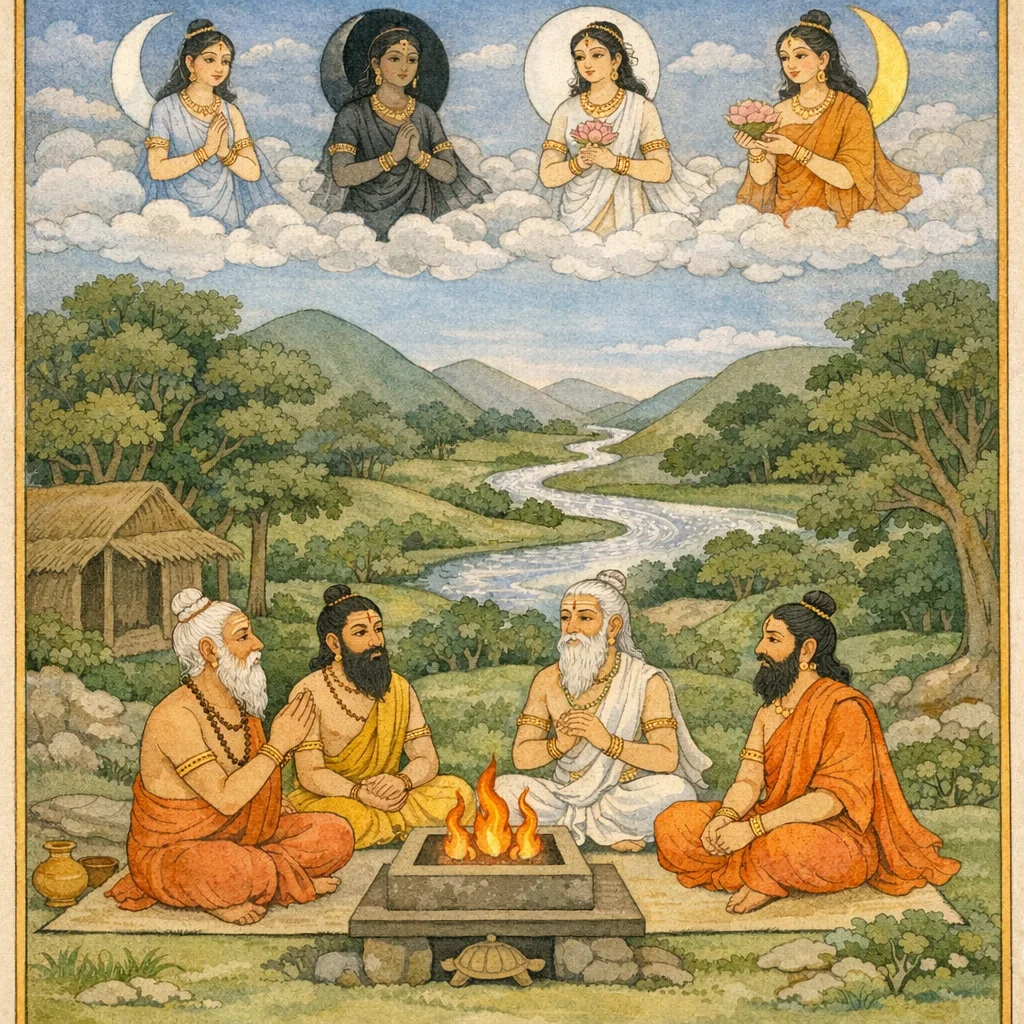
Adhyaya 12
Genealogies from Dakṣa’s Daughters: Ṛṣi Lines, Agni-Forms, Pitṛ Classes, and the Transition to Manu’s Progeny
This chapter concludes the preceding genealogical section and continues Sūta’s recital by tracing key descendants tied to Dakṣa’s daughter-lines and allied progenitors. Lakṣmī is said to be born of Bhṛgu and Khyāti. Dhātā and Vidhātā enter Meru’s family through marriage with Āyati and Niyati, begetting Prāṇa and Mṛkaṇḍu, from whom Mārkaṇḍeya arises. Further ṛṣi lineages are listed (Pulaha through Kṣamā; Atri through Anasūyā, with Soma, Durvāsas, Dattātreya, and Smṛti), along with lunar-linked figures (Sinīvālī, Kuhū, Rākā, Anumatī). The narrative then turns to sacrificial cosmology through Agni: Svāhā’s three fires—Pāvaka, Pavamāna, and Śuci—are distinguished by origin and function and expanded into a wider fire-lineage associated with Rudra-nature and ascetic participation in yajña. Next, the Pitṛs are classified as Agniṣvāttas and Barhiṣads; through Svadhā arise Menā and Vaitaraṇī. Menā’s line connects to Himavat and Gaṅgā, returning attention to Devī’s yogic power. The chapter ends by signaling a thematic shift: with Dakṣa’s daughter-descendants completed, the text prepares to explain Manu’s progeny-creation in manvantara-ordered sequence.
Shlokas
Verse 1
इति श्रीकूर्मपुराणे षट्साहस्त्र्यां संहितायां पूर्वविभागे एकादशो ऽध्यायः सूत उवाच भृगोः ख्यात्यां समुत्पन्ना लक्ष्मीर्नारायणप्रिया / देवौ धाताविधातारौ मेरोर्जामातरौ तथा
Thus ends the Eleventh Chapter in the Pūrvabhāga of the Śrī Kūrma Purāṇa, in the Ṣaṭsāhasrī Saṃhitā. Sūta said: From Bhṛgu and Khyāti was born Lakṣmī, beloved of Nārāyaṇa; and also the two deities Dhātā and Vidhātā, who likewise became the sons-in-law of Meru.
Verse 2
आयतिर्नियतिर्मेरोः कन्ये चैव महात्मनः / धाताविधात्रोस्ते भार्ये तयोर्जातौ सुतावुभौ
Āyati and Niyati were the two daughters of the great-souled Meru. They became the wives of Dhātā and Vidhātā, and from those two unions two sons were born.
Verse 3
प्राणश्चैव मृकण्डुश्च मार्कण्डेयो मृकण्डुतः / तथा वेदशिरा नाम प्राणस्य द्युतिमान् सुतः
Prāṇa and Mṛkaṇḍu were born; and from Mṛkaṇḍu came Mārkaṇḍeya. Likewise, Prāṇa had a radiant son named Vedaśiras.
Verse 4
मरीचेरपि संभूतिः पौर्णमासमसूयत / कन्याचतुष्टयं चैव सर्वलक्षणसंयुतम्
From Marīci, Sambhūti gave birth to Paurṇamāsa, and also to a set of four daughters, all endowed with every auspicious characteristic.
Verse 5
तुष्टिर्ज्येष्ठा तथा वृष्टिः कृष्टिश्चापचितिस्तथा / विरजाः पर्वश्चैव पौर्णमासस्य तौ सुतौ
Tuṣṭi and Jyeṣṭhā, likewise Vṛṣṭi, Kṛṣṭi, and also Apaciti—together with Virajā and Parva—are declared to be the sons of Paurṇamāsa.
Verse 6
क्षमा तु सुषुवे पुत्रान् पुलहस्य प्रजापतेः / कर्दमं च वरीयांसं सहिष्णुं मुनिसत्तमम्
Kṣamā (Forbearance) bore sons to the Prajāpati Pulaha—Kardama, Varīyān, and Sahiṣṇu, the most excellent of sages.
Verse 7
तथैव च कनीयासं तपोनिर्धूतकल्पषम् / अनसूया तथैवात्रेर्जज्ञे पुत्रानकल्पषान्
Likewise, she bore the younger son as well—purified of every stain by austerity. So too Anasūyā, the wife of Atri, gave birth to sons who were stainless and undefiled.
Verse 8
सोमं दुर्वाससं चैव दत्तात्रेयं च योगिनम् / स्मृतिश्चाङ्गिरसः पुत्रीर्जज्ञे लक्षणसंयुताः
From her were born Soma, Durvāsas, and Dattātreya—the yogin; and Smṛti as well. These daughters of Aṅgiras came forth endowed with auspicious marks and qualities.
Verse 9
सिनीवालीं कुहूं चैव राकामनुमतिं तथा / प्रीत्यां पुलस्त्यो भगवान् दत्तात्रिमसृजत् प्रभुः
Sinīvālī, Kuhū, Rākā, and Anumatī; and Pulastya—the blessed lord, sovereign among sages—brought forth from Prītī the revered Dattātreya, and likewise those others.
Verse 10
पूर्वजन्मनि सो ऽगस्त्यः स्मृतः स्वायंभुवे ऽन्तरे / वेदबाहुं तथा कन्यां सन्नतिं नाम नामतः
In a former birth, that Agastya is remembered as belonging to the Manvantara of Svāyambhuva; and there were also Vedabāhu and a maiden named Sannati—so called by name.
Verse 11
पुत्राणां षष्टिसाहस्त्रं संततिः सुषुवे क्रतोः / ते चोर्ध्वरेतसः सर्वे बालखिल्या इति स्मृताः
From Kratu, his line produced sixty thousand sons; and all of them were celibate ascetics (ūrdhvaretas), remembered in tradition as the Bālakhilyas.
Verse 12
वसिष्ठश्च तथोर्जायां सप्तपुत्रानजीजनत् / कन्यां च पुण्डरीकाक्षां सर्वेशोभासमन्विताम्
Thus Vasiṣṭha, through Urjā, begot seven sons; and also a daughter—Puṇḍarīkākṣā—endowed with every kind of beauty and auspicious splendor.
Verse 13
रजोहश्चोर्ध्वबाहुश्च सवनश्चानघस्तथा / सुतपाः शुक्र इत्येते सप्त पुत्रा महौजसः
Rajoha, Urdhvabāhu, Savana, and likewise Anagha; Sutapā and Śukra—these are the seven mighty sons of Mahaujasa.
Verse 14
यो ऽसौ रुद्रात्मको वह्निर्ब्रह्मणस्तनयो द्विजाः / स्वाहा तस्मात् सुतान् लेभे त्रीनुदारान् महौजसः
O twice-born sages, that Fire—Agni—who is of Rudra’s very nature and is the son of Brahmā; through him Svāhā obtained three noble, exceedingly radiant sons.
Verse 15
पावकः पवमानश्च शुचिरग्निश्च ते त्रयः / निर्मथ्यः पवमानः स्याद् वैद्युतः पावकः स्मृतः
Pāvaka, Pavamāna, and Śuci—these are the three forms of Agni. Of these, the fire kindled by churning the araṇi is called Pavamāna, while the fire born of lightning is remembered as Pāvaka.
Verse 16
यश्चासौ तपते सूर्यः शुचिरग्निस्त्वसौ स्मृतः / तेषां तु संततावन्ये चत्वारिंश्च पञ्च च
He who shines and burns as the Sun is remembered here as Śuci-Agni, the pure Fire. And in their lineage there were others as well—forty-five in number.
Verse 17
पावकः पवमानश्च शुचिस्तेषां पिता च यः / एते चैकोनपञ्चाशद् वह्नयः परिकीर्तितः
Pāvaka, Pavamāna, and Śuci—and he who is their father—these are proclaimed as the forty-nine fires (vahnis), though in this enumeration one is lacking (that is, forty-eight).
Verse 18
सर्वे तपस्विनः प्रोक्ताः सर्वे यज्ञेषु भागिनः / रुद्रात्मकाः स्मृताः सर्वे त्रिपुण्ड्राङ्कितमस्तकाः
All of them are declared to be ascetics; all of them share in the sacrifices (yajñas). All are remembered as bearing the nature of Rudra, their foreheads marked with the three sacred ash-lines (tripuṇḍra).
Verse 19
अयज्वानश्च यज्वानः पितरो ब्रह्मणः स्मृताः / अग्निष्वात्ता बर्हिषदो द्विधा तेषां व्यवस्थितिः
The Pitṛs are remembered as Brahmā’s progeny in two classes: those who did not perform sacrifices and those who did. Among them, the Agniṣvāttas and the Barhiṣads constitute the twofold arrangement.
Verse 20
तेभ्यः स्वधा सुतां जज्ञे मेनां वैतरणीं तथा / ते उभे ब्रह्मवादिन्यौ योगिन्यौ मुनिसत्तमाः
From them, Svadhā bore two daughters—Menā and Vaitaraṇī. Both were expounders of Brahman, accomplished yoginīs, and foremost among sages.
Verse 21
असूत मेना मैनाकं क्रौञ्चं तस्यानुजं तथा / गङ्गा हिमवतो जज्ञे सर्वलोकैकपावनी
Menā gave birth to Maināka and also to Kraunca, his younger brother; and from Himavat was born Gaṅgā—the sole purifier of all the worlds.
Verse 22
स्वयोगाग्निबलाद् देवीं लेभे पुत्रीं महेश्वरीं / यथावत् कथितं पूर्वं देव्या माहात्म्यमुत्तमम्
By the power of her own yogic fire, the Great Goddess obtained the Goddess as her daughter. Thus, as previously narrated in due order, the supreme glory of the Devī was set forth.
Verse 23
एषा दक्षस्य कन्यानां मयापत्यानुसंततिः / व्याख्याता भवतामद्य मनोः सृष्टिं निबोधत
Thus, today I have explained to you the lineage of descendants arising from Dakṣa’s daughters. Now understand the creation of progeny (sṛṣṭi) of Manu.
Frequently Asked Questions
It completes the descendant-map arising from Dakṣa’s daughters and allied unions, then explicitly announces a shift to ‘Manu’s progeny-creation’ (manu-sarga), moving from family-lines to manvantara-governed population and social-cosmic order.
They represent three principal forms of Agni tied to sacrificial function and cosmic operation; the chapter differentiates their manifestations (e.g., araṇi-produced fire and lightning-born fire) and frames their lineage as ascetic, yajña-sharing, and marked by Rudra-nature, reinforcing the Purāṇa’s synthesis of ritual and theology.
They are the two principal classes of Pitṛs (ancestral beings) described as Brahmā’s progeny, distinguished by sacrificial relation—forming a twofold structure that anchors śrāddha/ancestral rites within the broader yajña-based cosmology.