Adhyaya 73
Vaidūrya (Cat’s-eye) Examination: Origin, Auspicious Marks, Imitations, and Valuation Measures
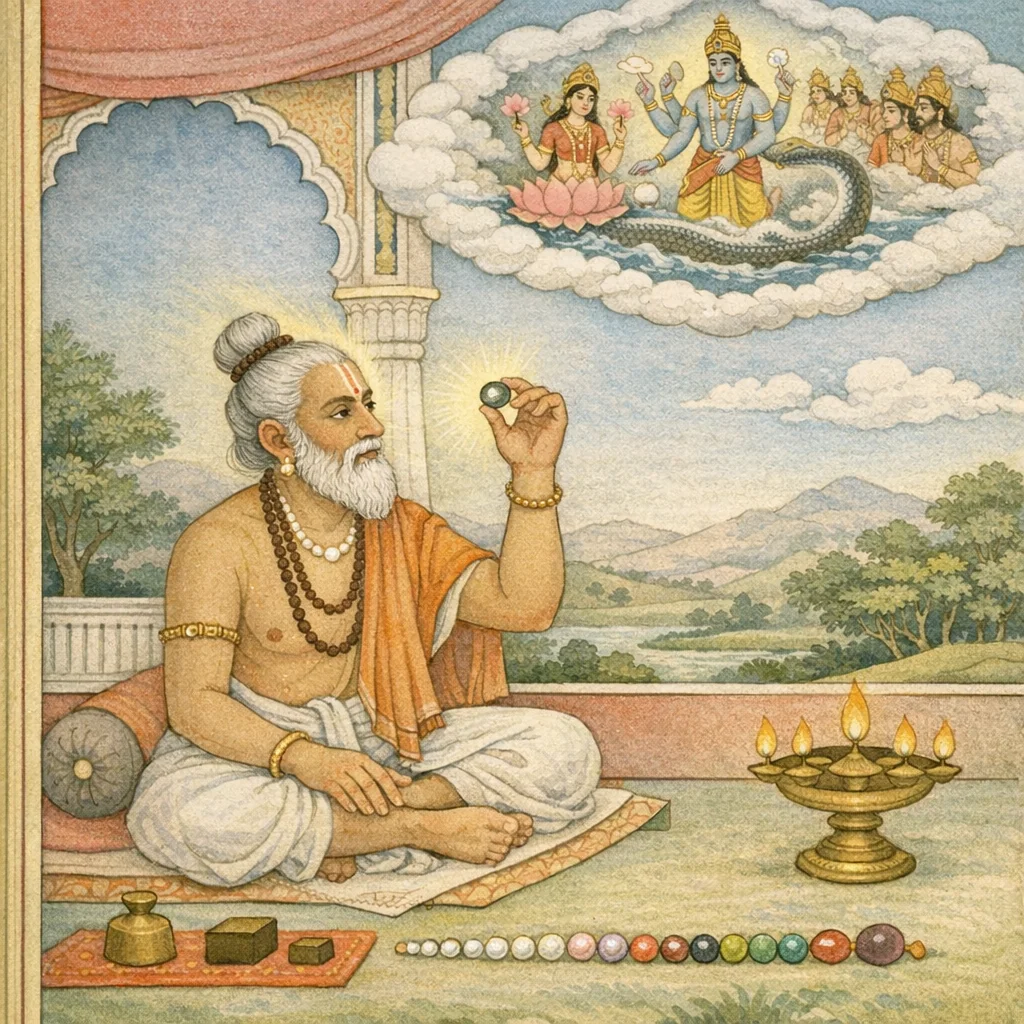
Sūta introduces this chapter as an authoritative ratna-parīkṣā (gem-examination) teaching first taught by Brahmā and later recounted by Vyāsa, framed within the account of Karketa and Bhīṣmaka. It opens with a mythic cosmogony: at pralaya, as the ocean is churned and a Dānava’s thunderous roar resounds, the many-colored vaidūrya (cat’s-eye) arises, linked with nāda and praised as an ornament of the three worlds. The text then lays out diagnostic marks—deep blue/green brilliance is auspicious, while a crow-wing sheen is inauspicious—and warns that flawless stones bestow great enjoyments whereas flawed ones bring harm, so careful testing is required. Deceptive substitutes (glass, crystal-like materials, smoky crystal) are named, with practical cues such as scratch-resistance, lightness, and brilliance. Valuation rules follow: excellent vaidūrya is priced on par with indranīla (sapphire), and proper stringing and ordering of flawless gems multiplies their worth. The chapter concludes by codifying the weights and measures (māṣaka, śāṇa, pala, dharaṇa) used in appraisal, preparing for similarly methodical discussions of material standards within a dharmic framework.
Shlokas
Verse 1
नाम द्विसप्ततितमो ऽध्यायः सूत उवाच / वैदूर्यपुष्परागाणां कर्केते भीष्मके वदे / परीक्षां ब्रह्मणा प्रोक्तां व्यासेन कथितां द्विजा
Sūta said: “This is, by name, the seventy-second chapter. O twice-born ones, the account of the examination concerning vaidūrya and puṣparāga—set in the context of Karketa and Bhīṣmaka—was first taught by Brahmā and later narrated by Vyāsa.”
Verse 2
कल्पान्तकालक्षुबिताम्बुराशेर्निर्ह्रादकल्पाद्दितिजस्य नादात् / वैदूर्यमुत्पन्नमनेकवर्णं शोभाभिरामद्युतिवर्णबीजम्
From the ocean heaving at the time of cosmic dissolution, and from a thunder-like roar—the cry of a Dānava—there arose vaidūrya (cat’s-eye), many-hued, delightful in splendor, the seed-source of brilliant colors.
Verse 3
अविदूरे विदूरस्य गिरेरुत्तुङ्गरोधसः / कामभूतिकसीमानमनु तस्याकरोभवत्
Not far from the lofty ridge of Mount Vidūra, there appeared—following along it—the boundary-region known as Kāmabhūtika.
Verse 4
तस्य नादसमुत्थत्वादाकरः सुमहागुणः / अभूदुत्तरीतो लोके लोकत्रयविभूषणः
Because it arose from sound (nāda), its form became exceedingly virtuous; and it became renowned in the world as “Uttarīta”, an ornament to the three worlds.
Verse 5
तस्यैव दानवपतेर्निनदानुरूपाः प्रवृट्पयोदवरदर्शित चारुरूपाः / वैदूर्यरत्नमणयो विविधावभासस्तस्मात्स्फुलिङ्गनिवहा इव संबभूवुः
From that lord of the Dānavas there arose clusters of jewel-like stones—vaidūrya gems of many hues—beautiful as monsoon rain-clouds, resonant in accord with his roar, appearing like swarms of sparks bursting forth from him.
Verse 6
पद्मरागमुपादाय मणिवर्णा हि ये क्षितौ / सर्वांस्तान्वर्णशोभाभिर्वैदूर्यमनुगच्छति
Taking the padmarāga (ruby) as the standard, among the jewel-colors found on earth the vaidūrya (cat’s-eye) follows and surpasses them all by the splendor of its hue.
Verse 7
तेषां प्रधानं शिखिकण्ठनीलं यद्वा भवेद्वेणुदलप्रकाशम् / चाषाग्रपक्षप्रतिमश्रियो ये न ते प्रशस्ता मणिशास्त्रविद्भिः
Among them, the foremost is that which is deep blue like a peacock’s throat, or gleaming like a fresh bamboo leaf. But those whose luster resembles the tip of a crow’s wing are not regarded as auspicious by experts in the science of gems.
Verse 8
गुणवान्वैदूर्यमणिर्योजयति स्वामिनं परंभा (भो) ग्यैः / दोषैर्युक्तो दोषैस्तस्माद्यत्नात्परीक्षेत
A virtuous vaidūrya (cat’s-eye) gem brings its owner the highest enjoyments; but one that is flawed brings only faults. Therefore, it should be examined carefully and with effort.
Verse 9
गिरिकाचशिशुपालौ काच स्फटिकाश्च धूमनिर्भिन्नाः / वैदूर्यमणेरेते विजातयः सन्निभाः सन्ति
Mountain-glass, a pale childlike lustre, common glass, and crystal (sphaṭika) stained by smoke—these are inferior imitations that resemble the vaidūrya gem (cat’s-eye), yet are of another kind.
Verse 10
लिख्याभावात्काचं लघुभावाच्छैसुपालकं विद्यात् / गिरिकाचसदीप्तित्वात्स्फटिकं वर्णोज्ज्वलत्वेन
Know it as glass because it does not take a scratch; know it as a light imitation gem because of its lightness. Yet know it as crystal (sphaṭika) because it gleams like mountain-glass and by the radiance of its color.
Verse 11
यदिन्द्रनीलस्य महागुणस्य सुवर्णसंख्याकलितस्य मूल्यम् / तदेव वैदूर्यमणेः प्रदिष्टं पलद्वयोन्मापि तगौरवस्य
Whatever price is fixed—reckoned in gold—for a highly excellent indranīla (sapphire), that very same value is prescribed for the vaidūrya gem (cat’s-eye), even if its weight reaches as much as two palas.
Verse 12
जात्यस्य सर्वे ऽपि मणेस्तु यादृग्विजातयः सन्ति समानवर्णाः / तथापि नानाकरणानुमेयभेदप्रकारः परमः प्रदिष्टः
All varieties within a gem’s own species may appear of the same color; even so, the highest teaching declares that their differences are many—discernible by their distinct causes and by the distinguishing marks inferred from them.
Verse 13
सुखोपलक्ष्यश्च सदा विचार्यो ह्ययं प्रभेदो विदुषा नरेण / स्नेहप्रभेदो लघुता मृदुत्वं विजातिलिङ्गं खलु सार्वजन्यम्
This distinction is easy to recognize and should always be carefully examined by the wise: differences in affection, lightness of conduct, and gentleness are indeed common signs by which one detects a difference of kind (true nature).
Verse 14
कुशलाकुशलैः प्रपूर्यमाणाः प्रतिबद्धाः प्रतिसत्क्रियाप्रयोगैः / गुणदोषसमुद्भवं लभन्ते मणयोर्ऽथोन्तरमूल्यमेव भिन्नाः
Filled by auspicious and inauspicious influences, and bound by the repeated performance of rites and deeds, beings come to gain the fruits born of merit and fault—just as gems, though diverse, differ only in their value in the world.
Verse 15
क्रमशः समतीतवर्तमानाः प्रतिबद्धा मणिबन्धकेन यत्नात् / यदि नाम भवन्ति दोषहीना मणयः षड्गुणमाप्नुवन्ति मूल्यम्
When a jeweller carefully strings gems in proper sequence, fitting the earlier with the later, then—if the gems are truly free from flaws—they attain a value six times greater.
Verse 16
आकरान्समतीतानामुदधेस्तीरसन्निधौ / मूल्यमेतन्मणीनां तु न सर्वत्र महीतले
For those who have gone beyond the mines, near the seashore, this is the true valuation of gems; yet such value is not recognized everywhere upon the earth.
Verse 17
सुवर्णो मनुना यस्तु प्रोक्तः षोडशमाषकः / तस्य सप्ततिमो भागः संज्ञारूपं करिष्यति
That standard of gold which Manu declared to be sixteen māṣakas—its seventieth part constitutes the unit known as saṃjñā (a named measure).
Verse 18
शाणश्चतुर्माषमानो माषकः पञ्चकृष्णलः / पलस्य दशमो भागो धरणः परिकीर्तितः
A śāṇa is measured as four māṣas; a māṣaka equals five kṛṣṇalas. One-tenth of a pala is declared to be a dharaṇa.
Verse 19
इत्थं मणिविधिः प्रोक्तो रत्नानां मूल्यनिश्चये
Thus the sacred procedure for appraising gems has been declared, for determining the value of precious stones.
Frequently Asked Questions
The foremost is described as deep blue like a peacock’s throat or gleaming like a fresh bamboo leaf; stones with luster like the tip of a crow’s wing are treated as inauspicious by gem experts.
The text points to observable cues: glass is recognized via scratch-related behavior, imitation stones by unusual lightness, and crystal (sphaṭika) by its mountain-glass-like shine and brilliance—urging careful comparative examination.
It states that whatever gold price is fixed for a highly excellent indranīla, the same value is prescribed for a vaidūrya, even when the latter’s weight may reach up to two palas.
The chapter references māṣaka, śāṇa (four māṣas), kṛṣṇala (five per māṣaka), pala, and dharaṇa (one-tenth of a pala), and mentions a Manu-declared gold standard of sixteen māṣakas.