Adhyaya 70
The Examination of Pearls and Padmarāga (Ruby): Origins, Marks, Defects, and Valuation
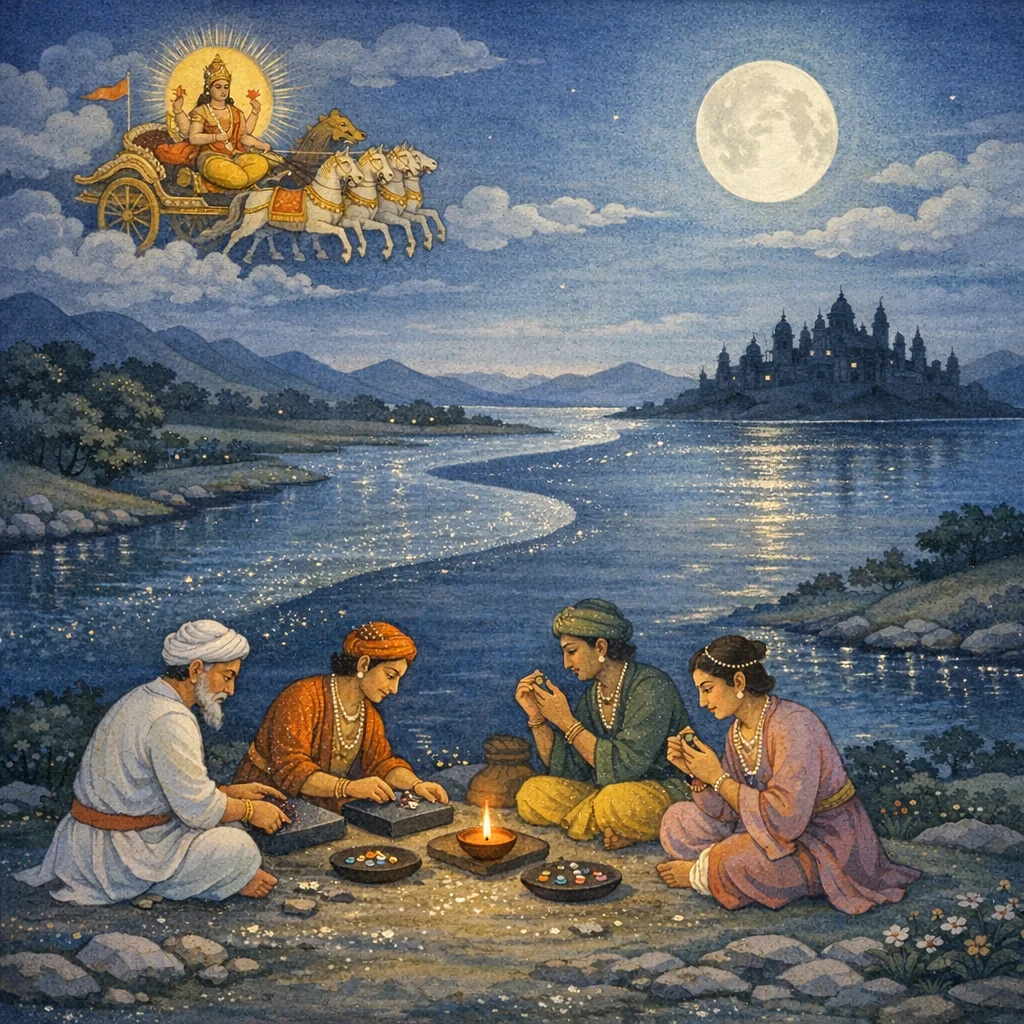
Continuing the Brahma-khaṇḍa’s practical teaching on worldly dharma and auspicious living, this chapter places gemological knowledge within sacred geography and moral causality. Sūta recounts how the Sun’s course is checked by the proud lord of Laṅkā, giving rise to the famed jewel-bearing Rāvaṇa-Gaṅgā, whose night-glittering banks and waters yield padmarāga (ruby), sapphires, and kuruvinda stones. The narrative then turns from poetic color to systematic appraisal: the ideal union of hue and luster, along with weight, hardness, clarity, and size. Defective stones, though resembling true kinds, are to be rejected as misfortune-bringing, and discernment is urged to detect subtle spurious marks. Padmarāga is further classified by origin (Kalaśapura, Siṃhala, Tumburu), with recognition signs and practical tests, and a warning that inferior stones can spoil superior sets. The chapter ends with valuation principles, likening pricing to diamond weight standards and stressing that even slight loss of color or luster destroys worth, preparing for subsequent discussions of ratna-lakṣaṇa and its dharmic import.
Shlokas
Verse 1
नाम मुक्ताफलपरीक्षा नामैकोनसप्ततितमो ऽध्यायः सूत उवाच / दिवाकरस्तस्य महामहिम्नो महासुरस्योत्तमरत्नबीजम् / असृग्गृहीत्वा चरितुं प्रतस्थे निस्त्रिंशनीलेन नभः स्थलेन
“The Examination of Pearls”—thus is the sixty-ninth chapter. Sūta said: The Sun, taking that blood—the finest “seed” of jewels of the greatly glorious great Asura—set forth to traverse the sky, dark-blue like a drawn sword.
Verse 2
जेत्त्रा सुराणां समरेष्वजस्त्रं वीर्यावलेपोद्धतमानसेन / लङ्काधिपेनार्धपथे समेत्य स्वर्भानुनेव प्रसभं निरुद्धः
He—an unceasing conqueror of the gods in battle—was forcibly checked halfway along the path when he encountered the lord of Laṅkā, whose mind was swollen with pride in his own prowess, just as Svarbhānu once obstructed the luminary.
Verse 3
तत्सिंहलीचारुनितम्बबिम्बविक्षो भितागाधमहाह्रदायाम् / पूगद्रुमाबद्धतटद्वयायां मुमोच सूर्यः सरिदुत्तमायाम्
There, in that supreme river—whose unfathomable, vast pools are stirred by the rounded, lovely hips of Sinhalī maidens, and whose two banks are bound with areca-palms—the Sun released his radiance and moved on.
Verse 4
ततः प्रभृति सा गङ्गा तुल्यपुण्यफलोदया / नाम्ना रावणगङ्गेति प्रथिमानमुपागता
From that time onward, that stream—bestowing meritorious results equal to the Gaṅgā—became renowned by the name “Rāvaṇa-Gaṅgā,” and attained wide fame.
Verse 5
ततः प्रभृत्येव च शर्वरीषु कूलानि रत्नैर्निचितानि तस्याः / सुवर्णनाराचशतैरिवान्तर्बहिः प्रदीप्तैर्निशितानि भान्ति
From that time onward, in the nights, her riverbanks appear heaped with jewels, shining as though lined within and without by hundreds of sharp, blazing golden arrows.
Verse 6
तस्यास्तटेपूज्ज्वचारुरागा भवन्ति तोयेषु च पद्मरागाः / सौगन्धिकोत्थाः कुरुविन्दजाश्च महागुणाः स्फाटिकसंप्रसूताः
Upon its banks appear brilliantly lustrous, beautiful gems; and within its waters are found rubies. There also arise fragrant sapphires and kuruvinda-stones—excellent jewels—born from crystal-clear sources.
Verse 7
बन्धू कगुञ्जासकलेन्द्रगोपजवासमासृक्समवर्णशोभाः / भ्राजिष्णवो दाडिमबीजवर्णास्तथापरे किशुकपुष्पभासः
Some were radiant with hues like bandhūka flowers, guñjā berries, the insect called indragopa, hibiscus, and fresh blood; others shone with the color of pomegranate seeds, and still others with the splendor of kiśuka blossoms.
Verse 8
खिन्दुरपद्मोत्पलकुङ्कुमानां लाक्षारसस्यापि समानवर्णः / सांद्रे ऽपि रागे प्रभया स्वयैव भान्ति स्वलक्ष्याः स्फुटमध्यशोभाः
Of the same hue as vermilion, lotus and blue-lotus pollen, saffron, and even lac-dye—though the coloring is deep—these marks shine by their own radiance, each distinct in its character, with a clear brilliance at the center.
Verse 9
भानोश्च भासामनुवेधयोगामासाद्य रशमि प्रकरेण दूरम् / पार्श्वानि सर्वाण्यनुरञ्जयन्ति गुणापपन्नाः स्फटिकप्रसूताः
Endowed with their proper qualities and born of crystal, they attain the capacity to receive the Sun’s radiance; and, by a multitude of rays extending far, they illuminate and tint all sides around.
Verse 10
कुसुंभनीलव्यतिमिश्ररागप्रत्युग्ररक्ताबुजतुल्यभासः / तथापरे ऽरुष्करकण्टकारिपुष्पत्विषो हिङ्गुलवत्त्विषो ऽन्ये
Some appear with a hue mixed of safflower and dark blue, shining like intensely red lotuses; others have the color-luster of the aruṣkara and kaṇṭakāri flowers, while still others gleam like vermilion (hiṅgula).
Verse 11
चकोरपुंस्कोकिलसारसानां नेत्रावभासश्च भवन्ति केचित् / अन्ये पुनः सन्ति च पुष्पितानां तुल्यत्विषा कोकनदोत्तमानाम्
Some eyes shine with the luster of male cakora birds, cuckoos, and cranes; others, again, with equal radiance, resemble the finest blossoming red lotuses (kokanada).
Verse 12
प्रभावकाठिन्यगुरुत्वयोगैः प्रायः समानाः स्फटिकोद्भवानाम् / आनीलरक्तोत्पलचारुभासः सौगन्धिकोत्था मणयो भवन्ति
In potency, hardness, and weight, the gems arising from the Saugaṇdhika source are generally comparable to those born of crystal (sphaṭika); yet they shine with a lovely luster like blue and red lotuses.
Verse 13
कामं तु रागः कुरुविन्दजेषु स नैव यादृक् स्फटिकोद्भवेषु / निरर्चिषो ऽन्तर्बहुला भवन्ति प्रभाववन्तो ऽपि नतैः समस्तैः
Though rubies (kuruvinda) may appear richly colored, their hue is not like that found in crystal-born gems. Those that lack radiance are dense within; even if they seem powerful, they are brought low by all.
Verse 14
ये तु रावणगङ्गायां जायन्ते कुरुविन्दकाः / पद्मरागघनं रागं बिभ्राणाः स्फटिकार्चिषः
But those born in the Rāvaṇa-Gaṅgā are kuruvindaka gems—bearing the deep-red hue of padmarāga (ruby) and shining with crystal-like radiance.
Verse 15
वर्णानुयायिनस्तेषा मान्ध्रदेशे तथा परे / न जायन्ते हि ये केचिन्मूल्यलेशमवाप्नुयुः
In the Andhra country and in other regions as well, indeed no one is born who follows the duties of varṇa-dharma and yet obtains even the slightest material gain.
Verse 16
तथैव स्फाटिकोत्थानां देशे तुम्बुरुसंज्ञके / सधर्माणः प्रजायन्ते स्वल्पमूल्या हि ते स्मृताः
Likewise, in the land called Tumburu, those who arise from crystal are born with similar dispositions; they are remembered as being of little worth.
Verse 17
वर्णाधिक्यं गुरुत्वं च स्निग्धता समताच्छता / अर्चिष्मत्ता महत्ता च मणीनां गुणसंग्रहः
Richness of color, heaviness, luster, evenness and clarity, brilliance, and largeness—these together constitute the collected qualities of gems.
Verse 18
ये कर्करच्छिद्रमलोपदिग्धाः प्रभाविमुक्ताः परुषा विवर्णाः / न ते प्रशस्ता मणयो भवन्ति समानतो जातिगुणैः समस्तैः
Gems that are rough, full of holes, smeared with impurity, devoid of luster, harsh to the touch, and discolored are not regarded as excellent—even if, in general, they belong to the same class and share the same basic qualities.
Verse 19
दोषोपसृष्टं मणिमप्रबोधाद्विभर्ति यः कश्चन कञ्चिदेव / तं शोकचिन्तामयमृत्युवित्तनाशादयो दोषगणा भजन्ते
Whoever, out of ignorance, wears a gemstone tainted by defects—him a host of misfortunes afflicts: grief, anxiety, death-like calamity, loss of wealth, and the like.
Verse 20
कामं चारुतराः पञ्च जातीना प्रतिरूपकाः / विजा तयः प्रयत्नेन विद्वांस्तनुपलक्षयेत्
Even if there are five very pleasing look-alikes of the true classes, a learned person should, with careful effort, discern the mismatched (spurious) ones by their subtle marks.
Verse 21
कलशपुरोद्भवसिंहलतुम्बुरुदेशोत्थमुक्तपाणीयाः / श्रीपूर्णकाश्च सदृशा विजातयः पद्मरागाणाम्
Those rubies are called of the Padmarāga kind when they arise from Kalaśapura, from Siṃhala, and from the Tumburu region, and when they are lustrous and filled with splendor—resembling the true ruby though belonging to distinct sub-varieties.
Verse 22
तुषोपसर्गात्कलशाभिधानमाताम्रभावादपि तुम्बुरूत्थम् / कार्ष्ण्यात्तथा सिंहलदेशजातं मुक्ताभिधानं नभसः स्वभावात्
Because of an attached covering like a husk it is called “kalaśa”; because of its coppery hue it is also said to arise from tumburu. Likewise, owing to its dark tint it is known as the “muktā” born in the land of Siṃhala; and by its very nature—like the sky—it is called “muktā”, the “released” one.
Verse 23
श्रीपूर्णकं दीप्तिविनाकृतत्वाद्विजातिलिङ्गाश्रय एव भेदः / यस्ताम्रिकां पुष्यति पद्मरागो योगात्तुषाणामिव पूर्णमध्यः
Because its radiance is not diminished, the Śrīpūrṇaka differs only in outward marks and in classification. Just as a Padmarāga ruby fosters a coppery hue, so—by a fitting conjunction—the middle becomes full, like grains filled within their husks.
Verse 24
स्त्रेहप्रदिग्धः प्रतिभाति यश्च यो वा प्रघृष्टः प्रजहाति दीप्तिम् / आक्रान्तमूर्धा च तथाङ्गुलिभ्यां यः कालिकां पार्श्वगतां बिभर्ति
That lamp which, when smeared with oil, shines forth, yet when rubbed too much abandons its brilliance; and that (creature) whose head is pressed down and whose fingers bear dark stains along the sides—all these are recognized here as signs in this matter.
Verse 25
संप्राप्य चोत्क्षिप्य यथानुवृत्तिं विभर्तियः सर्वगुणानतीव / तुल्यप्रमाणस्य च तुल्यजातेर्यो वा गुरुत्वेन भवेत्तु तुल्यः / प्राप्यापि रत्नाकरजा स्वजातिं लक्षेद्गुरुत्वेन गुणेन विद्वान्
One who, having attained a station and then rising in due order, truly bears virtues in surpassing measure—such a person, even among those equal in measure and equal in birth, becomes weightier (more eminent) through excellence. The wise discern greatness by inner quality: even if something has merely obtained the same kind—like a gem born of the ocean—its worth is known by its weight and its noble virtues.
Verse 26
अप्रणश्यति सन्देहे शाणे तु परिलेखयेत् / सु(स्व) जातकसमुत्थेन लिखित्वापि परस्परम्
If there arises any doubt regarding its endurance, one should test it upon the whetstone; and even having inscribed it, one must cross-verify it with the truths arising from one's own nativity.
Verse 27
वज्रं वा कुरुविन्दं वा विमुच्यानेन केनचित् / नाशक्यं लेखनं कर्तुं पद्मरागेन्द्रनीलयोः
Even were one to employ a diamond or the kuruvinda stone as a stylus, it remains impossible by any means to scratch the surface of the ruby or the sapphire.
Verse 28
जात्यस्य सर्वे ऽपि मणेर्न जातु विजातयः सन्ति समानवर्णाः / तथापि नानाकरणार्थमेव भेदप्रकारः परमः प्रदिष्टः
Among gems of a single caste, never do distinct species share the selfsame hue; yet, to account for their manifold origins and powers, a supreme method of distinction has been ordained.
Verse 29
गुणोपपन्नेन सहावबद्धोमेणिर्न धार्यो विगुणो हि जात्या / न कौस्तुभेनापि सहावबद्धं विद्वान्विजातिं बिभृयात्कदाचित्
A gem flawed by nature must not be worn, though it be set beside one of virtue; likewise, the wise never bear that of base origin, even were it bound to the divine Kaustubha itself.
Verse 30
चाण्डाल एको ऽपि यथा द्विजातीन्समेत्य भूरीनपि हन्त्ययत्नात् / अथो मणीन्भूरिगुणोपपन्नाञ्छक्रोति विप्लावयितुं विजात्यः
Just as a single outcast, upon encountering a multitude of the twice-born, may undo their purity without effort; so too does a stone of base lineage corrupt and cast into disarray even precious gems endowed with a myriad of virtues.
Verse 31
सपत्नमध्ये ऽपि कृताधिवासं प्रमादवृत्तावपि वर्तमानम् / न पद्मरागस्य महागुणस्य भर्तारमापत्स्पृशतीह काचित्
Even if he dwells among rivals, and even if he moves in heedless ways, no misfortune touches the one who possesses the great excellence of the padmarāga (ruby).
Verse 32
दोषोपसर्गप्रभवाश्च ये ते नोपद्रवास्तं समभिद्रवन्ति / गुणैः समुत्तेजितचारुरागं यः पद्मरागं प्रयतो बिभर्ति
Afflictions born of faults and contaminations do not assail the one who, with disciplined care, bears a padmarāga (ruby), whose lovely hue is kindled by its own virtues.
Verse 33
वज्रस्य यत्तण्डुलसंख्ययोक्तं मूल्यं समुत्पादितगौरवस्य / तत्पद्मरागस्य महागुणस्य तन्माषकल्पाकलितस्य मूल्यम्
Whatever price is stated for a diamond by counting it in grains of rice according to its produced weight—so too is the price of that highly excellent padmarāga (ruby) determined, calculated in māṣa-units by the established standard.
Verse 34
वर्णदाप्त्यपपन्नं हि मणिरत्नं प्रशस्यते / ताभ्यामीषदपि भ्रष्टं मणिमूल्यात्प्रहीयते
A jewel is praised when it possesses proper color and luster; but if it departs even slightly from these two, it loses its value as a gem.
Frequently Asked Questions
It states that even if there are multiple pleasing look-alikes, a learned person should carefully discern mismatched (spurious) stones by subtle marks; it also mentions practical verification such as inscribing/testing on a whetstone when durability is doubtful, along with cross-checking by one’s horoscope/birth-record tradition.
Excellence is tied to proper color and luster supported by weight, clarity/evenness, brilliance, and size; the chapter also notes that certain origins and crystal-like radiance (e.g., kuruvindaka gems from Rāvaṇa-Gaṅgā bearing deep-red ruby hue with crystal-like shine) are praised, and that a disciplined wearer of a fine padmarāga is said to be protected from misfortunes arising from faults.