Adhyaya 69
मुक्ता-उत्पत्ति-भेदाः, मूल्य-मान-निर्णयः, शोधन-परीक्षा-लक्षणानि (Pearl Sources, Valuation, Refinement, and Identification)
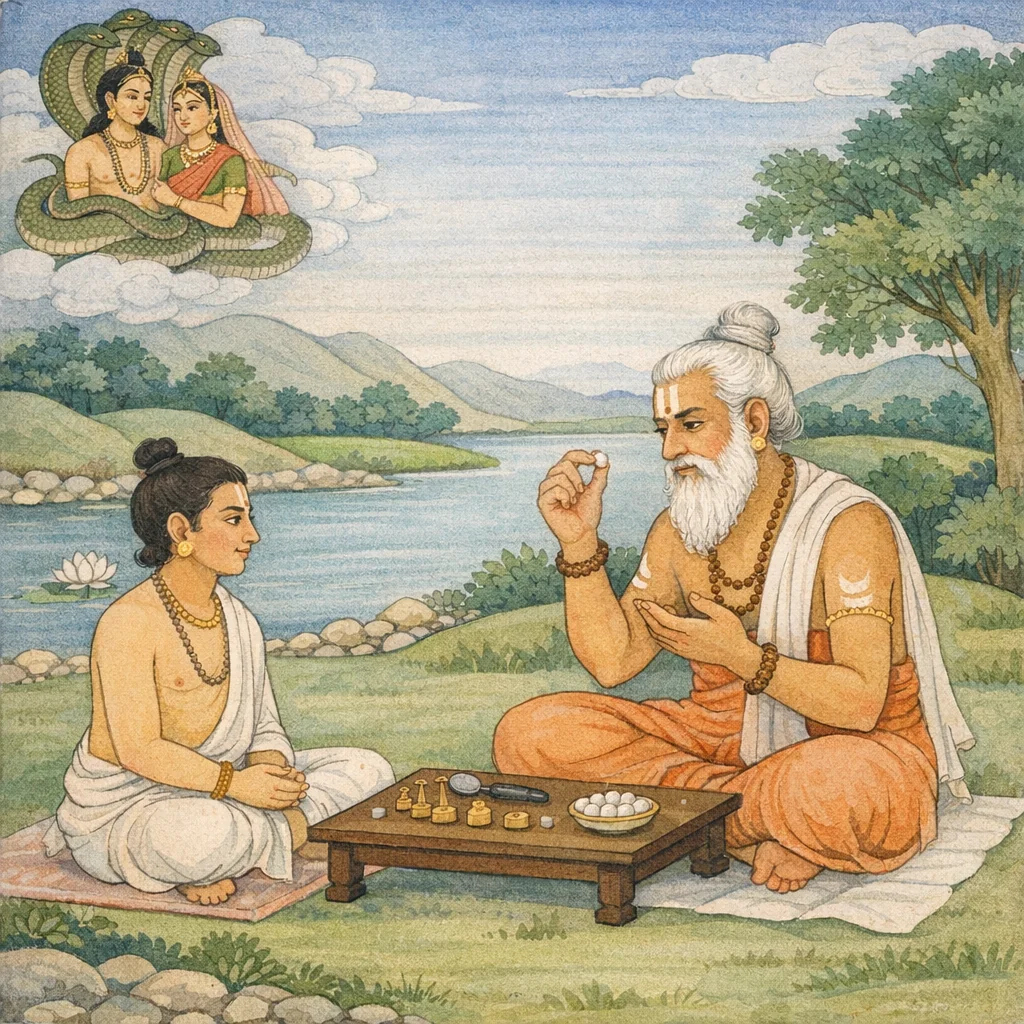
Continuing the Brahma Khanda’s practical-dharma and material-culture focus, Sūta presents a ratna-śāstra account of pearls: their eight traditional origins and a hierarchy that favors oyster-born pearls for their abundance and ease of perforation. The narrative then turns to rarer pearls (especially those linked with serpents/nāgas), framed by protective rites and auspicious conditions, blending ritual potency with the gaining of extraordinary gems and worldly sovereignty. Next it becomes technical, listing weights, measures, and price grades to establish a normative economic standard for valuation. It concludes with procedures for softening, cooking, refining, and testing pearls (including discoloration tests), and with the canonical lakṣaṇas of a superior pearl—whiteness, roundness, smoothness, proper weight, lustre, purity, and a clean, fine perforation—moving from mythic provenance to verifiable criteria and preparing for adjacent chapters on material signs, auspiciousness, and disciplined technique.
Shlokas
Verse 1
नामाष्टषष्टितमो ऽध्यायः सूत उवाच / द्विपेन्द्रजीमूतवराहशङ्खमत्स्याहिशुक्त्युद्भववेणुजानि / मुक्ताफलानि प्रथितानि लोके तेषां च शुक्त्युद्भवमेव भूरि
Sūta said: Pearls (muktāphala) are famed in the world as arising from the lordly elephant, the cloud, the boar, the sacred conch (śaṅkha), the fish, the serpent, the oyster-shell, and the bamboo; yet among these, those born from the oyster-shell are the most abundant.
Verse 2
तत्रैव चैकस्य हि मूलमात्र निविश्यते रत्नपदस्य जातु / वेध्यं तु शुक्तयुद्भवमेव तेषां शेषाण्यवेध्यानि वदन्ति तज्ज्ञाः
There, only the very base of a single jewel-bearing spot is ever pierced. Among such pearls, only those that arise from the oyster-shell are said to be fit for piercing; the rest, the experts declare, are not to be pierced.
Verse 3
त्वक्सारनागेन्द्रतिमिप्रसूतं यच्छङ्खजं यच्च वरा हजातम् / प्रायो विमुक्तानि भवन्ति भासा शस्तानि माङ्गल्यतया तथापि
That which is produced from the elephant’s tusk, from the king of serpents (Nāga), from the timi sea-creature, and that which is born of the boar—these are generally set aside by their very nature; yet they are still praised as auspicious objects.
Verse 4
या मौक्तिकानामिह जातये ऽष्टौ प्रकीर्तिता रत्नविनिश्चयज्ञैः / कम्बूद्भवं तेष्वधमं प्रदिष्टमुत्पद्यते यच्च गजेन्द्रकुम्भात्
Those skilled in judging gems declare that in this world eight kinds of pearls are spoken of. Among them, the lowest is said to be the pearl that arises from the sacred conch (śaṅkha), and likewise that which is produced from the frontal globes (temples) of a lordly elephant.
Verse 5
स्वयोनिमद्यच्छवितुल्यवर्णं शाङ्खं बृहल्लोलफलप्रमाणम् / उत्पद्यते वारणकुम्भमध्यादापीतवर्णं प्रभया विहीनम्
From its own source (the womb) there arises a conch-shaped mass, large—about the measure of a hanging fruit—emerging from the middle of the elephant-like pot (the womb). It is pale-yellow in hue and bereft of radiance.
Verse 6
ये कम्बवः शार्ङ्गमुखावमर्शपीतस्य शङ्खप्रवरस्य गोत्रे / मतङ्गजाश्चापि विशुद्धवंश्यास्ते मौक्तिकानां प्रभवाः प्रदिष्टाः
The conches known as Kambavas—belonging to the lineage of the foremost śaṅkha that was once “imbibed/received” when its mouth was touched by Śārṅga (Viṣṇu’s bow)—and likewise elephants of pure breed: these are declared to be the sources from which pearls arise.
Verse 7
उत्पद्यते मौक्तिकमेषु वृत्तमापीतवर्णं प्रभया विहीनम् / पाठीनपृष्ठस्य समानवर्णं मीनात्सुवृत्तं लघु चातिसूक्ष्मम्
In these, a pearl is produced—round in form, pale-yellow in colour, and lacking lustre; it bears the same hue as the back of the pāṭhīna-fish. From fish too such pearls arise: well-rounded, light, and exceedingly minute.
Verse 8
उत्पद्यते वारिचराननेषु मत्स्याश्चे ते मध्यचराः पयोधेः / वराहदंष्ट्राप्रभवं प्रदिष्टं तस्यैव दंष्ट्राङ्कुरतुल्यवर्णम्
Among aquatic creatures, fish are born and move in the mid-regions of the ocean. They are said to have originated from the tusk of Varāha, the sacred Boar, and their colour is described as like the sprout upon that very tusk.
Verse 9
क्रचित्कथञ्चित्स भुवः प्रदेशे प्रजायते सूकरराड्विशिष्टः / वर्षोपलानां समवर्णशोभं त्वक्सारपर्वप्रभवं प्रदिष्टम्
Somewhere, in a certain region of the earth, there arises a remarkable king of boars. It is described as having a hide whose sheen matches the colour and lustre of hailstones, and as being born from hard knots and the tough outer layers of skin.
Verse 10
ते वेणवो दिव्यजनोपभोग्ये स्थाने प्ररोहन्ति न सार्वजन्ये / भौजं गमं मीनविशुद्धवृत्तं संस्थानतो ऽत्युज्ज्वलवर्णशोभम्
Those bamboos sprout only in a place fit for the enjoyment of divine beings, not on common public ground. Their stalk is smooth and straight, with a fish-like pure roundness, and in form they shine with an exceedingly brilliant hue and beauty.
Verse 11
नितान्तधौतप्रविकल्पमाननिस्त्रिंशधारासमवर्णकान्ति / प्राप्यातिरत्नानि महाप्रभाणि राज्यं श्रियं वा महतीं दुरापाम्
Its radiance is like the gleam of a sword’s edge—thoroughly cleansed and brilliantly polished. By it one obtains exceedingly splendid, great-lustred jewels, and even hard-to-attain sovereignty or vast prosperity.
Verse 12
तेजो ऽन्विताः पुण्यकृतो भवन्ति मुक्ताफलस्याहिशिरोभवस्य / जिज्ञासया रत्नधनं विधिज्ञैः शुभेमुहूर्ते प्रयतैः प्रयत्नात्
Those who perform meritorious deeds become endowed with spiritual lustre. By the keen inquiry of ritual experts, the pearl that arises from the serpent’s head is obtained as a treasure of gems—secured with disciplined effort at an auspicious time.
Verse 13
रक्षाविधानं सुमहद्विधाय हर्म्योपरिष्ठं क्रियते यदा तत् / तदा महादुन्दुभिमन्द्रघोषैर्विद्युल्लताविस्फुरितान्तरालैः
When an extensive rite of protection is duly performed and that protective arrangement is set in place upon the upper part of the mansion, then the space between is filled with the deep resonance of great kettle-drums and with intervals flashing like streaks of lightning.
Verse 14
पयोधराक्रान्तिविलम्बिनम्रैर्घनैर्नवैराव्रियते ऽन्तरिक्षम् / न तं भुजङ्गा न तु यातुधाना न व्याधयो नाप्युपसर्गदोषाः
As the sky is covered by fresh clouds—heavy with water—moving slowly and bending low, so too his path is veiled from harm. Serpents do not afflict him, nor do yātudhāna demonic forces; neither diseases nor misfortunes and evil portents can touch him.
Verse 15
हिंसन्ति यस्याहिशिरः समुत्थं मुक्ताफलं तिष्ठति कोशमध्ये / नाभ्येति मेघप्रभवं धरित्रीं विप्रद्गतं तद्विबुधा हरन्ति
The serpent’s hood, rising up, strikes him for whom the pearl still lies shut within its shell; as cloud-born rain fails to reach the earth, so do the wise take back the merit or wealth that has been given to a brāhmaṇa.
Verse 16
अर्चिः प्रभानावृतदिग्विभागमादित्यवहुः खविभाव्यबिम्बम् / तेजस्तिरस्कृत्य हुताशनेन्दुनक्षत्रताराप्रभवं समग्रम्
A blazing radiance—its splendor veiling the quarters—appeared as though bearing the Sun, with a sky-like luminous orb; it outshone the brilliance of fire, the moon, the constellations, and the stars altogether.
Verse 17
दिवा यथा दीर्प्तिङ्करं तथैव तमो ऽवगाढास्वपि तन्निशासु / विचित्ररत्नद्युतिचारुतोया चतुः समुद्राभरणोपपन्ना
As the radiant sun shines by day, so too it shines even in nights plunged in darkness; for this world is adorned with the four oceans, whose lovely waters gleam with the luster of many-colored jewels.
Verse 18
मूल्यं न वा स्यादिति निश्चयो मे कृत्स्ना मही तस्य मुवर्णपूर्णा / हीनो ऽपियस्तल्लभते कदाचिद्विपाकयोगान्महतः शुभस्य
I am certain it is beyond price—even if the whole earth were filled with gold, it would not equal it. Yet even a lowly person may sometimes obtain that rare attainment through the ripening of a great store of auspicious karma.
Verse 19
सापत्न्यहीनां स महीं समग्रां भुनक्ति तत्तिष्ठति यावदेव / न केवलं तच्छुभकृन्नृपस्य भाग्यैः प्रजानामपि तस्य जन्म
He enjoys the whole earth, free from rival claimants, and remains established in sovereignty for as long as that merit endures. Such auspicious conduct benefits not only the king through his own fortune, but even his subjects—his very birth becomes a boon to the people.
Verse 20
तद्योजनानां परितः सहस्रं सर्वाननर्थान्विमुखी करोति / नक्षत्रमालेव दिवो विशीर्णा दन्तावलिस्तस्य महामुरस्य
Spreading a thousand yojanas in every direction, it turns back all calamities; the great asura’s row of teeth lay scattered—like a garland of stars fallen from the sky.
Verse 21
विचित्रवर्णेषु विशुद्धवर्णा पयः सु पत्युः पयसां पपात / सम्पूर्णचन्द्रांशुकलापकान्तेर्माणिप्रवेकस्य महागुणस्य
Amid the many variegated hues, one of perfectly pure color—milk—poured forth as the finest essence of all fluids, radiant like a cluster of moonbeams, a foremost jewel endowed with great virtues.
Verse 22
तच्छुक्तिमत्सु स्थितिमाप बीजमासन्पुराप्यन्यभवानि यानि / यस्मिन्प्रदेशे ऽम्बुनिधौ पपात सुचारुमुक्तामणिरत्नबीजम् / तस्मिन्पयस्तोयधरावकीर्णं शुक्तौ स्थितं मौक्तिकतामवाप
That ‘seed’—which in earlier states of becoming had existed in other forms—came to rest within oysters. In the region of the ocean where that beautiful seed of pearl-gem fell, drenched by milky waters and settled inside the shell, it attained the state of a pearl.
Verse 23
सैंहलिकपारलौकिकसौराष्ट्रिकताम्रपर्णपारशवाः / कौवेरपाण्ड्यहाटकहेमकमित्याकरास्त्वष्टौ
There are eight renowned mines (sources of metals): those of Siṃhala, Pāralaukika, Saurāṣṭra, Tāmraparṇa, Pāraśava, as well as those called Kauvera, Pāṇḍya, Hāṭaka, and Hemaka.
Verse 24
शुक्त्युद्भवं नातिनिकृष्टवर्णं प्रमाणसंस्थानगुणप्रभाभिः / उत्पद्यते वर्धनपारसीकपाताललोकान्तरसिंहलेषु
Born from oyster-shells, it is not of an inferior color; and by its measures, shape, qualities, and luster, it is produced in places such as Vardhana, Pārasīka (Persia), Pātāla, other regions, and Siṃhala (Sri Lanka).
Verse 25
चिन्त्या न तस्याकरजा विशेषा रूपे प्रमाणे च यतेत विद्वान् / न च व्यवस्थास्ति गुणागुणेषु सर्वत्र सर्वाकृतयो भवन्ति
No distinctive mark of Him can be grasped by thought as arising from any form. The wise should not strive to define Him by shape or measure. For in qualities and in non-qualities there is no fixed determination—everywhere He becomes all forms.
Verse 26
एतस्य शुक्तिप्रभस्य मुक्ताफलस्य चान्येन समुन्मितस्य / मूल्यं सहस्राणि तु रूपकाणां त्रिभिः शतैरप्याधिकानि पञ्च
The value of this pearl—shining with the luster of a nacre-shell (śukti) and weighed against another as a standard—is one thousand rūpakas, plus three hundred and five more.
Verse 27
यन्माषकार्धेन ततो विहीनं तत्पञ्चभागद्वयहीनमूल्यम् / यन्माषकांस्त्रीन्बिभृयात्सहस्रे द्वे तस्य मूल्यं परमं प्रदिष्टम्
That amount which is less by half a māṣaka is valued at two-fifths less; and that which amounts to three māṣakas in two thousand is declared to have the highest standard value.
Verse 28
अर्धाधिकौ द्वौ वहतो ऽस्य मूल्यं त्रिभिः शतैरप्यधिकं सहस्रम् / द्विमाष कोन्मानितगौरवस्य शतानि चाष्टौ कथितानि मूल्यम्
For this, when the weight comes to two and a half (2 1/2), its price is said to be one thousand plus three hundred (1,300). And for a weight assessed as two māṣas, the stated price is eight hundred.
Verse 29
अर्धाधिकं माषकमुन्मितस्य समं च विंशत्रितयं शतानाम् / गुञ्जाश्च षड् धारयतः शते द्वे मूल्यं परं तस्य वदन्ति तज्ज्ञाः / अध्यर्धमुन्मान(प) कृतं शतं स्यान्मूल्यं गुणैस्तस्य समन्वितस्य
For one measured as a māṣaka increased by a half, the value is said to be one hundred and sixty. For one that bears six guñjā seeds in weight, the experts declare its highest value to be two hundred. If the measure is made one and a half times, the standard becomes a hundred; and the value of that, endowed with its proper qualities, is determined accordingly.
Verse 30
यदि षोडशभिर्भवेदनूनन्धरणं तत्प्रवदन्ति दार्विकाख्यम् / अधिकं दशभिः शतं च मूल्यं समवाप्नोत्यपि बालिशस्य हस्तात्
If the quantity is held to be sixteen (units), they call it “dārvika”; and if it is greater—by ten more—its price becomes a hundred, obtainable even from the hand of a simpleton.
Verse 31
द्विगुणैर्दशभिर्भवेदनूनं धरणं तद्भवकं वदन्ति तज्ज्ञाः / नवसप्ततिमाप्नुयात्स्वमूल्यं यदि न स्याद्गुणसम्पदा विहीनम्
The learned say that a “dharaṇa” (a prescribed measure) is no less than twenty times ten (i.e., two hundred), and it is said to yield its corresponding result. It would attain a value of seventy-nine of its own units—provided it is not devoid of the wealth of good qualities (i.e., purity/fitness).
Verse 32
त्रिंशता धरणं पूर्णं शिक्यं तस्येति कीर्त्यते / चत्वारिंशद्भवेत्तस्याः परं मूल्यं विनिश्चयः
Thirty (units) make a complete dharaṇa; that is said to be its “śikya”. Forty (units) is determined, with certainty, to be its highest value.
Verse 33
चत्वारिंशद्र भवेत्तस्यास्त्रिंशन्मूल्यं लभेत् सा / पञ्चाशत्तु भवेत्सोमस्तस्य मूल्यं तु विंशतिः
If it becomes forty (in count), it obtains a value of thirty. But if Soma becomes fifty, its value is twenty.
Verse 34
षष्टिर्निकरशीर्षं स्यात्तस्या मूल्यं चतुर्दश / अशीतिर्नवतिश्चैव कूप्येति परिकीर्तिता / एकादश स्यान्नव च तयोर्मूल्यमनुक्रमात्
Sixty (units) are said to make a “nikara-śīrṣa”, and its value is fourteen. Eighty and ninety are also declared as “kūpya” measures. Eleven and nine are the respective values of those two, in due order.
Verse 35
आदाय तत्सकलमेव ततो ऽन्नभाण्डं जम्बीरजातरसयोजनया विपक्रम् / घृष्टं ततो मृदुतनूकृतपिण्डमूलैः कुर्याद्यथेष्टमनु मौक्तिकमाशु विद्धम्
Then take that entire mass and place it in a food-vessel; cook it with the addition of lemon (jambīra) juice. Afterward, rub it with roots made into a soft, thinned paste, and fashion it as you wish; the pearl (mauktika) is quickly pierced, ready for stringing.
Verse 36
मृल्लिप्तमत्स्यपुटमध्यगतं तु कृत्वा पश्चात्पचेत्तनु ततश्च बिडालपुट्या / दुग्धे ततः पयसि तं विपचेत्सुधायां पक्रं ततो ऽपि पयसा शुचिचिक्रणेन
After placing it within a fish-shaped casing coated with clay, one should first bake it gently; then enclose it in a cat-shaped casing as well. Next, one should boil it in milk, then in whey, and then in lime-water; and when it is cooked, it should again be washed and refined with pure milk, so it becomes clean and well-processed.
Verse 37
शुद्धं ततो विमलवस्त्रनिघर्षणेन स्यान्मौक्तिकं विपुलसद्गुणकान्तियुक्तम् / व्याडिर्जगाद जगतां हि महाप्रभावः सिद्धो विदग्धहिततत्परया दयालुः
Then, by rubbing it with a clean and spotless cloth, the pearl (mauktika) is purified and comes to possess abundant good qualities and radiant luster. Thus spoke Vyāḍi—the perfected siddha-sage of great power in the worlds—compassionate and intent on the welfare of the wise.
Verse 38
श्वेतकाचसमं तारं हेमांशशतयोजितम् / रसमध्ये प्रधार्येत मौक्तिकं देहभूषणम्
A pearl—lustrous like white crystal, set with a hundred threads (or rays) of gold—should be strung and worn at the center of the chest, as an ornament for the body.
Verse 39
एवं हि सिंहले देशे कुर्वन्ति कुशला जनाः / यस्मिन्कृत्रैमसन्देहः क्रचिद्भवति मौक्तिके
Thus indeed, in the land of Siṃhala, skilled people do this; for there, at times, doubt arises that a pearl (mauktika) may be artificial.
Verse 40
उष्णे सलवणे स्नेहे निशां तद्वासयेज्जले / व्रीहिभिर्मर्दनीयं वा शुष्कवस्त्रोपवेष्टितम्
Soak it overnight in warm water mixed with salt and oil; or rub it with rice grains, keeping it wrapped in a dry cloth.
Verse 41
यत्तु नायाति वैवर्ण्यं विज्ञेयं तदकृत्रिमम् / सितं प्रमाणवत्स्निग्धं गुरु स्वच्छं सुनिर्मलम्
That which does not undergo discoloration should be understood as genuine and unadulterated—white, of proper measure, smooth and unctuous, weighty, clear, and perfectly pure.
Verse 42
तेजो ऽधिकं सुवृत्तं च मौक्तिकं गुणवत्स्मृतम्
A pearl is remembered as possessing superior radiance, a fine rounded form, and excellent qualities.
Verse 43
प्रमाणवद्गौरवरश्मियुक्तं सितं सुवृत्तं समसूक्ष्मवेधम् / अक्रेतुरप्यावहति प्रमोदं यन्मौक्तिकं तद्गुणवत्प्रदिष्टम्
A pearl is declared to be of true quality when it has proper size, pleasing weight and lustre, is white, well-rounded, and evenly pierced with a fine hole; such a pearl brings delight even to one who does not buy it.
Verse 44
एवं समस्तेन गुणोदयेन यन्मौक्तिकं योगमुपागतं स्यात् / न तस्य भर्तारमनर्थजात एको ऽपि कश्चित् समुपैति दोषः
Thus, when a pearl has attained its state through the full manifestation of excellent qualities, not even a single defect—born of misfortune—can be found in its bearer (owner).
Frequently Asked Questions
A true-quality pearl is described as white, well-rounded, smooth/unctuous, weighty yet pleasing, clear and perfectly pure, with excellent lustre and an evenly made fine perforation; such completeness of qualities is said to leave no defect in the bearer’s possession.
It advises soaking overnight in warm water mixed with salt and oil, or rubbing with rice grains while wrapped in a dry cloth; a pearl that does not discolor under such handling is to be understood as genuine and unadulterated.
The text describes cooking with lemon juice, rubbing with softened root-paste, staged heating/baking in shaped casings, boiling sequentially in milk, whey, and lime-water, then washing again with pure milk and polishing with a clean cloth to restore lustre and good qualities.