Adhyaya 46
Vāstu-pūjā, Vāstu-maṇḍala Deities, Site Computations, and Doorway/Tree Prescriptions
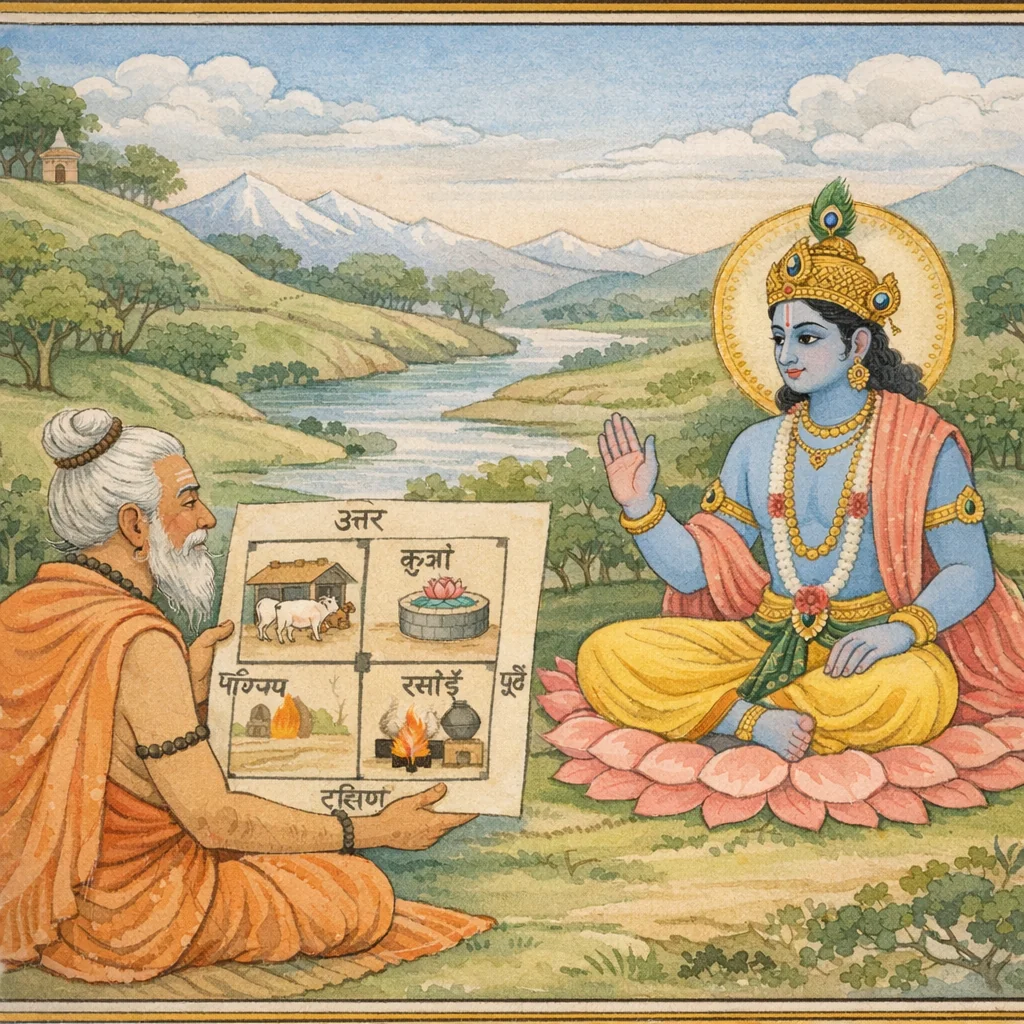
Continuing the Garuḍa Purāṇa’s practical dharma teaching, Hari turns from general religious duty to the consecration of lived space through vāstu. Beginning from Īśāna (the north-east), he sets out worship on the site-grid and the placement of deities for settlements and major structures, with outer and inner circles and a ninefold core centered on Brahmā. The teaching then moves from ritual mapping to architectural planning: altars and ritual pavilions, the proper locations of kitchen, stores, cowshed, water zones, weapons area, and a well-appointed southern guest-house, along with decorative and boundary rules for a Viṣṇu-āśrama. A second 64-square maṇḍala and further classes of beings and guardians extend the protective perimeter. The chapter adds computational rules based on site area and division remainders (eight/nine, nakṣatra residue, jīva remainder) to avoid building on ‘living’ instability. It concludes with doorway measurements, sector-based outcomes, and auspicious tree placements—especially in the north-east—preparing for later chapters that systematize ritual architecture and the karmic results of spatial choices.
Shlokas
Verse 1
नाम पञ्चचत्वारिंशो ऽध्यायः हरिरुवाच / वास्तुं संक्षेपतो वक्ष्ये गृहादौ विघ्ननाशनम् / ईसानकोणादारभ्य ह्येकाशीतिपदे यजेत्
Hari said: “I shall briefly explain the principles of Vāstu for removing obstacles in a house and other buildings. Beginning from the Īśāna (north-east) corner, one should perform worship at the eighty-one positions (padas).”
Verse 2
ईशाने च शिरः पादौ नैरृते ऽग्न्यनिले करौ / आवासवासवेश्मादौ पुरे ग्रामे वणिक्पथे
In the north-east are placed the head and the feet; in the south-west are placed the hands, in accord with Agni and Vāyu. This directional arrangement is to be observed in dwellings, in Indra’s mansions (temples or palaces), and likewise in towns, villages, and merchants’ streets.
Verse 3
प्रासादारामदुर्गेषु देवालयमठेषु च / द्वाविंशति सुरान्बाह्ये तदन्तश्च त्रयोदश
In palaces, pleasure-gardens, and forts, as well as in temples and monasteries, there are twenty-two deities on the outside; and within them there are thirteen.
Verse 4
ईशश्चैवाथ पर्जन्यो जयन्तः कुलिशायुधः / सूर्यः सत्यो भृगुश्चैव आकाशो वायुरेव च
Īśa, Parjanya, Jayanta, the wielder of the thunderbolt-weapon, Sūrya, Satya, Bhṛgu, and also Ākāśa and Vāyu—these too are to be remembered and invoked.
Verse 5
पूषा च वितथश्चैव ग्रहक्षेत्रयमावुभौ / गन्धर्वो भृगुराजस्तु मृगः पितृगणस्तथा
Pūṣā and Vitatha, and also both Graha and Kṣetra, and the two Yamas; likewise the Gandharva, Bhṛgurāja, Mṛga (the Deer), and the host of the Pitṛs (ancestral spirits) are enumerated.
Verse 6
दौवारिको ऽथ सुग्रीवः पुष्पदन्तो गणाधिपः / असुरः शेषपापौ (दौ) च रोगो/डहिमुख (ख्य) एव च
Then there are Dauvārika, Sugrīva, Puṣpadanta, and Gaṇādhipa; also Asura, Śeṣapāpa (or Śeṣapāpau), and Roga—likewise one known as Ḍahimukha. (These are functionaries or guardians connected with administering punishments for sins.)
Verse 7
भल्लाटः सोमसर्पौ च अदितिश्चदितिस्तथा / बहिर्द्वात्रिंशदेते तु तदन्तश्चतुरः शृणु
Bhallāṭa, Somasarpa, and likewise Aditi and Aditi—these are the thirty-two on the outer circle; now hear the four that are within them.
Verse 8
ईशानादिचतुष्कोणसंस्थितान्पूजयेद्धुधः / आपश्चैवाथ सावित्री जयो रुद्रस्तथैव च
A wise person should worship those stationed at the four corners beginning with Īśāna (the northeast): namely Āpaḥ (the Waters), Sāvitrī, Jaya, and Rudra as well.
Verse 9
मध्ये नवपदे ब्रह्मा तस्याष्ठौ च समीपगान् / देवानेकोत्तरानेतान्पूर्वादौ नामतः शृणु
In the middle, in the ninefold arrangement, is Brahmā; and near him are eight deities. Hear, from the eastern direction onward, the names of these deities—nine in all.
Verse 10
अर्यमा सविता चैव विवस्वान्विबुधाधिपः / मित्रो ऽथ राजयक्ष्मा च तथा पृथ्वीधरः क्रमात्
In due order come Aryamā, Savitṛ, Vivasvān—the lord of the gods—then Mitra, then Rājayakṣmā, and likewise Pṛthvīdhara, sequentially.
Verse 11
अष्टमश्चापवत्सश्च परितो ब्रह्मणः स्मृताः / ईशानकोणादारभ्य दुर्गे चर् (ज्ञेयो) वंश उच्यते
“The Eighth” and “Āpavatsa” are remembered as being situated all around Brahmā. Beginning from the north‑eastern corner, the lineage (vaṃśa) connected with Durgā—the protective stronghold—is to be understood as being described.
Verse 12
आग्नेयकोणादारभ्य वंशो भवति दुर्धरः / अदितिं हिमवन्तं च जयन्तं च इदं त्रयम्
Beginning from the south‑eastern quarter, a lineage becomes difficult to sustain. Here these three are to be understood: Aditi, Himavān, and Jayanta.
Verse 13
नायिका कालिका नाम शक्राद्रन्धर्वगाः पुनः / वास्तुदेवान्पूजयित्वा गृहप्रासादकृद्भवेत्
The presiding (nāyikā) power is named Kālikā; and again, influences connected with Indra (Śakra) and the Gandharvas operate. Having worshipped the Vāstu-deities, one becomes fit to undertake the construction of a house or a palace/temple.
Verse 14
सुरेज्यः पुरतः कार्यो यस्याग्नेय्यां महानसम् / कपिनिर्गमने (णी)?येन पूर्वतः सत्रमण्डपम्
The altar for worship of the gods should be made in the front; the kitchen should be placed in the south‑east. A passage for the monkey’s exit should be arranged, and in front (to the east) the pavilion for the sacrificial rite should be set up.
Verse 15
गन्धपुष्पगृहं कार्यमैशान्यां पट्टसंयुतम् / भाण्डागारं च कौबेर्यां गोष्ठागारं च वायवे
A room for fragrances and flowers should be made in the north‑east, fitted with shelves; a storeroom should be placed in the northern quarter; and a cowshed should be located in the north‑west.
Verse 16
उदगाश्रयं च वारुण्यां वातायनसमन्वितम् / समित्कुशेन्धनस्थानमायुधानां च नैरृते
To the north is the water‑reservoir; in the western quarter is the Varuṇa‑related water area furnished with ventilating openings; in the south‑east is the place for fuel‑sticks (samit), kuśa grass, and firewood; and in the south‑west is the place for weapons.
Verse 17
अभ्यागतालयं रम्यसशय्यासनापदुकम् / तोयाग्निदीपसद्भृत्यैर्युक्तं दक्षिणतो भवेत्
On the southern side there should be a welcoming guest-house, furnished with pleasing beds, seats, and sandals, and supplied with water, fire, lamps, and good attendants.
Verse 18
गृहान्तराणि सर्वाणि सजलैः कदलीगृहैः / पञ्चवर्णैश्च कुसुमैः शोभितानि प्रकल्पयेत्
One should arrange and adorn all the inner spaces of the house with moist banana-stalk structures, and decorate them with flowers of five colors.
Verse 19
प्राकारं तद्वहिर्दद्यात्पञ्चहस्तप्रमाणतः / एवं विष्ण्वाश्रमं कुर्याद्वनैश्चोपवनैर्युतम्
Outside it, one should construct an enclosing wall, measuring five hastas (cubits) in extent. Thus should one establish a Viṣṇu-āśrama, furnished with groves and adjoining garden-woods.
Verse 20
चतुः षष्टिपदो वास्तुः प्रासादादौ प्रपूजितः / मध्ये चतुष्पदो ब्रह्मा द्विप दास्त्वर्यमादयः
In palaces and similar buildings, Vāstu is worshipped as the sixty-four-squared maṇḍala. In its center is Brahmā in the four-squared place, while in the two-squared divisions are Aryamā and the other deities.
Verse 21
कर्णे चैवाथ शिख्याद्यास्तथा देवाः प्रकीर्तिताः / तेभ्यो ह्युभयतः सार्धादन्ये ऽपि द्विपदाः सुराः
And in the “ears” as well, and beginning with the śikhyā (tuft/crest), the Devas are said to be established. From them, on both sides together, other two-squared divine beings also are reckoned.
Verse 22
चतुः षष्टिपदा देवा इत्येवं परिकीर्तिताः / चरकी च विदारी च पूतना पापराक्षसी
Thus the deities are proclaimed as possessing sixty‑four feet. Also mentioned are Carakī, Vidārī, and Pūtanā—the sinful rākṣasī.
Verse 23
ईशानाद्यास्ततो बाह्ये देवाद्या हेतुकादयः / हैतुकस्त्रिपुरान्तश्च अग्निवेतालकौ यमः
Beyond them, on the outer side, are Īśāna and the others; then the gods and the rest—Hetuka and the like. There are also Haituka, Tripurānta, and the guardians Agni and Vetālaka, together with Yama.
Verse 24
अग्निजिह्वः कालकश्च करालो ह्यकपादकः / ऐशान्यां भीमरूपस्तु पाताले प्रेतनायकः
Agnijihva, Kālaka, Karāla, and Akapādaka—these dreadful beings are present. In the north‑eastern quarter stands Bhīmarūpa, and in Pātāla (the nether realm) is the leader of the pretas, the spirits of the dead.
Verse 25
आकाशे गन्धमाली स्यात्क्षेत्रपालांस्ततो यजेत् / विस्ताराभिहतं दैर्घ्यं राशिं वास्तोस्तु कारयेत्
In the open space above, one should place a fragrant garland as an offering; then one should worship the Kṣetrapālas, the guardians of the site. For the Vāstu rite, one should prepare a heap or measure obtained by multiplying the length by the breadth, that is, the area‑measure.
Verse 26
कृत्वा च वसुभिर्भागं शेषं बद्धा यमादिशेत् / पुनर्गुणितमष्टाभिरृभागं तु भाजयेत्
Having first divided it into eight shares in accord with the Vasus, one should bind up the remainder and consign it as ordained by Yama. Then, multiplying again by eight, one should duly apportion the Ṛ‑share.
Verse 27
यच्छेषं तद्भवेदृक्षं भागैर्हृत्वाव्ययं भवेत् / ऋक्षं चतुर्गुणं कृत्वा नवभिर्भागहारितम्
Whatever remains becomes the nakṣatra (ṛkṣa). After subtracting according to the parts, the unchanging constant is obtained. Then the nakṣatra is made fourfold and divided into nine parts.
Verse 28
शेषमंशं विजानीयाद्देवलस्य मतं यथा / अष्टाभिर्गुणितं पिण्डं षष्टिभिर्भागाहरितम्
One should understand the remaining portion according to Devala’s stated view: the piṇḍa (funeral rice-ball offering) is multiplied by eight and then divided into sixty parts.
Verse 29
यच्छेषं तद्भवेज्जीवं मरणं भतहारितम् / वास्तुक्रोडे गृहं कुर्यान्न पृष्ठे मानवः सदा
Whatever remains becomes the jīva, the life-principle; death occurs when it is carried off by Yama’s attendants. Therefore one should always build a house upon a proper foundation of ground, and never upon the back of a living being.
Verse 30
वामपार्श्वेन स्वापिति नात्र कार्या विचारणा / सिंहकन्यातुलायां च द्वारं शुध्येदथोत्तरम्
If one sleeps on the left side, no special deliberation is required. And in the zodiac signs Leo, Virgo, and Libra, the doorway should be ritually purified; thereafter one should proceed northward.
Verse 31
एवं च वृश्चिकादौ स्यात्पूर्वदक्षिणपश्चिमम् / द्वारं दीर्घार्धविस्तारं द्वाराण्यष्टौ स्मृतानि च
Likewise, beginning with Scorpio, the sequence is taken as east, south, and west. The doorway should have a length equal to half its width; and eight such doorways are spoken of in the tradition.
Verse 32
सन्तानप्रेष्यनीचत्वं स्वयानं स्वर्णभूषणम् / सुतहीनं तु रौद्रेण वीर्यघ्नं दक्षिणे तथा
To send one’s offspring into servile toil leads to a fallen state; riding in one’s own conveyance and wearing ornaments of gold are also spoken of here. He who is without sons is afflicted by the Raudra force, and likewise he who destroys virility is afflicted in the southern quarter.
Verse 33
वह्नौ बधश्चायुर्वृद्धिंपुत्त्रलाभसुतृप्तिदः / धनदे नृपपीडादमर्थघ्नं रोगदं जले
In fire it brings injury and destruction; yet it can also bestow increase of lifespan, the gaining of sons, and contentment. In matters of wealth it brings harassment by kings, it destroys prosperity, and in water it gives rise to disease.
Verse 34
नृपभी तिर्मृतापत्यं ह्यनपत्यं न वैरदम् / अर्थदं चार्थहान्यै च दोषदं पुत्रमृत्युदम्
Fear of the king, a child as good as dead, childlessness, and enmity—these do not bring prosperity. A son may bring wealth, yet he may also cause loss of wealth; he may bring blame, and he may even become a cause of a son’s death.
Verse 35
द्वाराण्युत्तरसंज्ञानि पूर्वद्वाराणि वच्म्यहम् / अग्निभीतिर्बहु कन्याधनसंमानकोपदम्
Now I shall describe the eastern gates, whose names are known in the north: Fear of Fire, Excess, Maidens, Wealth, Honour, and Anger.
Verse 36
राजघ्नं कोपदं पूर्वे फलतो द्वारमीरितम् / ईशानादौ भवेत्पूर्वमग्नेय्यादौ तु दक्षिणम्
It is said that the eastern side is connected with the “slayer of kings” and with the state of anger; and that a door (entrance) should be made on the side that yields auspicious results. Beginning from the north-east (Īśāna), the proper orientation is toward the east; beginning from the south-east (Agneya), it should be toward the south.
Verse 37
नैरृत्यादौ पश्चिमं स्याद्वायव्यादौ तु चोत्तरम् / अष्टभागे कृते भागे द्वाराणां च फलाफलम्
In the division that begins from the south‑west (Nairṛtya), the west is to be taken as the relevant direction; and in the division that begins from the north‑west (Vāyavya), the north is to be taken. When the space is divided into eight parts, the auspicious and inauspicious results of doors set in those sectors are determined accordingly.
Verse 38
अश्वत्थप्लक्षन्यग्रोधाः पूर्वादौ स्यादुदुम्बरः / गृहस्य शोभनः प्रोक्त ईशाने चैव साल्मलिः / पूजितो विग्नहारी स्यात्प्रासादस्य गृहस्य च
Aśvattha, Plakṣa, and Nyagrodha—sacred fig trees—are to be placed on the eastern side; Udumbara is declared an ornament that enhances the home with beauty and auspiciousness. And in the north‑east (Īśāna) there should be the Sālmali tree. When worshipped, it becomes a remover of obstacles for both the prāsāda (temple) and the house.
Frequently Asked Questions
Brahmā is installed at the center (brahmasthāna) within the ninefold arrangement, with eight deities placed around him in directional order. This makes the center the stabilizing spiritual axis of the plan, around which the remaining pads and guardians are harmonized through worship.
After dividing and recombining measures (area-based heap, eightfold and ninefold divisions, nakṣatra residue), the text describes a remainder that becomes ‘jīva’; when it is taken away by Yama’s attendants, death is said to occur. The teaching functions as a warning to build on proper ground/foundation rather than on unstable or ‘living’ back-like support, linking construction ethics to metaphysical consequence.