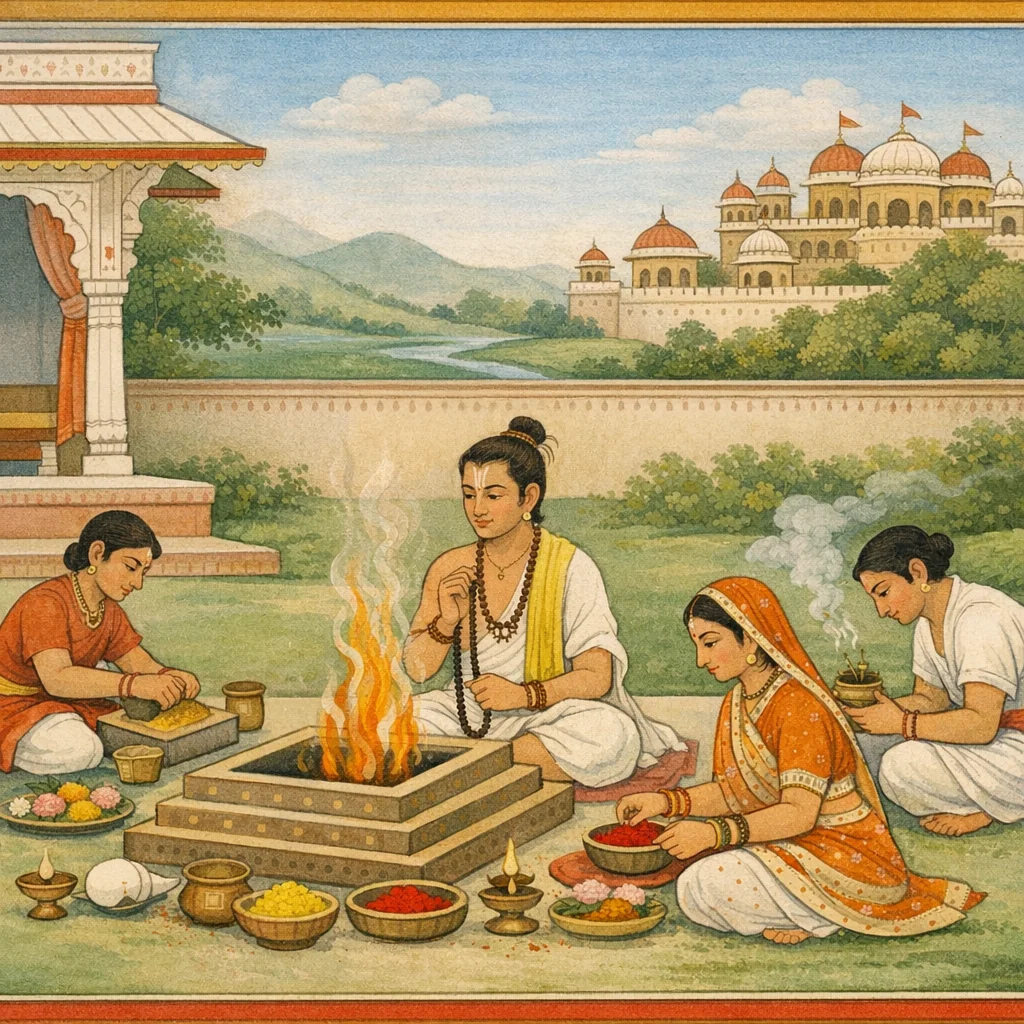
Adhyaya 185
Gaṇapati-Mantra Siddhi, Vighna-Nivāraṇa Rites, Vśīkaraṇa-Style Applications, and Cikitsā (Therapeutic Formulas)
Continuing the Brahma Khaṇḍa’s practical, instruction-driven tone, this adhyāya opens with Hari prescribing a Gaṇapati mantra (beginning “Āṁ gaṇapataye”), japa counts (including 8,000), śikhā-bandhana, and homa with black sesame and ghee to gain prosperity, persuasive success, and victory in disputes, especially in royal or administrative settings. It then sets out attraction and influence applications using the syllable Hrīṃ, tilaka preparations with manah-śilā, gorocanā, and kuṅkuma, fragrant incense blends, and anointments—presenting dravya-based ritual techniques for shifting social and erotic dynamics. The chapter closes in an Ayurvedic register with remedies for pariṇāma-śūla (colic), grahaṇī, diarrhoea, viṣūcikā-like illness, meha (urinary disorders), respiratory distress, eye diseases (films/opacity, night-blindness), and dental worms, linking obstacle-removal and ritual efficacy with bodily restoration and preparing for similarly compendious sections ahead.
Shlokas
Verse 1
ऽध्यायः हरिरुवाच / आं गणपतये इति अयं गणपतेर्न्मन्त्रो धनविद्याप्रदायकः
Hari (Lord Viṣṇu) said: “The mantra beginning with ‘Āṁ gaṇapataye’—this mantra of Gaṇapati bestows prosperity and the knowledge (skill) that leads to wealth.”
Verse 2
इममष्टसहस्रञ्च जप्त्वा बद्ध्वा शिखां ततः / व्यवहारे जयः स्याच्च शतं जापान्नृणां प्रियः
Having recited this (mantra) eight thousand times and then tying up one’s śikhā (tuft of hair), one gains victory in disputes and dealings; even a hundred repetitions make a person pleasing to others.
Verse 3
तिलानां तु घृताक्तानां कृष्णानां रुद्र होमयेत् / अष्टोत्तरसहस्रन्तु राजा वश्यस्त्रिभिर्दिनैः
One should perform a Rudra-homa with black sesame seeds anointed with ghee. By offering one thousand and eight oblations, even a king becomes amenable (brought under influence) within three days.
Verse 4
अष्टम्याञ्च चतुर्दश्यामुपोष्याभ्यर्च्य विघ्नराट् / तिलाक्षतानां जुहुयादष्टोत्तरसहस्रकम् / अपाजितः स्याद्युद्धे च सर्वे तञ्च सिषेविरे
On the eighth and the fourteenth lunar days, having fasted and worshipped Vighnarāja, the Lord who removes obstacles, one should offer oblations of sesame mixed with akṣata (unbroken grains), numbering one thousand and eight. Thus one becomes unconquered even in battle; indeed, all have resorted to this practice.
Verse 5
जप्त्वा चाष्टसहस्रन्तु ततश्चाष्टशतेन हि / शिखां बद्ध्वा राजकुले व्यवहारे जयो भवेत्
Having recited it eight thousand times, and then again eight hundred times, and having tied up one’s śikhā (tuft of hair), one attains victory in dealings and disputes within the royal court.
Verse 6
ह्रीङ्कारं सविसर्गञ्च प्रातः काले नरस्तु यः / स्त्रीणां ललाटे विन्यस्य वशतां नयति ध्रुवम्
A man who, in the morning time, places (writes/marks) the syllable “Hrīṃ” together with visarga (ḥ) upon the foreheads of women, surely brings them under his control.
Verse 7
सुसमाहितचित्तेन विन्यस्य प्रमदालये / सोत्कामां कामिनीं कुर्यान्नात्र कार्या विचारणा
With a mind well gathered and steady, placing her in the women’s quarters, one should make the passionate woman a partner in kāma; here there is no need for further deliberation.
Verse 8
जुहुयादयुतं यस्तु शुचिः प्रयतमानसः / दृष्टिमात्रे सदा तस्य वश्यमायान्ति योषितः
Whoever, being pure and with a disciplined mind, performs ten thousand oblations in the fire, finds that women become amenable and come under his influence merely by his glance.
Verse 9
मनः शिलापत्रकञ्च सगोरोचनकुङ्कुमम् / कृत एभिश्च तिलके वश्यमायान्ति योषितः
Using manah-śilā, śilā-patraka, and kuṅkuma mixed with gorocanā, when a tilaka is made upon the forehead with these, women are said to become submissive and come under one’s influence.
Verse 10
भृङ्गराट् सहदेवा च वचा श्वेतापराजिता / तेनैव तिलकं कृत्वा त्रैलोक्यं वशतां नयेत्
With bhṛṅgarāja, sahadevā, vacā, and white aparājitā, making a tilaka from these very herbs, one may bring the three worlds under one’s influence.
Verse 11
गोरोचना मीनपित्तमाभ्याञ्च कृतवर्तिकः / यः पुमांस्तिलकं कुर्याद्वामहस्तकनिष्ठया / स करोति वशे सर्वं त्रैलोक्यं नात्र संशयः
A man who prepares a pigment-stick from gorocanā and fish-bile, and applies a tilaka with the little finger of his left hand, brings all the three worlds under his influence; of this there is no doubt.
Verse 12
गोरोचना महादेव ! धातुशोणितभाविता / एतैर्वैतिलकं कृत्वा सा नरं यं निरीक्षते / तत्क्षणात्तं वशे कुर्या न्नात्र कार्या विचारणा
O Mahādeva! When gorocanā is infused with bodily minerals and blood, and a tilaka is made from these—whichever man she looks upon after applying it, she can bring him under her control instantly; there is no need for any further deliberation about it.
Verse 13
नागेश्वरञ्च शैलेयं त्वक्पत्रञ्च हरीतकी / चन्दनं कुष्ठसूक्ष्मैलारक्तशालिसमन्विता
Nageśvara, śaileya (a mountain aromatic), cinnamon leaf, and harītakī—together with sandalwood, kuṣṭha (costus), fine cardamom, and red śāli rice—are included (in the prescribed ritual materials).
Verse 14
एतैर्धूपो वशकरः स्मरबाणैः स्मारार्दनः / रतिकाले महादेव पार्वतीप्रिय शङ्कर
With these (ingredients) the incense becomes an instrument of attraction; it strikes like Kāma’s arrows and inflames desire. At the time of lovemaking—O Mahādeva, O Śaṅkara beloved of Pārvatī—(it is used thus).
Verse 15
निजशुक्रं गृही त्वा तु वामहस्तेन यः पुमान् / कामिनीचरणं वामं लिंपेत्स स्यात्स्त्रियाः प्रियः
A man who takes his own semen in his left hand and anoints with it the left foot of a beloved woman becomes dear to women.
Verse 16
सैन्धवञ्च महादेव पारावतमलं मधु / एभिर्लिप्ते तु लिङ्गे वै कामिनीवशकृद्भवेत्
O Mahādeva, if the liṅga is anointed with rock-salt, honey, and the droppings of a pigeon, then one becomes capable of bringing a woman under one’s influence.
Verse 17
पुष्पाणि पञ्चरक्तानि गृहीत्वा यानि कानि च / तत्तुल्यञ्च प्रियङ्गुञ्च पेषयेदेकयोगतः / अनेन लिप्तलिङ्गस्य कामिनीवशतामियात्
Taking five red flowers—whichever are at hand—and an equal measure of priyangu, one should grind them together into a single preparation. By anointing the liṅga with this, it is said that a woman comes under one’s influence.
Verse 18
हयगन्धा च मञ्जिष्ठा मालतीकुसुमानि च / श्वेतसषर्प एतैश्च लिप्तलिङ्गः स्त्रियाः प्रियः
If one anoints the liṅga with hayagandhā, mañjiṣṭhā, mālatī blossoms, and white sandal, he becomes dear and pleasing to women.
Verse 19
मूलन्तु काकजङ्घाया दुग्धपीतन्तु शोषनुत् / अश्वगन्धानागबलागुडमाषनिषेविणः / रूपं भवेद्यथा तद्वन्नवयौवनचारिणाम्
The root of kākajaṅghā, taken with milk, relieves wasting and dryness. One who regularly uses aśvagandhā and nāgabala, together with jaggery and black gram, attains a form and vigor like those who move about in fresh youth.
Verse 20
लौहचूर्णसमायुक्तं त्रिफलाचूर्णमेव वा / मधुना सेवितं रुद्र परिणामाख्यशूलनुत्
O Rudra, Triphalā powder mixed with iron powder—or even Triphalā powder alone—when taken with honey, alleviates the colicky pain called pariṇāma, arising from digestive transformation.
Verse 21
क्वथितोदकपानन्तु शम्बूकक्षारकं तथा / मृगशृङ्गं ह्यग्निदग्धं गव्याज्येन समन्वितम् / पीत हृत्पृष्ठशूलानां भवेन्नाशकरं शिव
O Śiva, drinking boiled water together with snail-alkali, and taking deer-horn burnt in fire and mixed with cow’s ghee, becomes a destroyer of pain in the heart and back; it is auspicious and beneficial.
Verse 22
हिङ्गु सौवर्चलं शुण्ठी वृषध्वज महौषधम्? / एभिस्तु क्वथितं वारि पीतं वै सर्वशूलनुत्
Asafoetida, black salt, dry ginger, vṛṣadhvaja, and the great medicinal herb—water boiled with these and then drunk truly relieves all colic and pains.
Verse 23
अपामार्गस्य वै मूलं सामुद्रलवणान्वितम् / आस्वादि तमजीर्णस्य शूलस्य स्याद्विमर्दनम्
The root of apāmārga, mixed with sea-salt, should be tasted; it is said to relieve the colicky pain that arises from indigestion.
Verse 24
वटरोहाङ्कुरो रुद्र तण्डुलोदकघर्षितः / पीतः सतक्रो ऽतीसारं क्षयं नयति शङ्कर
O Rudra, the tender sprout of the banyan tree, when rubbed with rice-water and then drunk, cures diarrhoea and also removes wasting disease, O Śaṅkara.
Verse 25
अङ्कोटमूलं कर्षार्धं पिष्टं तण्डुलवारिणा / सर्वातीसारग्रहणीं पीतं हरति भूतप
O Bhūtapa, half a karṣa of aṅkoṭa-root, ground with rice-water and drunk, removes all forms of diarrhoea and disorders of the intestines (grahaṇī).
Verse 26
मरीचशुण्ठिकुटजत्वक्चूर्णञ्च गुडान्वितम् / क्रमात्तद्द्विगुणं पीतं ग्रहणीव्याधिनाशनम्
Powder of black pepper, dry ginger, and kuṭaja bark, mixed with jaggery—taken as a regimen with the dose gradually increased to twice, destroys the disease of grahaṇī (intestinal disorder/malabsorption).
Verse 27
श्वेतापराजितामूलं हरिद्रासिक्थतण्डुलाः / अपामार्गत्रिकटुकमेषाञ्च वटिका शिव / विषूचिकामहाव्याधिं हरत्येव न संशयः
O Śiva, a pill (vaṭikā) made from the root of the white aparājitā, turmeric, sugar-candy, rice grains, apāmārga, and Trikaṭu (the three pungents) surely destroys grave diseases such as viṣūcikā (a cholera-like affliction); of this there is no doubt.
Verse 28
त्रिफलागुरु भूतेश शिलाजतु हरीतकी / एकैकमेषां चूर्णन्तु मधुना च विमिश्रितम् / पीतं सर्वञ्च मेहन्तु क्षयं नयति शङ्कर
Shankara (Śiva) says: “Triphala, aguru, bhūteśa, śilājatu, and harītakī—let each be powdered separately and mixed with honey. Taken thus, it relieves every form of meha (urinary disorder) and brings kṣaya (consumption) to destruction.”
Verse 29
अर्कक्षीरप्रस्थमेकं तिलतैलं तथैव च / मनः शिलामरीचानां सिन्दूरस्य पलं पलम्
Take one prastha of arka-milk (arka-kṣīra) and likewise sesame oil; and take one pala each of manaḥśilā (realgar), marīca (black pepper), and sindūra (red ochre/vermillion).
Verse 30
चूर्णं कृत्वा ताम्रपात्रे त्वातपैः शोषयेत्ततः / पीतं स्नुहीगतं दुग्धं सैन्धवं शूलनुद्भवेत्
After grinding it into a powder, one should dry it in a copper vessel under the heat of the sun. When the milk mixed with snuhī (euphorbia) is taken along with rock-salt (saindhava), it becomes a remover of colic and stabbing abdominal pain.
Verse 31
त्रिकटुत्रिफलानक्तं तिलतैलं तथैव च / मनः शिला निम्बपत्रं जातीपुष्पमजापयः
Sesame oil prepared with Trikaṭu and Triphalā, together with manaḥśilā (realgar), neem leaves, jasmine flowers (jāti), and goat’s milk—these are the prescribed ingredients for the rite as stated.
Verse 32
तन्मूत्रं सङ्खनाभिश्च चन्दनं घर्षयेत्ततः / एभिश्च वर्तिकां कृत्वा त्वक्षिणी चाञ्जयेत्ततः
Then, with that urine together with conch-shell powder and sandalwood, one should grind them well. From this, preparing a small paste, one should apply it as an añjana (collyrium) to the eyes.
Verse 33
नश्यते पटलं काचं पुष्पञ्च तिमिरादिकम् / विभीतकस्य वै चूर्णं समधु श्वासनाशनम्
The film upon the eye, cataract, and the ‘flower-like’ opacity—along with dimness of vision and the like—are destroyed. Indeed, bibhitaka powder taken with honey is a remedy that removes labored breathing.
Verse 34
पिप्पलीत्रिफलाचूर्णं मधुसैन्धवसंयुतम् / सर्वरोगज्वरश्वासशोषपीनसहृद्भवेत्
Powder of long pepper and Triphalā, combined with honey and rock-salt, becomes beneficial for all diseases—especially fever, breathlessness, wasting consumption, chronic rhinitis, and disorders of the heart.
Verse 35
देवदारोश्च वै चूर्णं अजामत्रेण भावयेत् / एकविंशतिवारंवैत्वक्षिणी तेन चाञ्जयेत् / रात्र्यन्धता पटलता नश्येन्निर्लोमता तथा
One should triturate deodar powder, impregnating it with goat’s urine. Then one should anoint the eyes with it twenty-one times; night-blindness and corneal film are destroyed, and it likewise helps in the condition of hairlessness.
Verse 36
पिप्पलीकेतकं रुद्र हरिद्रामलकं वचा / सर्वाक्षिरोगा नश्येयुः सक्षीरादञ्जनात्ततः
With long pepper, ketaka, rudra (a medicinal herb), turmeric, āmalaka, and vacā—when prepared as an añjana (collyrium) mixed with milk—then all diseases of the eyes would be destroyed.
Verse 37
काकजङ्घाशिग्रुमूले मुखेन विधृते शिव / चर्वित्वा दन्तकीटानां विनाशो हि भवेद्धर
O Śiva, O Dhara, if the root of kākajaṅghā and the root of śigrū (moringa) are held in the mouth and chewed, then the tooth-worms are indeed destroyed.
Frequently Asked Questions
The chapter outlines mantra-japa (including large counts such as 8,000), followed by śikhā-bandhana, and in some instructions a Rudra-homa using black sesame anointed with ghee, with oblation counts given as 1,008. The stated aim is victory in disputes and effectiveness in dealings, including within a royal setting.
The remedies target digestive colic (pariṇāma-śūla), indigestion-related pain, grahaṇī (malabsorption/intestinal disorder), diarrhoea, viṣūcikā-like severe illness, urinary disorders (meha), respiratory distress/breathlessness, and multiple eye conditions (films/opacity, dim vision, night-blindness), as well as dental worms.