Adhyaya 159
Prameha-Nidāna-Lakṣaṇa-Bheda: Etiology, Signs, Varieties, and Complications of Meha
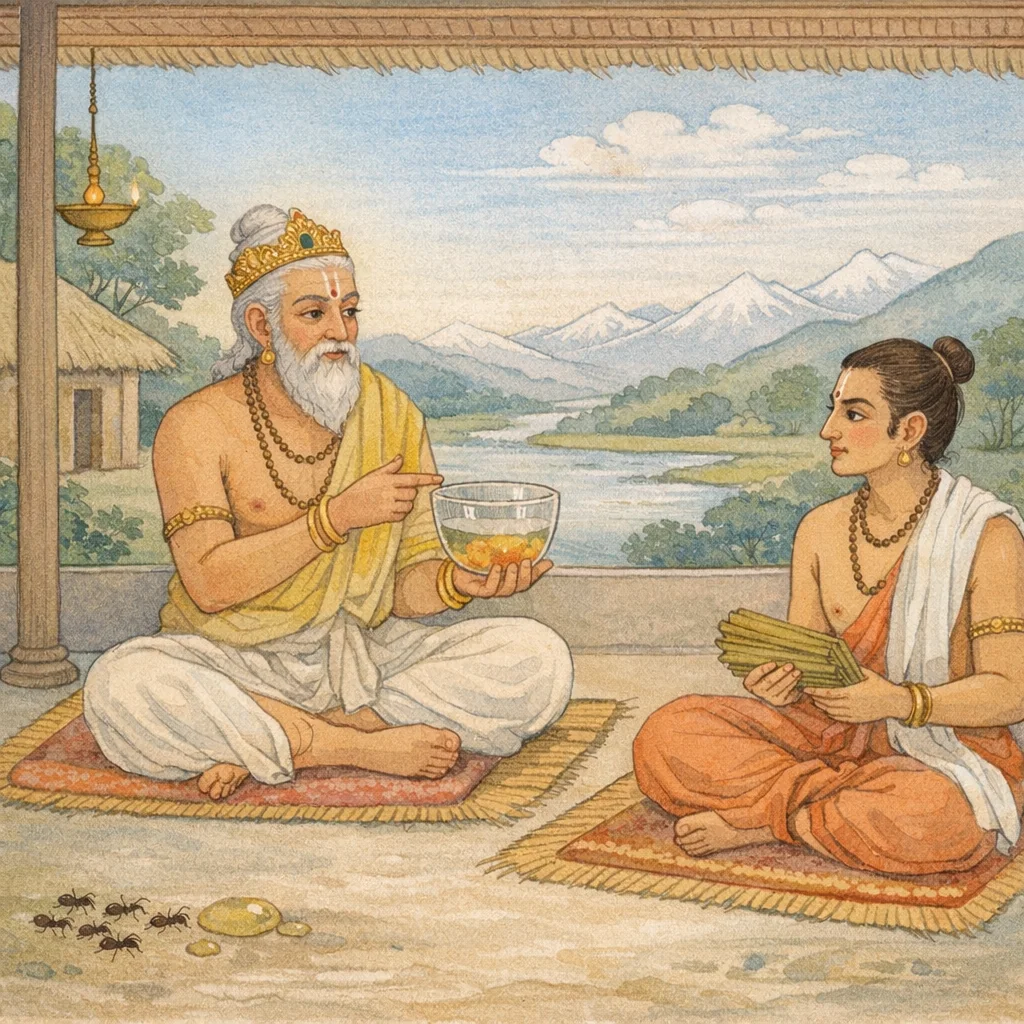
Continuing the Brahma Khanda’s dharma-aligned practical teaching, Dhanvantari instructs Suśruta in the diagnostic framework of prameha: its doṣa-based classes and the urine as the chief clinical mirror (color, turbidity, sweetness, viscosity, temperature). He presents madhumeha as a grave culmination—arising either from over-nourishment (kapha origin) or from dhātu-kṣaya with vāta dominance—marked by honey-sweet urination and systemic signs such as indigestion, anorexia, vomiting, drowsiness, cough, and catarrh. The chapter then details doṣa-specific complications and neglected-stage piḍakā/boils with distinct forms and burning qualities, links causation to kapha-provoking diet and sedentary conduct, and states prognosis depends on doṣic predominance, chronicity, and destiny (diṣṭa), preparing the way for subsequent therapeutic and conduct guidance.
Shlokas
Verse 1
नामाष्टपञ्चाशदुत्तरशततमो ऽध्यायः धन्वन्वरिरुवाच / प्रमेहाणां निदानन्ते वक्ष्ये ऽहं शृणु सुश्रुत ! / प्रमेहा विंशतिस्तत्र श्लेष्मणो दश पित्ततः
Chapter 159. Dhanvantari said: “Now I shall explain the causes of prameha (urinary/metabolic disorders); listen, O Suśruta. In this teaching, prameha is of twenty kinds—ten arising from kapha and ten from pitta.”
Verse 2
षट्चत्वारो ऽनिलात्तेच मेदोमत्रकफावहाः / हारिद्रमेही कटुकं हरिद्रासन्निभं शकृत्
Six types arise from deranged vāta; and four are those that bring disorders of fat (medas), urine, and phlegm (kapha). One afflicted with turmeric-colored prameha passes pungent stool, yellow like turmeric.
Verse 3
विस्त्रं माञ्जिष्ठमेहेच मञ्जिष्ठा सलिलोपमम् / विस्त्रमुष्णं सलवणं रक्ताभ रक्तमेहतः
In vistra-meha, the urine takes a hue like mañjiṣṭhā (madder), resembling a reddish infusion; in another form it becomes hot and saline. In raktameha, the urine appears blood-colored, as though blood were being passed.
Verse 4
वसामेही वसामिश्रं वसाभं मूत्रयेन्मुहुः / मज्जाभं मज्जमिश्रं वा मज्जमेही मुहुर्मुहुः
One afflicted with vasā-meha repeatedly passes urine mixed with fat or appearing like fat. Likewise, one afflicted with majjā-meha repeatedly passes urine that looks like marrow or is mixed with marrow.
Verse 5
हस्ती मत्त इवाजस्त्रं मूत्रं वेगविवर्जितम् / सलसीकं विवद्धं च हस्तिमेही प्रमेहति
One afflicted with “hastimeha” (elephantine diabetes) passes urine unceasingly like a rutting elephant—without force or urgency—thick, turbid, and obstructed; thus the hastimehī suffers from prameha.
Verse 6
मधुमेही मधुसमं जायते स किल द्विधा / क्रुद्धे धातुक्षयाद्वायौ दोषावृतपथे यदा
Diabetes (madhumeha) is said to arise in two ways: when the bodily wind (vāyu), aggravated through depletion of the tissues (dhātu-kṣaya), becomes enraged and its course is obstructed by the doṣas.
Verse 7
आवृतो दोषलिङ्गानि सो ऽनिमित्तं प्रदर्शयेत् / क्षणात्क्षीणः क्षणात्पूर्णो भजते कृच्छ्रसाघ्यताम्
When the signs of the bodily humors are obscured, the patient shows symptoms without a clear cause. He becomes emaciated in a moment and full (bloated) in a moment—thus falling into a condition that is difficult to cure.
Verse 8
कालेनोपेक्षितः सर्वोह्यायाति मधुमेहताम् / मधुरं यच्च मेहेषु प्रायो मध्विव मेहति
When one is neglected over time, he inevitably comes to the condition called madhumeha. And whatever he passes as urine is generally sweet—indeed, he urinates as though it were honey.
Verse 9
सर्वे ते मधुमेहाख्या माधुर्याच्च तनोर्यतः / अविपाको ऽरुचिश्छर्दिर्निद्रा कासः सपीनसः
All these are called “madhumeha” (diabetic disorders), arising from the sweetness of the body. There is indigestion, loss of appetite, vomiting, drowsiness, cough, and cough accompanied by catarrh (phlegm).
Verse 10
उपद्रवाः प्रजायन्ते मेहानां कफजन्मनाम् / बस्तिमेहनयोस्तोदोमुष्कावदरणं ज्वरः
In urinary disorders born of Kapha, complications arise: pain in the bladder and urinary organ, tearing or irritation of the testicles, and fever.
Verse 11
दाहस्तृष्णाम्लिका मूर्छा विड्भेदः पित्तजन्मनाम् / वातजानामुदावर्तः कम्पहृद्गहलोलताः
In (prameha) arising from Pitta there occur burning, thirst, sour belching, fainting, and looseness of stool. In that arising from Vāta there occur udāvarta (upward reversal/obstruction), tremors, and restless fluttering in the heart and throat.
Verse 12
शूलमुन्निद्राता शोषः श्वासः कासञ्च जायते / शराविका कच्छपिका ज्वालिनी विनतालजी
There arise agonizing pains as if from a spear, sleeplessness, wasting, breathlessness, and coughing. These are the sufferings in the hells named Śarāvikā, Kacchapikā, and Jvālinī, O son of Vinatā, Garuḍa.
Verse 13
मसूरिका सर्षपिका पुत्रिणी सविदारिका / विद्रधिश्चेति पिडिकाः प्रमेहोपेक्षया दश
Masūrikā, Sarṣapikā, Putriṇī, Vidārikā, and Vidradhi—these are forms of pustular eruptions and boils; thus, in connection with prameha, ten such lesions are said to arise from neglect.
Verse 14
अन्नस्य कफसंश्लेषात्प्रायस्तत्र प्रवर्तनम् / स्वाद्वम्ललवणस्निग्धगुरुपिच्छिलशीतम्
Because food tends to combine with Kapha, it commonly sets that condition in motion—especially foods that are sweet, sour, salty, unctuous, heavy, slimy, and cold.
Verse 15
नवं धान्यं सुरासूपमांसेक्षुगुडगोरसम् / एकस्थानासनवति शयनं विनिवर्तनम्
Freshly harvested grain, liquor, soups, meat, sugarcane, jaggery, and cow’s milk—together with sitting fixed in one place, clinging to a single seat, and restraining (or avoiding) indulgence in sleep—these are to be set aside or held in check as part of regulated observance.
Verse 16
बस्तिमाश्रित्य कुरुते प्रमेहाद्दूषितः कफः / दूषयित्वा वपुः क्लेदं स्वेदमेदोवसामिषम्
Kapha, corrupted by prameha (a urinary/metabolic disorder), takes refuge in the bladder; having tainted the body, it vitiates bodily moisture, sweat, fat, marrow, and flesh.
Verse 17
पित्तं रक्तमतिक्षीणे कफादौ मूत्रसंश्रयम् / धातुं बस्तिमुपानीय तत्क्षयेच्चैव मारुतः
When pitta (bile) and blood (rakta) are excessively depleted, kapha and the other doṣas take refuge in the urine (urinary system). Bearing the essence of the dhātus into the bladder, maruta (vāta, the vital wind) is also diminished when that essence is wasted.
Verse 18
साध्यासाध्यप्रतीत्याद्याः मेहास्तेनैव तद्भवाः / समे समकृता दोषे परमत्वात्तथापि च
Urinary disorders (meha), known as curable, incurable, and the like, arise from that very cause. Even when the doṣas are equal and seem evenly balanced, the condition still differs, for one factor becomes predominant.
Verse 19
सामान्य लक्षणन्तेषां प्रभूताविलमूत्रता / दोषदूष्या विशेषे ऽपि तत्संयोगविशेषतः
Their common sign is the passing of abundant, turbid urine; and even when the doṣas and the affected tissues differ, the manifestation varies according to the particular manner in which they combine.
Verse 20
मूत्रवर्णादिभेदेन भेदो मेहेषु कल्प्यते / अच्छं बहुसितं शीतं निर्गन्धमुदकोपमम्
The varieties of urinary disorders (meha) are distinguished by differences such as the urine’s color and other signs. In one type, the urine is clear, very white, cold, odorless, and like water.
Verse 21
मेहत्युदकमेहेन किञ्चिदाविलपिच्छिलम् / इक्षो रसमिवात्यर्थं मधुरं चेक्षुमेहतः
In udaka-meha (water-type prameha), the urine is slightly turbid and slimy. In ikṣu-meha (sugarcane-type prameha), the urine becomes exceedingly sweet—like sugarcane juice.
Verse 22
सान्द्री भवेत्पर्युषितं सान्द्रमेहेन मेहति / सुरामेही सुरातुल्यमुपर्यच्छमधोघनम्
In sāndra-meha, one passes urine that is dense and turbid, as though stale from standing. In surā-meha, the urine resembles liquor itself—clear above, heavy and cloudy below.
Verse 23
सहृष्टरोमा पिष्टेन पिष्टबद्बहुलं सितम् / शुक्राभं शुक्रमिश्रं वा शुक्रमेही प्रमेहति
With the hairs standing on end, the sufferer of piṣṭa-meha passes urine that is thick and very white like flour-paste—either semen-like in appearance or mixed with semen; thus the śukra-mehī is said to be afflicted with prameha.
Verse 24
मूत्रयेत्सिकतामेही सिकतारूपिणो मलान् / शीतमेही सुबहुशो मधुरं भृशशीतलम्
One afflicted with sikatā-meha passes sandy, gravel-like wastes in the urine. One suffering from śīta-meha urinates very frequently—urine that is sweet and exceedingly cold.
Verse 25
शनैः शनैः शनैर्मेही मन्दं मन्दंप्रमेहति / लालातन्तुयुतं मूत्रं लालामेहेन पिच्छिलम्
The one afflicted with prameha passes urine only very slowly, little by little. In the condition called “lālā-meha,” the urine becomes slimy and slick, mixed with thread-like strands of saliva-like mucus.
Verse 26
गन्धवर्णरसस्पर्शेः क्षारेण क्षारतोयवत् / नीलमेहन नीलाभं कालमेही मसीनिभम्
In smell, color, taste, and touch it is like an alkaline substance—like water mixed with alkali. One who passes blue urine takes on a bluish hue; one afflicted with “kāla-meha,” passing black urine, appears like ink.
Verse 27
सन्धिमर्मसु जायन्ते मांसलेषु च धामसु / अन्तोन्नता मध्यनिन्मा अक्लेदसुरुजान्विता
They arise at the joints and at the vital points (marma), and also in the fleshy regions of the body. Raised at the ends and depressed in the middle, they are dry, without moisture, and attended by slight pain.
Verse 28
शरावमानसंस्थाना पिडिका स्याच्छराविका / सदाहा कूर्मसंस्थाना ज्ञेया कच्छपिका बुधैः
A pustule whose form resembles a bowl (śarāva) is called charāvikā. And that which is tortoise-shaped and burns constantly is known by the wise as kacchapikā.
Verse 29
महती पिडिका नीला विनता नाम सा स्मृता / दहति त्वचमुत्थाने ज्वालिनी कष्टदायिनी
A large, bluish boil is remembered as the disease called Vinatā. When it rises upon the skin, it burns the flesh like fire—flame in its nature—and brings severe suffering.
Verse 30
रक्ता सिता स्फोटचिता दारुणा त्वलजी भवेत् / मसूराकृति संस्थाना विज्ञेया तु मसूरिका
When a skin eruption is red or white, filled with pustules and severe, it is called tvalajī. But when the lesions are shaped like lentil grains, it should be recognized as masūrikā.
Verse 31
सर्षपोपमसंस्थाना जिह्वापाकमहारुजा / पुत्रिणी महती चाल्पा सुसूक्ष्मा पिडिका स्मृता
A pīḍikā is said to be shaped like a mustard seed, bringing intense pain from ulceration of the tongue; it may suppurate, sometimes large and sometimes small, and may appear exceedingly minute.
Verse 32
विदारीकन्दवद्वृत्ता कठिना च विदारिका / विद्रधेर्लक्षणैर्युक्ता ज्ञेया विद्रधिका तु सा
Vidārikā is round like the vidārī tuber and is hard; when it bears the signs of vidradhi (an abscess), it should be known as vidradhikā.
Verse 33
पुत्रिणी च विदारी च दुः सहा बहुमेदसः / सद्यः पित्तोल्बणास्त्वन्याः सम्भवन्त्यल्पमेदसः
Putriṇī and Vidārī are hard to endure and arise in those with abundant medas (fat). Other kinds arise swiftly, are pitta-dominant, and occur in those with little medas.
Verse 34
पिडिकास्ता भवेयुः स्याद्दोषोद्रेको यथायथम् / प्रमेहेण विनाप्येता जायन्ते दुष्टमेदसः
Such pīḍikā (boils) arise according to the degree of aggravation of the bodily doṣas; even without prameha, they can develop due to vitiated medas (fat).
Verse 35
तावच्च नोपलक्ष्यन्ते यावद्वर्णञ्च वर्जितम् / हारिद्रं रक्तवर्णं वा मेहप्राग्रूपवर्जितम्
So long as the signs are not perceived—urine devoid of color, or yellow like haridrā (turmeric), or red, and lacking the fore-form that heralds meha—those indications are not discerned.
Verse 36
यो मूत्रयेत तन्महें रक्तपित्तन्तु तद्विदुः / स्वेदो ऽङ्गगान्धः शिथिलत्वमङ्गे श्य्याशनस्वप्नसुखाभिषङ्गः / हृन्नेत्रजिह्वाश्रवणोपदाहा घनोग्रता केशनखाभिवृद्धिः
One who passes such urine—so the wise declare—has raktapitta, the disorder of blood and pitta. There arise sweating and foul bodily odor, looseness of the limbs, excessive clinging to bed, food, sleep, and pleasures; burning pains in the region of the heart, in the eyes, the tongue, and the ears; heaviness and intense dullness, and abnormal overgrowth of hair and nails.
Verse 37
शीतप्रियत्वं गलतालुशोषो माधुर्य मास्ये करपाददाहः / भविष्यतो मेहगणस्य रूपं मूत्रे ऽपि धावन्ति पिपीलिकाश्च
Fondness for cold things, dryness of the throat and palate, sweetness in the mouth, and burning in the hands and feet—these are the signs that foretell the coming group of meha/prameha, the urinary disorders; even ants are seen running toward the urine.
Verse 38
तृष्णा प्रमेहे मधुरं प्रपिच्छं मध्वामये स्याद्विविधोविकारः / सम्पूरणाद्वा कफसम्भवः स्यात्क्षीणेषु दोषेष्वनिलात्मको वा
In prameha there is excessive thirst, and the urine becomes sweet and sticky; in madhumeha the disorder manifests in varied ways. It may arise from over-nourishment as a kapha-born condition, or—when the other doṣas are depleted—become predominantly vāta (anila) in nature.
Verse 39
सम्पूर्णरूपाः कफपित्तमेहाः क्रमेण ये वै रतिसम्भवाश्च / सक्रामते पित्तकृतास्तु याप्याः साध्यो ऽस्ति मेहो यदि नास्ति दिष्टम्
Kapha- and pitta-type mehas, when they appear in their full form, develop progressively; some also arise from excessive indulgence in sexual pleasure. Those caused by pitta may be yāpya—manageable with sustained care. A meha can be curable, provided adverse destiny (diṣṭa) does not obstruct it.
Frequently Asked Questions
Adhyaya 159 differentiates meha by urine qualities such as clarity/whiteness/coldness/odorlessness (water-like), sliminess and mild turbidity (water-type prameha), extreme sweetness (sugarcane-juice-like), liquor-like layering in drinkers, semen-like thick white urine (śukra-meha), sandy/gravel-like sediment, very cold sweet frequent urine (cold-diabetes), and unusual colors such as blue or black.
Hastimeha is described as incessant urination “like a rutting elephant,” characterized by thick, turbid flow that is obstructed, occurring without the usual force or urgency—presented as a prameha manifestation with distinctive urinary behavior.
The chapter states that neglect of prameha can lead to multiple piḍakā/lesions arising at joints, vital spots, and fleshy regions, often raised at the edges and depressed in the middle, with burning or pain depending on doṣa. Their forms (e.g., bowl-shaped śarāvikā, tortoise-shaped kacchapikā, severe burning eruptions) signal systemic derangement extending beyond urine into medas (fat), māṃsa (flesh), and other tissues.