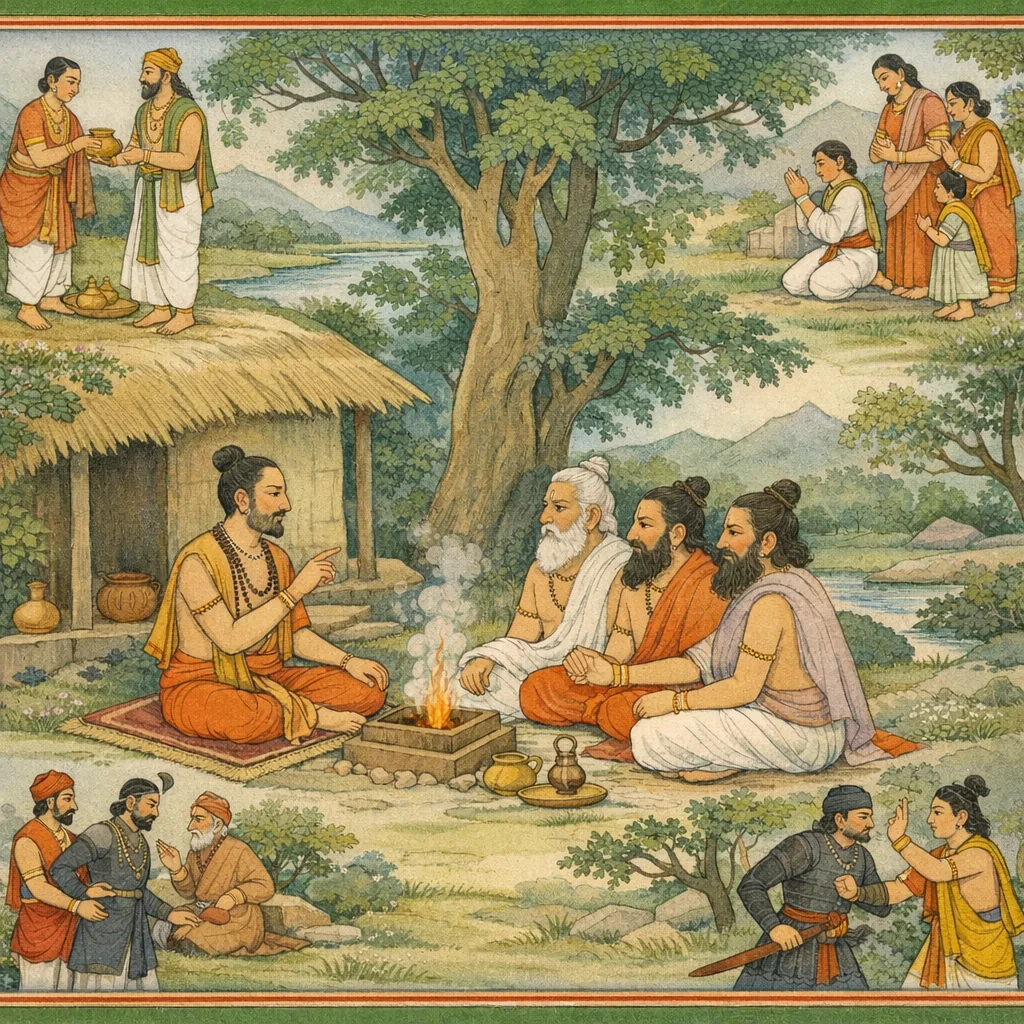
Adhyaya 110
Nīti-Upadeśa: Discernment, Proper Use of Resources, and Social Strategy
Continuing the Ācāra Khanda’s practical dharma teaching, Sūta offers Śaunaka and the gathered sages a chain of aphorisms. He warns that pursuing the impermanent ruins even lasting gains, and explains learning and prosperity as rooted in inner capacity—right speech, sound digestion, desire disciplined by good company, and the will to give. He defines the “fruit” of life’s pillars: the Veda through Agnihotra, auspiciousness through right conduct, marriage through love and progeny, and wealth through charity and rightful enjoyment. The chapter then turns to social prudence: cautions about marriage and lineage, when value may be taken even from doubtful sources (good counsel, gold, knowledge), and the instability of royal friendship. Household governance is taught through proper delegation, educating sons, employing even adversaries in hardship, and placing people and ornaments appropriately. Strategic counsel on enemies follows—avoid reconciling with the wicked, beware sweet-talking agents, use one enemy to check another, and trust that habitual wrongdoers fall by their own momentum. It concludes with reflections on fate and timely action, freedom from misplaced shame in practical affairs, criteria for dwelling in a healthy polity, and epistemic humility: wisdom lies in knowing degrees of knowledge, not claiming omniscience.
Shlokas
Verse 1
ऽध्यायः सूत उवाच / योध्रुवाणि परित्यज्य ह्यधुवाणि निषेवते / ध्रुवाणि तस्य नश्यन्ति ह्यध्रुवं नष्टमेव च
Sūta said: Whoever abandons what is enduring and pursues what is fleeting—his enduring gains are destroyed, and the fleeting is lost all the same.
Verse 2
वाग्यन्त्रहीनस्य नरस्य विद्या शस्त्रं यथा कापुरुषस्य हस्ते / न तुष्टिमुत्पादयते शरीरे ह्यन्धस्य दारा इव दर्शनीयाः
For a man who lacks the instrument of speech, learning is like a weapon in the hand of a coward; it brings no satisfaction within one’s being—like a blind man’s wife, spoken of as “to be seen,” yet unseen.
Verse 3
भोज्ये भोजनशक्तिश्च रतिशक्तिर्वरस्त्रियः / विभवे दानशक्तिश्च नाल्पस्य तपसः फलम्
When good food is at hand, one needs the strength to partake and digest; for enjoyment, one needs the power of desire and worthy companions. When wealth is present, one needs the ability to offer dāna, sacred charity. The fruit of tapas, austerity, is not small.
Verse 4
अग्निहोत्रफला वेदाः शीलवृत्तिफलं शुभम् / रतिपुत्रफला दारा दत्तभुक्तफलं धनम्
The Vedas bear fruit through the Agnihotra offering; auspiciousness bears fruit through good conduct and right livelihood. A wife bears fruit as love and progeny; wealth bears fruit as what is given in charity and what is rightly enjoyed.
Verse 5
वरयेत्कुलजां प्राज्ञो विरूपामपि कन्यकाम् / सुरूपां सुनितम्बाञ्च नाकुलीनां कदाचन
A wise man should choose a maiden born of a good family, even if she lacks beauty; but he should never, at any time, choose a woman without noble lineage, even if she is fair and well-formed.
Verse 6
अर्थेनापि हि किं तेन यस्यानर्थे तु संगतिः / को हि नाम शिखाजातं पन्नगस्य मणिं हरेत्
What use is wealth to one whose companionship is with misfortune? Who, indeed, would dare to seize the jewel born upon the hood of a serpent?
Verse 7
हविर्दुष्टकुलद्वाह्यं बालादपि सुभाषितम् / अमेध्यात्काञ्चनं ग्राह्यं स्त्रीरत्नं दुष्कुलादपि
Oblations (havi) are acceptable even when they come from a wicked family; and wise speech may be received even from a child. Gold should be taken even from what is impure, and a jewel-like woman may be accepted even from a low family.
Verse 8
विषादप्यमृतं ग्राह्यममेध्यादपि काञ्चनम् / नीचादप्युत्तमां विद्यां स्त्रीरत्नं दुष्कुलादपि
Even from poison, nectar should be accepted; even from what is impure, gold may be taken. Even from a low-born person, excellent knowledge should be learned; and even from a family of poor repute, a jewel-like woman of virtue may be accepted.
Verse 9
न राज्ञा सह मित्रत्वं न सर्पो निर्विषः क्रचित् / न कुलं निर्मलं तत्र स्त्रीजनो यत्र जायते
Friendship with a king is never secure; nor is a serpent ever truly without poison. Likewise, a family is not considered wholly untainted where women are born (that is, where women are present).
Verse 10
कुले नियोजयेद्भक्तं पुत्रं विद्यासु योजयेत् / व्यसने योजयेच्छत्रुमिष्टं धर्मे नियोज्येत्
Appoint a devoted person to oversee the affairs of the family; engage one’s son in learning; in times of adversity set even an enemy to work; and employ what is dear and valued in the service of Dharma.
Verse 11
स्थानेष्वेव प्रयोक्ताव्या भृत्याश्चाभरणानि च / न हि चूडामणिः पादे शोभते वै कदाचन
Servants and ornaments should be used only in their proper places; for a crest-jewel never appears fitting when worn upon the foot.
Verse 12
चूडामणिः समुद्रो ऽग्निर्घण्टा चाखण्डमम्बरम् / अथवा पृथिवीपालो मूर्ध्नि पादे प्रमादतः
A crest-jewel, the ocean, fire, a bell, and the unbroken sky—even such mighty and revered things—or even a king upon the earth, may through heedlessness fall from the head to the foot, from the highest to the lowest.
Verse 13
कुसुमस्तबकस्येव द्वे गती तु मनस्विनः / मूर्ध्नि वा सर्वलोकानां शीर्षतः पतितो वने
Like a cluster of flowers, the strong-minded have but two destinies: either they rise to the head, the highest place among all beings, or, falling from the summit, they lie cast down in the wilderness.
Verse 14
कनकभूषणसंग्रहणोचितो यदि मणिस्त्रपुणि प्रतिबध्यते / न च विरौति न चापि स शोभते भवति योजयितुर्वचनीयता
If a jewel fit to be set among golden ornaments is fastened into tin, it yields neither its proper resonance nor its radiance; the blame belongs to the one who set it so.
Verse 15
वाजिवारणलौहानां काष्ठपाषाणवाससाम् / नारीपुरुषतोयानामन्तरं महदन्तरम्
There is a vast difference between horses, elephants, and iron; between wood, stone, and cloth; and likewise there is a great difference between women, men, and water.
Verse 16
कदर्थितस्यापि हि धैर्यवृत्तेर्न शक्यते सर्वगुणप्रमाथः / अधः खलेनापि कृतस्य वह्नेर्नाधः शिखा याति कदाचिदेव
Even when a steadfast person is humiliated, their fortitude cannot be completely destroyed. Just as the flame of fire—though pressed downward by a wicked force—never truly turns and rises downward.
Verse 17
न सदश्वः कशाघातं सिंहो न गजगर्जितम् / वीरो वा परनिर्दिष्टं न सहेद्भीमनिः स्वनम्
A well-bred horse does not endure the lash; a lion does not tolerate an elephant’s roar. Likewise, a true hero cannot bear being pointed out as ‘belonging to another’—nor can he endure a terrifying, humiliating outcry.
Verse 18
यदि विभवविहीनः प्रच्युतो वाशु दैवान्न तु खलजनसेवां काङ्क्षयेन्नैव नीचाम् / न तृणमदनकार्ये सुक्षुधार्तो ऽत्ति सिंहः पिबति रुधिरमुष्णं प्रायशः कुञ्चराणाम्
Even if one becomes bereft of wealth, or is suddenly cast down by fate, one should never desire the service of wicked people—never that which is base. For a lion, though tormented by sharp hunger, does not eat grass for appeasing desire; it usually drinks the warm blood of elephants.
Verse 19
सकृद्दुष्टञ्च यो मित्रं पुनः सन्धातुमिच्छति / स मृत्युमेव गृह्णीयाद्गर्भमश्वतरी यथा
Whoever wishes to reconcile again with a friend who has once turned wicked—he embraces death itself, like the she-mule that conceives a fetus.
Verse 20
शत्रोरपत्यानि प्रियंवदानि नोपेक्षितव्यानि बुधैर्मनुष्यैः / तान्येव कालेषु विपत्कराणि विषस्य पात्राण्यपि दारुणानि
Wise people should not disregard the sweet-spoken offspring or agents of an enemy; in due time they themselves become the cause of calamity—like dreadful vessels filled with poison.
Verse 21
उपकारगृहीतेन शत्रुणा शत्रुमुद्धरेत् / पादलग्नं करस्थेन कण्टकेनैव कण्टकम्
One should overcome an enemy by means of another enemy who is bound by a favor received—just as a thorn stuck in the foot is removed with a thorn held in the hand.
Verse 22
अपकारपरान्नित्यं चिन्त येन्न कदाचन / स्वयमेव पतिष्यन्ति कूलजाता इव द्रुमाः
Never worry about those who are constantly intent on harming others; in time they will fall of their own accord—like trees that grow on an eroding riverbank.
Verse 23
अनर्था ह्यर्थरूषाश्च अर्थाश्चानर्थरूपिणः / भवन्ति ते विनाशाय दैवायत्तस्य वै सदा
Misfortunes may appear in the guise of prosperity, and prosperity in the guise of misfortune; for one who is ever dependent on fate (daiva), these become causes of ruin.
Verse 24
कार्यकालोचितापापा मतिः सञ्जायते हि वै / सानुकूले तु दैवे शं पुंसः सर्वत्र जायते
Indeed, when the time for action is ripe, an appropriate and sinless understanding arises. And when destiny (daiva) is favorable, well-being and success arise for a person everywhere.
Verse 25
धनप्रयोगकार्येषुः तथा विद्या गमेषु च / आहारे व्यवहारे च त्यक्तलज्जः सदा भवेत्
In the use of wealth, in the pursuit of learning, and in food and daily dealings, one should ever cast off misplaced shame and act without hesitation.
Verse 26
धनिनः श्रोत्रियो राजा नदी वैद्यस्तु पञ्चमः / पञ्च यत्र न विद्यन्ते न कुर्यात्तत्रत्र संस्थितिम्
A wealthy patron, a Veda-learned brāhmaṇa, a king, a river, and—fifth—a physician: where these five are not found, one should not choose to settle there.
Verse 27
लोकयात्रा भयं लज्जा दाक्षिण्यं दानशीलता / पञ्च यत्र न विद्यन्ते न तत्र दिवसं वसेत्
Worldly propriety, moral fear, modesty, courtesy, and a charitable disposition—where these five are absent, one should not reside even for a single day.
Verse 28
कालविच्छोत्रियो राजा नदी साधुश्च पञ्चमः / एते यत्र न विद्यन्ते तत्र वासं न कारयेत्
A time-knowing astrologer, a learned brāhmaṇa, a king of good governance, a river, and—fifth—a saintly sādhū: where these are not found, one should not establish residence.
Verse 29
नैकत्र परिनिष्ठास्ति ज्ञानस्य किल शौनक / सर्वः सर्वं न जानाति सर्वज्ञो नास्ति कुत्रचित्
O Śaunaka, knowledge does not attain final certainty in one place alone. No one knows everything; nowhere is there one who is truly omniscient.
Verse 30
न सर्ववित्कश्चिदिहास्ति लोके नात्यन्तमूर्खो भुवि चापि कश्चित् / ज्ञानेन नीचोत्तममध्यमेन यो ऽयं विजानाति स तेन विद्वान्
In this world no one is wholly omniscient, and on earth no one is utterly foolish. He who understands that knowledge exists in lower, middling, and higher degrees—by that very understanding, he is truly wise.
Frequently Asked Questions
It states that Vedic learning bears fruit through performance of Agnihotra; learning is validated by dharmic application rather than mere recitation or status.
It repeatedly uses the model of extracting nectar from poison or gold from impurity: excellent knowledge, counsel, or value may be accepted wherever found, provided one has discernment and the aim is dharma.