Adhyaya 9
Mānasasṛṣṭi-varṇana (Account of Mind-born Creation) | मानससृष्टिवर्णनम्
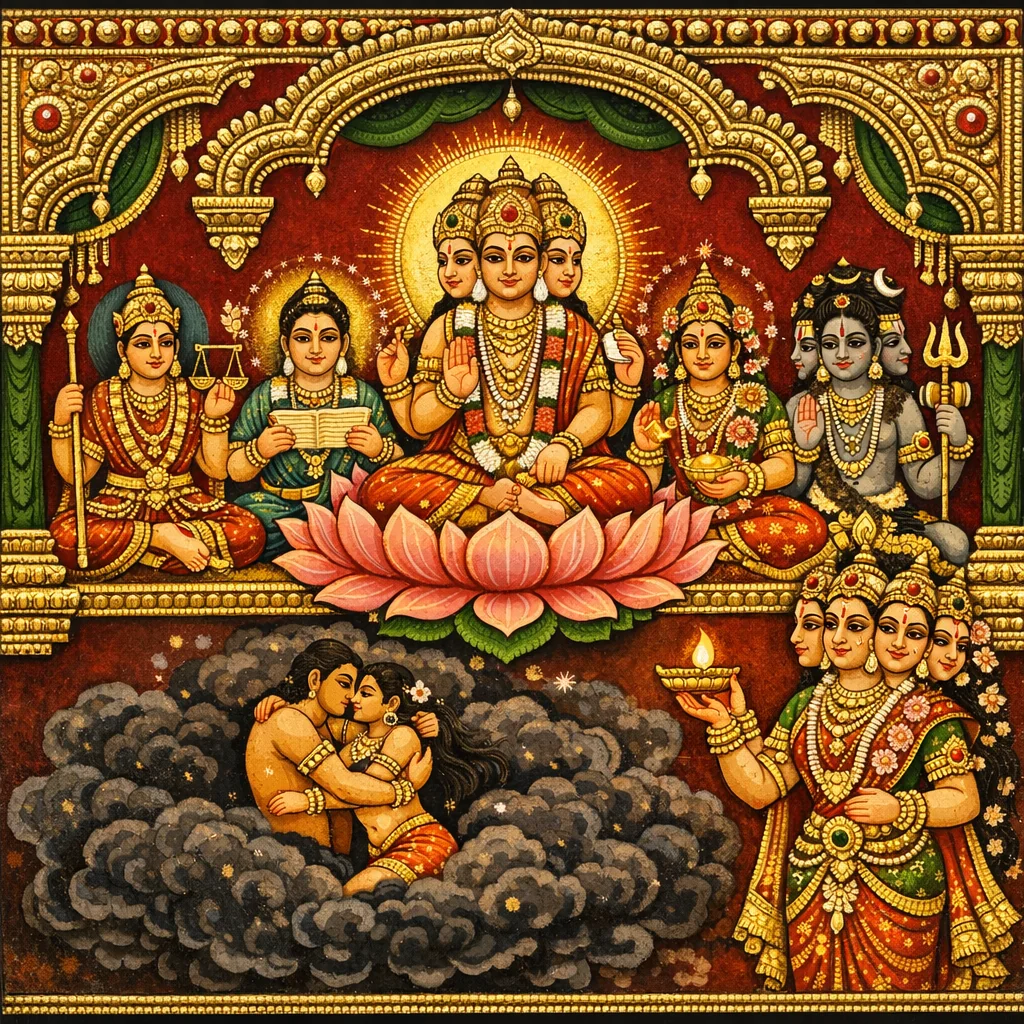
This Adhyāya sets out a technical cosmogonic sequence in which the Lord begins mānasasṛṣṭi (mind-born creation) by emanating five “kartṛ” principles—Rudra, Dharma, Manas (Mind), Ruci, and Ākṛti—each appointed to sustain prajā: Dharma upholds order, Manas enables knowledge, Ākṛti grants form and beauty, and Ruci gives rise to śraddhā and affective inclination. A ritual-epithet thread identifies Rudra as Tryambaka through sacrificial and metrical correspondences (gāyatrī, triṣṭubh, jagatī), linking cosmology with Vedic liturgical logic. The narrative then turns to a guṇa-dynamic difficulty: beings do not multiply; the creator applies discriminative buddhi and observes tamas dominating, suppressing rajas and sattva. From the repelled tamas arises a mithuna (pair) marked by obstruction and covering, tied to adharma-practice that produces hiṃsā (violence) and śoka (grief). In response, a feminine principle—Śatarūpā—emerges from the creator’s body, providing the generative complement needed for the increase of beings and the continuation of creation.
Shlokas
Verse 1
इति श्रीब्रह्माण्डे महापुराणे वायुप्रोक्ते पूर्वभागे द्वितीये ऽनुषङ्गपादे मानससृष्टिवर्णनं नामाष्टमो ऽध्यायः सूत उवाच रुद्रं धर्मं मनश्चैव रुचिं चैवाकृतिं तथा / पञ्च कर्तॄन् हि स तदा मनसा व्यसृजत्प्रभुः
Thus in the Śrī Brahmāṇḍa Mahāpurāṇa, in the former section spoken by Vāyu, in the second anuṣaṅga-pāda, the eighth chapter called “The Account of Mental Creation.” Sūta said: Then the Lord, by mind alone, brought forth five agents—Rudra, Dharma, Manas, Ruci, and Ākṛti.
Verse 2
एते महाभुजाः सर्वे प्रजानां स्थितिहेतवः / औषधीः प्रतिसंधत्ते रुद्रः क्षीणः पुनः पुनः
All these are mighty-armed and are the cause of the creatures’ continuance. Rudra, again and again grown weary, restores and rebinds the healing herbs (auṣadhi).
Verse 3
प्राप्तौषधिफलैर्देवः सम्यगिष्टः फलार्थिभिः / त्रिभिरेव कपालैस्तु त्र्यंबकैरोषधीक्षये
Having obtained the fruits of the sacred herbs, those who sought results worshiped the Deva in due rite. At the waning of the herbs, the offering to Tryambaka is performed with only three kapāla.
Verse 4
इज्यते मुनिभिर्यस्मात्तस्मात्त्त्र्यंबक उच्यते / गायत्रीं चैव त्रिष्टुप् च जगती चैव ताः स्मृताः
Because the sages perform worship to him through yajña, he is therefore called “Tryambaka.” Gāyatrī, Triṣṭup, and Jagatī—these are remembered as the sacred metres.
Verse 5
अंबिकानां मया प्रोक्ता योनयः स्वनस्पतेः / ताभिरेकत्वभूता भिस्त्रिविधाभिः स्ववीर्यतः
I have declared the origins of the Ambikās as of the nature of vanaspati, the sacred vegetation. By their own potency they are threefold, yet they abide united in oneness.
Verse 6
त्रिसाधनः पुरोडाशस्त्रिकपालस्ततः स्मृतः / त्र्यंबकः स पुरोडाशस्तेनेह त्र्यंबकःस्मृतः
The puroḍāśa endowed with three requisites is remembered as “trikapāla.” That very puroḍāśa is Tryambaka; therefore here it is spoken of as Tryambaka.
Verse 7
धत्ते धर्मः प्रजाः सर्वा मनो ज्ञानकरं स्मृतम् / आकृतिः सुरुचे रूपं रुचिः श्रद्धाकरः स्मृतः
Dharma upholds all beings; the mind is remembered as the cause of knowledge. Ākṛti is the form of fair beauty, and ruci is remembered as that which awakens śraddhā—faith.
Verse 8
एवमेते प्रजापालाः प्रजानां स्थितिहेतवः / अथास्य सृजतः सर्गं प्रजानां परिवृद्धये
Thus these guardians of the creatures are the cause of the beings’ continuance. Then he set in motion the order of creation for the increase of the prajās.
Verse 9
न व्यवर्द्धत ताः सृष्टाः प्रजाः केनापि हेतुना / ततः स विदधे बुद्धिमर्थनिश्चयगा मिनीम्
For no reason did those created beings increase. Then he established a discerning intellect that leads to sure determination of meaning and purpose.
Verse 10
अथात्मनि समद्राक्षीत्तमोमात्रां तु चारिणीम् / रजः सत्त्वं परित्यज्य वर्तमानां स्वकर्मतः
Then he beheld within himself the mere portion of tamas moving about, having set aside rajas and sattva, proceeding according to its own action.
Verse 11
ततः स तेन दुखेनशुचं चक्रे जगत्पतिः / तमश्च व्यनुदत्पश्चाद् रजसातु समावृणोत्
Then the Lord of the world, from that suffering, brought forth sorrow. Thereafter he drove away tamas and covered it with rajas.
Verse 12
तत्तमः प्रतिनुत्तं वै मिथुनं संप्रसूयत / अधर्माचरणा त्तस्य हिंसा शोको व्यजायत
That tamas, when repelled, brought forth a pair. From its practice of adharma arose violence and sorrow.
Verse 13
ततस्तस्मिन्समुद्भूते मिथुने वरणात्मके / ततः स भगवानासीत् प्रीतश्चैतं हि शिश्रिये
Then, when that chosen-natured pair arose, the Bhagavān was filled with joy and took refuge in it, abiding there.
Verse 14
एवं प्रीतात्मनस्तस्य स्वदेहार्द्धाद्विनिःसृता / नारी परमकल्याणी सर्वभूतमनोहरा
Thus, from half of his own body, as his heart rejoiced, there issued a woman most auspicious, enchanting the minds of all beings.
Verse 15
सा हि कामात्मना सृष्टा प्रकृतेः सा सुरूपिणी / शतरूपेति सा प्रोक्ता सा प्रोक्तैव पुनः पुनः
She was created from the very essence of desire, born of Prakṛti, fair in form; she was called Śatarūpā, and that name was spoken again and again.
Verse 16
ततः प्रजाः समुद्भूता यथा प्रोक्ता मया पुरा / प्रक्रियायां यथा तुभ्यं त्रेतामध्ये महात्मनः
Then the creatures came forth, just as I had spoken before; O great-souled one, according to the process I described to you in the midst of the Tretā-yuga.
Verse 17
यदा प्रजास्तु ताः सृष्टा न व्यवद्धत धीमतः / ततो ऽन्यान्मानसान्पुत्रानात्मनः सदृशो ऽसृजत
When those creatures, though created, did not multiply under the wise one’s governance, he then brought forth other mind-born sons, resembling himself.
Verse 18
भृग्वङ्गिरोमरीचींश्च पुलस्त्यं पुलहं क्रतुम् / दक्षमत्रिं वसिष्ठं च निर्ममे मानसान्सुतान्
Brahmā fashioned Bhṛgu, Aṅgiras, Marīci, Pulastya, Pulaha, Kratu, Dakṣa, Atri, and Vasiṣṭha as mind-born sons.
Verse 19
नव ब्रह्माण इत्येते पुराणे निश्चयं गताः / ब्रह्मा यतात्मकानां तु सर्वेषामात्मयोनिनाम्
The Purāṇas declare with certainty that these are the “nine Brahmās”; and Brahmā is the primal source of all self-born beings, of his own essence.
Verse 20
ततो ऽसृजत्पुनर्ब्रह्मा धर्मं भूतसुखावहम् / प्रजापतिं रुचिं चैव पूर्वेषामेव पूर्वजौ
Then Brahmā again brought forth Dharma, the bringer of welfare to all beings, and also produced Prajāpati Ruci, ancestor even of the ancients.
Verse 21
बुद्धितः ससृजे धर्मं सर्वभूतसुखावहम् / मनसस्तु रुचिर्नाम जज्ञे जो ऽव्यक्तजन्मनः
From his buddhi Brahmā created Dharma, bestowing happiness on all beings; and from his mind was born the Prajāpati named Ruci, sprung from the Unmanifest.
Verse 22
भृगुस्तु त्दृदयाज्जज्ञे ऋषिः साललयोनिनः / प्राणाद्दक्षं सृजन्ब्रह्मा चक्षुर्भ्यां तु मरीचिनम्
Ṛṣi Bhṛgu was born from Brahmā’s heart, of a lineage linked with the waters; Brahmā created Dakṣa from his prāṇa, and Marīci from his eyes.
Verse 23
अभिमानात्मकं रुद्रं निर्ममे नीललोहितम् / शिरसोंगिरसं चैव श्रोत्रादत्रिं तथैव च
He created Rudra, whose very nature is self-sense, as Nīlalohita. From the head he brought forth Aṅgiras, and from the ears likewise Atri.
Verse 24
पुलस्त्यं च तथोदानाद्व्यानाच्च पुलहं पुनः / समानजो वसिष्ठश्च ह्यपानान्निर्ममे क्रतुम्
From udāna he fashioned Pulastya, and from vyāna again Pulaha. From samāna was born Vasiṣṭha, and from apāna he formed Kratu.
Verse 25
इत्येते ब्रह्मणः पुत्राः प्रजादौ द्वादश स्मृताः / धर्मस्तेषां प्रथमजो देवतानां स्मृतस्तु वै
Thus, at the dawn of progeny, these are remembered as the twelve sons of Brahmā. Among them, the first-born is Dharma, revered even among the gods.
Verse 26
भृग्वादयस्तु ये सृष्टास्ते वै ब्रह्मर्षयः स्मृताः / गृहमेधिपुराणास्ते धर्मस्तैः प्राक् प्रवर्त्तितः
Bhr̥gu and the others who were created are remembered as Brahmarṣis. Ancient in the gṛhamedhī tradition, they had already set Dharma in motion before.
Verse 27
द्वादशैते प्रसूयन्ते प्रजाः कल्पे पुनः पुनः / तेषां द्वादश ते वंशा दिव्या देवगुणान्विताः
These twelve beget the creatures again and again in every kalpa. From them arise twelve divine lineages, endowed with the qualities of the gods.
Verse 28
क्रियावन्तः प्रजावन्तो महर्षिभिरलङ्कृताः / यदा तैरिह सृष्टैस्तु धर्म्माद्यैश्च महर्षिभिः
They were active in sacred works and rich in progeny, adorned by the great seers. When those Maharsis created here Dharma and the rest.
Verse 29
सृज्यमानाः प्रजाश्चैव न व्यवर्द्धन्त धीमतः / तमोमात्रावृतः सो ऽभूच्छोकप्रतिहतश्च वै
Even the beings being created did not bring increase to that wise one. He became covered by sheer darkness and was indeed struck down by sorrow.
Verse 30
यथाऽवृतः स वै ब्रह्मा तमोमात्रा तु सा पुनः / पुत्राणां च तमोमात्रा अपरा निःसृताभवत्
Just as Brahma was veiled by sheer darkness, that same darkness again issued forth from his sons in another form.
Verse 31
प्रतिस्रोतात्मको ऽधर्मो हिंसा चैवाशुभात्मिका / ततः प्रतिहते तस्य प्रतीते वरणात्मके
Adharma was of a counter-current nature, and violence too was of inauspicious essence. Then, when that veiling condition was checked, it became manifest.
Verse 32
स्वां तनुं स तदा ब्रह्मा समपोहत भास्वराम् / द्विधा कृत्वा स्वकं देहमर्द्धेन पुरुषो ऽभवत्
Then Brahma set aside his radiant form. Dividing his own body in two, with one half he became the form of Purusha.
Verse 33
अर्धेन नारी सा तस्य शतरूपा व्यजायत / प्रकृतिर्भूतधात्री सा कामाद्वै सृजतः प्रभोः
From his half was born that woman, Śatarūpā. By the desire of the Lord who creates, she manifested as Prakṛti, the Mother who bears all beings.
Verse 34
सा दिवं पृथिवीं चैव महिम्ना व्याप्य सुस्थिता / ब्रह्माणः सा तनुः पूर्वा दिवमावृत्य तिष्टतः
She stood well-established, pervading heaven and earth with her majesty. She was Brahmā’s primal body, veiling the celestial realm as she remained.
Verse 35
या त्वर्द्धा सृज्यते नारी शतरूपा व्यजायत / सा देवी नियुतं तप्त्वा तपः परम दुश्चरम्
The woman created from that half was born as Śatarūpā. That Devī performed the supreme, most arduous tapas for a niyuta span of time.
Verse 36
भर्त्तारं दीप्तयशसं पुरुषं प्रत्यपद्यत / स वै स्वायंभुवः पूर्वं पुरुषो मनुरुच्यते
She accepted as her husband the Puruṣa of radiant renown. That primal Svāyaṃbhuva Puruṣa is indeed called Manu.
Verse 37
तस्यैकसप्ततियुगं मन्वन्तरमिहोच्यते / लब्ध्वा तु पुरुषः पत्नीं शतरूपामयोनिजाम्
His Manvantara is here said to span seventy-one yugas. And that Puruṣa obtained as his wife Śatarūpā, the one born not from a womb.
Verse 38
तया स रमते सार्द्धं तस्मात्सा रतिरुच्यते / प्रथमः संप्रयोगः स कल्पादौ समवर्त्तत
He delights together with her; therefore she is called “Rati.” That first union came to pass at the very beginning of the kalpa.
Verse 39
विराजमसृजद्ब्रह्मा सो ऽभवत्पुरुषो विराट् / सम्राट् सशतरूपस्तु वैराजस्तु मनुः स्मृतः
Brahmā created Virāj; he became the cosmic Person, Virāṭ. He was Samrāṭ and also Śatarūpa; and Vairāja is remembered as Manu.
Verse 40
स वैराजः प्रजासर्गं ससर्ज पुरुषो मनुः / वैराजात्पुरुषाद्वीरौ शतरूपा व्यजायत
That Vairāja—Manu, the Person—brought forth the creation of beings. From the Person Vairāja, Śatarūpā was born as vital seed-power (vīrya).
Verse 41
प्रियव्रतोत्तानपादौ पुत्रौ पुत्रवतां वरौ / कन्ये द्वे सुमहाभागे याभ्यां जाता इमाः प्रजाः
Priyavrata and Uttānapāda were two sons, foremost among those blessed with sons. And there were two daughters of great fortune, from whom these beings were born.
Verse 42
देवी नाम्ना तथाकूलिः प्रसूतिश्चैव ते शुभे / स्वायंभुवः प्रसूतिं तु दक्षाय व्यसृजत्प्रभुः
Among those auspicious daughters, one was named Devī; the others were Ākūti and Prasūti. The lord Svāyambhuva Manu bestowed Prasūti upon Dakṣa.
Verse 43
रुचेः प्रजापतेश्चैव आकूतिं प्रत्य पादयत् / आकूत्यां मिथुनं जज्ञे मानसस्य रुचेः शुभम्
Prajāpati Ruci took Akūti as his consort; and in Akūti, by Ruci’s sacred resolve of mind, an auspicious pair was born.
Verse 44
यज्ञश्च दक्षिणा चैव यमलौ तौ बभूवतुः / यज्ञस्य दक्षिणायां च पुत्रा द्वादश जज्ञिरे
That twin pair became known as Yajña and Dakṣiṇā; and from Dakṣiṇā, the consort of Yajña, twelve sons were born.
Verse 45
यामा इति समाख्याता देवाः स्वायंभुवेतरे / यमस्य पुत्रा यज्ञस्य तस्माद्यामास्तु ते स्मृताः
The gods of that Svāyambhuva Manvantara were renowned as the Yāmās; since they were sons of Yajña, they are remembered by that name.
Verse 46
अजिताश्चैव शुक्राश्च द्वौ गणौ ब्रह्मणः स्मृतौ / यामाः पूर्वं परिक्रान्ता येषां संज्ञा दिवौकसः
Ajitas and Śukras are remembered as two hosts of Brahmā. Those Yāmās who had earlier made the sacred circuit came to be known as Divaukasa, dwellers of heaven.
Verse 47
स्वायंभूव सुतायां तु प्रसूत्यां लोकमातरः / तस्यां कन्याश्चतुर्विंशद्दक्षस्त्वजनयत्प्रभुः
In Prasūti, the daughter of Svāyambhuva, the Mothers of the worlds manifested; and in her, the lord Dakṣa begot twenty-four daughters.
Verse 48
सर्वास्ताश्च महाभागाः सर्वाः कमललोचनाः / योगपत्न्यश्च ताः सर्वाः सर्वास्ता योगमातरः
All of them are greatly blessed, lotus-eyed; all are the consorts of Yoga, and all are the Mothers of Yoga.
Verse 49
सर्वाश्च ब्रह्मवादिन्यः सर्वा विश्वस्य मातरः / श्रद्धा लक्ष्मीर्धृतिस्तुष्टिः पुष्टिर्मेधा तथा क्रिया
All are proclaimers of Brahman, all are Mothers of the universe: Śraddhā, Lakṣmī, Dhṛti, Tuṣṭi, Puṣṭi, Medhā, and Kriyā.
Verse 50
बुद्धिर्लज्जा वसुः शान्तिः सिद्धिः कीर्त्तिस्त्रयोदश / पत्न्यर्थं प्रतिजग्राह धर्मो दाक्षायणीः प्रभुः
Buddhi, Lajjā, Vasu, Śānti, Siddhi, and Kīrti—thus the thirteen daughters of Dakṣa were accepted by Lord Dharma as his wives.
Verse 51
द्वाराण्येतानि चैवास्य विहितानि स्वयंभुवा / यान्याः शिष्टा यवीयस्य एकादश सुलोचनाः
These are indeed his ‘gateways’, ordained by Svayambhū; and those who remained were eleven fair-eyed maidens for the younger one.
Verse 52
सती ख्यातिश्च संभूतिः स्मृतिः प्रीतिः क्षमा तथा / सन्नतिश्चानसूया च ऊर्जा स्वाहा स्वधा तथा
Satī, Khyāti, Saṃbhūti, Smṛti, Prīti, Kṣamā; and also Sannati, Anasūyā, Ūrjā, Svāhā, and Svadhā.
Verse 53
तास्तदा प्रत्यगृह्णन्त पुनरन्ये महार्षयः / रुद्रो भृगुर्मरीचिश्च अङ्गिराः पुलहः क्रतुः
Then other great sages received them again—Rudra, Bhṛgu, Marīci, Aṅgiras, Pulaha, and Kratu.
Verse 54
पुलस्त्यो ऽत्रिर्वसिष्ठश्च पितरो ऽग्रिस्तथैव च / सतीं भवाय प्रायच्छत्ख्यातिं च भृगवे तथा
Pulastya, Atri, Vasiṣṭha, the Pitṛs, and Agni likewise—gave Satī to Bhava (Śiva), and Khyāti to Bhṛgu.
Verse 55
मरीचये तु संभूतिं स्मृतिमङ्गिरसे ददौ / प्रीतिं चैव पुलस्त्याय क्षमां वै पुलहाय च
To Marīci was given Sambhūti, to Aṅgiras was given Smṛti; to Pulastya, Prīti, and to Pulaha, indeed, Kṣamā.
Verse 56
क्रतवे संततिं नाम अनसूयां तथात्रये / ऊर्जां ददौ वसिष्ठाय स्वाहां चैवाग्नये ददौ
To Kratu was given Santati by name, and to Atri, Anasūyā; to Vasiṣṭha was given Ūrjā, and to Agni was given Svāhā.
Verse 57
स्वधां चैव पितृभ्यस्तु तास्वपत्यानि मे शृणु / एताः सर्वा महाभागाः प्रजास्त्वनुसृताः स्थिताः
And to the Pitṛs was given Svadhā; now hear from me the offspring born of those wives. All these most fortunate beings endure, continuing in unbroken lineage.
Verse 58
मन्वन्तरेषु सर्वेषु यावदाभूतसंप्लवम् / श्रद्धा कामं प्रजज्ञे ऽथ दर्पो लक्ष्मी सुतः स्मृतः
In all the Manvantaras, until the great deluge of dissolution, Śraddhā gave birth to Kāma; and Darpa is remembered as the son of Lakṣmī.
Verse 59
धृत्यास्तु नियमः पुत्रस्तुष्ट्याः संतोष उच्यते / पुष्ट्या लाभः सुतश्चापि मेधापुत्रः श्रुतस्तथा
Dhṛti’s son is called Niyama; Tuṣṭi’s son is known as Saṃtoṣa. Puṣṭi’s son is Lābha; and Medhā’s son is likewise famed as Śruta.
Verse 60
क्रियायास्तनयौ प्रोक्तौ दमश्च शम एव च / बुद्धेर्बोधः सुतश्चापि अप्रमादश्च तावुभौ
Kriyā is said to have two sons—Dama and Śama. Buddhi’s son is Bodha; and also Apramāda—those two.
Verse 61
लज्जाया विनयः पुत्रो व्यवसायो वसोः सुतः / क्षेमः शान्तेः सुतश्चापि सुखं सिद्धेर्व्यजायत
Lajjā’s son is Vinaya; Vasu’s son is Vyavasāya. Śānti’s son is Kṣema; and from Siddhi was born Sukha.
Verse 62
यशः कीर्तेः सुतश्चापि इत्येते धर्मसूनवः / कामस्य तु सुतो हर्षो देव्यां सिद्ध्यां व्यजायत
Yaśa, too, is the son of Kīrti—these are the sons of Dharma. And Kāma’s son, Harṣa, was born of the goddess Siddhi.
Verse 63
इत्येष वै सुखोदर्कः सर्गो धर्मस्य सात्त्विकः / जज्ञे हिंसा त्वधर्माद्वै निकृतिं चानृतं च ते
Thus this sāttvika creation of Dharma bears the fruit of happiness; but from Adharma were born violence, and also deceit and falsehood.
Verse 64
निकृत्यनृतयोर्जज्ञ भयं नरक एव च / माया च वेदना चापि मिथुनद्वयमेतयोः
From deceit and falsehood were born fear and hell; and as their paired offspring appeared Māyā and Vedanā (pain).
Verse 65
मयाज्जज्ञे ऽथ वै माया मृत्युं भूतापहारिणम् / वेदनायां ततश्चापि जेज्ञ दुःखं तु रौरवात्
From Māyā arose Māyā again, and Mṛtyu, the taker of beings; and from Vedanā was born the sorrow linked with the Raurava hell.
Verse 66
मृत्योर्व्याधिर्जराशोकक्रोधासूया विजज्ञिरे / दुःखोत्तराः स्मृता ह्येते सर्वे चाधर्मलक्षणाः
From Mṛtyu arose disease, old age, grief, anger, and envy; all these are remembered as increasing sorrow and as marks of Adharma.
Verse 67
तेषां भार्यास्ति पुत्रो वा सर्वे ह्यनिधनाः स्मृताः / इत्येष तामसः सर्गो जज्ञे धर्मनिया मकः
They too have wives or sons, and all are remembered as imperishable; thus arose this tāmasa creation, set to regulate and order Dharma.
Verse 68
प्रजाः सृचेति व्यादिष्टो ब्रह्मणा नीललोहितः / सो ऽभिध्याय सतीं भार्यां निर्ममे चात्मसंभवान्
Commanded by Brahmā, “Create the beings,” Nīlalohita meditated upon his virtuous wife Satī and brought forth creatures born of his own self.
Verse 69
नाधिकान्न च हीनास्तान्मानसानात्मना समान् / सहस्रं च सहस्राणामसृजत्कृत्तिवाससः
They were neither greater nor lesser—mind-born and equal to him in essence. Kṛttivāsa created thousands upon thousands of beings.
Verse 70
तुल्यानेवात्मना सर्वान् रूपतेजोबल श्रुतैः / पिङ्गलान्सनिषङ्गांश्च कपर्दी नीललोहितान्
Kapardī Nīlalohita made them all equal to himself—in form, radiance, strength, and sacred learning; tawny in hue and bearing the niṣaṅga, the quiver.
Verse 71
विशिखान्हीनकेशांश्च दृष्टिघ्नास्तान्कपालिनः / महारूपान्विरूपांश्च विश्वरूपाश्च रूपिणः
They were without topknots, scant of hair, and so dreadful they struck down the gaze—skull-bearers. Some were of vast form, some misshapen, and some bore the universal form, viśvarūpa.
Verse 72
रथिनो वर्मिणश्चैव धन्विनो ऽथ वरूथिनः / सहस्रशतबाहूंश्च दिव्यभौमान्तरिक्षगान्
They were chariot-warriors, armored, bow-bearing, and guarded by ranks; with a thousand and a hundred arms—divine beings who moved upon the earth and through the sky.
Verse 73
स्थूल शीर्षानष्टदंष्ट्रान् द्विजिह्वांस्तु त्रिलोचनान् / अन्नादान्पिशितादांश्च आज्यपान्सोमपोस्तथा
They were great-headed, with fangs lost, double-tongued and three-eyed; some lived on food, some on flesh, some drank ghee, and some drank Soma.
Verse 74
अतिमेढ्रोग्रकायांश्च शितिकण्ठोग्रमन्युकान् / सनिषङ्गतनुत्रांश्च धन्विनो ह्यसिचर्मिणः
There were those with enormous virility and fearsome bodies, dark-throated and fierce in wrath; bearing quivers and armor, archers indeed, and also wielders of sword and shield.
Verse 75
आसीनान् धावतश्चापि जृंभतश्चाप्यधिष्ठितान् / अधीयानाश्च जपतो युञ्जतो ध्यायतस्तथा
Some were seated, some were running, some were yawning, and some were established in posture; some were studying, some reciting japa, some engaged in yoga, and some absorbed in meditation.
Verse 76
ज्वलतो वर्षतश्चैव द्योतमानान्प्रधूपितान् / बुद्धान्बुद्धतमांश्चैव ब्रह्मस्वान् ब्रह्मदर्शिनः
Some were aflame, some poured forth rain, some shone with splendor, and some were wreathed in incense-smoke; some were awakened, some supremely awakened—brahmanic in essence, seers of Brahman.
Verse 77
नीलग्रीवान्सहस्राक्षान् सर्वांश्चैव क्षमाचरान् / अदृश्यान्सर्वभूतानां महायोगान्महौजसः
They were blue-necked and thousand-eyed, all of them moving in forbearance; unseen by all beings, great yogins of mighty splendor.
Verse 78
रुदतो द्रवतश्चैव एवं युक्तान्सहस्रशः / अयातयामान् सृजतं रुद्रमेतान्सुरोत्तमान्
Crying and running about, thus joined in their thousands, Rudra brought forth these highest of gods—ayātayāma, imperishable.
Verse 79
दृष्ट्वा ब्रह्माब्रवीदेनं मास्राक्षीरीदृशीः प्रजाः / न स्रष्टव्यात्मन स्तल्या प्रजा नैवाधिका तथा
Seeing this, Brahmā said to him: “Do not create such beings. From your own nature such progeny should not be fashioned, nor is it fitting.”
Verse 80
अन्याः सृजस्व भद्रं ते प्रजास्त्वं मृत्युसंयुताः / नारभन्ते हि कर्माणि प्रजा विगतमृत्यवः
Blessing be upon you—create other beings, joined with death; for beings without death do not set their works (karma) in motion.
Verse 81
एवसुक्तो ऽब्रवीदेनं नाहं मृत्युजरान्विताः / प्रजाः स्रक्ष्यामि भद्रं ते स्थितो ऽहं त्वं सृज प्रभो
Thus addressed, he replied: “Blessing be upon you; I will not create beings bound to death and old age. I remain withdrawn—O Lord, you create.”
Verse 82
एते ये वै मया सृष्टा विरूपा नीललोहिताः / सहस्रं हि सहस्राणामात्मनो मम निःसृताः
These are indeed the ones I created—misshapen, blue and red; from my own Self they issued forth, thousands upon thousands.
Verse 83
एते देवा भविष्यन्ति रुद्रा नाम महाबलाः / पृथिव्यामन्तरिक्षे च रुद्राण्यस्ताः परिश्रुताः
These gods shall in time become the mighty ones called Rudras; on earth and in the mid‑realm as well, those Rudrāṇīs are famed in sacred tradition.
Verse 84
शतरुद्रे समाम्नाता भविष्यन्तीह यज्ञियाः / यज्ञभाजो भविष्यन्ति सर्वे देवगणैः सह
Those proclaimed in the Śatarudra shall here be worthy of the sacred sacrifice; together with all the hosts of gods, they shall partake of the yajña’s due share.
Verse 85
मन्वन्तरेषु ये देवा भविष्यन्तीह छन्दजाः / तैः सार्द्धमिज्यमानास्ते स्थास्यन्तीहायुगक्षयात्
In the manvantaras, the gods born of the sacred metres (chandas) shall arise here; worshipped along with them, they shall abide here until the yuga’s end.
Verse 86
एवमुक्तस्ततो ब्रह्मा महादेवेन स प्रभुः / प्रत्युवाच तथा भीमं त्दृष्यमाणः प्रजापतिः
Thus addressed by Mahādeva, Brahmā the Lord, the Prajāpati, gazing upon Bhīma, replied in the same manner.
Verse 87
एवं भवतु भद्रं ते यथा ते व्यात्दृतं प्रभो / ब्रह्मणा समनु ज्ञाते ततः सर्वमभूत्किल
So be it; may auspiciousness be yours, O Lord, just as you have spoken. Once Brahmā granted assent, then indeed everything came to be exactly so.
Verse 88
ततः प्रभृति देवः स न प्रासूयत वै प्रजाः / ऊर्ध्वरेताः स्थितः स्थाणुर्यावदाभूतसंप्लवम्
From that time onward, that God did not beget the creatures. With his generative power turned upward, he stood as Sthāṇu, unmoving, until the great dissolution.
Verse 89
यस्मात्प्रोक्तं स्थितो ऽस्मीति तस्मात्स्थाणुर्बुधैः स्मृतः / ज्ञानं तपश्च सत्यं च ह्यैश्वर्यं धर्म एव च
Because he declared, “I stand established,” the wise remember him as Sthāṇu. Knowledge, austerity, truth, divine sovereignty, and dharma abide in him.
Verse 90
वैराग्यमात्मसंबोधः कृत्स्नान्येतानि शङ्करे / सर्वान्देवानृषींश्चैव समेतानसुरैः सह
Dispassion and awakening to the Self—all these are complete in Śaṅkara, and were revealed to all who had assembled: the gods and the seers, together with the asuras.
Verse 91
अत्येति तेजसा देवो महादेवस्ततः स्मृतः / अत्येति देवा नैश्वर्याद्वलेन च महासुरान्
That God surpasses all by his radiance; therefore he is remembered as Mahādeva. By sovereignty he excels even the gods, and by strength he overcomes the mighty asuras.
Verse 92
ज्ञानेन च मुनीन्सर्वान्योगाद्भूतानि सर्वशः / एवमेव महादेवः सर्वदेवनमस्कृतः / प्रजामनु द्यामां सृष्ट्वा सर्गादुपरराम ह
By knowledge he surpasses all sages, and by yoga he pervades and transcends all beings. Thus Mahādeva, revered by all the gods, having created for the creatures the order of the heavens, ceased from the work of creation.
Frequently Asked Questions
Five functional agents are projected—Rudra, Dharma, Manas, Ruci, and Ākṛti—each serving as a stabilizing cause for creatures (order, cognition, form, and affective inclination/faith), setting conditions for the world’s maintenance and growth.
The chapter links the epithet to triadic sacrificial/metrical structures (e.g., threefold implements/“kapālas” and the Vedic meters gāyatrī, triṣṭubh, jagatī), presenting Tryambaka as a ritual-cosmological designation rather than a purely mythic nickname.
Beings do not proliferate; the creator observes a tamas-dominant movement, repels it, and from that repulsion arises a paired emergence associated with adharma leading to hiṃsā and śoka. Subsequently a feminine generative principle—Śatarūpā—manifests, indicating the needed complement for increase of beings.