Adhyaya 9
Dāmodara-līlā: Mother Yaśodā Binds Kṛṣṇa; the Two-Fingers Mystery; Prelude to the Yamala-Arjuna Deliverance
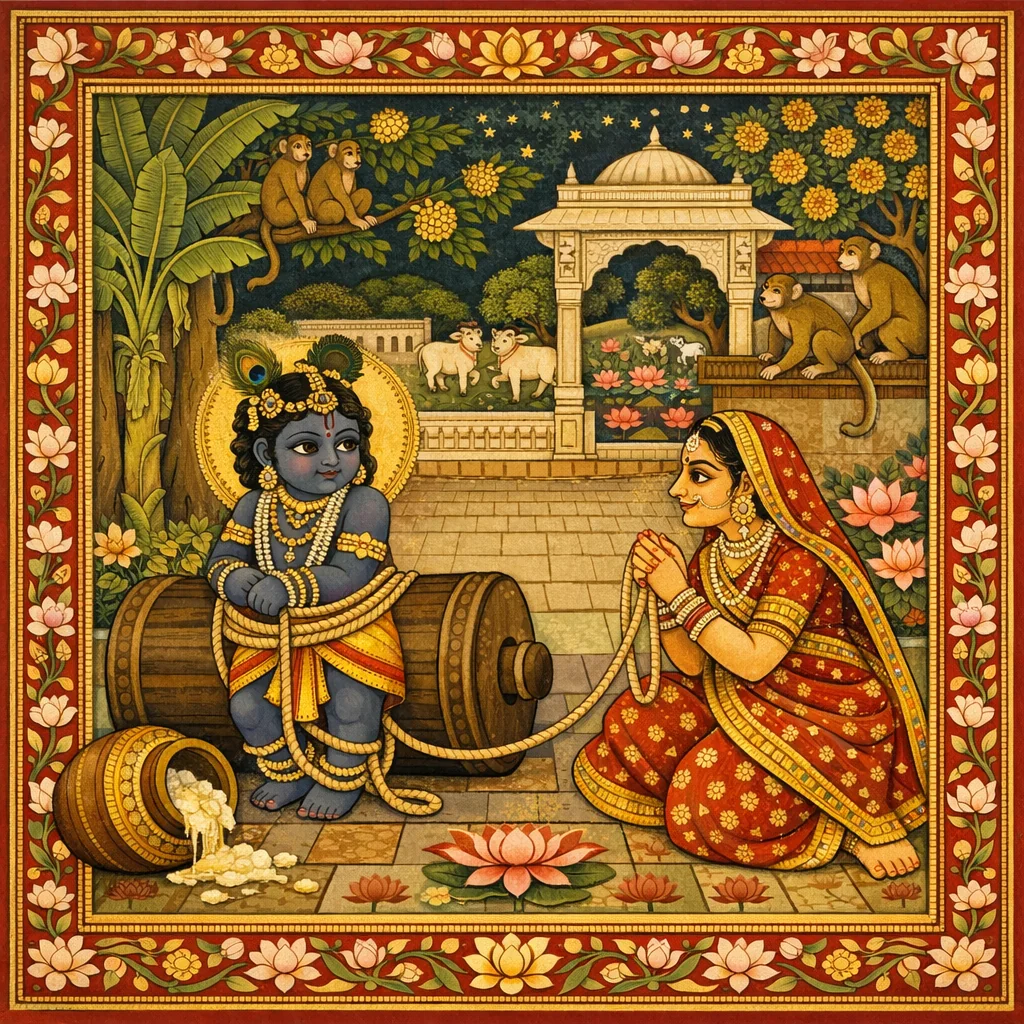
Continuing the intimate household līlās of Kṛṣṇa’s childhood in Vraja, Mother Yaśodā churns yogurt while singing of His pranks. Kṛṣṇa interrupts, asking to nurse; when she briefly leaves Him to save boiling milk, He shows playful anger—breaking the yogurt pot and secretly feeding butter to monkeys. Yaśodā discovers this, approaches quietly, and chases Him, highlighting the contrast that yogīs cannot capture Him by meditation, yet He flees before His mother’s stick. She decides to bind Him to prevent further “offenses,” but every rope is short by two fingers, even after many are joined. As neighbors smile in wonder and Yaśodā grows exhausted, Kṛṣṇa mercifully consents to be bound, revealing bhakti-vaśyatā—the Lord’s subjugation to devotion. The chapter then turns toward the next episode: bound near the twin yamala-arjuna trees, Kṛṣṇa recalls their former identity as Nalakūvara and Maṇigrīva, setting up their coming deliverance.
Shlokas
Verse 1
श्रीशुक उवाच एकदा गृहदासीषु यशोदा नन्दगेहिनी । कर्मान्तरनियुक्तासु निर्ममन्थ स्वयं दधि ॥ १ ॥ यानि यानीह गीतानि तद्बालचरितानि च । दधिनिर्मन्थने काले स्मरन्ती तान्यगायत ॥ २ ॥
Śrī Śukadeva said: One day, seeing that the maidservants were busy with other household duties, Mother Yaśodā, the lady of Nanda’s home, began churning the yogurt herself. As she churned, she remembered Kṛṣṇa’s childhood pastimes and, in her own way, composed songs and softly sang of them to herself.
Verse 2
श्रीशुक उवाच एकदा गृहदासीषु यशोदा नन्दगेहिनी । कर्मान्तरनियुक्तासु निर्ममन्थ स्वयं दधि ॥ १ ॥ यानि यानीह गीतानि तद्बालचरितानि च । दधिनिर्मन्थने काले स्मरन्ती तान्यगायत ॥ २ ॥
Śrī Śukadeva said: One day, seeing that the maidservants were busy with other household duties, Mother Yaśodā, the lady of Nanda’s home, began churning the yogurt herself. As she churned, she remembered Kṛṣṇa’s childhood pastimes and, in her own way, composed songs and softly sang of them to herself.
Verse 3
क्षौमं वास: पृथुकटितटे बिभ्रती सूत्रनद्धं पुत्रस्नेहस्नुतकुचयुगं जातकम्पं च सुभ्रू: । रज्ज्वाकर्षश्रमभुजचलत्कङ्कणौ कुण्डले च स्विन्नं वक्त्रं कबरविगलन्मालती निर्ममन्थ ॥ ३ ॥
Clad in saffron-yellow cloth and girded with a belt upon her full hips, mother Yaśodā labored at the churning, pulling the rope again and again. From love for her child her breasts were wet with milk; her body trembled, and her bangles and earrings shook. Her face, graced with lovely brows, was damp with perspiration, and mālatī blossoms slipped from her hair.
Verse 4
तां स्तन्यकाम आसाद्य मथ्नन्तीं जननीं हरि: । गृहीत्वा दधिमन्थानं न्यषेधत् प्रीतिमावहन् ॥ ४ ॥
As mother Yaśodā churned, Hari—Lord Kṛṣṇa—came before her, longing to drink her milk. To increase her transcendental delight, He seized the churning rod and began to stop her from churning.
Verse 5
तमङ्कमारूढमपाययत् स्तनं स्नेहस्नुतं सस्मितमीक्षती मुखम् । अतृप्तमुत्सृज्य जवेन सा यया- वुत्सिच्यमाने पयसि त्वधिश्रिते ॥ ५ ॥
Mother Yaśodā embraced Kṛṣṇa, set Him upon her lap, and nursed Him from a breast flowing with affection, smiling as she gazed upon His face. But seeing the milk on the stove boiling over, she at once left her son—though He was not yet satisfied—to tend the overflowing milk.
Verse 6
सञ्जातकोप: स्फुरितारुणाधरं सन्दश्य दद्भिर्दधिमन्थभाजनम् । भित्त्वा मृषाश्रुर्दृषदश्मना रहो जघास हैयङ्गवमन्तरं गत: ॥ ६ ॥
Angered, biting His reddish lips with His teeth and filling His eyes with feigned tears, Kṛṣṇa smashed the yogurt pot with a piece of stone. Then He slipped into an inner room and, in a hidden place, began to eat the freshly churned butter.
Verse 7
उत्तार्य गोपी सुशृतं पय: पुन: प्रविश्य संदृश्य च दध्यमत्रकम् । भग्नं विलोक्य स्वसुतस्य कर्म त- ज्जहास तं चापि न तत्र पश्यती ॥ ७ ॥
After taking the hot milk down from the stove, mother Yaśodā returned to the churning place. Seeing the yogurt pot broken and Kṛṣṇa nowhere to be found, she understood it to be her son’s handiwork, and the thought made her laugh.
Verse 8
उलूखलाङ्घ्रेरुपरि व्यवस्थितं मर्काय कामं ददतं शिचि स्थितम् । हैयङ्गवं चौर्यविशङ्कितेक्षणं निरीक्ष्य पश्चात् सुतमागमच्छनै: ॥ ८ ॥
At that time Śrī Kṛṣṇa sat upon an overturned wooden mortar and, as He pleased, distributed milk delicacies—yogurt and butter—to the monkeys. Fearing punishment for His theft, He anxiously glanced in every direction. Seeing Him thus, Mother Yaśodā approached very cautiously from behind, step by step.
Verse 9
तामात्तयष्टिं प्रसमीक्ष्य सत्वर- स्ततोऽवरुह्यापससार भीतवत् । गोप्यन्वधावन्न यमाप योगिनां क्षमं प्रवेष्टुं तपसेरितं मन: ॥ ९ ॥
Seeing His mother with a stick in hand, Lord Śrī Kṛṣṇa quickly climbed down from the mortar and fled as though greatly afraid. Though yogīs strive through meditation and austerity to grasp Him as Paramātmā, they cannot attain Him; yet Mother Yaśodā, thinking that same Supreme Lord to be her own son, ran after Kṛṣṇa to catch Him.
Verse 10
अन्वञ्चमाना जननी बृहच्चल- च्छ्रोणीभराक्रान्तगति: सुमध्यमा । जवेन विस्रंसितकेशबन्धन- च्युतप्रसूनानुगति: परामृशत् ॥ १० ॥
As she chased Kṛṣṇa, Mother Yaśodā—slender-waisted—naturally slowed, weighed down by her heavy breasts. In her swift pursuit her hair-knot loosened and the flowers in her hair fell behind her; yet she still managed to seize her son, Kṛṣṇa.
Verse 11
कृतागसं तं प्ररुदन्तमक्षिणी कषन्तमञ्जन्मषिणी स्वपाणिना । उद्वीक्षमाणं भयविह्वलेक्षणं हस्ते गृहीत्वा भिषयन्त्यवागुरत् ॥ ११ ॥
Caught by Mother Yaśodā, Kṛṣṇa grew even more afraid and acknowledged His mischief. He wept; His tears mixed with the dark ointment around His eyes, and as He rubbed them with His hands the ointment smeared across His face. Taking her beautiful son by the hand, Mother Yaśodā began to chastise Him gently.
Verse 12
त्यक्त्वा यष्टिं सुतं भीतं विज्ञायार्भकवत्सला । इयेष किल तं बद्धुं दाम्नातद्वीर्यकोविदा ॥ १२ ॥
Seeing her son exceedingly frightened, Mother Yaśodā—ever affectionate to her child—threw away the stick. Not knowing who Kṛṣṇa was or how great His power, she desired to bind Him with a rope so that He would not commit further mischief.
Verse 13
न चान्तर्न बहिर्यस्य न पूर्वं नापि चापरम् । पूर्वापरं बहिश्चान्तर्जगतो यो जगच्च य: ॥ १३ ॥ तं मत्वात्मजमव्यक्तं मर्त्यलिङ्गमधोक्षजम् । गोपिकोलूखले दाम्ना बबन्ध प्राकृतं यथा ॥ १४ ॥
The Supreme Personality of Godhead has no inside or outside, no beginning or end, no front or rear; He is all-pervading and beyond time—both the universe and the support of the universe.
Verse 14
न चान्तर्न बहिर्यस्य न पूर्वं नापि चापरम् । पूर्वापरं बहिश्चान्तर्जगतो यो जगच्च य: ॥ १३ ॥ तं मत्वात्मजमव्यक्तं मर्त्यलिङ्गमधोक्षजम् । गोपिकोलूखले दाम्ना बबन्ध प्राकृतं यथा ॥ १४ ॥
That unmanifest Adhokṣaja, beyond the reach of the senses, appeared as a human child; mother Yaśodā, thinking Him her ordinary son, bound Him with a rope to the wooden mortar.
Verse 15
तद् दाम बध्यमानस्य स्वार्भकस्य कृतागस: । द्व्यङ्गुलोनमभूत्तेन सन्दधेऽन्यच्च गोपिका ॥ १५ ॥
As mother Yaśodā tried to bind her mischievous little child, she saw the rope was short by two fingerbreadths; so the gopī brought another rope to join to it.
Verse 16
यदासीत्तदपि न्यूनं तेनान्यदपि सन्दधे । तदपि द्व्यङ्गुलं न्यूनं यद् यदादत्त बन्धनम् ॥ १६ ॥
That rope too proved insufficient; she joined more ropes, yet whatever binding she took up, it was always two fingerbreadths short, again and again.
Verse 17
एवं स्वगेहदामानि यशोदा सन्दधत्यपि । गोपीनां सुस्मयन्तीनां स्मयन्ती विस्मिताभवत् ॥ १७ ॥
Thus Yaśodā joined all the ropes in the house, yet still could not bind Kṛṣṇa. The elderly gopīs nearby smiled in delight; Yaśodā too smiled as she labored, and all were filled with wonder.
Verse 18
स्वमातु: स्विन्नगात्राया विस्रस्तकबरस्रज: । दृष्ट्वा परिश्रमं कृष्ण: कृपयासीत् स्वबन्धने ॥ १८ ॥
By mother Yaśodā’s strenuous effort, her whole body was drenched in perspiration, and the flowers and comb slipped from her hair. Seeing her so weary, child Kṛṣṇa became compassionate and consented to be bound.
Verse 19
एवं सन्दर्शिता ह्यङ्ग हरिणा भृत्यवश्यता । स्ववशेनापि कृष्णेन यस्येदं सेश्वरं वशे ॥ १९ ॥
O Parīkṣit, in this pastime Hari revealed His wondrous trait: though Kṛṣṇa controls the entire universe, along with Śiva, Brahmā, Indra and all the gods, He nonetheless comes under the sway of His devotees’ loving bhakti.
Verse 20
नेमं विरिञ्चो न भवो न श्रीरप्यङ्गसंश्रया । प्रसादं लेभिरे गोपी यत्तत्प्राप विमुक्तिदात् ॥ २० ॥
Neither Virinci (Brahmā), nor Bhava (Śiva), nor even Śrī Lakṣmī who ever rests upon the Lord’s chest, obtained from the Deliverer of liberation such mercy as the gopī mother Yaśodā received.
Verse 21
नायं सुखापो भगवान्देहिनां गोपिकासुत: । ज्ञानिनां चात्मभूतानां यथा भक्तिमतामिह ॥ २१ ॥
Bhagavān Kṛṣṇa, the son of the gopī, is not easily attained by those absorbed in bodily identity, by mere jñānīs and speculators, or by severe ascetics; but to devotees engaged in spontaneous loving bhakti, He is readily accessible here.
Verse 22
कृष्णस्तु गृहकृत्येषु व्यग्रायां मातरि प्रभु: । अद्राक्षीदर्जुनौ पूर्वं गुह्यकौ धनदात्मजौ ॥ २२ ॥
While mother Yaśodā was busily engaged in household duties, the Supreme Lord Kṛṣṇa noticed before Him the twin trees known as yamala-arjuna, who in a former age had been the divine sons of Kuvera, the lord of wealth (Dhanada).
Verse 23
पुरा नारदशापेन वृक्षतां प्रापितौ मदात् । नलकूवरमणिग्रीवाविति ख्यातौ श्रियान्वितौ ॥ २३ ॥
In a former birth, these two—famed as Nalakūvara and Maṇigrīva—were endowed with great opulence and fortune; but, intoxicated by pride, they were cursed by Nārada Muni to become trees.
Frequently Asked Questions
Traditional Vaiṣṇava explanation reads the “two fingers” as a deliberate theological sign: one ‘finger’ represents human endeavor (sādhaka-prayatna or the devotee’s sincere effort), and the second represents Bhagavān’s mercy (kṛpā). Binding the Infinite is impossible by material means alone; Kṛṣṇa allows Himself to be ‘captured’ only when devotion is complete—effort is offered fully and grace is bestowed freely.
The chapter juxtaposes tattva and līlā: ontologically Kṛṣṇa is the timeless, all-pervading Absolute, yet in Vraja He voluntarily accepts the rules of intimate relationship (vātsalya-rasa). His ‘fear’ is not ignorance or limitation imposed by māyā; it is a self-chosen līlā that magnifies His devotee’s love and demonstrates that prema is a higher ‘binding force’ than yogic or speculative approaches.
Commentarial tradition highlights dharma within bhakti: Yaśodā’s love is practical, attentive, and responsible—she serves Kṛṣṇa while also protecting offerings and household duties meant for Him. The scene also intensifies the līlā’s rasa: Kṛṣṇa’s playful jealousy and mischief amplify the sweetness (mādhurya) of their relationship.
They are the two sons of Kuvera, formerly cursed by Nārada Muni due to intoxication with wealth and pride, resulting in their birth as the twin yamala-arjuna trees. Their mention here functions as narrative foreshadowing: bound to the mortar, Kṛṣṇa will soon move between the trees and grant them liberation, demonstrating His compassion and the purifying power of contact with Him.