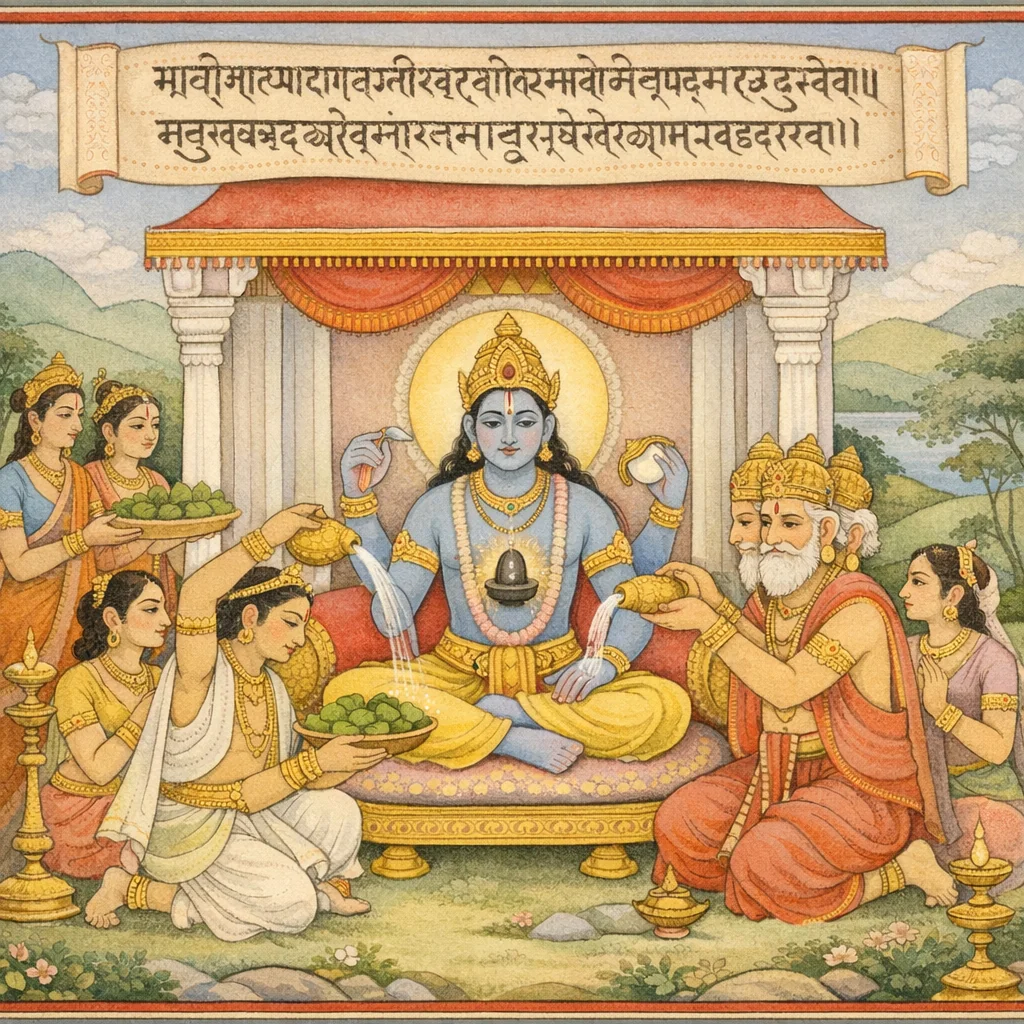
Adhyaya 36: Harihara Revelation and the Tirtha-Glorification of Saptasarasvata in Kurukshetra
हरिहर-दर्शनं तथा सप्तसरस्वत-तीर्थमाहात्म्यम् (Harihara-Darśanaṃ tathā Saptasarasvata-Tīrtha-Māhātmyam)
Harihara Glory at Kurukshetra
Within the Pulastya–Nārada narrative frame, this Adhyāya advances a syncretic theology by staging a crisis among the devas: their inability to perceive Maheśvara even when he stands before them. Viṣṇu diagnoses this as a consequence of moral fault (āgaḥ) and prescribes bodily purification through the taptakṛcchra-vrata and a carefully graded abhiṣeka regimen (milk, curd, pañcagavya, honey, water), followed by bilva-offerings and Śatarudrīya-japa. The resolution culminates in an explicit Harihara iconographic disclosure: Śaṅkara is shown as an Īśvara-liṅga abiding in Viṣṇu’s own heart-lotus, and the devas perform ritual worship, thereby restoring divine vision and doctrinal harmony. The chapter then pivots to topographical sanctification in Kurukṣetra: Rudra traces the cause of cosmic trembling to ascetic acts (Uśanas seeking Saṃjīvanī-vidyā; the dancing ṛṣi Maṅkaṇaka), and consecrates the Saptasārasvata complex—seven Sarasvatī streams—declaring enduring sānnidhya of divine and semi-divine beings and the tīrtha’s power to remove pāpa-mala.
Divine Beings
Sacred Geography
Mortal & Asura Figures
Key Content Points
- Devas’ ‘blindness’ to Śiva is explained as karmic-ethical obstruction; Viṣṇu prescribes taptakṛcchra and a detailed Śaiva abhiṣeka/arcana protocol (kṣīra, dadhi, pañcagavya, madhu; bilva; Śatarudrīya) to restore devadṛṣṭi.
- Harihara synthesis is made explicit through iconographic and theological revelation: Śiva as liṅga residing in Viṣṇu’s hṛtpaṅkaja, followed by devas’ ritual worship and contemplation of the unified Harīśvara form.
- Kurukṣetra tīrtha-mahātmya: Rudra identifies world-tremors as arising from tapas (Uśanas’ Saṃjīvanī pursuit; Maṅkaṇaka’s ecstatic dance) and establishes/endorses Saptasārasvata and associated rivers as pāpamalāpahāri and dharma-nidhāna.
Shlokas in Adhyaya 36
Verse 1
इति श्रीवामनपुराणे पञ्चत्रिंशो पुलस्त्य उवाच ततो मुरारिभवनं समभ्येत्य सुरास्ततः ऊचुर्देवं नमस्कृत्य जगत्संक्षुब्धिकारणम्
Thus, in the Śrī Vāmana Purāṇa, (ends) the thirty-fifth chapter. Pulastya spoke: Then the gods approached the abode of Murāri; thereafter, having bowed to the Lord—the cause of the world’s upheaval—they spoke.
Verse 2
तच्छ्रुत्वा भगवान् प्राह गच्छामो हरमन्दिरम् स तव्त्स्यति महाज्ञानी जगत्क्षुब्धं चरचरम्
Hearing that, the Blessed Lord said: “Let us go to Hara’s temple. That great-knowing one will protect (and steady) the world—both the moving and the unmoving—now thrown into agitation.”
Verse 3
तयोक्ता वासुदेवेनन देवाः शक्रपुरोगमाः जनार्दनं पुरस्कृत्य प्रजाग्मुर्मन्दरं गिरिम् न तत्र देवं न वृषं न देवीं न च नन्दिनम्
Thus instructed by Vāsudeva, the gods—led by Śakra—set out, placing Janārdana at their head, and went to Mount Mandara. There they saw neither the god (Śiva), nor the Bull (Vṛṣa), nor the Goddess, nor Nandin.
Verse 4
शून्यं गिरिमपश्यन्त अज्ञानतिमिरावृताः तान् मूढदृष्टीन् संप्रोक्ष्य देवान् विष्णुर्महाद्युतिः
Covered by the darkness of ignorance, they perceived the mountain as empty. Then the radiant Viṣṇu, sprinkling those gods whose vision was deluded, (restored clarity).
Verse 5
प्रोवाच किं न पश्यध्वं महेशं पुरतः स्थितम् तमूचुर्नैव देवेशं पश्यामो गिरिजापतिम्
He said, “Why do you not see Maheśa standing before you?” They replied, “O Lord of the gods, we do not at all see the Lord, the husband of Girijā.”
Verse 6
न विद्मः कारणं तच्च येन दृष्टिर्हता हि नः तानुवाच जगन्मूर्तिर्यूयं देवस्य सागसः
“We do not know the reason for this, by which our sight has indeed been struck down.” Then the embodiment of the world said to them, “You are offenders against the god.”
Verse 7
पापिष्ठा गर्भहन्तारो मृडान्याः स्वार्थतत्पराः तेन ज्ञानविवेको वै हृतो देवेवन शूलिना
“Most sinful—slayers of embryos—cruel, intent only on your own advantage; therefore, indeed, your discriminative knowledge has been taken away by the god, the wielder of the trident.”
Verse 8
येनाग्रतः स्थितमपि पश्यन्तो ऽपि न पश्यथ तस्मात् कायविशुद्ध्यर्थं देवदृष्ट्यर्थमादरात्
“Because of that (impurity/obstruction), even while looking you do not perceive the Lord who stands before you. Therefore, for the sake of bodily purification—and for the attainment of divine vision—perform (the prescribed rites) with earnest care.”
Verse 9
तप्तकृच्छ्रेम संशुद्धाः कुरुध्वं स्नानमीश्वरे क्षीरस्नाने प्रयुञ्जीत सार्द्ध कुम्भशतं सुराः
“Having become purified by the Tapta-Kṛcchra observance, perform bathing for Īśvara. For a milk-bath (kṣīra-snāna), O gods, one should employ one hundred and a half pitchers (i.e., 150 kumbhas).”
Verse 10
दधिस्नाने चुतःषष्टिर्द्वात्रिंशद्धविषोर्ऽहणे पञ्चगव्यस्य शुद्धस्य कुम्भाः षोडश कीर्तिताः
“For a curd-bath (dadhi-snāna), sixty-four (pitchers are prescribed); for a ghee-bath (haviṣ/ghṛta), thirty-two. For purified pañcagavya, sixteen pitchers are declared.”
Verse 11
मदुनो ऽष्टौ जलस्योक्ताः सर्वे ते द्विगुणाः सुराः ततो रोचनया देवमष्टोत्तरशतेन हि
Eight (measures) of honey are prescribed, and all those (measures) are to be doubled in the case of surā (spirituous liquor). Thereafter, one should anoint the deity with rocanā, (doing so) with the (recitation of) the one-hundred-and-eight (names/mantras).
Verse 12
अनुलिम्पेत् कुङ्कुमेन चन्दनेन च भक्तितः बिल्वपत्रैः सकमलैः धत्तूरसुरचन्दनैः
With devotion, one should anoint (the deity) with saffron and sandalpaste, and (worship) with bilva leaves together with lotuses, with dhattūra flowers, and with ‘asura-sandal’ (a variety of sandal/unguent).
Verse 13
मन्दारैः पारिजातैश्च अतिमुक्तैस्तथार्ऽचयेत् अगुरुं सह कालेयं चन्दनेनापि धूपयेत्
One should likewise worship with mandāra and pārijāta flowers, and with atimuktā blossoms. One should also fumigate (the deity/altar) with aguru together with kāleyaka, and also with sandalwood (as incense).
Verse 14
जप्तव्यं शतरूद्रीयं ऋग्वेदोक्तैः पदक्रमैः एवं कृते तु देवेशं पश्यध्वं नेतरेण च
“The Śatarudrīya should be recited (as japa) according to the word-by-word sequence (padakrama) as taught in the Ṛgveda. When this is done, you will behold the Lord of the gods; not otherwise.”
Verse 15
इत्युक्ता वासुदेवेन देवाः केशवमब्रुवन् विधानं तप्तकृच्छ्रस्य कथ्यतां मधुसूदन यस्मिश्चिर्णे कायशुद्धिर्भवते सार्वकालिकी
“Thus addressed by Vāsudeva, the gods said to Keśava: ‘O Madhusūdana, please explain the procedure of the Taptakṛcchra (penance), by the performance of which bodily purification becomes perpetual (effective for all times).’”
Verse 16
वासुदेव उवाच त्र्यहमुष्णं पिबेदापः त्र्यहमुष्णं पयः पिवेत् त्र्यहमुष्णं पिबेत्सर्पिर्वायुभक्षो दिनत्रयम्
Vāsudeva said: “For three days one should drink warm water; for three days one should drink warm milk; for three days one should drink warm ghee; and for three days one should subsist on air (i.e., fast completely).”
Verse 17
पला द्वादश तोयस्य पलाष्टौ पयसः सुराः षट्पलं सर्पिषः प्रोक्तं दिवसे दिवसे पिबेत्
“(Let him take) twelve palas of water, eight palas of milk, and six palas of clarified butter—so it is prescribed. Day after day he should drink (these measured portions).”
Verse 18
पुलस्त्य उवाच इत्येवमुक्ते वचने सुराः कायविशुद्धये तप्तकृच्छ्ररहस्यं वै चक्रुः शक्रपुरोगमाः
Pulastya said: “When these words had thus been spoken, the gods—led by Śakra—performed the secret discipline of the ‘taptakṛcchra’ for the purification of the body.”
Verse 19
ततो व्रते सुराश्चीर्णे विमुक्ताः पापतो ऽभवन् विमुक्तपापा देवेशं वासुदेवमथाब्रुवन्
“Then, when the gods had completed the vow, they became freed from sin. Having been released from sin, they then addressed Vāsudeva, the Lord of the gods.”
Verse 20
क्वासौ वद जगन्नाथ शंभुस्तिष्ठति केशव यं क्षीराद्यभिषेकेण स्नापयामो विधानतः
“Tell us, O Lord of the universe, O Keśava: where does Śambhu (Śiva) stand (abide)? Him we wish to bathe, according to rule, with ritual ablutions of milk and the like.”
Verse 21
अथोवाच सुरान्विष्णुरेव तिष्ठति शङ्करः मद्देहे किं न पश्यध्वं योगाश्चायं प्रतिष्ठितः
Then Viṣṇu said to the gods: “Śaṅkara (Śiva) indeed abides (here). Why do you not see (him) in my body? This (truth) is established by yoga.”
Verse 22
तमूचुर्नैव पश्यामस्त्वत्तो वै त्रिपुरान्तकम् सत्यं वद सुरेशान महेशानः क्व तिष्ठति
They said to him: “We do not at all see Tripurāntaka (the destroyer of Tripura) within you. Speak the truth, O Lord of the gods: where does Maheśāna (the great Lord) abide?”
Verse 23
ततो ऽव्ययात्मा स हरिः स्वहृत्पङ्कजशायिनम् दर्शयामास देवानां मुरारिर्लिङ्गमैश्वरम्
Then that imperishable-souled Hari—Murāri—revealed to the gods the Aiśvara Liṅga, (the emblem of the Lord), (identified as) the One who lies upon the lotus of his own heart.
Verse 24
ततः सुराः क्रमेणैव क्षीरादिभिरनन्तरम् स्नापयाञ्चक्रिरे लिङ्गं शाश्वतं ध्रुवमव्ययम्
Thereupon the gods, in due sequence and without delay, bathed (performed abhiṣeka for) the Liṅga with milk and other (offerings), (that Liṅga) which is eternal, steadfast, and imperishable.
Verse 25
गोरोचनया त्वालिप्य चन्दनेन सुगन्धिना बिल्वपत्राम्बुजैर्देवं पूजयामासुरञ्जसा
Having anointed (the Liṅga) with gorocanā and with fragrant sandalpaste, the gods worshipped the Lord with bilva leaves and lotuses, readily and with ease.
Verse 26
प्रधूप्यागुरुणा भक्त्या निवेद्य परमैषधीः जप्त्वाष्टशतनामानं प्रणामं चक्रिरे ततः
Then, with devotion, they fumigated (the place of worship) with agaru-incense, offered the finest medicinal herbs, recited the litany of the eight-hundred names, and thereafter performed prostration.
Verse 27
इत्येवं चिन्तयन्तश्च देवावेतौ हरीश्वरौ कथं योगत्वमापन्नौ सत्त्वान्धतमसोद्भवौ
Thus, while reflecting, the gods (wondered about) these two—Hari and Īśvara: how had they attained a state of union (yoga), though arising from (distinct) sources—sattva, and the blinding darkness (tamas)?
Verse 28
सुराणां चिन्तितं ज्ञात्वा विश्वमूर्तिभूद्विभुः सर्वलक्षणसंयुक्तः सर्वायुधधरो ऽव्ययः
Knowing what the gods were thinking, the all-pervading Lord became the Universal-Form; endowed with every auspicious mark, bearing every weapon, imperishable.
Verse 29
सार्द्धं त्रिनेत्रं कमलाहिकुण्डलं जटागुडाकेशखगर्षभध्वजम् समाधवं हारभुजङ्गवक्षसं पीताजिनाच्छन्नकटिप्रदेशम्
He beheld that (supreme) form as a single, united reality: three‑eyed, wearing lotus and serpent as ear‑ornaments; bearing matted locks and the yellow garment; marked with the emblems of Garuḍa and the bull upon its banner; possessing Mādhava (Viṣṇu) together with (Śiva’s) deep meditative poise; with a serpent as a chest‑ornament/garland; and with the region of the waist covered by a yellow hide/cloth.
Verse 30
चक्रासिहस्तं हलशार्ङ्गपाणिं पिनाकशूलाजगवान्वितं च कपर्दखट्वाङ्गकपालघण्टासशङ्खटङ्काररवं महर्षे
O great sage, (they saw) that form bearing in its hands the discus and sword; holding the plough and Śārṅga (the bow); and also equipped with Pināka, the trident, and the serpent. It was adorned with the matted-hair topknot, the khaṭvāṅga staff, skull and bell, and it resounded with the clangor together with the conch’s sound.
Verse 31
दृष्ट्वैव देवा हरिशङ्करं तं नमो ऽस्तु ते सर्वगताव्ययेति प्रोक्त्वा प्रणामं कमलासनाद्याश्चक्रुर्मतिं चैकतरां नियुज्य
Upon merely seeing that Hari-Śaṅkara, the gods—beginning with the Lotus-seated (Brahmā)—uttered, ‘Homage to You, the all-pervading and imperishable!’ Having spoken thus, they performed obeisance, and fixing their minds in single-pointedness, they devoted themselves wholly (to that one supreme).
Verse 32
तानेकचित्तान् विज्ञाय देवान् देवपतिर्हरिः प्रगृह्याभ्यद्रवत्तूर्णं कुरुक्षेत्रं स्वमाश्रमम
Recognizing that the gods had become of one intent (single-minded), Hari—the Lord of the gods—set out at once and swiftly hastened to Kurukṣetra, to his own hermitage there.
Verse 33
ततो ऽपश्यन्त देवेशं स्थाणुभूतं जले शुचिम् दृष्ट्वानमः स्थाणवेति प्रोक्त्वा सर्वेह्युपाविशन्
Then they beheld the Lord of the gods, pure, present in the water in the form of Sthāṇu. Having seen him, they all uttered, ‘Homage to Sthāṇu,’ and sat down (in reverent attendance).
Verse 34
ततो ऽब्रवीत् सुरपतिरेह्येहि दीयतां वरः क्षुब्धं जगज्जगन्नाथ उन्मज्जस्व प्रियातिथे
Then the lord of the gods spoke: ‘Come, come—grant a boon. The world is agitated, O Lord of the world; rise up (emerge), O dear guest.’
Verse 35
ततस्तां मधुरां वाणीं शुश्राव वृषभध्वजः श्रुत्वोत्तस्थौ च वैगेन सर्वव्यापी निरञ्जनः
Then the Bull-bannered Lord (Śiva) heard that sweet voice; and upon hearing it, the all-pervading, stainless One rose up swiftly.
Verse 36
नमो ऽस्तु स्र्वदेभ्यः प्रोवाच प्रहसन् हरः स चागतः सुरैः सेन्द्रः प्रणतो विनयान्वितैः
Smiling, Hara said, “Homage be (to you) all, O gods.” And Indra, together with the gods, approached—bowed down and endowed with humility.
Verse 37
तमूचुर्देवताः सर्वस्त्यज्यतां शङ्करद्रत्म् महाव्रतं त्रयो लोकाः क्षुब्धास्त्वत्तेसावृताः
All the gods said to him: “O Śaṅkara, abandon (this) great vow. The three worlds are agitated, being overwhelmed by your radiance/energy.”
Verse 38
अथोवाच महादेवो मया त्यक्तो महाव्रतः ततः सुरा दिवं जग्मुर्हृष्टाः प्रयतमानसाः
Then Mahādeva said: “The great vow (mahāvrata) has been relinquished by me.” Thereupon the gods, delighted and with minds intent on their purpose, went up to heaven.
Verse 39
ततो ऽपि कम्पते पृथ्वी साब्धिद्वीपाचला मुने ततो ऽभिचिन्तयद्रुद्रः किमर्थं क्षुभिता मही
Even then the earth shook—together with its oceans, continents, and mountains, O sage. Thereupon Rudra reflected: “For what reason has the earth become agitated?”
Verse 40
ततः पर्यचरच्छूली कुरुक्षेत्रं समन्ततः ददर्शोघवतीतीरे उशनसं तपोनिधिम्
Then the trident-bearer (Śiva) ranged all around Kurukṣetra. On the bank of the Oghavatī he saw Uśanas, a treasury of austerity (a great ascetic).
Verse 41
ततो ऽब्रवीत्सुरपतिः किमर्थं तप्यते तपः जगत्क्षोभकरं विप्र तच्छीघ्रं कथ्यतां मम
Then the lord of the gods said: “For what purpose is this austerity being performed, O brāhmaṇa—an austerity that causes agitation in the worlds? Tell it to me quickly.”
Verse 42
उशना उवाच तवाराधनकामार्थं तप्यते हि महत्तपः संजीवनीं शुभां विद्यां ज्ञातुमिच्छे त्रिलोचन
Uśanā said: “This great austerity is indeed being practiced for the sake of worshipping you. I desire to know the auspicious Saṃjīvanī-vidyā, O Three-Eyed One.”
Verse 43
हर उवाच तपसा परितुष्टो ऽस्मि सुतप्तेन तपोधन तस्मात् संजीवनींविद्यां भवान् ज्ञास्यति तत्तवत्तः
Hara said: “I am satisfied with your austerity, well-performed, O treasure of ascetic power. Therefore you shall know the Saṃjīvanī-vidyā in accordance with the truth (in its real principles).”
Verse 44
वरं लब्ध्वा ततः शुक्रस्तपसः संन्यवर्त्तत तथापि चलते पृथ्वी साब्धिभूभृन्नगावृता
Having obtained the boon, Śukra then desisted from his austerities. Yet even so the earth—encircled by oceans, mountains, and ranges—began to tremble.
Verse 45
ततो ऽगमन्महादेवः सप्तसारस्वतं शुचिः ददर्श नृत्यमानं च ऋषिं मङ्कणसंज्ञितम्
Then the pure Mahādeva went to Saptasārasvata, and he saw a sage—named Maṅkaṇa—dancing.
Verse 46
भावेन पोप्लूयति बालवत् स भुजौ प्रसार्यैव ननर्त्त वेगात् तस्यैव वेगेन समाहता तु चचाल भूर्भूमिधरैः सहैव
Overwhelmed by emotion, he—like a child—stretched out his arms and danced with force. Struck by the very force of his movement, the earth shook together with its mountains.
Verse 47
तं शङ्गरो ऽभ्येत्य करे निगृह्य प्रोवाच वाक्यं प्रहसन् महर्षे किं भावितो नृत्यसि केन हेतुना वदस्व मामेत्य किमत्र तुष्टिः
Śaṅkara approached him, took hold of his hand, and—smiling—spoke these words: “O great ṛṣi, why do you dance in such exaltation? For what reason? Come, tell me: what is the satisfaction (that you have attained) here?”
Verse 48
स ब्राह्मणः प्राह ममाद्य तुष्टिर्येनेह जाता शृणु तद् द्विजेन्द्र बहून् गणान् वै मम तप्यतस्तपः संवत्सरान् कायविशोषणार्थम्
That brāhmaṇa said: “Hear, O best of twice-born, the reason why satisfaction has arisen in me today. For many multitudes (of years), for many years, I have practiced austerity—undertaken for the purpose of drying up (emaciating) the body.”
Verse 49
ततो ऽनुपश्यामि करात् क्षतोत्थं निर्गच्छते शाकरसं ममेह तेनाद्य तुष्टो ऽस्मि भृशं द्विजेन्द्र येनास्मि नृत्यामि सुभावितात्मा
“Then I behold this: from my hand, from a wound, there issues forth a mass of ‘śākara’ (sugar-like crystals). Because of that, today I am greatly satisfied, O best of twice-born; for this reason I dance—my self made auspicious and uplifted.”
Verse 50
तं प्राह शंभुर्द्विज पश्य मह्यं भस्म प्रवृत्तो ऽङ्गुलितो ऽतिशुक्लम् संताडनादेव न च प्रहर्षो ममास्ति नृनं हि भवान् प्रमत्तः
Śambhu said to him: “O twice-born, look at me. From my finger there issues exceedingly white ash. Yet merely because of this striking (manifestation) I feel no exhilaration; for you, among men, have become heedless (intoxicated with pride).”
Verse 51
श्रुत्वाथ वाक्यं वृषभध्वजस्य मत्वा मुनिर्मङ्कणको महर्षे नृत्यं परित्यज्य सुविस्मितो ऽथ ववन्द पादौ विनयावनम्रः
Having heard the words of the Bull-bannered Lord, the sage Maṅkaṇaka, understanding (their import), abandoned his dancing. Then, greatly astonished, he bowed to (Śiva’s) feet, bending down with humility.
Verse 52
तमाह शंभुर्द्विज गच्छ लोकं तं ब्रह्मणो दुर्गममव्ययस्य इदं च तीर्थं प्रवरं पृथिव्यां पृथूदकस्यास्तु समं फलेन
Śambhu said to him: “O twice-born, go to that world of the imperishable Brahmā, difficult to attain. And let this excellent tīrtha on earth be equal in merit to Pṛthūdaka.”
Verse 53
सांनिध्यमत्रैव सुरासुराणां गन्धर्वविद्याधरकिन्नराणाम् सदास्तु धर्मस्य निधानमग्र्यं सारस्वतं पापमलापहारि
May there be here, indeed, the constant presence of the gods and the asuras, and of the Gandharvas, Vidyādharas, and Kinnaras. May this foremost Sarasvata (holy place/waters) ever remain the supreme treasury of Dharma, removing the stain of sin.
Verse 54
सुप्रभा काञ्चानाक्षी च सुवेणुर्विमलोदका मनोहरा चौघवती विशाला च सरस्वती
(They are:) Suprabhā, Kāñcānākṣī, Suveṇu, Vimalodakā, Manoharā, Caughavatī, and Viśālā—(these are the) Sarasvatīs.
Verse 55
एताः सप्त सरस्वत्यो निविसिष्यन्ति नित्यशः सोमपालफलं सर्वाः प्रयच्छन्ति सुपुण्यदाः
These seven Sarasvatīs abide here perpetually; all of them bestow the fruit (merit) of the Soma-sacrifice (Somapāla) and grant excellent पुण्य (religious merit).
Verse 56
भवानपि कुरुक्षेत्रे मूर्तिं स्थाप्य गरीयसीम् गमिष्यति महापुण्यं ब्रह्मलोकं सुदुर्गमम्
“You too, having established an exalted image (mūrti) in Kurukṣetra, will go to the supremely meritorious Brahmaloka, which is difficult to attain.”
Verse 57
इत्येवमुक्तो देवेन शङ्करेम तपोधनः मूर्त्ति स्थाप्य कुरुक्षेत्रे ब्रह्मलोकमगाद् वशी
“Thus addressed by the god Śaṅkara, the ascetic rich in austerity, having installed the image in Kurukṣetra, went—self-controlled—to Brahmaloka.”
Verse 58
गते मङ्कणके पृथ्वी निश्चला समजायत अथागान्मन्दरं शंभुर्निजमावसथं शुचिः
“When Maṅkaṇaka had departed, the earth became still. Then Śambhu, the pure one, went to Mandara—his own abode.”
Verse 59
एतत् तवोक्तं द्विज शङ्करस्तु गतस्तदासीत् तपसे ऽथ शैले शून्ये ऽभ्यगाद् दृष्टमतिर्हि देव्या संयोधितो येन हि कारणेन
“So it is, O twice-born, as you have said. Śaṅkara then went at that time to perform austerities upon a mountain. There, in a solitary (deserted) place, he approached (a situation) in which the Goddess’s resolve/understanding was perceived; and for that very reason he was drawn into combat.”
Frequently Asked Questions
It presents a syncretic theology in which Viṣṇu restores the devas’ capacity for Śiva-darśana through purification and then reveals Śaṅkara as an Īśvara-liṅga abiding in Viṣṇu’s own hṛtpaṅkaja (heart-lotus). The devas’ subsequent abhiṣeka, bilva-arcana, and japa function as a ritual confirmation that Śaiva worship is not opposed to Vaiṣṇava devotion but integrated within a Harīśvara/Harihara framework.
The chapter sanctifies Kurukṣetra by locating within it the Saptasārasvata complex and naming seven Sarasvatī streams (Suprabhā, Kāñcānākṣī, Suvenu, Vimalodakā, Manoharā, Caughavatī, Viśālā, alongside Sarasvatī). Rudra declares enduring sānnidhya of devas and other beings there and characterizes the tīrtha as pāpamalāpahāri (remover of sin-impurity) and a dharma-nidhāna (repository of dharma).
Viṣṇu teaches the taptakṛcchra regimen (three days hot water, three days hot milk, three days hot ghee, followed by three days of vāyu-bhakṣa/fasting), with measured quantities, and pairs it with a structured Śaiva worship sequence: multi-substance abhiṣeka (kṣīra, dadhi, pañcagavya, madhu, jala), anointing with gorocanā/candana/kuṅkuma, bilva and floral offerings, dhūpa, and Śatarudrīya-japa—culminating in restored perception of Maheśvara.