Adhyaya 21
अध्याय २१ — गान्धार्या वैकर्तनदर्शनम् (Gāndhārī’s Viewing of Vaikartana/Karṇa)
Upa-parva: Strī-parva — Battlefield Lament and the Viewing of the Fallen (Kurukṣetra-śava-darśana episode)
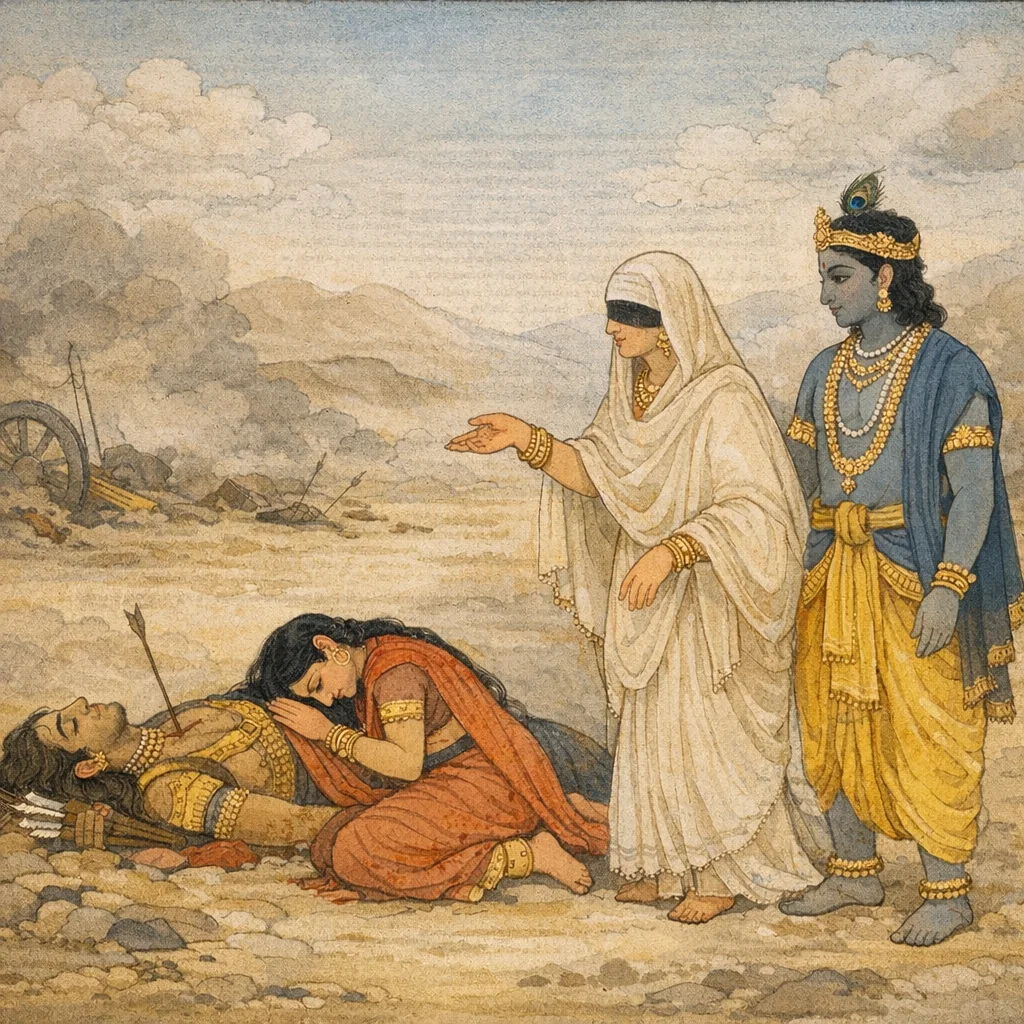
Gāndhārī speaks while surveying the battlefield and identifies Karṇa (Vaikartana) lying slain. She describes him as a formidable archer and mahāratha, formerly a major source of anxiety for Yudhiṣṭhira and a protective pillar for the Dhārtarāṣṭras, now felled by Arjuna (Gāṇḍīvadhanvan). The verses employ comparative imagery—lion and tiger, maddened elephants, a storm-broken tree—to mark the reversal from invincibility to vulnerability. The chapter also registers the communal dimension of grief: Karṇa’s wives gather with disheveled hair, weeping around him; his wife (mother of Vṛṣasena) is singled out in visible collapse. Causal explanation is introduced through reference to an ācārya’s curse affecting Karṇa at a critical moment (his chariot wheel trapped), enabling Arjuna to strike. The passage closes with intensified mourning as the bereaved woman rises, falls again, and clings to Karṇa’s face, lamenting especially under the pain of her son’s death.
Chapter Arc: युद्धभूमि में गान्धारी श्रीकृष्ण के सम्मुख कर्ण के शव को देखती हैं—वह अग्नि-सा तेजस्वी वीर अब शान्त पड़ा है, और दृष्टि के साथ ही वाणी विलाप में बदल जाती है। → गान्धारी कर्ण के पराक्रम का स्मरण कराती हैं: दीर्घरोषी, महाबली, महाधनुर्धर; जिसे आगे रखकर उनके महारथी पुत्र पाण्डवों से जूझते थे। वह बताती हैं कि कर्ण के भय/प्रताप से धर्मराज युधिष्ठिर वर्षों तक उद्विग्न रहे, निद्रा तक न पा सके—और अब वही कर्ण धरती पर निःशब्द है। → कर्ण की पत्नी (वृषसेन की माता) भूमि पर गिरकर करुण विलाप करती है और कर्ण के अंत का कारण कहती है—आचार्य-शाप के प्रभाव से पृथ्वी ने रथचक्र को ग्रस लिया, तभी रणशोभा वाले धनंजय ने शर से उसका शिर काट दिया। → विलाप के बीच कर्ण की पत्नी बार-बार उठकर फिर गिरती है, कर्ण के मुख को स्पर्श/परिमार्जन करती है और पुत्र-वध व पति-वध की दोहरी पीड़ा में डूब जाती है; गान्धारी का वर्णन शोक को स्थिर, ठोस सत्य में बदल देता है—युद्ध का वैभव अब केवल शवों और स्त्रियों के आँसुओं में शेष है। → गान्धारी का शोक श्रीकृष्ण के प्रति एक कठोर प्रश्न/आरोप की ओर बढ़ता हुआ प्रतीत होता है—क्या यह विनाश रोका जा सकता था?
Shlokas
Verse 1
अत---#क+ एकविशोड< ध्याय: गान्धारीके द्वारा कर्णको देखकर उसके शौर्य तथा उसकी स्त्रीके विलापका श्रीकृष्णके सम्मुख वर्णन गान्धायुवाच एष वैकर्तन: शेते महेष्वासो महारथ: । ज्वलितानलवत् संख्ये संशान्त: पार्थतेजसा,वह बेचारी कर्णकी पत्नी पृथ्वीपर गिरकर उठी और उठकर पुनः गिर पड़ी। कर्णका मुख सूँघती हुई यह नारी अपने पुत्रके वधसे संतप्त हो फ़ूट-फ़ूटकर रो रही है ।। इति श्रीमहा भारते स्त्रीपर्वणि स्त्रीविलापपर्वणि कर्णदर्शनो नामैकविंशो5ध्याय: ।। २१३१ ॥। इस प्रकार श्रीमहाभारत स्त्रीपर्वके अन्तर्गत स्रीविलापपर्वमें कर्णका दर्शनविषयक इक्कीसवाँ अध्याय प्रा हुआ ॥/ २९ ॥। अपन का छा | अर द्ाविशोद्ध्याय: अपनी-अपनी स्त्रियोंसे घिरे हुए अवन्ती-नरेश और जयद्रथको देखकर तथा दुःशलापर दृष्टिपात करके गान्धारीका श्रीकृष्णके सम्मुख विलाप गान्धायुवाच आवन्त्यं भीमसेनेन भक्षयन्ति निपातितम् । गृध्रगोमायव: शूरं बहुबन्धुमबन्धुवत्
Vaiśampāyana said: “Here lies Vaikartana (Karna), a great archer and a foremost chariot-warrior. In the press of battle he blazed like a flaming fire, yet now he has been stilled—his ardor quenched by the splendor and might of Pārtha (Arjuna).” The verse frames Karna’s fall not merely as a military outcome but as a moral spectacle: heroic power, however radiant, is rendered transient by the larger forces of fate, duty, and the terrible cost of war that the women now mourn.
Verse 2
गान्धारी बोलीं--श्रीकृष्ण! देखो, यह महाधनुर्धर महारथी वैकर्तन कर्ण कुन्तीकुमार अर्जुनके तेजसे बुझी हुई प्रजवलित आगके समान युद्धस्थलमें शान्त होकर सो रहा है ।। पश्य वैकर्तनं कर्ण निहत्यातिरथान् बहून् । शोणितौघपरीताडूं शयानं पतितं भुवि,माधव! देखो, वैकर्तन कर्ण बहुत-से अतिरथी वीरोंका संहार करके स्वयं भी खूनसे लथपथ होकर पृथ्वीपर सोया पड़ा है
Vaiśampāyana said: “O Mādhava, behold Vaikartana Karṇa. Having slain many mighty chariot-warriors, he now lies fallen upon the earth, his body engulfed by torrents of blood—stilled at last after the blaze of battle. The scene lays bare the grim moral cost of war: even the most radiant hero, after fulfilling his martial role, meets the same silence of death.”
Verse 3
अमर्षी दीर्घरोषश्न महेष्वासो महाबल: । रणे विनिहत: शेते शूरो गाण्डीवधन्चना,शूरवीर कर्ण महान् बलवान् और महाधनुर्धर था। यह दीर्घकालतक रोषमें भरा रहनेवाला और अमर्षशील था, परंतु गाण्डीवधारी अर्जुनके हाथसे मारा जाकर यह वीर रणभूमिमें सो गया है
Vaiśampāyana said: The warrior—intolerant of affronts and long-nursing in anger, a mighty archer and a man of great strength—now lies on the battlefield, slain in combat by the bowman who bears the Gāṇḍīva. The verse underscores how even formidable power, when driven by enduring wrath, meets its end within the moral catastrophe of war.
Verse 4
यं सम पाण्डवसंत्रासान्मम पुत्रा महारथा: । प्रायुध्यन्त पुरस्कृत्य मातज्रा इव यूथपम्,पाणए्डुपुत्र अर्जुनके डरसे मेरे महारथी पुत्र जिसे आगे करके यूथयतिको आगे रखकर लड़नेवाले हाथियोंके समान पाण्डव-सेनाके साथ युद्ध करते थे, उसी वीरको सव्यसाची अर्जुनने समरांगणमें उसी तरह मार डाला है, जैसे एक सिंहने दूसरे सिंहको तथा एक मतवाले हाथीने दूसरे मदोन्मत्त गजराजको मार गिराया हो
Vaiśaṃpāyana said: The very hero whom my sons—great chariot-warriors—used to place in the forefront and fight behind, as elephants rallying around their herd-leader, and by whose presence the Pāṇḍavas were struck with fear—him Savyasācī Arjuna has slain on the battlefield, as a lion fells another lion, or as a musth elephant brings down a rival lord of elephants.
Verse 5
शार्टूलमिव सिंहेन समरे सव्यसाचिना । मातड़मिव मत्तेन मातड्रेन निपातितम्,पाणए्डुपुत्र अर्जुनके डरसे मेरे महारथी पुत्र जिसे आगे करके यूथयतिको आगे रखकर लड़नेवाले हाथियोंके समान पाण्डव-सेनाके साथ युद्ध करते थे, उसी वीरको सव्यसाची अर्जुनने समरांगणमें उसी तरह मार डाला है, जैसे एक सिंहने दूसरे सिंहको तथा एक मतवाले हाथीने दूसरे मदोन्मत्त गजराजको मार गिराया हो
Vaiśampāyana said: In the battle, Savyasācin Arjuna struck down that hero as a lion fells a tiger, or as a rut-maddened elephant brings down another mighty elephant. The image underscores the terrible symmetry of war: great warriors meet great warriors, and prowess becomes the measure of death on the field.
Verse 6
समेता: पुरुषव्याप्र निहतं शूरमाहवे | प्रकीर्णमूर्धजा: पत्न्यो रुदत्य: पर्युपासते,पुरुषसिंह! रणभूमिमें मारे गये इस शूरवीरके पास आकर इसकी पत्नियाँ सिरके बाल बिखेरे बैठी हुई रो रही हैं
Vaiśampāyana said: “O tiger among men, the wives—having gathered around the hero slain in battle—sit close by him with their hair dishevelled, weeping. The scene lays bare the human cost of war: the fall of the brave is followed immediately by the grief and vulnerability of those bound to him by duty and love.”
Verse 7
उद्विग्न: सततं यस्माद् धर्मराजो युधिष्ठिर: । त्रयोदश समा निद्रां चिन्तयन् नाध्यगच्छत,माधव! जिससे निरन्तर उद्विग्न रहनेके कारण धर्मराज युधिष्ठिरको चिन्ताके मारे तेरह वर्षोतक नींद नहीं आयी, जो युद्धस्थलमें इन्द्रके समान शत्रुओंके लिये अजेय था, प्रलयंकर अग्निके समान तेजस्वी और हिमालयके समान निश्चल था, वही वीर कर्ण धृतराष्ट्रपुत्र दुर्योधनके लिये शरणदाता हो मारा जाकर आँधीसे टूटकर पड़े हुए वृक्षके समान धराशायी हो गया है
Vaiśampāyana said: “Because Dharmarāja Yudhiṣṭhira was continually distressed, he could not obtain sleep for thirteen years, being consumed by anxious reflection, O Mādhava.”
Verse 8
अनाधुृष्य: परैर्युद्धे शत्रुभिर्मघवानिव । युगान्ताग्निरिवार्चिष्मान् हिमवानिव निश्चल:ः,माधव! जिससे निरन्तर उद्विग्न रहनेके कारण धर्मराज युधिष्ठिरको चिन्ताके मारे तेरह वर्षोतक नींद नहीं आयी, जो युद्धस्थलमें इन्द्रके समान शत्रुओंके लिये अजेय था, प्रलयंकर अग्निके समान तेजस्वी और हिमालयके समान निश्चल था, वही वीर कर्ण धृतराष्ट्रपुत्र दुर्योधनके लिये शरणदाता हो मारा जाकर आँधीसे टूटकर पड़े हुए वृक्षके समान धराशायी हो गया है
Vaiśampāyana said: In battle he was unassailable by others, like Maghavān (Indra) against his foes; blazing like the fire at the end of an age, and immovable like Himavān (the Himalaya). Such was that hero Karṇa—who had become a refuge for Dhṛtarāṣṭra’s son Duryodhana—now lies slain, felled like a tree broken by a storm. The passage underscores the tragic reversal of war: even the mightiest protector, steadfast and radiant, is brought down, leaving behind grief, moral reckoning, and the stark impermanence of worldly power.
Verse 9
स भूत्वा शरणं वीरो धार्तराष्ट्रस्य माधव । भूमौ विनिहत: शेते वातभग्न इव द्रुम:,माधव! जिससे निरन्तर उद्विग्न रहनेके कारण धर्मराज युधिष्ठिरको चिन्ताके मारे तेरह वर्षोतक नींद नहीं आयी, जो युद्धस्थलमें इन्द्रके समान शत्रुओंके लिये अजेय था, प्रलयंकर अग्निके समान तेजस्वी और हिमालयके समान निश्चल था, वही वीर कर्ण धृतराष्ट्रपुत्र दुर्योधनके लिये शरणदाता हो मारा जाकर आँधीसे टूटकर पड़े हुए वृक्षके समान धराशायी हो गया है
Vaiśampāyana said: O Mādhava, that hero—having become a refuge and protector for Dhṛtarāṣṭra’s son—now lies slain upon the earth, like a tree broken by a violent wind. The verse underscores the tragic reversal of war: even the mightiest, who once served as another’s shield, is reduced to stillness, reminding the listener of the fragility of power and the ruin that follows adharma-driven ambition.
Verse 10
पश्य कर्णस्य पत्नीं त्वं वृषसेनस्य मातरम् । लालप्यमानां करुणं रुदतीं पतितां भुवि,देखो, कर्णकी पत्नी एवं वृषसेनकी माता पृथ्वीपर गिरकर रोती हुई कैसा करुणाजनक विलाप कर रही है?
Vaiśampāyana said: “Look—behold Karṇa’s wife, the mother of Vṛṣasena. Fallen upon the earth, she weeps and laments in a heart-rending manner.” The verse underscores the human cost of war: beyond the fallen warriors, their families are left to grieve, revealing the ethical weight of violence and the sorrow that follows adharma-driven conflict.
Verse 11
आचार्यशापो<नुगतो ध्रुवं त्वां यदग्रसच्चक्रमिदं धरित्री । तत: शरेणापहतं शिरस्ते धनंजयेनाहवशोभिना युधि
Vaiśampāyana said: Surely the curse of the teacher has overtaken you, since this wheel of the earth has seized you fast. Therefore, in battle, your head was struck down by an arrow from Dhanañjaya (Arjuna), the one who makes the battlefield shine—an outcome that frames the fall as both a moral consequence and a fated turning within the war’s tragic order.
Verse 12
'प्राणनाथ! निश्चय ही तुमपर आचार्यका दिया हुआ शाप लागू हो गया, जिससे इस पृथ्वीने तुम्हारे रथके पहियेको ग्रस लिया, तभी युद्धमें शोभा पानेवाले अर्जुनने रणभूमिमें अपने बाणसे तुम्हारा सिर काट लिया” ।। हाहा धिगेषा पतिता विसंज्ञा समीक्ष्य जाम्बूनदबद्धकक्षम् कर्ण महाबाहुमदीनसत्त्वं सुषेणमाता रुदती भृशार्ता,हाय! हाय! मुझे धिक्कार है। सुवर्ण-कवचधारी उदार हृदय महाबाहु कर्णको इस अवस्थामें देखकर अत्यन्त आतुर हो रोती हुई सुषेणकी माता मूर्च्छिंत होकर गिर पड़ी
Vaiśampāyana said: “O lord of my life! Surely the curse pronounced by the teacher has taken effect upon you: the earth seized the wheel of your chariot, and then Arjuna—glorious in battle—cut off your head on the field with his arrow.” Seeing Karṇa, the great-armed hero of unbroken spirit, his waist bound with golden ornaments, Suṣeṇa’s mother cried out in piercing grief: “Alas, alas—shame upon me!” Overwhelmed by sorrow, she collapsed senseless to the ground. The passage underscores how fate (a curse fulfilled) and the brutal finality of war converge, and how the ethical weight of a warrior’s death is borne most painfully by those who love him.
Verse 13
अल्पावशेषो<पि कृतो महात्मा शरीरभक्षै: परिभक्षयद्धिः । द्रष्ट न नः प्रीतिकर: शशीव कृष्णस्य पक्षस्य चतुर्दशाहे,मानव-शरीरका भ्क्षण करनेवाले जन्तुओंने खा-खाकर महामना कर्णके शरीरको थोड़ा-सा ही शेष रहने दिया है। उसका यह अल्पावशेष शरीर कृष्णपक्षकी चतुर्दशीके चन्द्रमाकी भाँति देखनेपर हमलोगोंको प्रसन्नता नहीं प्रदान करता है
Vaiśampāyana said: Though only a small remnant of that great-souled one remained—his body having been repeatedly devoured by creatures that feed on corpses—what we saw gave us no joy. Like the moon on the fourteenth night of the dark fortnight, his diminished form, when beheld, could not bring us gladness. The verse underscores the ethical horror of war’s aftermath: even the mighty are reduced to pitiable remnants, and the sight becomes a moral wound rather than a triumph.
Verse 14
सा वर्तमाना पतिता पृथिव्या- मुत्थाय दीना पुनरेव चैषा | कर्णस्य वक्त्र॑ परिजिपम्रमाणा रोख्यते पुत्रवधाभितप्ता
As she moved about, she fell upon the ground. Rising again in misery, she once more began to lament—her face contorted and her tongue faltering—burning with anguish over the slaughter of her sons. The verse underscores how war’s violence does not end on the battlefield: it ripples into the lives of the bereaved, where grief overwhelms speech and dignity alike.
Frequently Asked Questions
It implies a dharma-sankat between martial duty and humane responsibility: the same valor celebrated in war becomes ethically destabilized when survivors must face the embodied consequences and bereavement it produces.
The chapter frames grief as a form of knowledge: truthful remembrance requires confronting impermanence, the limits of power, and the interweaving of personal choices with larger causal forces (vows, curses, circumstance).
No explicit phalaśruti appears in this excerpt; its meta-function is structural—anchoring post-conflict reflection by pairing heroic epithet with mortality and by linking outcome to narrated causes within the epic’s ethical memory.