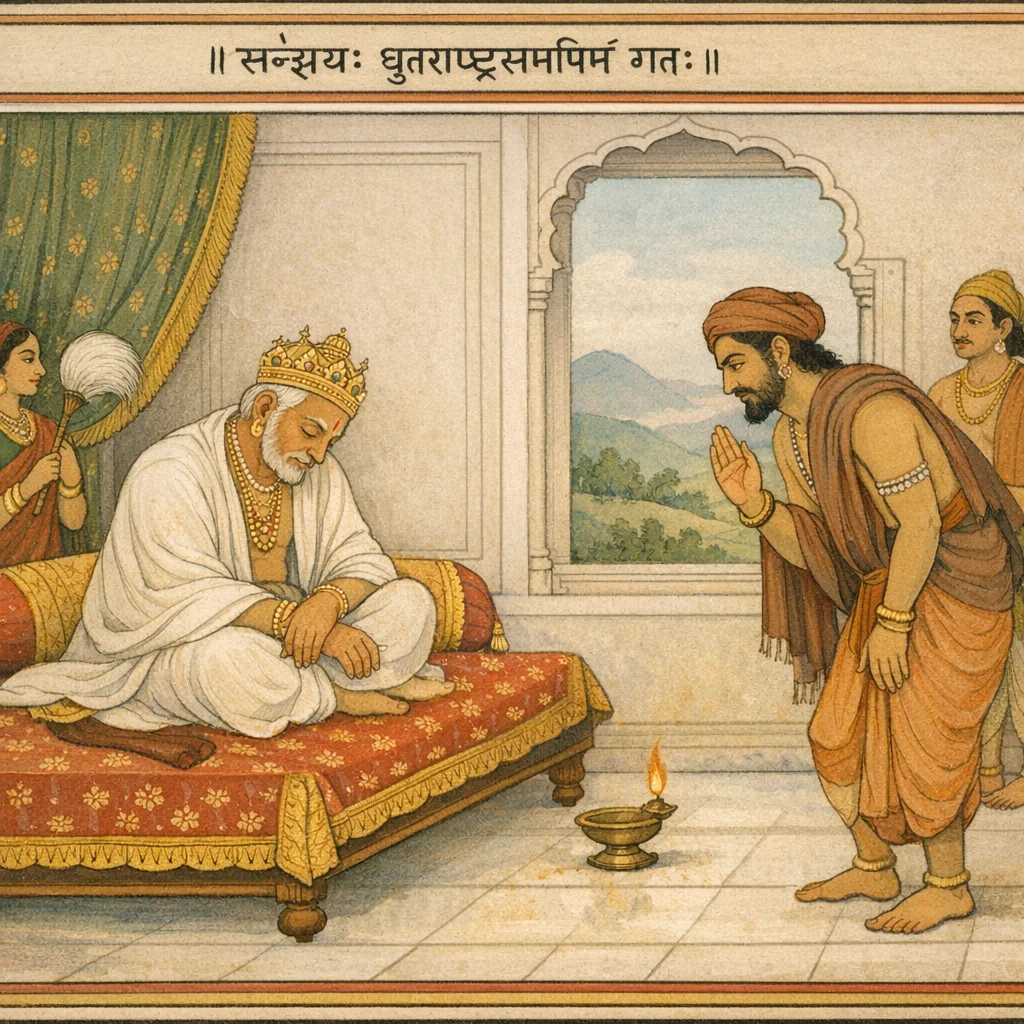
Adhyaya 2
Droṇanidhana-anantaraṃ sainya-viṣādaḥ and Karṇa-pravṛttiḥ (After Droṇa’s fall: army despondency and Karṇa’s advance)
Upa-parva: Karṇābhiṣeka (Appointment of Karṇa as Commander) – Context Unit
Saṃjaya reports to Dhṛtarāṣṭra that, upon Droṇa’s death, the Kaurava mahārathas and the wider armed host display visible despondency: downcast faces, silence, and mutual non-communication. The troops appear stunned, with weapons slipping from blood-smeared hands; hanging straps and gear are compared to stars in the sky, emphasizing disorientation and ominous stillness. Observing this, Duryodhana addresses his forces, asserting that the war was undertaken relying on their strength and that in battle victory and death are both plausible outcomes. He directs attention to Karṇa Vaikartana’s demonstrated prowess—his capacity to pressure Arjuna, subdue Bhīma through human combat, and fell Ghaṭotkaca with an unfailing śakti—presenting Karṇa as a stabilizing center of martial competence. Karṇa responds with a lion-roar and advances with great force, inflicting significant casualties among Sṛñjayas, Pāñcālas, Kekayas, and Videhas; volleys of arrows are described in dense, swarming imagery. The chapter closes by noting that after extensive pressure and large-scale killing, Karṇa is ultimately brought down by Arjuna, foreshadowing the parva’s terminal trajectory.
Chapter Arc: हस्तिनापुर लौटे संजय का उद्विग्न चित्त और प्रक्षीण-बान्धव धृतराष्ट्र का मोहग्रस्त तेज—राजसभा में शोक का घना बादल उतर आता है। → धृतराष्ट्र संजय को देख कर टूटे हुए उत्साह के साथ प्रणाम ग्रहण करते हैं; संजय उन्हें विदुर, द्रोण, भीष्म और केशव के उपदेशों की उपेक्षा स्मरण कराते हुए संकेत देता है कि यह विपत्ति ‘तवापराध’ से उपजी है। → धृतराष्ट्र संजय से आग्रह करते हैं—‘यथावृत्तं’ सब कहो—और संजय कठोर सत्य बोलता है: जो होना था, वह हो चुका; बुद्धिमान दिष्टि/प्रारब्ध के सामने व्यथा नहीं करता। → संजय नियति-चिन्तन द्वारा धृतराष्ट्र की व्यथा को बाँधने का प्रयत्न करता है—हानि-लाभ, प्राप्ति-अप्राप्ति सब दिष्ट के अधीन हैं; इसलिए शोक को विवेक में रूपान्तरित करो। → धृतराष्ट्र का उत्तर—‘कथयस्व यथेच्छकम्’—आगामी वर्णन का द्वार खोल देता है: अब युद्ध के ताज़ा वृत्तान्त और पाण्डव-कौरव पराक्रम का क्रमशः उद्घाटन होगा।
Shlokas
Verse 1
इस प्रकार श्रीमह्याभारत कर्णपर्वमें जनमेजयवाक्य नामक पहला अध्याय पूरा हुआ,ऑपनआक्रा बछ। से, द्वितीयो&्ध्याय: धृतराष्ट्र और संजयका संवाद वैशम्पायन उवाच हते कर्णे महाराज निशि गावल्गणिस्तदा । दीनो ययौ नागपुरमश्चैर्वातसमैर्जवे वैशम्पायनजीने कहा--महाराज! कर्णके मारे जानेपर गवल्गणपुत्र संजय अत्यन्त दुःखी हो वायुके समान वेगशाली घोड़ोंद्वारा उसी रातमें हस्तिनापुर जा पहुँचे
Vaiśampāyana said: “O great king, when Karṇa had been slain, Sañjaya, the son of Gāvalgaṇa, overwhelmed with sorrow, set out that very night and reached Nāgapura (Hastināpura), borne by horses swift as the wind.”
Verse 2
स हास्तिनपुरं गत्वा भृशमुद्विग्नचेतन: । जगाम धृतराष्ट्रस्य क्षयं प्रक्षीणबान्धवम्,उस समय उनका चित्त अत्यन्त उद्विग्न हो रहा था। हस्तिनापुरमें पहुँचकर वे धृतराष्ट्रके उस महलनमें गये, जहाँ रहनेवाले बन्धु-बान्धव प्राय: नष्ट हो चुके थे इति श्रीमहाभारते कर्णपर्वणि धृतराष्ट्रसंजयसंवादे द्वितीयो5ध्याय:
With his mind deeply shaken, he went to Hastināpura. On arriving there, he proceeded to Dhṛtarāṣṭra’s residence—now a house bereft of kin, its family ties largely exhausted by the devastation of war.
Verse 3
स तमुद्वीक्ष्य राजानं कश्मलाभिहतौजसम् | ववन्दे प्राञ्जलि र्भूत्वा मूर्थ्ना पादौ नृपस्य ह,मोहवश जिनके बल और उत्साह नष्ट हो गये थे, उन राजा धृतराष्ट्रका दर्शन करके संजयने उनके चरणोंमें मस्तक झुकाकर हाथ जोड़ प्रणाम किया
Seeing the king—Dhṛtarāṣṭra—whose strength and spirit had been struck down by anguish, Sañjaya bowed with folded hands and, lowering his head to the monarch’s feet, offered reverent homage. The scene frames a courtly ethic of respect and duty amid the moral weight of war and grief.
Verse 4
सम्पूज्य च यथान्यायं धृतराष्ट्र महीपतिम् । हा कष्टमिति चोक््त्वा स ततो वचनमाददे,राजा धृतराष्ट्रका यथायोग्य सम्मान करके संजयने “हाय! बड़े कष्टकी बात है” ऐसा कहकर फिर इस प्रकार वार्तालाप आरम्भ किया--
Having duly paid respectful homage to King Dhṛtarāṣṭra in the proper manner, he exclaimed, “Alas, how grievous this is!” and then proceeded to speak further. The line frames the scene with courtly decorum and a moral undertone: even amid calamity, right conduct and reverence are observed, while the lament signals the heavy ethical cost of the unfolding war.
Verse 5
संजयोऊ5हं क्षितिपते कच्चिदास्ते सुखं भवान् | स्वदोषैरापदं प्राप्य कच्चिन्नाद्य विमुह्मुति,'पृथ्वीनाथ! मैं संजय हूँ। आप सुखसे तो हैं न? अपने ही अपराधोंसे विपत्तिमें पड़कर आज आप मोहित तो नहीं हो रहे हैं?
Sañjaya said: “O king of the earth, are you seated in ease—are you well? Having fallen into calamity through your own faults, are you not, even today, sinking into delusion?”
Verse 6
हितान्युक्तानि विदुरद्रोणगाज़ेयकेशवै: । अगृहीतान्यनुस्मृत्य कच्चिन्न कुरुषे व्यथाम्,“विदुर, द्रोणाचार्य, भीष्म और श्रीकृष्णके कहे हुए हितकारक वचन आपने स्वीकार नहीं किये थे। अब उन वचनोंको बारंबार याद करके क्या आपको व्यथा नहीं होती है?
Vaiśampāyana said: “The wholesome counsels spoken by Vidura, Droṇa, Gāṅgeya (Bhīṣma), and Keśava (Kṛṣṇa) were not accepted by you. Now, recalling those unheeded words again and again, do you not feel anguish?”
Verse 7
रामनारदकण्वाद्य्हितमुक्तं सभातले | न गृहीतमनुस्मृत्य कच्चिन्न कुरुषे व्यथाम्,“सभामें परशुराम, नारद और महर्षि कण्व आदिकी कही हुई हितकर बातें आपने नहीं मानी थीं। अब उन्हें स्मरण करके कया आपके मनमें कष्ट नहीं हो रहा है?
Vaiśampāyana said: “Do you not feel distress when you recall that, in the assembly hall, you failed to accept the wholesome counsel spoken by Rāma (Paraśurāma), Nārada, and the sage Kaṇva and others? Remembering those beneficial words now, does your heart not ache?”
Verse 8
सुहृदस्त्वद्धिते युक्तान् भीष्मद्रोणमुखान् परै: । निहतान् युधि संस्मृत्य कच्चिन्न कुरुषे व्यथाम्,“आपके हितमें लगे हुए भीष्म, द्रोण आदि जो सुहृद् युद्धमें शत्रुओंके हाथसे मारे गये हैं, उन्हें याद करके क्या आप व्यथाका अनुभव नहीं करते हैं?”
Vaiśampāyana said: “When you recall those well-wishers—Bhīṣma, Droṇa, and the rest—who were devoted to your welfare, yet were slain in battle by the enemy, do you not feel anguish?”
Verse 9
तमेवंवादिनं राजा सूतपुत्रं कृताउ्जलिम् । सुदीर्घमथ नि:श्वस्य दुःखार्त इदमब्रवीत्,हाथ जोड़कर ऐसी बातें कहनेवाले सूतपुत्र संजयसे दुःखातुर राजा धृतराष्ट्रने लंबी साँस खींचकर इस प्रकार कहा
Vaishampayana said: Hearing Sanjaya—the charioteer’s son—speak in this manner, and seeing him with folded hands, King Dhritarashtra, overwhelmed by sorrow, heaved a long sigh and then spoke these words. The scene underscores the king’s moral anguish as he confronts the consequences of the war and his own attachments.
Verse 10
धृतराष्ट उवाच आपगेये हते शूरे दिव्यास्त्रवति संजय । द्रोणे च परमेष्वासे भृशं मे व्यथितं मन:,धृतराष्ट्र बोले--संजय! दिव्यास्त्रोंके ज्ञाता शूरवीर गंगानन्दन भीष्म तथा महाधनुर्धर ट्रोणाचार्यके मारे जानेसे मेरे मनमें बड़ी भारी व्यथा हो रही है
Dhṛtarāṣṭra said: “Sañjaya, my mind is deeply tormented. When the heroic son of the Gaṅgā—Bhīṣma, master of celestial weapons—was slain, and when Droṇa too, the supreme archer, was killed, a great anguish has seized me.”
Verse 11
यो रथानां सहस्राणि दंशितानां दशैव तु । अहन्यहनि तेजस्वी निजघ्ने वसुसम्भव:,जो तेजस्वी भीष्म साक्षात् वसुके अवतार थे और युद्धमें प्रतिदिन दस हजार कवचधारी रथियोंका संहार करते थे। उन्हींको यहाँ पाण्डुपुत्र अर्जुनसे सुरक्षित ट्रपदकुमार शिखण्डीने मार डाला है, यह सुनकर मेरे मनमें बड़ी व्यथा हो रही है
Dhṛtarāṣṭra said: “That radiant warrior, born of the Vasus, who day after day used to slay ten thousand fully armoured chariot-fighters—he, Bhīṣma himself, the very incarnation of a Vasu—has been brought down here by Śikhaṇḍin, the prince of Drupada, while Arjuna stood as his protection. Hearing this, my heart is overwhelmed with anguish.”
Verse 12
तं हतं यज्ञसेनस्य पुत्रेणेह शिखण्डिना । पाण्डवेयाभिगुप्तेन श्र॒ुत्वा मे व्यथितं मन:,जो तेजस्वी भीष्म साक्षात् वसुके अवतार थे और युद्धमें प्रतिदिन दस हजार कवचधारी रथियोंका संहार करते थे। उन्हींको यहाँ पाण्डुपुत्र अर्जुनसे सुरक्षित ट्रपदकुमार शिखण्डीने मार डाला है, यह सुनकर मेरे मनमें बड़ी व्यथा हो रही है
Dhṛtarāṣṭra said: “Hearing that Bhīṣma—slain here by Śikhaṇḍin, the son of Yajñasena, while protected by the Pāṇḍava—my mind is stricken with anguish. The fall of such a radiant and formidable elder, who stood as the very pillar of our cause, fills me with grief and foreboding about the moral and strategic unraveling of the war.”
Verse 13
भार्गव: प्रददौ यस्मै परमास्त्र महात्मने । साक्षाद् रामेण यो बाल्ये धनुर्वेद उपाकृत:
Dhṛtarāṣṭra said: “To that great-souled one, Bhārgava (Paraśurāma) granted the supreme weapon. Indeed, it was Rāma himself who, from his very boyhood, personally instructed him in the science of archery.”
Verse 14
यस्य प्रसादात् कौन्तेया राजपुत्रा महारथा: । महारथत्वं सम्प्राप्तास्तथान्ये वसुधाधिपा:
Dhṛtarāṣṭra said: “By whose favor the sons of Kuntī—royal princes and great chariot-warriors—attained the status of mahārathas; and likewise other rulers of the earth as well.”
Verse 15
त॑ द्रोणं निहतं श्रुत्वा धृष्टद्युम्नेन संयुगे । सत्यसंध॑ महेष्वासं भृशं मे व्यथितं मन:
Dhṛtarāṣṭra said: Hearing that Droṇa—steadfast in his vows and a mighty archer—had been slain in battle by Dhṛṣṭadyumna, my mind has been deeply shaken. The news strikes not only as a military loss but as a moral rupture: the fall of a revered teacher in the very arena meant to uphold warrior codes leaves the king overwhelmed with grief and disquiet.
Verse 16
जिन महात्माको भृगुनन्दन परशुरामने उत्तम अस्त्र प्रदान किया था, जिन्हें बाल्यावस्थामें धनुर्वेदकी शिक्षा देनेके लिये साक्षात् परशुरामजीने अपना शिष्य बनाया था, जिनकी कृपासे कुन्तीके पुत्र राजकुमार पाण्डव महारथी हो गये तथा अन्यान्य नरेशोंने भी महारथी कहलानेकी योग्यता प्राप्त की थी, उन्हीं सत्य-प्रतिज्ञ महाधनुर्थर द्रोणाचार्यको युद्धस्थलमें धृष्टद्युम्मके हाथसे मारा गया सुनकर मेरे मनमें बड़ी पीड़ा हो रही है ।। १३-- १५ || ययोलॉकिे पुमानस्त्रे न समो<$स्ति चतुर्विधे । तौ द्रोणभीष्मौ श्रुत्वा तु हतौ मे व्यथितं मन:,संसारमें चार- प्रकारके अस्त्रोंकी विद्यामें जिनकी समानता करनेवाला दूसरा कोई पुरुष नहीं है, उन्हीं द्रोणाचार्य और भीष्मको मारा गया सुनकर मेरे मनमें बड़ा दुःख हो रहा है
Dhṛtarāṣṭra said: “In this world, no man is equal to those two in the fourfold science of weapons. Hearing that Droṇa and Bhīṣma have been slain, my mind is shaken with anguish.”
Verse 17
त्रैलोक्ये यस्य चास्त्रेषु न पुमान् विद्यते सम: । त॑ द्रोणं निहत॑ श्रुत्वा किमकुर्वत मामका:,तीनों लोकोंमें दूसरा कोई पुरुष जिनके समान अस्त्रवेत्ता नहीं है, उन द्रोणाचार्यको मारा गया सुनकर मेरे पुत्रोंने क्या किया?
Dhṛtarāṣṭra said: “In all the three worlds there is no man equal to him in the science of weapons. Hearing that Droṇa had been slain, what did my sons do then?”
Verse 18
संशप्तकानां च बले पाण्डवेन महात्मना । धनंजयेन विक्रम्प गमिते यमसादनम्,महात्मा पाण्डुपुत्र अर्जुनने पराक्रम करके संशप्तकोंकी सारी सेनाको यमलोक पहुँचा दिया और बुद्धिमान् द्रोणकुमार अश्वत्थामाका नारायणास्त्र भी जब शान्त हो गया, उस समय अपनी सेनाओंमें भगदड़ मच जानेपर मेरे पुत्रोंने क्या किया?
Dhṛtarāṣṭra said: When the great-souled Pāṇḍava Dhanañjaya (Arjuna), displaying his might, sent the entire force of the Saṁśaptakas to the abode of Yama, and when Aśvatthāmā, the wise son of Droṇa, had his Nārāyaṇa-weapon pacified—then, as panic and rout spread through the armies, what did my sons do?
Verse 19
नारायणानस्त्रे च हते द्रोणपुत्रस्य धीमतः । विप्रद्रुतेष्वनीकेषु किमकुर्वत मामका:,महात्मा पाण्डुपुत्र अर्जुनने पराक्रम करके संशप्तकोंकी सारी सेनाको यमलोक पहुँचा दिया और बुद्धिमान् द्रोणकुमार अश्वत्थामाका नारायणास्त्र भी जब शान्त हो गया, उस समय अपनी सेनाओंमें भगदड़ मच जानेपर मेरे पुत्रोंने क्या किया?
Dhṛtarāṣṭra said: “When the Nārāyaṇa-weapon had been neutralized, and when the forces were thrown into panic, what did my sons do then—especially with the wise son of Droṇa (Aśvatthāmā) having been checked and the battle-lines in disarray?”
Verse 20
विप्रद्रुतानहं मन््ये निमग्नान् शोकसागरे । प्लवमानान् हते द्रोणे सन्ननौकानिवार्णवे,मैं तो समझता हूँ, द्रोणाचार्यके मारे जानेपर मेरे सारे सैनिक भाग चले होंगे, शोकके समुद्रमें डूब गये होंगे, उनकी दशा समुद्रमें नाव मारी जानेपर वहाँ हाथोंसे तैरनेवाले मनुष्योंके समान संकटपूर्ण हो गयी होगी
Dhṛtarāṣṭra said: “I think that when Droṇa was slain, my warriors fled in panic—sinking into an ocean of grief. Like men forced to swim in the sea after their boat has been shattered, they must have been left in a perilous, helpless state.”
Verse 21
दुर्योधनस्य कर्णस्य भोजस्य कृतवर्मण: । मद्रराजस्य शल्यस्य द्रौणेश्वैव कृपस्य च,संजय! जब सारी सेनाएँ भाग गयीं, तब दुर्योधन, कर्ण, भोजवंशी कृतवर्मा, मद्रराज शल्य, द्रोणकुमार अश्वत्थामा, कृपाचार्य, मरनेसे बचे हुए मेरे पुत्र तथा अन्य लोगोंके मुखकी कान्ति कैसी हो गयी थी?
Dhṛtarāṣṭra said: “O Sañjaya, when all the armies had fled, what became of the radiance on the faces of Duryodhana, Karṇa, Kṛtavarman of the Bhoja line, Śalya the king of Madra, Droṇa’s son Aśvatthāmā, and Kṛpa—along with my sons who survived and the others?” In this question, the blind king’s anxiety reveals the moral and psychological collapse that follows adharma-driven warfare: when support and collective strength dissolve, even famed warriors are left exposed to fear, shame, and the consequences of their choices.
Verse 22
मत्पुत्रस्य च शेषस्य तथान्येषां च संजय । विप्रद्रुतेष्वनीकेषु मुखवर्णो5भवत् कथम्,संजय! जब सारी सेनाएँ भाग गयीं, तब दुर्योधन, कर्ण, भोजवंशी कृतवर्मा, मद्रराज शल्य, द्रोणकुमार अश्वत्थामा, कृपाचार्य, मरनेसे बचे हुए मेरे पुत्र तथा अन्य लोगोंके मुखकी कान्ति कैसी हो गयी थी?
Dhṛtarāṣṭra said: “O Sañjaya, when the battle-formations had been thrown into panic and the armies were fleeing in disorder, what became of the facial complexion—what was the look—of my son and of the survivors among my sons, and of the others as well?”
Verse 23
एतत् सर्व यथावृत्तं तथा गावल्गणे मम । आचक्ष्व पाण्डवेयानां मामकानां च विक्रमम्,गवल्गणकुमार! मेरे तथा पाण्डुके पुत्रोंके पराक्रमसे सम्बन्ध रखनेवाला यह सारा वत्तान्त यथार्थरूपसे मुझे कह सुनाओ
Dhṛtarāṣṭra said: “O Gāvalgaṇa, tell me truthfully and in full just as it happened—recount the deeds of valor of the sons of Pāṇḍu and of my own men. O son of Gāvalgaṇa, narrate to me the entire course of events connected with their prowess.”
Verse 24
संजय उवाच तवापराधाद्ू यद् वृत्तं कौरवेयेषु मारिष । तच्छुत्वा मा व्यथां कार्षीर्दिष्टे न व्यथते बुध:,संजयने कहा--माननीय नरेश! आपके अपराधसे कौरवोंपर जो कुछ बीता है, उसे सुनकर दुःख न मानियेगा; क्योंकि दैववश जो दु:ख प्राप्त होता है, उससे विद्वान् पुरुष व्यथित नहीं होते हैं
Verse 25
यस्मादभावी भावी वा भवेदर्थो नरं प्रति । अप्राप्तौ तस्य वा प्राप्ती न कश्चिद् व्यथते बुध:,प्रारब्धवश मनुष्यको अभीष्ट वस्तुकी प्राप्ति हो भी जाती है और नहीं भी होती है। अतः उसकी प्राप्ति हो या न हो, किसी भी दशामें कोई ज्ञानी पुरुष (हर्ष या) कष्टका अनुभव नहीं करता है
Verse 26
धघतयाट्र उवाच न व्यथाभ्यधिका काचिद् विद्यते मम संजय । दिष्टमेतत् पुरा मन््ये कथयस्व यथेच्छकम्,धृतराष्ट्र बोले--संजय! मुझे इससे अधिक कोई व्यथा नहीं होगी, मैं पहलेसे ही ऐसा मानता हूँ कि यह अवश्यम्भावी दैवका विधान है; अतः तुम इच्छानुसार सारा वृत्तान्त कहो
Frequently Asked Questions
The ethical tension lies in continuing duty-bound engagement after catastrophic loss: whether leadership should acknowledge grief as decisive or reframe it as a condition to be governed in order to fulfill institutional responsibility.
The text presents contingency as intrinsic to action: outcomes cannot be guaranteed, but disciplined agency—supported by coherent leadership and collective steadiness—remains the operative standard of conduct.
No explicit phalaśruti is stated here; the chapter functions as narrative-ethical framing, using battlefield psychology and leadership rhetoric to position later events within the epic’s broader inquiry into dharma under pressure.