Adhyaya 87
ययाति–अष्टक–प्रतर्दन संवादः | Yayāti’s Dialogue with Aṣṭaka and Pratardana on Merit, Gifts, and Ethical Restraint
Upa-parva: Sambhava Upaparva (Genealogies and Early Exempla)
This chapter is structured as a sequence of inquiries and replies. Aṣṭaka questions comparative precedence—who reaches divine compatibility first—using the metaphor of the sun and moon in motion. Yayāti answers by privileging disciplined restraint within the household sphere: an unattached, self-controlled mendicant-like life in the village is described as earlier/foremost in attainment. The discourse then turns to moral psychology: actions marked by cruelty or pursued with distorted understanding are treated as unwholesome, while straightforwardness (ārjava) and composure (samādhi) are elevated as noble traits. Aṣṭaka then challenges a radiant youth-like figure (Yayāti) about his identity and origin. Yayāti reveals he is about to enter an earthly hell due to exhausted merit (kṣīṇa-puṇya), falling from the sky, even as divine custodians press him onward; he notes he has obtained a boon from Śakra in this circumstance. Aṣṭaka and later Pratardana offer to transfer their own heavenly “worlds” (lokāḥ) to prevent Yayāti’s fall, framing generosity as rescue. Yayāti declines, asserting a principled constraint: one not born a Brahmin, even if a knower of sacred knowledge, should not subsist by accepting gifts; he further rejects living as a miserly Brahmin or as a Brahmin’s wife, emphasizing role-appropriate dignity and prior conduct. Pratardana repeats the offer; Yayāti acknowledges the existence and qualities of the offered worlds (described as sweet, ghee-anointed, sorrowless, and enduring for set periods), but again stresses that a ruler should not adopt ruthless or degrading measures when adversity arrives by fate. The chapter closes with another royal voice (Vasumanā) responding to Yayāti’s expressed wish to do what others have not done, keeping the focus on the ethics of aspiration under constraint.
Chapter Arc: ययाति—जो कभी इन्द्रतुल्य ऐश्वर्य से स्वर्ग में विहरता था—दीर्घ काल के बाद शक्र द्वारा पुनः स्वर्ग से पतित किया जाता है, और उसके पुण्य-क्षय का रहस्य कथा को भीतर तक हिला देता है। → पृथ्वीपति ययाति कुरुवंश-वर्धक होकर भी अंततः वैराग्य का मार्ग चुनता है: छोटे पुत्र पूरु को राज्य सौंपकर वन में वानप्रस्थ-विधान से कठोर तप करता है—फल-मूल, यज्ञाग्नि-सेवा, क्रोध-जय, पितृ-देव-तर्पण; फिर वायु-भक्षण, पंचाग्नि-मध्य तप, एकपाद-स्थित साधना—पर प्रश्न बना रहता है: क्या यह तप स्थायी स्वर्ग दे सकेगा? → तप की चरम सीमा के बाद ययाति पुनः स्वर्गारोहण करता है—पर उसी स्वर्ग-निवास में ‘बहुत काल’ के पश्चात शक्र द्वारा पतन का संकेत यह उद्घोष करता है कि पुण्य भी क्षयशील है; स्वर्ग स्थिर नहीं, कर्मफल की घड़ी है। → अध्याय ययाति के तप-क्रम और स्वर्ग-गमन/पतन की परंपरा को स्थापित करता है, तथा यह भी जोड़ता है कि मुनि-समाज/सभा में ययाति का अन्य धर्मात्मा राजाओं (वसुमान्, अष्टक, प्रतर्दन, शिबि) से संगम-प्रसंग प्रसिद्ध है—मानो राजधर्म और तपधर्म की संयुक्त परंपरा का प्रमाण। → ययाति के पतन के बाद आगे यह जिज्ञासा तीव्र होती है कि स्वर्ग-स्थायित्व का उपाय क्या है, और उन अन्य राजाओं के साथ सभा-संवाद में कौन-सा निर्णायक उपदेश/निष्कर्ष प्रकट होगा।
Shlokas
Verse 1
इस प्रकार श्रीमहाभारत आदिपर्वके अन्तर्गत सम्भवपर्वमें ययात्युपाख्यानके प्रसंगमें पूर्ववायातसमाप्तिविषयक पचासीवाँ अध्याय पूरा हुआ ॥/ ८५ ॥/ (दाक्षिणात्य अधिक पाठके ३ ३ “लोक मिलाकर कुल ३८३ लोक हैं) #्न्रैमा रन (2) अऔअन+े षडशीतितमो<्ध्याय: वनमें राजा ययातिकी तपस्या और उन्हें स्वर्गलोककी प्राप्ति वैशम्पायन उवाच एवं स नाहुषो राजा ययाति: पुत्रमीप्सितम् । राज्येडभिषिच्य मुदितो वानप्रस्थो5भवन्मुनि:,वैशम्पायनजी कहते हैं--जनमेजय! इस प्रकार नहुषनन्दन राजा ययाति अपने प्रिय पुत्र पूरका राज्याभिषेक करके प्रसन्नतापूर्वक वानप्रस्थ मुनि हो गये
Vaiśampāyana said: Thus King Yayāti, the descendant of Nahuṣa, having joyfully consecrated his desired son to the kingship, withdrew from royal life and entered the forest-stage, living as a sage. The passage highlights the ethical ideal that rulership is not mere possession but a duty that can be responsibly handed over, after which one may pursue austerity and inner discipline.
Verse 2
उषित्वा च वने वासं ब्राह्मणै: संशितव्रत: । फलमूलाशनो दान्तस्तत: स्वर्गमितो गत:,वे वनमें ब्राह्मणोंके साथ रहकर कठोर व्रतका पालन करते हुए फल-मूलका आहार तथा मन और इन्द्रियोंका संयम करते थे, इससे वे स्वर्गलोकमें गये
Vaiśampāyana said: Having lived in the forest in the company of brāhmaṇas, observing strict vows, subsisting on fruits and roots, and restraining his mind and senses, he thereafter departed from this world and attained heaven. The narrative underscores the ethical ideal that disciplined ascetic conduct and self-control, guided by the company of the virtuous, lead to higher spiritual destiny.
Verse 3
स गत: स्वर्निवासं तं॑ निवसन् मुदितः सुखी । कालेन चातिमहता पुन: शक्रेण पातितः,स्वर्गलोकमें जाकर वे बड़ी प्रसन्नताके साथ सुखपूर्वक रहने लगे और बहुत कालके बाद इन्द्रद्वारा वे पुनः स्वर्गसे नीचे गिरा दिये गये। स्वर्गसे भ्रष्ट हो पृथ्वीपर गिरते समय वे भूतलतक नहीं पहुँचे, आकाशमें ही स्थिर हो गये, ऐसा मैंने सुना है
Vaiśampāyana said: Having gone to that heavenly abode, he lived there joyfully and in comfort. But after a very long time he was again cast down by Śakra (Indra). Thus, even the pleasures of heaven are not permanent: when the merit that sustains them is exhausted, one falls from that state.
Verse 4
निपतन प्रच्युत: स्वर्गादप्राप्तो मेदिनीतलम् । स्थित आसीदन्तरिक्षे स तदेति श्रुतं मया,स्वर्गलोकमें जाकर वे बड़ी प्रसन्नताके साथ सुखपूर्वक रहने लगे और बहुत कालके बाद इन्द्रद्वारा वे पुनः स्वर्गसे नीचे गिरा दिये गये। स्वर्गसे भ्रष्ट हो पृथ्वीपर गिरते समय वे भूतलतक नहीं पहुँचे, आकाशमें ही स्थिर हो गये, ऐसा मैंने सुना है
Vaiśaṃpāyana said: “Falling down from heaven, cast out from Svarga, he did not reach the surface of the earth. Instead, he remained suspended in mid-air—so I have heard.” The passage underscores the moral logic of heaven: enjoyment gained by merit is finite, and when that merit is exhausted, a fall follows; yet the fall itself can be portrayed as a liminal, instructive state between worlds.
Verse 5
तत एव पुनश्चापि गतः स्वर्गमिति श्रुतम् राज्ञा वसुमता सार्थमष्टकेन च वीर्यवान्
Vaiśampāyana said: It is heard that from that very place the valiant one again went up to heaven, together with King Vasumat and with Aṣṭaka. The passage underscores the fruit of accumulated merit and right conduct: those who uphold dharma and perform worthy deeds are said to attain the heavenly goal, and even return to it again through the force of their virtue.
Verse 6
जनमेजय उवाच कर्मणा केन स दिवं पुन: प्राप्तो महीपति:,जनमेजयने पूछा--मुने! किस कर्मसे वे भूपाल पुनः स्वर्गमें पहुँचे थे?
Janamejaya said: “By what deed did that king attain heaven again?” In ethical terms, the question seeks the specific meritorious action (karma) that restores a ruler’s heavenly destiny—implying that even a fallen or interrupted celestial status can be regained through a particular dharmic act or expiation.
Verse 7
सर्वमेतदशेषेण श्रोतुमिच्छामि तत्त्वत: । कथ्यमानं त्वया विप्र विप्र्षिगणसंनिधौ,विप्रवर! मैं ये सारी बातें पूर्णरूपसे यथावत् सुनना चाहता हूँ। इन ब्रह्मर्षियोंके समीप आप इस प्रसंगका वर्णन करें
Janamejaya said: “I wish to hear all of this completely and exactly as it truly is. O brāhmaṇa, in the presence of this assembly of eminent seers, relate the account—O best among the twice-born.”
Verse 8
देवराजसमो हासीद् ययाति: पृथिवीपति: । वर्धन: कुरुवंशस्य विभावसुसमद्युति:,कुरुवंशकी वृद्धि करनेवाले, अग्निके समान तेजस्वी राजा ययाति देवराज इन्द्रके समान थे
Janamejaya said: King Yayāti, lord of the earth, was like the king of the gods (Indra). He was the increaser of the Kuru lineage, radiant with a splendor equal to Vibhāvasu (Agni).
Verse 9
तस्य विस्तीर्णयशस: सत्यकीर्तेर्महात्मन: । चरितं श्रोतुमिच्छामि दिवि चेह च सर्वश:,उनका यश चारों ओर फैला था। मैं उन सत्यकीर्ति महात्मा ययातिका चरित्र, जो इहलोक और स्वर्गलोकमें सर्वत्र प्रसिद्ध है, सुनना चाहता हूँ
Janamejaya said: “I wish to hear in full the life and deeds of that great-souled one whose fame has spread far and wide, whose renown is grounded in truth—celebrated everywhere, both in heaven and here on earth.”
Verse 10
वैशम्पायन उवाच हन्त ते कथयिष्यामि ययातेरुत्तमां कथाम् | दिवि चेह च पुण्यार्था सर्वपापप्रणाशिनीम्,वैशम्पायनजी बोले--जनमेजय! ययातिकी उत्तम कथा इहलोक और स्वर्गलोकमें भी पुण्यदायक है। वह सब पापोंका नाश करनेवाली है, मैं तुमसे उसका वर्णन करता हूँ
Vaiśampāyana said: “Come then— I shall recount to you the excellent story of Yayāti. It is meritorious both in this world and in heaven, and it destroys all sins. I will describe it to you.”
Verse 11
ययातिर्नाहुषो राजा पूरुं पुत्र कनीयसम् | राज्येडभिषिच्य मुदित: प्रवव्राज वनं तदा,नहुषपुत्र महाराज ययातिने अपने छोटे पुत्र पूरको राज्यपर अभिषिक्त करके यदु आदि अन्य पुत्रोंको सीमान्त (किनारेके देशों)-में रख दिया। फिर बड़ी प्रसन्नताके साथ वे वनमें गये। वहाँ फल-मूलका आहार करते हुए उन्होंने दीर्घकालतक वनमें निवास किया
Vaiśampāyana said: King Yayāti, son of Nahuṣa, joyfully consecrated his youngest son Pūru to the sovereignty; and then, content in mind, he departed for the forest. In keeping with the royal ethic of orderly succession and renunciation after installing a worthy heir, he withdrew from power and lived the forest-life, sustained by fruits and roots.
Verse 12
अन्त्येषु स विनिक्षिप्य पुत्रान् यदुपुरोगमान् । फलमूलाशनो राजा वने संन्यवसच्चिरम्,नहुषपुत्र महाराज ययातिने अपने छोटे पुत्र पूरको राज्यपर अभिषिक्त करके यदु आदि अन्य पुत्रोंको सीमान्त (किनारेके देशों)-में रख दिया। फिर बड़ी प्रसन्नताके साथ वे वनमें गये। वहाँ फल-मूलका आहार करते हुए उन्होंने दीर्घकालतक वनमें निवास किया
Vaiśampāyana said: Having assigned his sons—led by Yadu—to the frontier regions, the king lived for a long time in the forest, sustaining himself on fruits and roots. The episode underscores a ruler’s deliberate withdrawal after securing succession and order, choosing austerity and restraint over continued attachment to power.
Verse 13
शंसितात्मा जितक्रोधस्तर्पयन् पितृदेवता: । अग्नींश्व विधिवज्जुद्धन् वानप्रस्थविधानत:,उन्होंने अपने मनको शुद्ध करके क्रोधपर विजय पायी और प्रतिदिन देवताओं तथा पितरोंका तर्पण करते हुए वानप्रस्थाश्रमकी विधिसे शास्त्रीय विधानके अनुसार अग्निहोत्र प्रारम्भ किया
Vaiśampāyana said: Having purified his inner self and conquered anger, he regularly offered libations to the gods and the ancestral spirits; and, following the discipline prescribed for the forest-dweller stage of life, he duly maintained the sacred fires and performed the fire-offerings according to scriptural rule.
Verse 14
अतिथीन् पूजयामास वन्येन हविषा विभु: । शिलोज्छवृत्तिमास्थाय शेषान्नकृतभोजन:,वे राजा शिलोज्छवृत्तिका आश्रय ले यज्ञशेष अन्नका भोजन करते थे। भोजनसे पूर्व वनमें उपलब्ध होनेवाले फल, मूल आदि हविष्यके द्वारा अतिथियोंका आदर-सत्कार करते थे
Vaiśampāyana said: The noble one honored his guests with forest-offerings—fruits, roots, and the like. Living by the śiloccha mode of subsistence, he himself ate only what remained after the offerings, taking his meal from the sacrificial remnants. The passage highlights disciplined simplicity and the ethical priority of hospitality over personal consumption.
Verse 15
पूर्ण वर्षसहस्रं च एवंवृत्तिरभून्नप: । अब्भक्ष: शरदस्त्रिंशदासीज्नियतवामड्मना:,राजाको इसी वृत्तिसे रहते हुए पूरे एक हजार वर्ष बीत गये। उन्होंने मन और वाणीपर संयम करके तीस वर्षोतक केवल जलका आहार किया
Vaiśampāyana said: Thus maintaining this discipline, the king completed a full thousand years. With speech and mind brought under control, he lived for thirty autumn seasons taking only water as his sustenance—an austere vow marked by restraint and steadfastness.
Verse 16
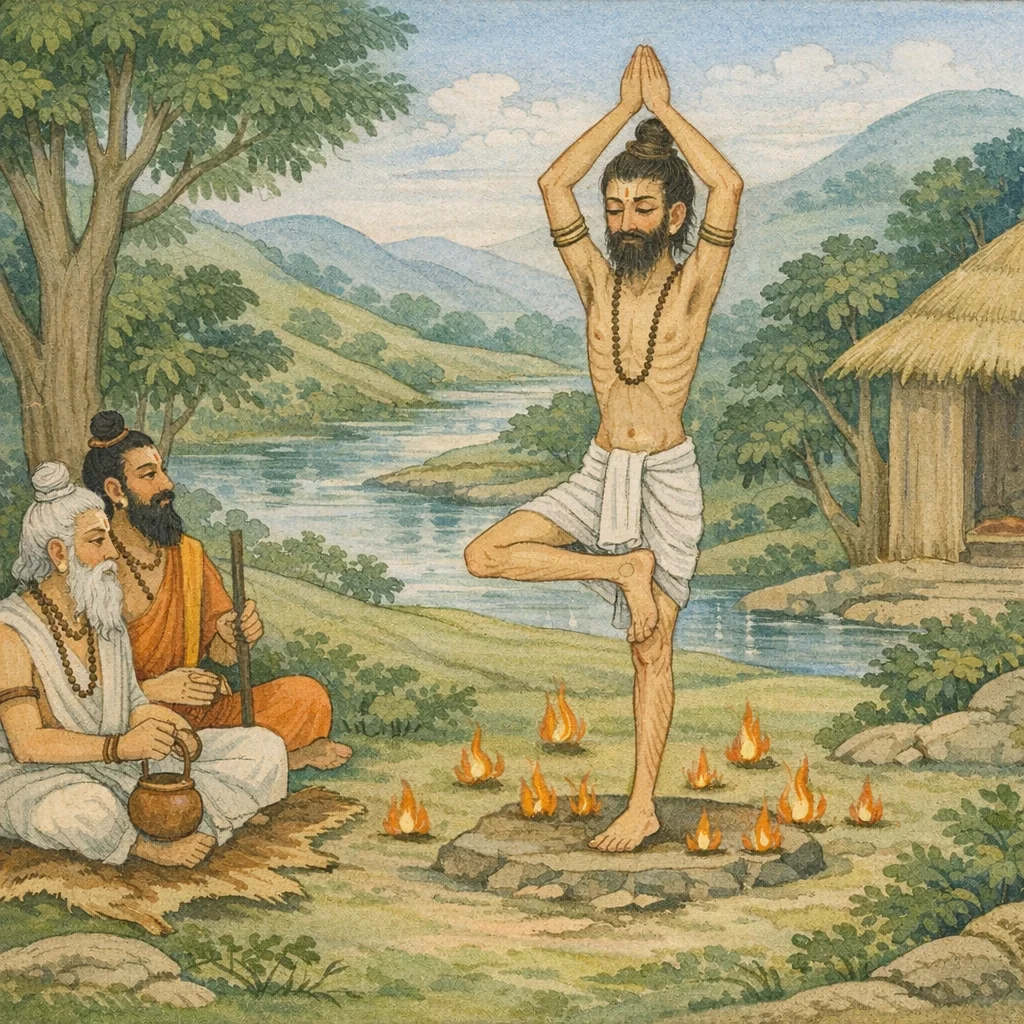
ततश्न वायुभक्षो5भूत् संवत्सरमतन्द्रित: । तथा पज्चाग्निमध्ये च तपस्तेपे च वत्सरम्,तत्पश्चात् वे आलस्यरहित हो एक वर्षतक केवल वायु पीकर रहे। फिर एक वर्षतक पाँच अग्नियोंके बीचमें बैठकर तपस्या की
Vaiśaṃpāyana said: Thereafter, remaining free from lethargy, he lived for a full year sustaining himself only on air. Then, for another year, he performed severe austerities seated amid the five fires—an act of disciplined self-control undertaken to purify himself and strengthen his resolve.
Verse 17
एकपाद: स्थितश्चासीत् षण्मासाननिलाशन: । पुण्यकीर्तिस्तत: स्वर्गे जगामावृत्य रोदसी,इसके बाद छः महीनोंतक हवा पीकर वे एक पैरसे खड़े रहे। तदनन्तर पुण्यकीर्ति महाराज ययाति पृथ्वी और आकाशमें अपना यश फैलाकर स्वर्गलोकमें चले गये
Vaiśampāyana said: Standing on a single foot, he lived for six months, sustaining himself only on air. Thereafter Puṇyakīrti, having spread his fame across earth and sky through the merit of his austerity, departed to the heavenly world. The passage underscores the ethical idea that disciplined self-restraint and tapas, when aligned with dharma, are believed to yield both renown and higher spiritual reward.
Verse 53
प्रतर्दनेन शिबिना समेत्य किल संसदि । फिर यह भी सुननेमें आया है कि वे पराक्रमी राजा ययाति मुनिसमाजमें राजा वसुमान्, अष्टक, प्रतर्दन और शिबिसे मिलकर पुनः वहींसे साधु पुरुषोंके संगके प्रभावसे स्वर्गलोकमें चले गये
Vaiśampāyana said: It is also heard that the valiant King Yayāti, having assembled in the sages’ council together with King Vasumān, Aṣṭaka, Pratardana, and Śibi, departed once again from there to the heavenly world—carried by the purifying influence of the company of the virtuous. The passage underscores the Mahābhārata’s ethical emphasis that association with sādhus (good and disciplined persons) elevates one’s destiny and reinforces righteous conduct.
Verse 86
इति श्रीमहाभारते आदिपर्वणि सम्भवपर्वणि उत्तरयायाते षडशीतितमो<ध्याय: ।। ८६ || इस प्रकार श्रीमह्याभारत आदिपव॑के अन्तर्गत सम्भवपर्वमें उत्तरयायातविषयक छियासीवाँ अध्याय पूरा हुआ
Thus, in the Śrī Mahābhārata, within the Ādi Parva and specifically the Sambhava Parva, the eighty-sixth chapter—concerning Uttara and Yāyāti—comes to its conclusion. This closing colophon marks the completion of the chapter and signals a transition in the genealogy-centered narrative that frames lineage, duty, and the moral consequences of royal conduct.
Frequently Asked Questions
Whether it is ethically permissible to avert a deserved fall caused by exhausted merit by accepting another person’s heavenly rewards; the chapter tests the boundary between compassionate exchange and compromised integrity.
Merit is finite and cannot substitute for sustained ethical discipline; dignity and role-appropriate conduct should be maintained even under misfortune, and straightforwardness with inner composure is treated as a stable marker of nobility.
No explicit phalaśruti formula appears in the provided passage; the meta-lesson is implicit—understanding the limits of puṇya and the ethics of giving/receiving clarifies how dharma governs both worldly status and post-mortem outcomes.