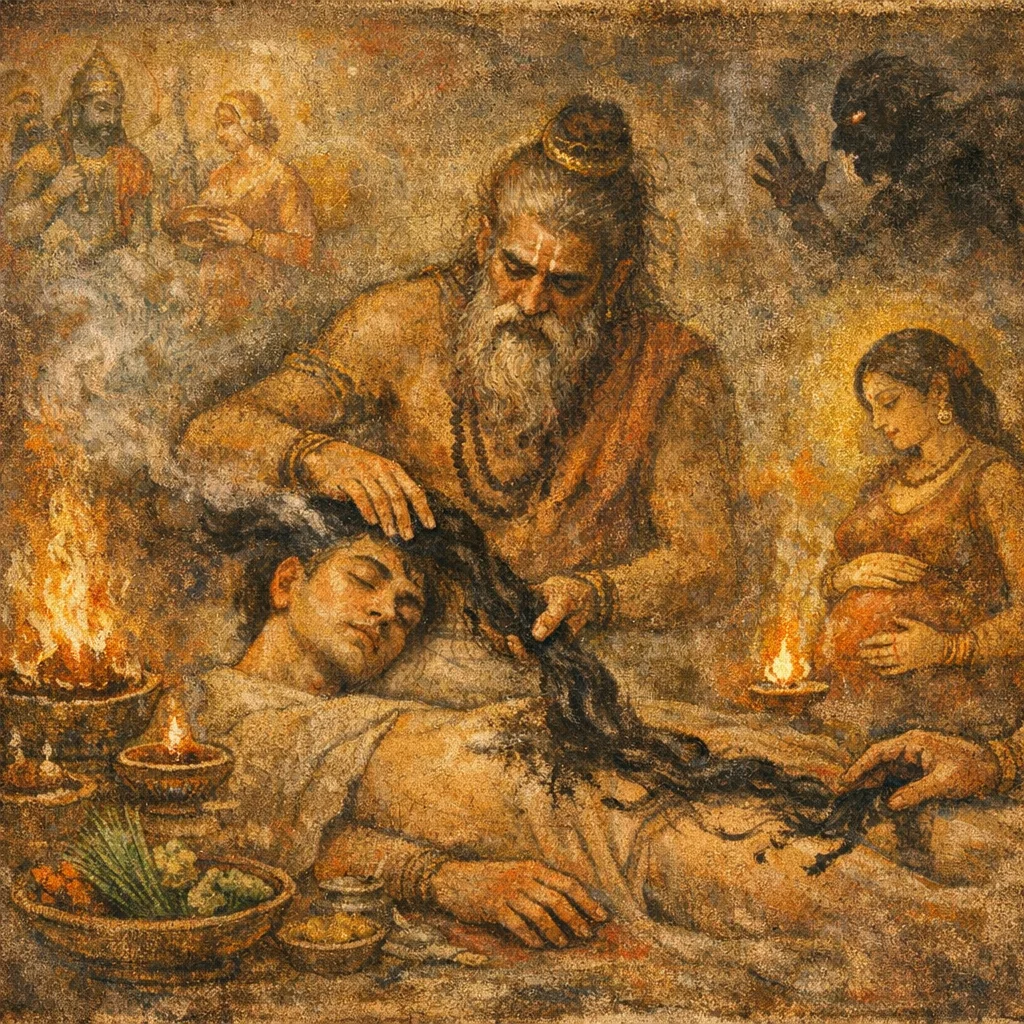
Sukta 96
Rishi: Traditionally connected with Indra-hymnic transmission in AV 20 (RV-derived strata); specific r̥ṣi attribution varies in anukramaṇī traditions.
Devata: Indra
Chandas: Predominantly Triṣṭubh/Jagatī style in AV 20 RV-recitations; this verse is RV-like in cadence (exact metrical scan requires pada-length verification).
Mantras
Mantra 1
तीव्रस्याभिवयसो अस्य पाहि सर्वरथा वि हरी इह मुञ्च । इन्द्र मा त्वा यजमानासो अन्ये नि रीरमन् तुभ्यमिमे सुतासः
Drink of this strong, impetuous Soma; come with all thy chariots: here unloose thy two bay steeds. O Indra, let not other sacrificers detain thee and turn thee aside: for thee are these pressings made.
Mantra 2
तुभ्यं सुतास्तुभ्यमु सोत्वासस्त्वां गिरः श्वात्र्या आ ह्वयन्ति । इन्द्रेदमद्य सवनं जुषाणो विश्वस्य विद्वां इह पाहि सोमम्
For thee are the pressings; for thee, moreover, the pressers call thee hither with heroic songs. O Indra, accepting this pressing to-day, thou knower of all—here drink the Soma.
Mantra 3
य उशता मनसा सोममस्मै सर्वहृदा देवकामः सुनोति । न गा इन्द्रस्तस्य परा ददाति प्रशस्तमिच्चारुमस्मै कृणोति
Whoso with eager mind, with all his heart, desiring the gods, presseth Soma for him—Indra withholdeth not the cows from such an one, but maketh for him what is fair and famed and gracious.
Mantra 4
अनुस्पष्टो भवत्येषो अस्य यो अस्मै रेवान् न सुनोति सोमम्। निररत्नौ मघवा तं दधाति ब्रह्मद्विषो हन्त्यनानुदिष्टः
Plainly is he marked for this—he, though wealthy, who presseth not Soma for him. The Bounteous One casteth him forth, handless and helpless; the hater of holy speech he smiteth down, though none denounce him.
Mantra 5
अश्वायन्तो गव्यन्तो वाजयन्तो हवामहे त्वोपगन्तवा उ । आभूषन्तस्ते सुमतौ नवायां वयमिन्द्र त्वा शुनं हुवेम
Seeking steeds, seeking kine, seeking the prize of strength, we invoke thee, that thou mayest draw nigh. Adorning ourselves for thy gracious favour in this new occasion, we, O Indra, would call thee for our weal.
Mantra 6
मुञ्चामि त्वा हविषा जीवनाय कमज्ञातयक्ष्मादुत राजयक्ष्मात्। ग्राहिर्जग्राह यद्येतदेनं तस्या इन्द्राग्नी प्र मुमुक्तमेनम्
With oblation I loose thee forth for life, from unknown wasting and from kingly wasting. If the Seizer have seized him with this assault, from that, O Indra and Agni, do ye wholly release him.
Mantra 7
यदि क्षितायुर्यदि वा परेतो यदि मृत्योरन्तिकं नीऽत एव। तमा हरामि निरृतेरुपस्थादस्पार्शमेनं शतशारदाय
If his life be wasted, if he be as one departed, if verily he be led nigh unto Death—him do I bring back from Nirṛti’s lap, making him untouched, for a hundred autumns.
Mantra 8
सहस्राक्षेण शतवीर्येण शतायुषा हविषाहार्षमेनम्। इन्द्रो यथैनं शरदो नयात्यति विश्वस्य दुरितस्य पारम्
With thousand-eyed, hundred-strong, hundred-lived oblation I cheer him up; so that Indra may lead him through the autumns, beyond the farther shore of all distress.
Mantra 9
शतं जीव शरदो वर्धमानः शतं हेमन्तान्छतमु वसन्तान्। शतं त इन्द्रो अग्निः सविता बृहस्पतिः शतायुषा हविषाहार्षमेनम्
Live thou a hundred autumns, waxing ever; a hundred winters, yea a hundred springs. A hundred—may Indra, Agni, Savitar, Bṛhaspati grant thee; with hundred-lived oblation I cheer him up.
Mantra 10
आहार्षमविदं त्वा पुनरागाः पुनर्णवः । सर्वाङ्ग सर्वं ते चक्षुः सर्वमायुश्च तेऽविदम्
Hither have I brought thee; I have found thee: come back again, renewed anew. Whole-limbed—thy sight entire; thy life entire—this all have I recovered for thee.
Mantra 11
ब्रह्मणाग्निः सम्विदानो रक्षोहा बाधतामितः । अमीवा यस्ते गर्भं दुर्णामा योनिमाशये
With brahman let Agni, well-aware, the Rakṣas-slayer, thrust hence away the wasting ill—what ill-named bane lies lodged upon thy embryo, upon the womb.
Mantra 12
यस्ते गर्भममीवा दुर्णामा योनिमाशये । अग्निष्टं ब्रह्मणा सह निष्क्रव्यादमनीनशत्
What wasting, ill-named ill lies lodged within thy womb, upon the embryo—Agni, with brahman for his fellow, hath driven that forth as a flesh-devourer.
Mantra 13
यस्ते हन्ति पतयन्तं निषत्स्नुं यः सरीसृपम्। जातं यस्ते जिघांसति तमितो नाशयामसि
Whoso would smite—be it the flier, the stealthy creeper, or the crawling thing—whoso would slay thy newborn child, him from hence we cause to perish.
Mantra 14
यस्त ऊरू विहरत्यन्तरा दम्पती शये । योनिं यो अन्तरारेल्हि तमितो नाशयामसि
Whoso between thy thighs doth roam, who lies between the wedded pair; who in-between doth lick the womb—him from hence we banish and destroy.
Mantra 15
यस्त्वा भ्राता पतिर्भूत्वा जारो भूत्वा निपद्यते । प्रजां यस्ते जिघांसति तमितो नाशयामसि
Whoso, becoming thy brother, becoming thy husband, becoming thy paramour, lieth down upon thee—whoso would smite thy progeny, him from hence we cause to perish.
Mantra 16
यस्त्वा स्वप्नेन तमसा मोहयित्वा निपद्यते । प्रजां यस्ते जिघांसति तमितो नाशयामसि
Whoso, with dream and darkness having bewildered thee, lieth down upon thee—whoso would smite thy progeny, him from hence we cause to perish.
Mantra 17
अक्षीभ्यां ते नासिकाभ्यां कर्णाभ्यां छुबुकादधि । यक्ष्मं शीर्षण्यं मस्तिष्काज्जिह्वाया वि वृहामि ते
From thine eyes, from thy nostrils, from thine ears, from thy chin—yakṣma, head-seated, from the brain, from the tongue, I tear it forth from thee.
Mantra 18
ग्रीवाभ्यस्त उष्णिहाभ्यः कीकसाभ्यो अनूक्याऽत्। यक्ष्मं दोषण्य१मंसाभ्यां बाहुभ्यां वि वृहामि ते
From thy neck, from thy nape, from the vertebrae, from the spine—yakṣma, lodged in shoulder and arm, from shoulders, from arms, I tear it forth from thee.
Mantra 19
हृदयात् ते परि क्लोम्नो हलीक्ष्णात् पार्श्वाभ्याम्। यक्ष्मं मतस्नाभ्यां प्लीह्नो यक्नस्ते वि वृहामसि
From thy heart, from about the kloman, from the hālīkṣṇa, from thy sides—yakṣma from the inner parts, from the spleen, from the liver, from thee we tear it utterly forth.
Mantra 20
आन्त्रेभ्यस्ते गुदाभ्यो वनिष्ठोरुदरादधि । यक्ष्मं कुक्षिभ्यां प्लाशेर्नाभ्या वि वृहामि ते
From thine intestines, from thy fundament, from the groin, from the belly—therefrom; from the flanks, from the bladder, from the navel, the Yákṣma do I rend away from thee.
Mantra 21
ऊरुभ्यां ते अष्ठीवद्भ्यां पार्ष्णिभ्यां प्रपदाभ्याम्। यक्ष्मं भसद्यं१ श्रोणिभ्यां भासदं भंससो वि वृहामि ते
From thy thighs, from thy knee-joints, from thy heels, from thy forefeet; the Yákṣma, seated in the buttocks, from the hips, seated in the haunch—do I rend away from thee.
Mantra 22
अस्थिभ्यस्ते मज्जभ्यः स्नावभ्यो धमनिभ्यः यक्ष्मं पाणिभ्यामङ्गुलिभ्यो नखेभ्यो वि वृहामि ते
From thy bones, from thy marrow, from thy sinews, from thy vessels; from thy hands, from thy fingers, from thy nails, the Yákṣma do I rend away from thee.
Mantra 23
अङ्गेअङ्गे लोम्निलोम्नि यस्ते पर्वणिपर्वणि । यक्षं त्वचस्यं ते वयं कश्यपस्य वीबर्हेण विष्वञ्चं वि वृहामसि
Limb after limb, hair after hair, joint after joint, whatsoever of thine is there: the skin-seated Yákṣma, all-pervading, we—by Kāśyapa’s vībarha—do rend away from thee.
Mantra 24
अपेहि मनसस्पतेऽप क्राम परश्चर । परो निरृत्या आ चक्ष्व बहुधा जीवतो मनः
Depart, O Lord of Mind; step away, and roam afar. Far from Nirṛti turn thy gaze: behold, in manifold wise, the mind of him that liveth.
Frequently Asked Questions
It is used to invoke Indra for welfare and renewed strength, and—within a healing frame—to drive out wasting disease (yakṣma) from the patient’s body.
Not necessarily. The sukta’s stated mechanism is mantra-directed expulsion and Indra-invocation; an offering (havis such as ghee/food) can accompany the recitation, but specific herbs are not central here.
That passage presents Indra as an enforcer of sacred obligation and a smiter of brahman-hatred. In Atharvan usage, this strengthens the hymn’s coercive authority: the same power that punishes disorder is invoked to remove disease and restore well-being.