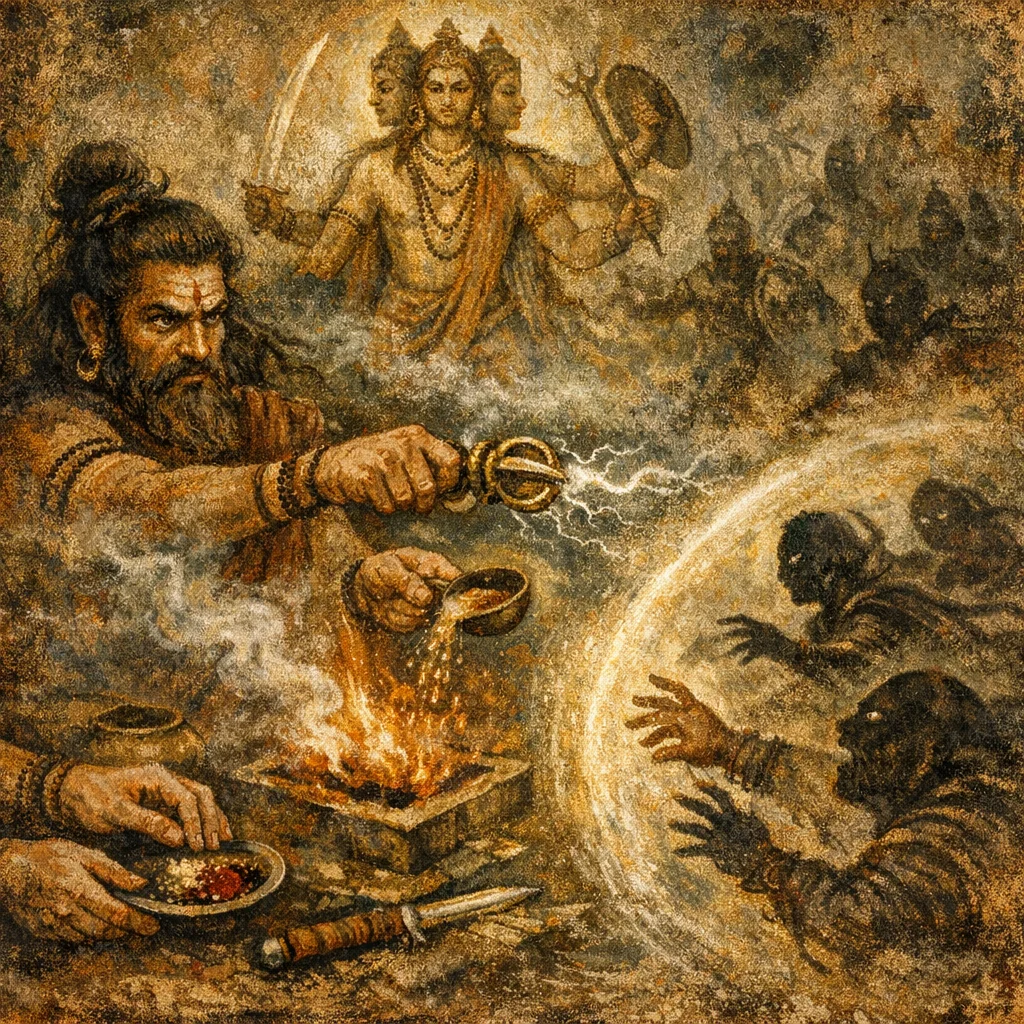
Sukta 10
Rishi: Atharvanic/Angirasa tradition (ascribed in AV ancillary tradition for battle-charms; exact r̥ṣi to be verified from Śaunaka Anukramaṇī for 11.10)
Devata: Imprecatory force; indirectly the scavengers (dogs) and the destructive ‘arbuda’ as personified calamity
Chandas: Anuṣṭubh (probable; to be confirmed by metrical count in pada form)
Mantras
Mantra 1
शत्रुनाशनम्। उत् तिष्ठत सं नह्यध्वमुदाराः केतुभिः सह। सर्पा इतरजना रक्षांस्यमित्राननु धावत
For the destruction of the foe: Stand up; bind ye on together, conspicuous, with your banners. Ye serpents, ye other folk—chase after the demons, chase after the foes.
Mantra 2
ईशां वो वेद राज्यं त्रिषंधे अरुणैः केतुभिः सह। ये अन्तरिक्षे ये दिवि पृथिव्यां ये च मानवाः। त्रिषंधेस्ते चेतसि दुर्णामान उपासताम्
Lordship for you—kingship—Triṣandhi knows, together with ruddy banners. They that are in mid-air, they that are in heaven, on earth, and they that are men: let the ill-named in their mind attend upon Triṣandhi; let them be subject.
Mantra 3
अयोमुखाः सूचीमुखा अथो विकङ्कतीमुखाः । क्रव्यादो वातरंहसः आ सजन्त्वमित्रान् वज्रेण त्रिषंधिना
Iron-mouthed, needle-mouthed, yea, with vikaṅkatī-beaks—flesh-eaters, wind-swift—let them fasten upon the foes, with the thunderbolt, with the three-jointed (Triṣaṃdhi) weapon.
Mantra 4
अन्तर्धेहि जातवेद आदित्य कुणपं बहु। त्रिषंधेरियं सेना सुहितास्तु मे वशे
Hide thou away, O Jātavedas; O Āditya, the abundant carrion. Let this host of Triṣaṃdhi be well-set, and be it under my control.
Mantra 5
उत् तिष्ठ त्वं देवजनार्बुदे सेनया सह। अयं बलिर्व आहुतस्त्रिषंधेराहुतिः प्रिया
Rise thou up, O god-born Arbuda, together with thy host. This tribute, verily, is offered: dear is the oblation unto Triṣaṃdhi.
Mantra 6
शितिपदी सं द्यतु शरव्ये३यं चतुष्पदी । कृत्येऽमित्रेभ्यो भव त्रिषंधेः सह सेनया
Let the bright-footed, the four-footed, smite full—O Śaravya. O Kṛtyā, become (directed) against the foes, together with the host of Triṣaṃdhi.
Mantra 7
धूमाक्षी सं पततु कृधुकर्णी च क्रोशतु । त्रिषंधेः सेनया जिते अरुणाः सन्तु केतवः
Let the smoke-eyed swoop down full; and let Kṛdhukarṇī shriek aloud. With the host of Triṣaṃdhi, when conquest is won, let the signals be ruddy—tokens of victory.
Mantra 8
अवायन्तां पक्षिणो ये वयांस्यन्तरिक्षे दिवि ये चरन्ति । श्वापदो मक्षिकाः सं रभन्तामामादो गृध्राः कुणपे रदन्ताम्
Let the birds descend—those fliers that roam in mid-air, those that move in the sky. Let the wild dog-footed beasts and the flies seize it wholly; let the raw-devouring vultures gnaw upon the carrion.
Mantra 9
यामिन्द्रेण संधां समधत्था ब्रह्मणा च बृहस्पते । तयाहमिन्द्रसंधया सर्वान् देवानिह हुव इतो जयत मामुतः
The compact which thou, O Bṛhaspati, hast firmly set with Indra, and by the power of sacred speech—by that Indra-compact I here invoke all the Gods: from this side conquer ye; win ye me moreover.
Mantra 10
बृहस्पतिराङ्गिरस ऋषयो ब्रह्मसंशिताः । असुरक्षयणं वधं त्रिषंधिं दिव्याश्रयन्
Bṛhaspati, the Angirasa seers, whetted with sacred speech, took their stand in heaven—(framing) the Asura-destroying smiting, the threefold compact.
Mantra 11
येनासौ गुप्त आदित्य उभाविन्द्रश्च तिष्ठतः। त्रिषंधि देवा अभजन्तौजसे च बलाय च
By which that Āditya is guarded, and Indra too—both stand firm: the Gods adopted the tri-saṃdhi for vigour and for strength.
Mantra 12
सर्वांल्लोकान्त्समजयन् देवा आहुत्यानया । बृहस्पतिराङ्गिरसो वज्रं यमसिञ्चतासुरक्षयणं वधम्
All the worlds the Gods won wholly by this oblation. Bṛhaspati the Angirasa poured out—fashioned—the bolt which is the Asura-destroying smiting.
Mantra 13
बृहस्पतिराङ्गिरसो वज्रं यमसिञ्चतासुरक्षयणं वधम्। तेनाहममूं सेनां नि लिम्पामि बृहस्पतेऽमित्रान् हन्म्योजसा
Bṛhaspati of the Aṅgirases infused the bolt, a slaughter, Asura-wasting. With that I besmear yonder host: O Bṛhaspati, with might I smite the foes.
Mantra 14
सर्वे देवा अत्यायन्ति ये अश्नन्ति वषट् कृतम् । इमां जुषध्वमाहुतिमितो जयत मामुतः
All the Gods draw nigh—those who partake of what is made with Vaṣaṭ. Be pleased with this oblation; from hence win ye for me, moreover, the victory.
Mantra 15
सर्वे देवा अत्यायन्तु त्रिषन्धेराहुतिः प्रिया। संधां महतीं रक्षत ययाग्रे असुरा जिताः
Let all the Gods draw nigh: dear is the oblation of the threefold junction. Guard ye the mighty boundary—wherewith of old the Asuras were subdued.
Mantra 16
वायुरमित्राणामिष्वग्राण्याञ्चतु । इन्द्र एषां बाहून् प्रति भनक्तु मा शकन् प्रतिधामिषुम्। आदित्य एषामस्त्रं वि नाशयतु चन्द्रमा युतामगतस्य पन्थाम्
Let Vāyu turn aside the foemen’s arrow-points. Let Indra break their arms in counter-stroke: let them not have power to set the arrow to its aim. Let Āditya shatter their weapon utterly; let Moon yoke for the ungoing one a path astray.
Mantra 17
यदि प्रेयुर्देवपुरा ब्रह्म वर्माणि चक्रिरे। तनूपानं परिपाणं कृण्वाना यदुपोचिरे सर्वं तदरसं कृधि
If they should march, with ‘divine strongholds,’ having made armours by spell—body-guard and all-around guard—whatsoever they have muttered over: make thou all that sapless, void of virtue.
Mantra 18
क्रव्यादानुवर्तयन्मृत्युना च पुरोहितम्। त्रिषन्धे प्रेहि सेनया जयामित्रान् प्र पद्यस्व
Pursuing the flesh-devourers, and with Death for thine ally, smite first the foeman’s leader set in front. At the threefold junction go forth with the host: conquer the enemies; advance and set thy foot upon them.
Mantra 19
त्रिषन्धे तमसा त्वममित्रान् परि वारय । पृषदाज्यप्रणुत्तानां मामीषां मोचि कश्चन
At the threefold junction, with darkness do thou encompass and restrain the enemies. Of those whom the speckled ghee hath thrust back, let not a single one of ours be loosed away.
Mantra 20
शितिपदी सं पतत्वमित्राणाममूः सिचः । मुह्यन्त्वद्यामूः सेनाः अमित्रानां न्यर्बुदे
Let Śitipadī fall together upon those yonder streams/bands of the enemies. Let those yonder armies of the foes be confounded this day, down in Nyarbuda.
Mantra 21
मूढा अमित्रा न्यर्बुदे जह्येऽषां वरंवरम्। अनया जहि सेनया
The enemies, bewildered, in Nyarbuda—smite them; smite, of them, each chosen champion. With this same host (thus empowered) do thou strike them down.
Mantra 22
यश्च कवची यश्चाकवचो३मित्रो यश्चाज्मनि । ज्यापाशैः कवचपाशैरज्मनाभिहतः शयाम्
Whether armoured or unarmoured be the foe, and whether he be upon the march: with bowstring-nooses, with armour-nooses—by the very track smitten—may he lie prone.
Mantra 23
ये वर्मिणो येऽवर्माणो अमित्रा ये च वर्मिणः । सर्वांस्तां अर्बुदे हतांछ्वानोऽदन्तु भूम्याम्
Whether mail-clad or mail-less, the foemen, yea, the armoured also—let dogs devour them, all of them, when slain, in the crushing arbuda, upon the ground.
Mantra 24
ये रथिनो ये अरथा असादा ये च सादिनः । सर्वानदन्तु तान् हतान् गृध्राः श्येनाः पतत्रिणः
Whether chariot-warriors, or chariotless, unmounted, or mounted—let vultures, hawks, the winged tribes, devour them all, when slain.
Mantra 25
सहस्रकुणपा शेतामामित्री सेना समरे वधानाम्। विविद्धा ककजाकृता
Let the foeman’s host, in battle’s slaughter, lie a thousand-fold in carrion heaps—pierced through, made over to the carrion-eaters.
Mantra 26
मर्माविधं रोरुवतं सुपर्णैरदन्तु दुश्चितं मृदितं शयानम्। य इमां प्रतीचीमाहुतिममित्रो नो युयुत्सति
Pierced in his vital parts, howling—let the fair-winged devour him, the ill-devised, crushed down, lying low: the foe who would contend with us, and turn this oblation back against us.
Mantra 27
यां देवा अनुतिस्ठन्ति यस्या नास्ति विराधनम्। तयेन्द्रो हन्तु वृत्रहा वज्रेण त्रिषंधिना
That rite which the Gods uphold, wherein is no miscarriage—therewith let Indra, Vṛtra-slayer, smite (our foe) with his three-jointed thunderbolt.
Frequently Asked Questions
Primarily aggressive (Abhicārika/Saṃgrāmika). It aims to coerce and crush enemies, though it also functions defensively by reversing hostile kṛtyā (witchcraft) back to the sender.
Triṣaṃdhi is treated as a commanding junction-power associated with banners/marks (ketu) and lordship. The hymn uses Triṣaṃdhi to impose submission across all domains—sky, mid-air, earth, and human society.
They intensify the curse’s finality: Arbuda represents crushing calamity, and dogs symbolize post-mortem pollution and dishonour. Together they deny the enemy a dignified end, making defeat socially and ritually complete.