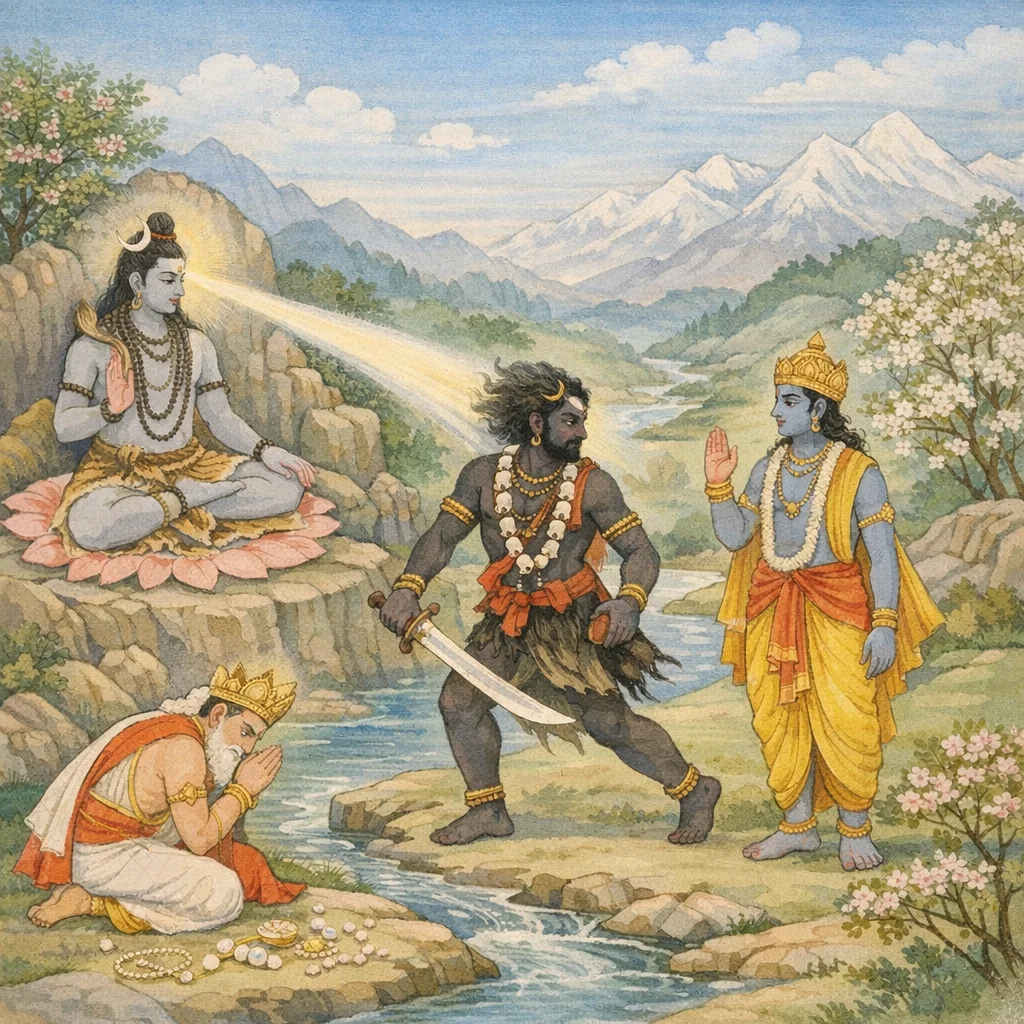
भैरवोत्पत्तिः ब्रह्मदर्पनिग्रहश्च (Origin of Bhairava and the Subduing of Brahmā’s Pride)
Nandikeśvara (Nandin) narrates, in a report-like manner, a crisis in the divine assembly. To curb Brahmā’s arrogance and false speech, Mahādeva manifests an extraordinary being—Bhairava—from the space between his brows. Bhairava immediately receives Śiva’s command to chastise Brahmā with a sharp sword, a sacred severity meant to restore cosmic propriety. Brahmā is humiliated—disheveled and stripped of ornaments—and submits at Bhairava’s feet. Viṣṇu (Acyuta) then mediates with a conciliatory plea, recalling the earlier honor of the “five-faced” mark bestowed by Śiva, and asks forgiveness and grace for Brahmā. Pleased, Śiva restrains Bhairava from further punishment and admonishes Brahmā for deceitful ambition for worship, precedence, and lordship. Esoterically, the chapter presents a model of governance: fierce divine forms serve as juridical instruments of truth (satya) and humility, while mercy is granted through right recognition of Śiva’s supremacy.
Shlokas
Verse 1
नंदिकेश्वर उवाच । ससर्जाथ महादेवः पुरुषं कंचिदद्भुतम् । भैरवाख्यं भ्रुवोर्मध्याद्ब्रह्मदर्पजिघांसया
Nandikeśvara said: Then Mahādeva created a wondrous being—a person called Bhairava—from the space between His brows, with the intent of crushing Brahmā’s pride.
Verse 2
स वै तदा तत्र पतिं प्रणम्य शिवमंगणे । किं कार्यं करवाण्यत्र शीघ्रमाज्ञापय प्रभो
Then, right there in Śiva’s sacred courtyard, he bowed to the Lord (Pati) and said: “What task shall I carry out here? Command me quickly, O Master.”
Verse 3
वत्सयोऽयं विधिः साक्षाज्जगतामाद्यदैवतम् । नूनमर्चय खड्गेन तिग्मेन जवसा परम्
My child, this rite is verily the manifest ordinance of worship of the Primordial Divinity of the worlds. Therefore, worship Him at once—swiftly and with utmost resolve—using the sharp sword, as prescribed in this context.
Verse 4
स वै गृहीत्वैककरेण केशं तत्पंचमं दृप्तमसत्यभाषणम् । छित्त्वा शिरांस्यस्य निहंतुमुद्यतः प्रकंपयन्खड्गमतिस्फुटं करैः
Then he seized by the hair with one hand that fifth one—arrogant and given to false speech—and, having cut off his heads, he rose to strike him down, shaking the sword vigorously in his hands.
Verse 5
पिता तवोत्सृष्टविभूषणांबरस्रगुत्तरीयामलकेशसंहतिः । प्रवातरंभेव लतेव चंचलः पपात वै भैरवपादपंकजे
Your father—having cast aside his ornaments, garments, garlands, upper cloth, and even his neat arrangement of hair—trembling like a plantain tree in a gust of wind, fell indeed at the lotus-feet of Bhairava.
Verse 6
तावद्विधिं तात दिदृक्षुरच्युतः कृपालुरस्मत्पतिपादपल्लवम् । निषिच्य बाष्पैरवदत्कृतांजलिर्यथा शिशुः स्वं पितरं कलाक्षरम्
Then Acyuta (Viṣṇu), compassionate and eager to behold that ordinance, bathed with tears the tender lotus-feet of our Lord (Śiva). With palms joined, he spoke—like a child addressing his own father with faltering, broken syllables.
Verse 7
अच्युत उवाच । त्वया प्रयत्नेन पुरा हि दत्तं यदस्य पंचाननमीशचिह्नम् । तस्मात्क्षमस्वाद्यमनुग्रहार्हं कुरु प्रसादं विधये ह्यमुष्मै
Acyuta (Viṣṇu) said: “Formerly, with great effort, you bestowed upon him the Lord’s emblem—the five-faced mark of Īśa. Therefore, forgive him now; he is worthy of grace. Show your favor and grant your blessing to this Vidhī (Brahmā).”
Verse 8
इति श्रीशिवमहापुराणे विद्येश्वरसंहितायामष्टमोऽध्यायः
Thus ends the Eighth Chapter in the Vidyeśvara-saṃhitā of the Śrī Śiva Mahāpurāṇa.
Verse 9
अथाह देवः कितवं विधिं विगतकंधरम् । ब्रह्मंस्त्वमर्हणाकांक्षी शठमीशत्वमास्थितः
Then the Lord spoke to Vidhi (Brahmā), the deceitful one, who stood with downcast head: “O Brahman, you crave worship and, through duplicity, have assumed the posture of lordship.”
Verse 10
नातस्ते सत्कृतिर्लोके भूयात्स्थानोत्सवादिकम् । ब्रह्मोवच । स्वामिन्प्रसीदाद्य महाविभूते मन्ये वरं वरद मे शिरसः प्रमोक्षम्
“In this world no honour—whether by rank, festivals, or the like—can surpass what comes from You.” Brahmā said: “O Lord, be gracious today, O Great Sovereign. O Bestower of boons, I deem the highest boon for me to be the release of my head from the burden of pride and bondage.”
Verse 11
नमस्तुभ्यं भगवते बंधवे विश्वयोनये । सहिष्णवे सर्वदोषाणां शंभवे शैलधन्वने
Salutations to You, the Blessed Lord—our kinsman and refuge, the womb and source of the universe; the forbearing One who endures all faults; to Śambhu, the Auspicious, who removes every blemish; to the Mountain-armed Archer, whose bow is the steadfast power of Dharma.
Verse 12
ईश्वर उवाच । अराजभयमेतद्वै जगत्सर्वं न शिष्यति । ततस्त्वं जहि दंडार्हं वह लोकधुरं शिशो
Īśvara said: “Without the fear of rightful kingship, this entire world will not be disciplined. Therefore, chastise the one deserving punishment, and bear the burden of governing the people, O child.”
Verse 13
वरं ददामि ते तत्र गृहाण दुर्लभं परम् । वैतानिकेषु गृह्येषु यज्ञे च भवान् गुरुः
“There I grant you a boon—accept this supreme gift, difficult to obtain. In the śrauta (Vedic) rites, in the gṛhya (domestic) rites, and in sacrificial worship, you shall be the authoritative preceptor (guru).”
Verse 14
निष्फलस्त्वदृते यज्ञः सांगश्च सहदक्षिणः । अथाह देवः कितवं केतकं कूटसाक्षिणम्
“Without You, the sacrifice is fruitless—even if performed with all its auxiliaries and with the prescribed gifts (dakṣiṇā).” Then the Lord addressed the Ketakī, that deceitful one who had stood as a false witness.
Verse 15
रे रे केतक दुष्टस्त्वं शठ दूरमितो व्रज । ममापि प्रेम ते पुष्पे मा भूत्पूजास्वितः परम्
“Hey, Ketaka! You wicked, deceitful one—go far away from here. Though I too once had affection for your flower, may you never again become foremost in worship.”
Verse 16
इत्युक्ते तत्र देवेन केतकं देवजातयः । सर्वानि वारयामासुस्तत्पार्श्वादन्यतस्तदा
When the Deva spoke thus, the hosts of divine beings then restrained Ketaka from all sides, standing around him on every side.
Verse 17
केतक उवाच । नमस्ते नाथ मे जन्मनिष्फलं भवदाज्ञया । सफलं क्रियतां तात क्षम्यतां मम किल्बिषम्
Ketaka said: “Salutations to You, O Lord. By disobeying Your command, my very birth has become fruitless. O revered one, make it fruitful again, and forgive my sin.”
Verse 18
ज्ञानाज्ञानकृतं पापं नाशयत्येव ते स्मृतिः । तादृशे त्वयि दृष्टे मे मिथ्यादोषः कुतो भवेत्
Whether sins are committed knowingly or unknowingly, the very remembrance of You destroys them. And when I have beheld You in such a form, how could any fault of falsehood or delusion remain in me?
Verse 19
तथा स्तुतस्तु भगवान्केतकेन सभातले । न मे त्वद्धारणं योग्यं सत्यवागहमीश्वरः
Thus praised by the ketakī flower in the assembly hall, the Blessed Lord said: “You are not fit to be worn by Me; for I, the Lord, am a speaker of truth.”
Verse 20
मदीयास्त्वां धरिष्यंति जन्म ते सफलं ततः । त्वं वै वितानव्याजेन ममोपरि भविष्यसि
My own attendants will bear you; then your birth will become fruitful. Indeed, under the pretext of being a canopy, you shall remain above Me.
Verse 21
इत्यनुगृह्य भगवान्केतकं विधिमाधवौ । विरराज सभामध्ये सर्वदेवैरभिष्टुतः
Thus, having shown grace to Ketaka, and to Vidhi (Brahmā) and Mādhava (Viṣṇu), the Blessed Lord shone resplendent in the midst of the assembly, praised by all the gods.
Frequently Asked Questions
Śiva manifests Bhairava from the brow to punish Brahmā’s arrogance and falsehood; Viṣṇu petitions for clemency, leading Śiva to restrain Bhairava and verbally reprimand Brahmā—asserting Śiva’s supreme regulatory role over the cosmic offices.
The brow-emergence signifies sovereign command (ājñā-cakra/authority imagery) and immediate divine agency; the sword symbolizes discriminative enforcement of truth and order; Bhairava embodies sanctioned severity (nigraha) that is ultimately subordinated to Śiva’s grace (anugraha).
Bhairava is highlighted as a fierce emanation of Mahādeva/Īśa, functioning as a protective-juridical power; Śiva appears as the supreme arbiter, while Viṣṇu (Acyuta) is highlighted as the mediating intercessor within the divine hierarchy.