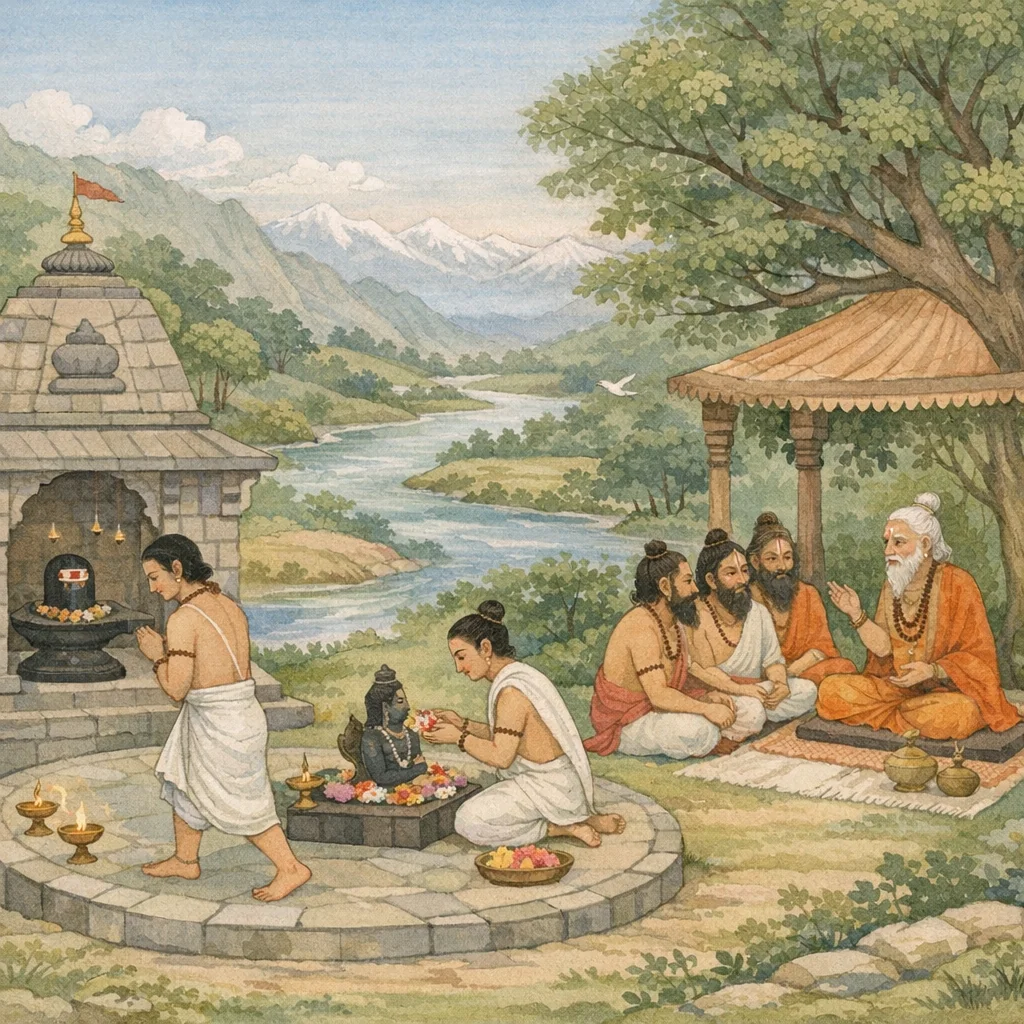
Liṅga–Bera Pūjā: Nitya-Arcana and Upacāras as an Accessible Sādhana (लिङ्गबेरपूजा-विधानम्)
This chapter unfolds as Sūta’s instructive dialogue with the sages. It teaches an inclusive ritual path to liberation: even if one cannot complete the full triad of disciplines connected with śravaṇa-ādi (hearing and related practices), one may still cross saṃsāra by establishing (saṃsthāpya) and worshiping daily (nityam abhyarcya) Śaṅkara’s liṅga and/or bera. It lists many supports for temple service and pūjā—patronage of structures such as maṇḍapa and gopura, sacred institutions and sites like tīrtha, maṭha, kṣetra, and utsava, and the standard upacāras of cloth, fragrance, garlands, incense, lamps, and food offerings (naivedya). Royal-style honors (rājopacāra) and embodied acts of devotion—pradakṣiṇā, namaskāra, and japa—are also commended, to be performed according to one’s capacity (yathāśakti). The sages then ask a theological question: since other deities are chiefly worshiped through icons (bera), how can Śiva be fully worshiped everywhere through both liṅga and bera? Sūta praises the question as meritorious and indicates that Mahādeva alone is the final authority for the answer, signaling a shift from procedural enumeration to deeper theological grounding.
Shlokas
Verse 1
सूत उवाच । श्रवणादित्रिकेऽशक्तो लिंगं बेरं च शांकरम् । संस्थाप्य नित्यमभ्यर्च्य तरेत्संसारसागरम्
Sūta said: One who is unable to practice the triad beginning with hearing (śravaṇa) should establish the Śaṅkara-liṅga and also the sacred Śaṅkara-image (bera); worshipping them daily with devotion, he shall cross the ocean of saṃsāra.
Verse 2
अपि द्र व्यं वहेदेव यथाबलमवंचयन् । अर्पयेल्लिंगबेरार्थमर्चयेदपि संततम्
Even if one can bring only a small offering, one should bring it according to one’s capacity, without deceit, and present it for the worship of the Śiva-liṅga and the sacred icon; thus one should worship continually with sincere heart.
Verse 3
मंडपं गोपुरं तीर्थं मठं क्षेत्रं तथोत्सवम् । वस्त्रं गंधं च माल्यं च धूपं दीपं च भक्तितः
With devotion one should offer in Śiva’s service a pavilion and gateway, sacred bathing-places (tīrthas), monasteries, holy fields and festivals; likewise cloth, fragrance, garlands, incense, and lamps.
Verse 4
विविधान्नं च नैवेद्यमपूपव्यंजनैर्युतम् । छत्रं ध्वजं च व्यजनं चामरं चापि सांगकम्
One should offer as naivedya a variety of prepared foods, along with cakes and savory dishes. One should also present the royal emblems of honor—an umbrella, a banner, fans, and a yak-tail whisk (cāmara)—together with all the proper accessories of worship.
Verse 5
इति श्रीशिवमहापुराणे विद्येश्वरसंहितायां पंचमोऽध्यायः
Thus ends the Fifth Chapter of the Vidyeśvara-saṃhitā in the Śrī Śiva Mahāpurāṇa.
Verse 6
आवाहनादिसर्गांतं नित्यं कुर्यात्सुभक्तितः । इत्थमभ्यर्च्य यन्देवं लिंगेबेरे च शांकरे
With sincere devotion, one should daily perform the entire order of worship—from āvāhana (invocation) up to visarjana (the concluding dismissal). Having thus adored Lord Śaṅkara, present both in the Liṅga and in the consecrated icon (bera), the devotee should remain established in reverent worship.
Verse 7
सिद्धिमेति शिवप्रीत्या हित्वापि श्रवणादिकम् । लिंगबेरार्चनामात्रान्मुक्ताः पुर्वे महाजनाः
By Śiva’s gracious pleasure one attains fulfilment—even if one has set aside practices such as listening to sacred teachings and the like. Indeed, the great ones of old were liberated merely through the worship of the Liṅga and the sacred icon (bera).
Verse 8
मनुय ऊचुः । बेरमात्रे तु सर्वत्र पूज्यंते देवतागणाः । लिंगेबेरे च सर्वत्र कथं संपूज्यते शिवः
The sages said: “Everywhere, the hosts of deities are worshipped only in their icons (bera). But Śiva is worshipped everywhere both in the Liṅga and in the icon—how, then, is Śiva to be worshipped in a complete and proper manner?”
Verse 9
सूत उवाच । अहो मुनीश्वराः पुण्यं प्रश्नमेतन्महाद्भुतम् । अत्र वक्ता महादेवो नान्योऽस्ति पुरुषः क्वचित्
Sūta said: “O lordly sages, this question is holy and exceedingly wondrous. Here, the true speaker is Mahādeva Himself—there is no other person anywhere who can speak this in full truth.”
Verse 10
शिवेनोक्तं प्रवक्ष्यामि क्रमाद्गुरुमुखाच्छ्रुतम् । शिवैको ब्रह्मरूपत्वान्निष्कलः परिकीर्तितः
I shall now expound, in due order, what was spoken by Lord Śiva and heard from the mouth of the Guru. Śiva alone—because His very nature is Brahman—is proclaimed to be niṣkala, partless and without divisions.
Verse 11
रूपित्वात्सकलस्तद्वत्तस्मात्सकलनिष्कलः । निष्कलत्वान्निराकारं लिंगं तस्य समागतम्
Because He possesses manifest form, He is also sakala (with parts and attributes). Therefore He is both sakala and niṣkala (without parts, without attributes). And because of His niṣkala nature, the Liṅga pertaining to Him is formless and without shape.
Verse 12
सकलत्वात्तथा बेरं साकारं तस्य संगतम् । सकलाकलरूपत्वाद्ब्रह्मशब्दाभिधः परः
Because He is endowed with the complete manifest aspect (sakala), His consecrated icon (bera) is rightly conceived as having form. And since His nature is both sakala and akala (unmanifest), He—the Supreme—is denoted by the word “Brahman.”
Verse 13
अपि लिंगे च बेरे च नित्यमभ्यर्च्यते जनैः । अब्रह्मत्वात्तदन्येषां निष्कलत्वं न हि क्वचित्
People daily worship (Śiva) in the Liṅga and also in the consecrated image (bera). But for others—because they are not Brahman, the Supreme Reality—the state of being niṣkala (partless) is never truly applicable at any time.
Verse 14
तस्मात्ते निष्कले लिंगे नाराध्यंते सुरेश्वराः । अब्रह्मत्वाच्च जीवत्वात्तथान्ये देवतागणाः
Therefore, in that niṣkala (partless) Liṅga, even the lords of the gods are not fit to be worshipped; and likewise the other hosts of deities too—because they are not the Supreme Brahman and because they remain in the state of limited souls (jīvas).
Verse 15
तूष्णीं सकलमात्रत्वादर्च्यंते बेरमात्रके । जीवत्वं शंकरान्येषां ब्रह्मत्वं शंकरस्य च
Because (the Lord) pervades all measures and all categories of existence, He is worshipped in silence through the mere icon (bēra). The others—those other than Śaṅkara—have the status of jīva (the individual soul), whereas Śaṅkara alone has the status of Brahman (the Supreme Reality).
Verse 16
वेदांतसारसंसिद्धं प्रणवार्थे प्रकाशनात् । एवमेव पुरा पृष्टो मंदरे नंदिकेश्वरः
Because the meaning of the Praṇava (Oṃ) reveals what is firmly established as the very essence of Vedānta, in the same way, long ago on Mount Mandara, Nandikeśvara was questioned about it.
Verse 17
सनत्कुमारमुनिना ब्रह्मपुत्रेण धीमता । सनत्कुमार उवाच । शिवान्यदेववश्यानां सर्वेषामपि सर्वतः
The wise sage Sanatkumāra, the mind-born son of Brahmā, spoke: “Among all beings everywhere, those devoted to Śiva are not subject to any other deity.”
Verse 18
बेरमात्रं च पूजार्थं श्रुतं दृष्टं च भूरिशः । शिवमात्रस्य पूजायां लिंगं बेरं च दृश्यते
O Bhūrīśa, it has been heard and also seen many times that, for the sake of worship, an icon (bera) is employed. Yet in the worship of Śiva alone, both the Liṅga and the icon are recognized as valid supports of worship.
Verse 19
अतस्तद्ब्रूहि कल्याण तत्त्वं मे साधुबोधनम् । नंदिकेश्वर उवाच । अनुत्तरमिमं प्रश्नं रहस्यं ब्रह्मलक्षणम्
Therefore, O auspicious one, tell me that true principle—grant me the right instruction for my spiritual awakening. Nandikeśvara said: “This question is unsurpassed; it is a secret teaching, bearing the mark of Brahman, the Supreme Reality.”
Verse 20
कथयामि शिवेनोक्तं भक्तियुक्तस्य तेऽनघ । शिवस्य ब्रह्मरूपत्वान्निष्कलत्वाच्च निष्कलम्
O sinless one, I shall tell you what Śiva spoke for the devotee endowed with bhakti: since Śiva is of the nature of Brahman and is niṣkala, partless, that Supreme Reality too is truly partless.
Verse 21
लिंगं तस्यैव पूजायां सर्ववेदेषु संमतम् । तस्यैव सकलत्वाच्च तथा सकलनिष्कलम्
In the worship of Him (Śiva), the Liṅga is approved by all the Vedas. And because He is the source and support of all manifested forms, the Liṅga is to be understood as both “sakala” (with aspects, endowed with attributes) and “niṣkala” (partless, beyond attributes)—thus, sakala-niṣkala.
Verse 22
सकलं च तथा बेरं पूजायां लोकसंमतम् । शिवान्येषां च जीवत्वात्सकलत्वाच्च सर्वतः
In worship, both the Sakala (manifest, embodied form) and the Bera (the consecrated icon) are accepted by the world. For Śiva and the other deities bear a living presence, and, being fully manifest in every way, are accessible to devotion.
Verse 23
बेरमात्रं च पूजायां संमतं वेदनिर्णये । स्वाविर्भावे च देवानां सकलं रूपमेव हि
In worship, the Bera alone—the consecrated icon—is approved, according to the settled decision of the Vedas. Indeed, when the deities manifest of their own accord, they appear in the complete, fully formed Sakala mode.
Verse 24
शिवस्य लिंगं बेरं च दर्शने दृश्यते खलु । सनत्कुमार उवाच । उक्तं त्वया महाभाग लिंगबेरप्रचारणम्
In the vision of worship, Śiva’s Liṅga (the aniconic emblem) and the Bera (the iconic image) are indeed both beheld. Sanatkumāra said: “O noble one, you have explained the propagation and practice of worship through the Liṅga and the Bera.”
Verse 25
शिवस्य च तदन्येषां विभज्य परमार्थतः । तस्मात्तदेव परमं लिंगबेरादिसंभवम्
Having truly discerned, in the highest sense, the distinction between Śiva and all that is other than Him, one knows that That alone is the Supreme—He from whom the Liṅga, the Bera-forms, and all else arise.
Verse 26
श्रोतुमिच्छामि योगींद्र लिंगाविर्भावलक्षणम् । नंदिकेश्वर उवाच । शृणु वत्स भवत्प्रीत्या वक्ष्यामि परमार्थतः
“O lord among yogins, I wish to hear the characteristics of the manifestation of the Liṅga.” Nandikeśvara said: “Listen, dear child. Out of affection for you, I shall explain it in accordance with the highest truth.”
Verse 27
पुरा कल्पे महाकाले प्रपन्ने लोकविश्रुते । आयुध्येतां महात्मानौ ब्रह्मविष्णू परस्परम्
In a former aeon, in that great and world-renowned time, the two great souls—Brahmā and Viṣṇu—came to be engaged in battle with one another.
Verse 28
तयोर्मानं निराकर्तुं तन्मध्ये परमेश्वरः । निष्कलस्तंभरूपेण स्वरूपं समदर्शयत्
To humble the pride of those two, the Supreme Lord appeared between them and revealed His own essential nature in the form of the partless, motionless pillar (the Linga).
Verse 29
ततः स्वलिंगचिह्नत्वात्स्तंभतो निष्कलं शिवः । स्वलिंगं दर्शयामास जगतां हितकाम्यया
Thereafter, because that pillar bore His own mark as the Liṅga, the partless (niṣkala) Lord Śiva revealed His own Liṅga from within the column—out of a compassionate wish for the welfare of all the worlds.
Verse 30
तदाप्रभृति लोकेषु निष्कलं लिंगमैश्वरम् । सकलं च तथा बेरं शिवस्यैव प्रकल्पितम्
From that time onward, in the worlds, the sovereign Liṅga of Śiva was established as the formless (niṣkala) reality; and likewise, the embodied icon (bera) was duly ordained as the formed (sakala) manifestation of Śiva.
Verse 31
शिवान्येषः तु देवानां बेरमात्रं प्रकल्पितम् । तत्तद्बेरं तु देवानां तत्तद्भोगप्रदं शुभम् । शिवस्य लिंगबेरत्वं भोगमोक्षप्रदं शुभम्
For the other gods, an icon (bera) is devised only as a form for worship; and each deity’s own icon auspiciously bestows the enjoyments proper to that deity. But for Śiva, the icon is the Liṅga itself—auspicious, granting both worldly enjoyment and final liberation (mokṣa).
Frequently Asked Questions
It argues that even without extensive śravaṇa-ādi disciplines, one can attain siddhi and cross saṃsāra through devoted, regular worship of Śiva via liṅga and bera, supported by offerings and acts of reverence performed according to one’s capacity.
The pair functions as a theological bridge: the liṅga encodes Śiva’s transpersonal, non-figurative absoluteness, while the bera supports relational devotion and liturgical detail; together they authorize multiple cognitive and devotional entry-points into the same Śiva-Tattva.
Śiva is foregrounded as Śaṅkara and Mahādeva—titles emphasizing auspiciousness and supreme divinity—rather than a localized avatāra; the focus is on his worshipable presence through liṅga/bera rather than a narrative form.