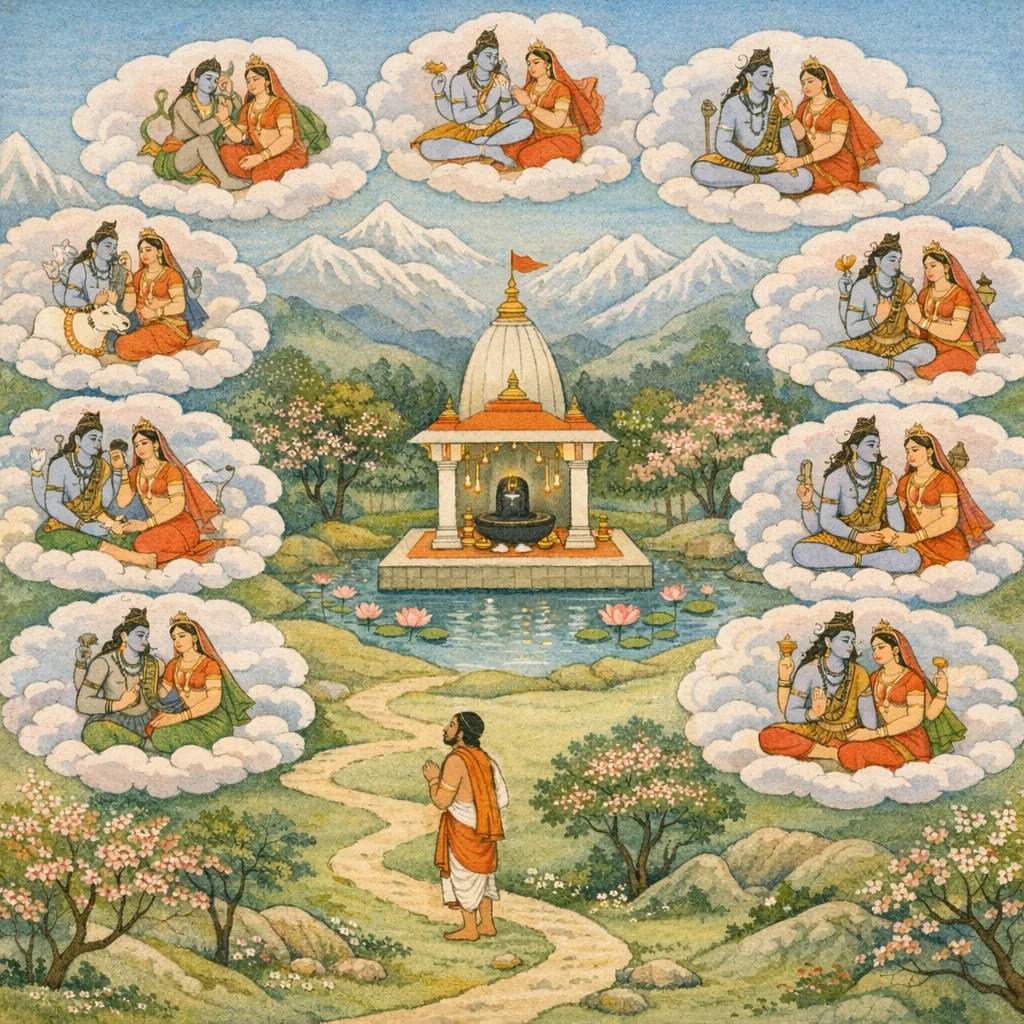
Daśa-Śivāvatāra-Nirūpaṇa (Enumeration of Ten Prime Manifestations of Śiva with Their Śaktis)
Adhyāya 17 gives a catalog-style teaching that enumerates Śiva’s ten principal avatāra-manifestations, held worthy of bhakti and upāsanā practice. Each form is named and placed in order, paired with its corresponding Śakti (a Devī-form), and described by its saving efficacy—typically granting bhukti and mukti or fulfilling devotees’ desired aims. The sequence includes Mahākāla with Mahākālī, Tārā with Tārā, Bhuvaneśa with Bhuvaneśī, Śrīvidyeśa with Śrīvidyā, Bhairava with Bhairavī, Chinnamastaka with Chinnamastakā, Dhūmavān with Dhūmavatī, Bagalāmukha with Bagalāmukhī, and Mātaṅga with Mātaṅgī. The esoteric lesson is that Śiva’s salvific power is inseparable from Śakti, and that iconographic plurality is arranged as a practical worship-map aimed at specific spiritual outcomes.
Shlokas
Verse 1
शृण्वथो गिरिशस्याद्यावतारान् दशसंख्यकान् । महाकलमुखान् भक्त्योपासनाकाण्डसेवितान्
Listen now to the ten prime incarnations of Girīśa (Lord Śiva)—beginning with Mahākāla—who are revered and approached through devoted worship and the disciplines of sacred observance.
Verse 2
तत्राद्यो हि महाकालो भुक्तिमुक्तिप्रदस्सताम् । शक्तिस्तत्र महाकाली भक्तेप्सितफलप्रदा
There, the foremost is Mahākāla, who grants both worldly enjoyment and liberation to the virtuous. There also is His Śakti, Mahākālī, who bestows upon devotees the very fruits they desire.
Verse 3
तारनामा द्वितीयश्च तारा शक्तिस्तथैव सा । भुक्तिमुक्तिप्रदौ चोभौ स्वसेवकसुखप्रदौ
The second is named Tāra, and likewise the power called Tārā. Both bestow worldly enjoyment and liberation, and grant happiness to their own devoted worshippers.
Verse 4
भुवनेशो हि बालाह्वस्तृतीयः परिकीर्तितः । भुवनेशी शिवा तत्र बालाह्वा सुखदा सताम्
The third manifestation is proclaimed as Bhuvaneśa, also known as Bāla. In that very form, Śivā is Bhuvaneśī, called Bālā, bestowing happiness upon the virtuous.
Verse 5
श्रीविद्येशः षोडशाह्वः श्रीर्विद्या षोडशी शिवा । चतुर्थो भक्त सुखदो भुक्तिमुक्तिफलप्रदः
The Lord named Śrīvidyeśa, also renowned as “the Sixteenth,” is Śrīvidyā herself—the Sixteenth Power, the auspicious Śivā. He is the fourth manifestation, giver of joy to devotees, bestowing the fruits of both worldly enjoyment and final liberation.
Verse 6
पञ्चमो भैरवः ख्यातः सर्वदा भक्तकामदः । भैरवी गिरिजा तत्र सदुपासककामदा
The fifth manifestation is renowned as Bhairava, who ever grants the cherished desires of devotees. There, Bhairavī—Giri-jā (Pārvatī)—also bestows the wished-for fruits upon sincere and proper worshippers.
Verse 7
छिन्नमस्तकनामासौ शिवः षष्ठः प्रकीर्तितः । भक्तकामप्रदा चैव गिरिजा छिन्नमस्तका
The sixth form of Śiva is proclaimed as “Chinnamastaka.” In that very form, Girijā (Pārvatī) too is known as Chinnamastakā, the bestower of the devotees’ cherished wishes.
Verse 8
धूमवान् सप्तमः शम्भुस्सर्वकामफलप्रदः । धूमवती शिवा तत्र सदुपासककामदा
The seventh form is Śambhu, called Dhūmavān, bestower of the fruits of all desired aims. There, the Goddess Śivā known as Dhūmavatī grants the wishes of sincere and devoted worshippers.
Verse 9
शिवावतारः सुखदो ह्यष्टमो बगलामुखः । शक्तिस्तत्र महानन्दा विख्याता बगलामुखी
The eighth incarnation of Śiva, the bestower of well-being, is Bagalāmukha. In that form, His Śakti is the Great Bliss (Mahānandā), renowned as Bagalāmukhī.
Verse 10
शिवावतारो मातङ्गो नवमः परिकीर्तितः । मातंगी तत्र शर्वाणी सर्वकामफलप्रदा
The ninth incarnation of Śiva is proclaimed to be Mātaṅga. In that manifestation, Śarvāṇī (the Divine Consort) is Mātaṅgī, bestower of the fruits of all desired aims.
Verse 11
दशमः कमलः शम्भुर्भुक्तिमुक्तिफलप्रदः । कमला गिरिजा तत्र स्वभक्तपरिपालिनी
The tenth manifestation is Śambhu as “Kamala,” bestower of the fruits of worldly enjoyment and liberation. There, Girijā (Pārvatī) is “Kamalā,” ever protecting and nurturing her own devotees.
Verse 12
एते दशमिताः शैवा अवतारास्सुखप्रदाः । भुक्तिमुक्तिप्रदाश्चैव भक्तानां सर्वदास्सताम्
Thus, these ten Śaiva descents (avatāras), so enumerated, are givers of auspicious happiness. Indeed, they bestow both worldly enjoyment and liberation, always granting these to the virtuous devotees.
Verse 13
एते दशावतारा हि शंकरस्य महात्मनः । नानासुखप्रदा नित्यं सेवतां निर्विकारतः
These indeed are the ten incarnations of the great-souled Śaṅkara. To those who worship and serve these forms with an unchanging, desireless mind, they ever bestow manifold auspicious joys and spiritual well-being.
Verse 14
एतद्दशावताराणां माहात्म्यं वर्णितं मुने । सर्वकामप्रदं ज्ञेयं तंत्रशास्त्रादिगर्भितम्
O sage, thus has been described the glory of these ten divine manifestations. Know it as the bestower of all worthy aims, imbued with the essence of Tantra, Śāstra, and related sacred teachings.
Verse 15
एतासामादिशक्तीनामद्भुतो महिमा मुने । सर्वकामप्रदो ज्ञेयस्तत्रंशास्त्रादिगर्भितः
O sage, wondrous indeed is the greatness of these primordial divine powers. Know that it grants the fulfillment of all rightful aims, and that its import is embedded in the essence of the Śāstras and the ancient teachings.
Verse 16
शत्रुमारणकार्य्यादौ तत्तच्छक्तिः परा मता । खल दण्डकरी नित्यम्ब्रह्मतेजोविवर्द्धिनी
In acts such as the subduing (even the destruction) of enemies and the like, that corresponding Power is regarded as supreme. She ever chastises the wicked and continually increases the splendour of Brahman (spiritual radiance).
Verse 17
इति श्रीशिवमहापुराणे तृतीयायां शतरुद्रसंहितायां शिवदशावतारवर्णनं नाम सप्तदशोऽध्यायः
Thus ends the seventeenth chapter, entitled “The Description of Shiva’s Ten Incarnations,” in the third section of the Śrī Śiva Mahāpurāṇa, the Śatarudra Saṃhitā.
Verse 18
शैवपर्वसु सर्वेषु योऽधीते भक्तितत्परः । एतदाख्यानममलं सोतिशम्भुप्रियो भवेत्
Whoever, intent on bhakti, studies this pure sacred narrative throughout all the Śaiva sections becomes exceedingly dear to Śambhu (Lord Śiva).
Verse 19
ब्रह्मणो ब्रह्मवर्चस्वी क्षत्रियो विजयी भवेत । धनाधिपो हि वैश्यः स्याच्छूद्रः सुखमवाप्नुयात्
By the grace of Śiva’s ordinance and worship, a brāhmaṇa becomes radiant with spiritual brilliance; a kṣatriya becomes victorious; a vaiśya becomes a lord of wealth; and a śūdra attains happiness and well-being.
Verse 20
शांकरा निजधर्मस्थाः शृण्वन्तश्चरितन्त्विदम् । सुखिनः स्युर्विशेषेण शिवभक्ता भवन्तु च
May those devoted to Śaṅkara, established in their own righteous duty, who listen to this sacred account, become especially happy—and may they indeed become devotees of Lord Śiva.
Frequently Asked Questions
Rather than a single leelā-event, the chapter advances a theological taxonomy: Śiva manifests in an ordered set of forms, each paired with a Śakti, and each validated as an effective object of worship yielding defined results (especially bhukti and mukti).
The rahasya is the pairing principle: every Śiva-form is operationally complete only with its Śakti, implying that liberation/attainment is mediated through integrated consciousness-power (Śiva–Śakti) expressed as name, form, and worship-function.
Highlighted pairs (from the excerpt) include Mahākāla–Mahākālī, Tāra–Tārā, Bhuvaneśa/Bālāhvā–Bhuvaneśī/Bālāhvā, Śrīvidyeśa/Ṣoḍaśāhva–Śrīvidyā/Ṣoḍaśī, Bhairava–Bhairavī, Chinnamastaka–Chinnamastakā, Dhūmavān–Dhūmavatī, Bagalāmukha–Bagalāmukhī (Mahānandā), and Mātaṅga–Mātaṅgī (Śarvāṇī).