Sukta 26
Sukta 3.26
Viśvāmitra Gāthina / Kuśika lineage (self-referential: kuśikāsaḥ)
Agni Vaiśvānara
Jagatī (likely; long pādas; requires metrical verification)
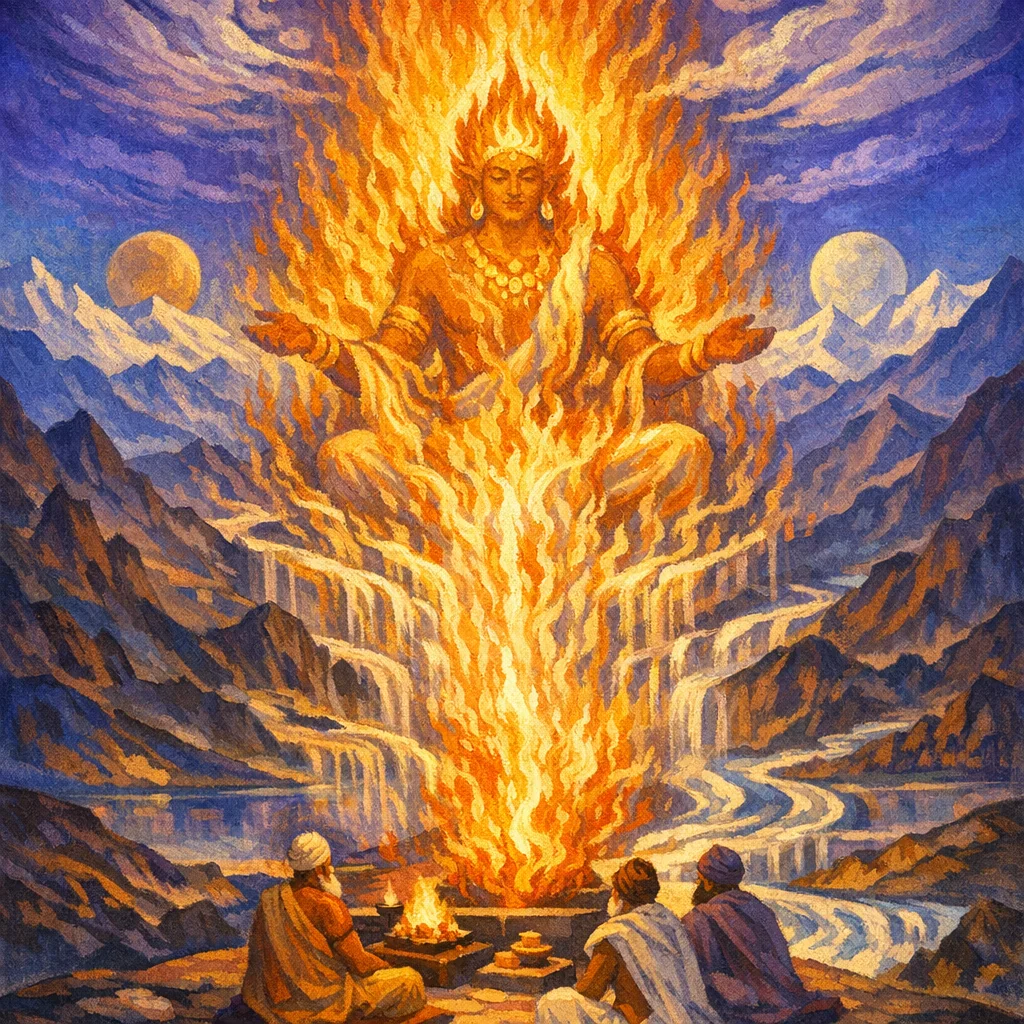
This hymn of Viśvāmitra’s Kuśika line invokes Agni Vaiśvānara as the universal Fire who discovers the “luminous world” (svar) and faithfully carries the offering along the true course of ṛta. As the praise unfolds, Agni’s power is amplified through the Maruts—fierce, rain-bright allies—until Agni is revealed as an inexhaustible, many-streaming fountain: the wise “father of utterances” (vāc) whom Heaven and Earth themselves sustain.
Mantras
Mantra 1
वैश्वानरं मनसाग्निं निचाय्या हविष्मन्तो अनुषत्यं स्वर्विदम् । सुदानुं देवं रथिरं वसूयवो गीर्भी रण्वं कुशिकासो हवामहे ॥
We, bearers of the offering, contemplating with the mind, call the universal Fire, faithful to the truth of the movement, finder of the luminous world. Seeking the riches of being, the Kuśikas invoke with inspired words the god of good giving, swift in the march, delightful in his gladness.
Mantra 2
तं शुभ्रमग्निमवसे हवामहे वैश्वानरं मातरिश्वानमुक्थ्यम् । बृहस्पतिं मनुषो देवतातये विप्रं श्रोतारमतिथिं रघुष्यदम् ॥
For help we call that bright Agni—Vaiśvānara, Mātariśvan, worthy of the hymn—Bṛhaspati for the forming of the godhead in man: the inspired seer, the listener, the swift-moving guest within us.
Mantra 3
अश्वो न क्रन्दञ्जनिभिः समिध्यते वैश्वानरः कुशिकेभिर्युगेयुगे । स नो अग्निः सुवीर्यं स्वश्व्यं दधातु रत्नममृतेषु जागृविः ॥
Like a neighing horse, Vaiśvānara is kindled by the births, age after age, by the Kuśikas. May that Agni, wakeful among the immortals, place in us the treasure—noble heroic power and a right mastery of the life-forces that carry us forward.
Mantra 4
प्र यन्तु वाजास्तविषीभिरग्नयः शुभे सम्मिश्लाः पृषतीरयुक्षत । बृहदुक्षो मरुतो विश्ववेदसः प्र वेपयन्ति पर्वताँ अदाभ्याः ॥
Let the plenitudes of force go forth with the fires in their might; for the shining work they have yoked the dappled energies. The Maruts, strong-bull powers, all-knowing, irresistible, shake the mountains—stirring the fixed masses of our nature to awaken and move.
Mantra 5
अग्निश्रियो मरुतो विश्वकृष्टय आ त्वेषमुग्रमव ईमहे वयम् । ते स्वानिनो रुद्रिया वर्षनिर्णिजः सिंहा न हेषक्रतवः सुदानवः ॥
We call for the help of the Maruts who carry the splendour of Agni, powers belonging to all the peoples. We seek their fierce and vehement protection. Those roaring Rudra-powers, clothed in the rain’s shining force, are like lions—impetuous in will and generous in their giving.
Mantra 6
व्रातंव्रातं गणंगणं सुशस्तिभिरग्नेर्भामं मरुतामोज ईमहे । पृषदश्वासो अनवभ्रराधसो गन्तारो यज्ञं विदथेषु धीराः ॥
Band after band, troop after troop, with clear and right praises we seek the shining power of Agni and the strength of the Maruts. Dapple-horsed, with unclouded bounty, they come to the sacrifice in the assemblies—wise in their discerning movement.
Mantra 7
अग्निरस्मि जन्मना जातवेदा घृतं मे चक्षुरमृतं म आसन् । अर्कस्त्रिधातू रजसो विमानोऽजस्रो घर्मो हविरस्मि नाम ॥
I am Agni by birth, the knower of all becomings. Clarified light is my seeing, and the deathless is my dwelling. I am the hymn as the threefold-founded measure, spanning the mid-worlds; I am the unceasing heat of tapas—by name I am the offering.
Mantra 8
त्रिभिः पवित्रैरपुपोद्ध्यर्कं हृदा मतिं ज्योतिरनु प्रजानन् । वर्षिष्ठं रत्नमकृत स्वधाभिरादिद्द्यावापृथिवी पर्यपश्यत् ॥
With the three strainers he purified the hymn; with the heart he purified the thought, following the light in full knowing. By his own powers of right self-law he made the most raining treasure; then he encompassed and beheld Heaven and Earth.
Mantra 9
शतधारमुत्समक्षीयमाणं विपश्चितं पितरं वक्त्वानाम् । मेळिं मदन्तं पित्रोरुपस्थे तं रोदसी पिपृतं सत्यवाचम् ॥
A hundred-streaming fountain, unfailing; the seer-father of the uttered words—him, the joyous Meḷi in the Father’s lap, the two worlds nourish and fill: him whose speech is truth.
Frequently Asked Questions
The hymn primarily praises Agni as Vaiśvānara, the “universal Fire” present among all peoples, who carries offerings and opens the way to the luminous realm (svar).
The Maruts are invoked as powers that bear Agni’s splendor and provide fierce, energizing protection. They strengthen Agni’s work in the sacrifice and symbolize storm-like force that supports growth and victory.
It means Agni is seen as the source of inspired, truthful speech (vāc) and insight. As the sacrificial fire is kindled, it ‘kindles’ clarity and right expression in the worshiper as well.