Sukta 124
Sukta 10.124
Traditionally attributed in Anukramaṇī to a seer of Mandala 10 (exact name varies by recension); hymn is Agni-directed.
Agni.
Triṣṭubh.
This hymn primarily invokes Agni to come to the sacrifice as the guiding, offering-bearing fire who goes in front and dispels long darkness with enduring light. As the verses unfold, the hymn ranges beyond Agni into allied sovereignty themes—Ṛta versus untruth (Varuṇa), the waning of hostile powers, and a culminating recognition of Indra through symbolic imagery—showing a late-Rigvedic tendency to weave multiple deities into one ritual-spiritual movement.
Mantras
Mantra 1
इमं नो अग्न उप यज्ञमेहि पञ्चयामं त्रिवृतं सप्ततन्तुम् । असो हव्यवाळुत नः पुरोगा ज्योगेव दीर्घं तम आशयिष्ठाः ॥
Come near, O Agni, to this our sacrifice—fivefold in its movements, threefold in its wideness, seven-threaded in its weaving. Be our carrier of the offering, go before us; and as with a long-continued light, lay down the prolonged darkness.
Mantra 2
अदेवाद्देवः प्रचता गुहा यन्प्रपश्यमानो अमृतत्वमेमि । शिवं यत्सन्तमशिवो जहामि स्वात्सख्यादरणीं नाभिमेमि ॥
From the non-god to the God I go, moving with awakened force, journeying in the secret cave, seeing ahead I attain immortality. Leaving the unblissful, though it seemed benign, I pass from my old companionship; I go to the Arani, to the navel—source where the Fire is born.
Mantra 3
पश्यन्नन्यस्या अतिथिं वयाया ऋतस्य धाम वि मिमे पुरूणि । शंसामि पित्रे असुराय शेवमयज्ञियाद्यज्ञियं भागमेमि ॥
Seeing the Guest of another (power) and the wide-winged movement, I measure out many abiding seats of the Ṛta. I proclaim a blissful good to the Father, the Asura (lordly Power); from what is not fit for sacrifice I move toward the truly sacrificial share.
Mantra 4
बह्वीः समा अकरमन्तरस्मिन्निन्द्रं वृणानः पितरं जहामि । अग्निः सोमो वरुणस्ते च्यवन्ते पर्यावर्द्राष्ट्रं तदवाम्यायन् ॥
For many years I dwelt within this (old order); now choosing Indra, I leave the Father. Agni, Soma, and Varuṇa move away from you; the kingdom turns about—I come to claim and protect that (new) domain.
Mantra 5
निर्माया उ त्ये असुरा अभूवन्त्वं च मा वरुण कामयासे । ऋतेन राजन्ननृतं विविञ्चन्मम राष्ट्रस्याधिपत्यमेहि ॥
Those Asuras became devoid of true power; and you too, O Varuṇa, desire me. O King, by Ṛta sifting out the untrue, come to the overlordship of my inner kingdom.
Mantra 6
इदं स्वरिदमिदास वाममयं प्रकाश उर्वन्तरिक्षम् । हनाव वृत्रं निरेहि सोम हविष्ट्वा सन्तं हविषा यजाम ॥
This is the Light; this indeed is the desirable good; this is the wide mid-world of clear shining. We shall smite Vṛtra—come forth, O Soma; you who are present as the offering, with the offering we sacrifice to you.
Mantra 7
कविः कवित्वा दिवि रूपमासजदप्रभूती वरुणो निरपः सृजत् । क्षेमं कृण्वाना जनयो न सिन्धवस्ता अस्य वर्णं शुचयो भरिभ्रति ॥
The Seer, by seerhood, set his form in heaven; Varuṇa, of unobstructed power, released the waters. Making peace and safe wideness, like mothers, like rivers, the pure ones bear and carry his radiant hue.
Mantra 8
ता अस्य ज्येष्ठमिन्द्रियं सचन्ते ता ईमा क्षेति स्वधया मदन्तीः । ता ईं विशो न राजानं वृणाना बीभत्सुवो अप वृत्रादतिष्ठन् ॥
They cleave to his highest might, his Indra-force; they dwell here, rejoicing by their own inner law. Like peoples choosing a king, they choose him; turning away from the Vṛtra-cover, they took their stand apart from it.
Mantra 9
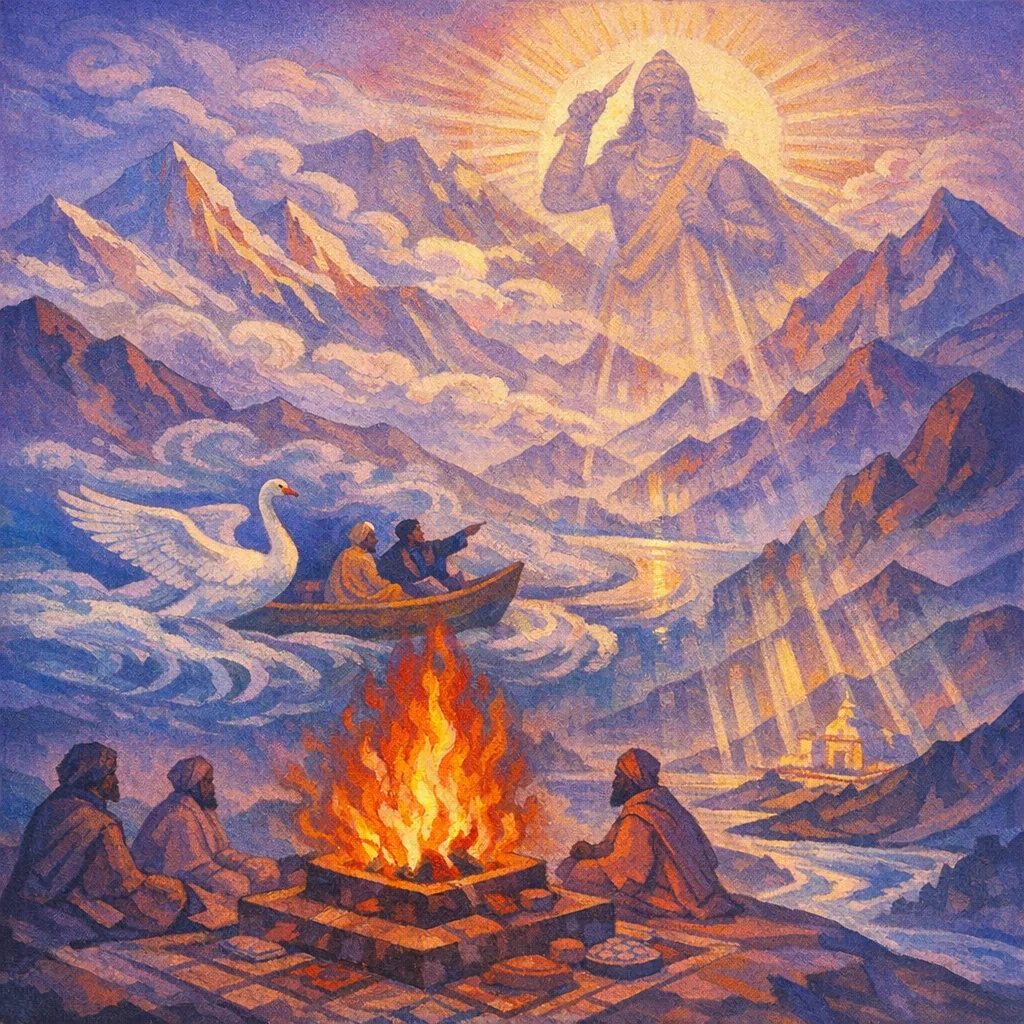
बीभत्सूनां सयुजं हंसमाहुरपां दिव्यानां सख्ये चरन्तम् । अनुष्टुभमनु चर्चूर्यमाणमिन्द्रं नि चिक्युः कवयो मनीषा ॥
They call him the Swan, united with the shunning powers, moving in friendship with the heavenly waters. Following the Anuṣṭubh, following the rhythm that is being set in motion, the seers by inspired thought recognized Indra.
Frequently Asked Questions
Agni is the primary deity and the hymn opens as a clear Agni-invocation, but later verses bring in Varuṇa (ṛta versus untruth) and culminate with a recognition of Indra through symbolic imagery.
It is a poetic way to say the yajña is carefully structured and ‘woven’—having ordered movements, layered expansions, and interlinked parts—so Agni can carry it correctly to the gods.
It can be recited at the lighting of a ritual fire (or a simple home lamp) as an invocation for clarity, right order, and guidance—asking the ‘inner Agni’ to lead and to remove lingering darkness of confusion or inertia.