Sukta 121
Sukta 10.121
Hiraṇyagarbha / Prajāpati (traditional attributions vary; often given to Hiraṇyagarbha)
Ka / Prajāpati / Hiraṇyagarbha (the One Lord as origin of beings)
Tr̥ṣṭubh
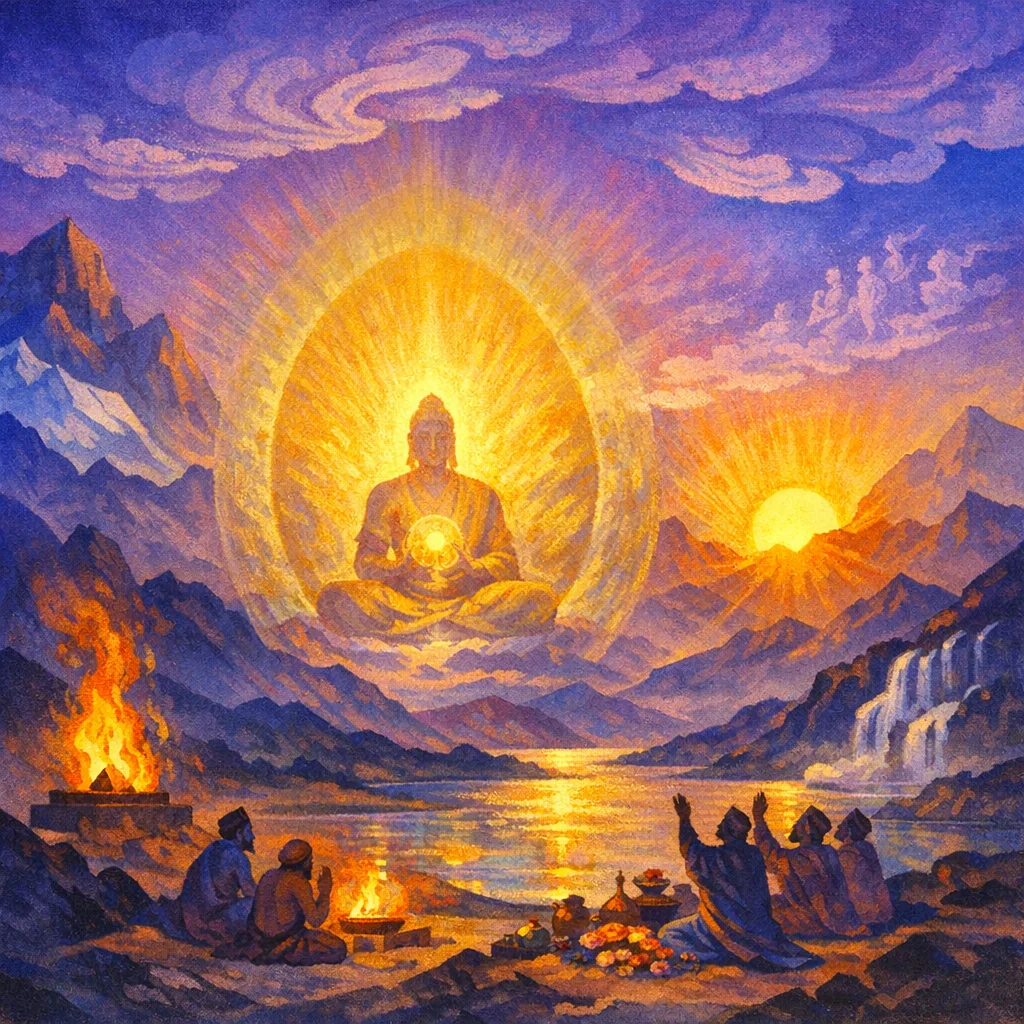
This hymn contemplates the first principle of creation—Hiraṇyagarbha, the “Golden Germ”—as the sole Lord who upholds heaven and earth and from whom all beings arise. Each verse culminates in the searching refrain “kasmai devāya haviṣā vidhema” (“to which God shall we offer?”), expressing awe before the One behind the many. The final verse resolves the inquiry by naming Prajāpati as that encompassing Lord, to whom desires and offerings are entrusted for fullness and prosperity.
Mantras
Mantra 1
हिरण्यगर्भः समवर्तताग्रे भूतस्य जातः पतिरेक आसीत् । स दाधार पृथिवीं द्यामुतेमां कस्मै देवाय हविषा विधेम ॥
The Golden Embryo came into movement in the beginning; born as the one Lord of all becoming. He bore the earth and this heaven: to which God shall we offer the oblation of our will?
Mantra 2
य आत्मदा बलदा यस्य विश्व उपासते प्रशिषं यस्य देवाः । यस्य छायामृतं यस्य मृत्युः कस्मै देवाय हविषा विधेम ॥
He who gives the self and gives the strength, whose command all beings attend, whom even the gods follow in obedience; whose shadow is the Truth-Order and whose shadow is Death: to which God shall we offer the oblation of our will?
Mantra 3
यः प्राणतो निमिषतो महित्वैक इद्राजा जगतो बभूव । य ईशे अस्य द्विपदश्चतुष्पदः कस्मै देवाय हविषा विधेम ॥
He who by his greatness became the one King of all that moves and breathes and blinks; who rules over this two-footed and four-footed world: to which God shall we offer the oblation of our will?
Mantra 4
यस्येमे हिमवन्तो महित्वा यस्य समुद्रं रसया सहाहुः । यस्येमाः प्रदिशो यस्य बाहू कस्मै देवाय हविषा विधेम ॥
Whose greatness these snow-peaks are, whose is the ocean with the flowing sap of waters; whose are these directions as his arms: to which God shall we offer the oblation of our will?
Mantra 5
येन द्यौरुग्रा पृथिवी च दृळ्हा येन स्व स्तभितं येन नाकः । यो अन्तरिक्षे रजसो विमानः कस्मै देवाय हविषा विधेम ॥
By whom the mighty heaven and the firm earth were made stable; by whom the luminous world was propped and the summit established; who in the mid-region measured out the spaces: to which God shall we offer the oblation of our will?
Mantra 6
यं क्रन्दसी अवसा तस्तभाने अभ्यैक्षेतां मनसा रेजमाने । यत्राधि सूर उदितो विभाति कस्मै देवाय हविषा विधेम ॥
Whom the two worlds, upheld by his help, looked upon—trembling in mind; in whom and upon whom the Sun, when risen, shines forth: to which God shall we offer the oblation of our will?
Mantra 7
आपो ह यद्बृहतीर्विश्वमायन्गर्भं दधाना जनयन्तीरग्निम् । ततो देवानां समवर्ततासुरेकः कस्मै देवाय हविषा विधेम ॥
When the mighty Waters came bearing all the world, holding the embryo, bringing forth Agni—then from them the one Breath of the gods came into full movement: to which God shall we offer the oblation of our will?
Mantra 8
यश्चिदापो महिना पर्यपश्यद्दक्षं दधाना जनयन्तीर्यज्ञम् । यो देवेष्वधि देव एक आसीत्कस्मै देवाय हविषा विधेम ॥
He who, by his greatness, beheld the Waters all around as they held the creative skill and brought forth the sacrifice. He who was the one God above the gods: to which God shall we offer the oblation of our will?
Mantra 9
मा नो हिंसीज्जनिता यः पृथिव्या यो वा दिवं सत्यधर्मा जजान । यश्चापश्चन्द्रा बृहतीर्जजान कस्मै देवाय हविषा विधेम ॥
May He not harm us—He, the Father who brought forth the Earth, and who, established in the law of Truth, engendered the Heaven; who also brought forth the Waters—luminous and vast. To which God shall we offer the oblation?
Mantra 10
प्रजापते न त्वदेतान्यन्यो विश्वा जातानि परि ता बभूव । यत्कामास्ते जुहुमस्तन्नो अस्तु वयं स्याम पतयो रयीणाम् ॥
O Lord of beings, none other than you has encompassed all these births. What desires we offer to you in the flame—may that become ours; may we be masters of the plenitudes of being.
Frequently Asked Questions
It is a deliberate spiritual inquiry: the hymn lists the powers that sustain the universe and then asks who truly stands behind them. The refrain turns wonder into worship, pointing toward one ultimate Lord rather than many separate sources.
In the verses, “Ka” is grammatically “who,” but it functions as the name of the unknown supreme source being sought. The last verse clarifies the intended deity by naming Prajāpati as that encompassing Lord.
Hiraṇyagarbha means “Golden Germ/Embryo,” an image for the first seed of creation—radiant, life-bearing, and prior to the formed worlds. It signifies the primordial origin from which heaven, earth, and all beings arise and by which they are upheld.