Sarga 66
शिवधनुर्न्यासकथा तथा सीतोत्पत्तिविवाहशुल्क-निश्चयः (The Bow of Śiva: Its Deposit, Sītā’s Origin, and the Prowess-Brideprice Vow)
बालकाण्ड
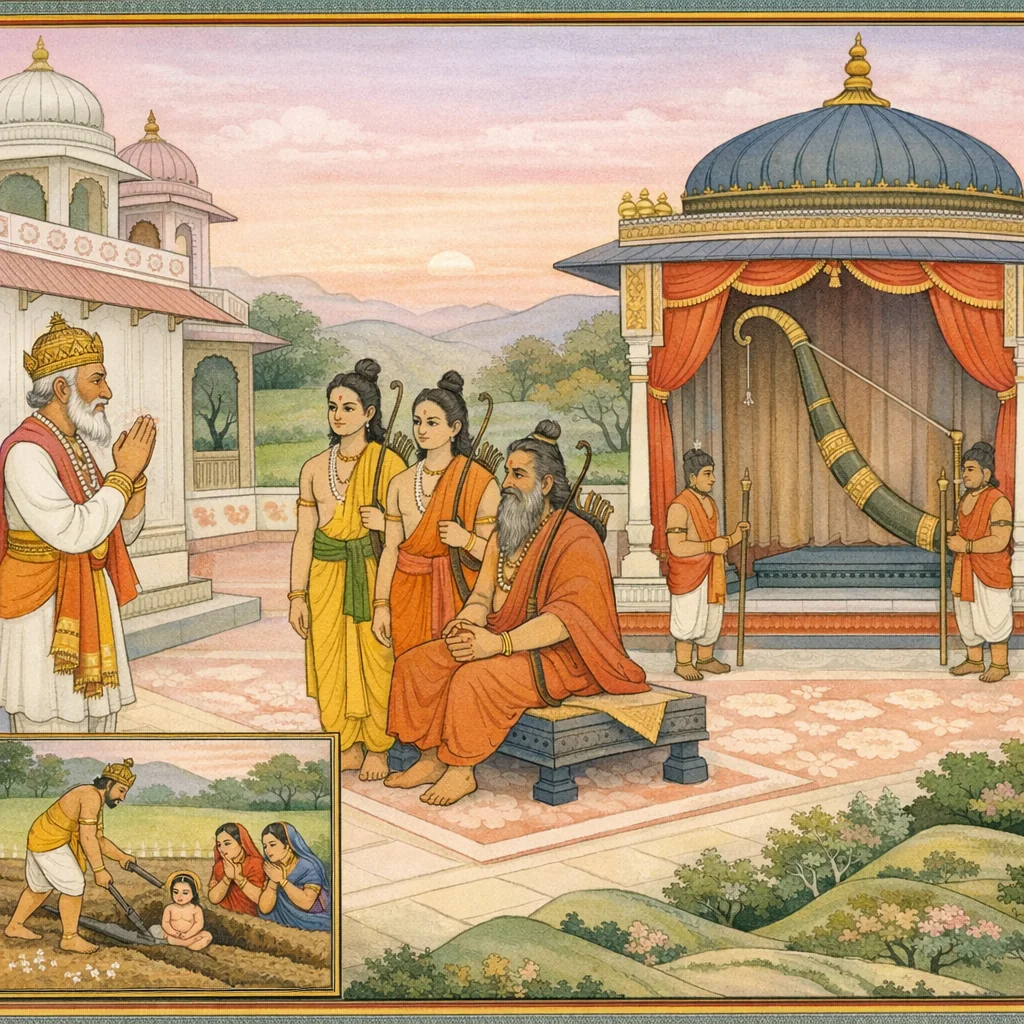
At dawn, King Janaka, having completed his rites, honors Viśvāmitra together with Rāma and Lakṣmaṇa and formally offers his service. Viśvāmitra states the princes’ purpose: they wish to behold the extraordinary bow kept in Janaka’s custody. Janaka recounts the bow’s custodial history: during the episode of Dakṣa’s sacrifice, Rudra brandished it and threatened the gods for neglecting his sacrificial share; the frightened devas propitiated Śiva, and when he was pleased, the bow was entrusted to Janaka’s ancestral line for safekeeping. He then narrates Sītā’s emergence from the earth as he ploughed and purified the sacrificial field, emphasizing that she is ayoni-ja—not womb-born—and that she grew as his daughter. Janaka sets a strict marriage condition: only one who proves his prowess by lifting and stringing the bow may win Sītā. Many kings come to test themselves but cannot even lift it; Janaka rejects them. Humiliated, they besiege Mithilā for a year and drain its resources; Janaka performs austerities, receives divine fourfold forces, and defeats the aggressors, who flee. Concluding, he promises to show the radiant bow to Rāma and Lakṣmaṇa and vows to give Sītā to Rāma if he can lift and string it.
Shlokas
Verse 1
तत: प्रभाते विमले कृतकर्मा नराधिप:।विश्वामित्रं महात्मानं आजुहाव सराघवम्।।1.66.1।।
Then, at the clear and stainless dawn, the king—having completed his daily rites—invited the great-souled Viśvāmitra, together with the Rāghavas.
Verse 2
तमर्चयित्वा धर्मात्मा शास्त्रदृष्टेन कर्मणा।राघवौ च महात्मानौ तदा वाक्यमुवाच ह।।1.66.2।।
Having honoured Viśvāmitra with rites prescribed by the śāstras, the righteous-souled Janaka also paid due respect to the great-souled Rāghavas, and then began to speak.
Verse 3
भगवन् स्वागतं तेऽस्तु किं करोमि तवानघ।भवानाज्ञापयतु मामाज्ञाप्यो भवता ह्यहम्।।1.66.3।।
“Venerable sir, welcome. O sinless one, what may I do for you? Please command me—for I am indeed to be directed by you.”
Verse 4
एवमुक्तस्स धर्मात्मा जनकेन महात्मना।प्रत्युवाच मुनिर्वीरं वाक्यं वाक्यविशारद:।।1.66.4।।
Thus addressed by the great-souled Janaka, the righteous sage—skilled in speech—replied to the heroic king.
Verse 5
पुत्रौ दशरथस्येमौ क्षत्रियौ लोकविश्रुतौ।द्रुष्टुकामौ धनु श्श्रेष्ठं यदेतत्वयि तिष्ठति।।1.66.5।।
“These two are Daśaratha’s sons, renowned kṣatriyas in the world. They wish to see that excellent bow which is in your keeping.”
Verse 6
एतद्दर्शय भद्रं ते कृतकामौ नृपात्मजौ।दर्शनादस्य धनुषो यथेष्टं प्रतियास्यत:।।1.66.6।।
May good befall you. Show this bow to the two princes; once they have seen it and their wish is fulfilled, they will return as they please.
Verse 7
एवमुक्तस्तु जनक: प्रत्युवाच महामुनिम्।श्रूयतामस्य धनुषो यदर्थमिह तिष्ठति।।1.66.7।।
Thus addressed, Janaka replied to the great sage: “Let it be heard why this bow is kept here.”
Verse 8
देवरात इति ख्यातो निमेष्षष्ठो महीपति:।न्यासोऽयं तस्य भगवन् हस्ते दत्तो महात्मना।।1.66.8।।
“O revered one, there was a famed king named Devarāta, sixth in descent from Nimi. This bow, O Bhagavān, was entrusted into his hands by the great Lord Śiva.”
Verse 9
दक्षयज्ञवधे पूर्वं धनुरायम्य वीर्यवान्।रुद्रस्तु त्रिदशान् रोषात्सलीलमिदमब्रवीत्।।1.66.9।।
Formerly, at the destruction of Dakṣa’s sacrifice, mighty Rudra drew up the bow; angered, he spoke these words to the gods—yet with a dreadful, playful edge.
Verse 10
यस्माद्भागार्थिनो भागान्नाकल्पयत मे सुरा:।वराङ्गाणि महार्हाणि धनुषा शातयामि व:।।1.66.10।।
“Since you gods—though eager for your own shares—did not allot me my due portion in the sacrificial offerings, I shall cut down your precious, beautiful limbs with this bow!”
Verse 11
ततो विमनसस्सर्वे देवा वै मुनिपुङ्गव।प्रसादयन्ति देवेशं तेषां प्रीतोऽभवद्भव:।।1.66.11।।
Then, O best of sages, all the gods—downcast at heart—propitiated the Lord of the gods, Bhava (Śiva), and he became pleased with them.
Verse 12
प्रीतियुक्तस्स सर्वेषां ददौ तेषां महात्मनाम्।तदेतद्देवदेवस्य धनूरत्नं महात्मन:। न्यासभूतं तदा न्यस्तमस्माकं पूर्व के विभो।।1.66.12।।
Pleased with them all, he granted those great beings the jewel-like bow of the great Devadeva (Śiva). Later, O Lord, it was deposited as a sacred trust with our ancestor in former times.
Verse 13
अथ मे कृषत: क्षेत्रं लाङ्गूलादुत्थिता मया।क्षेत्रं शोधयता लब्धा नाम्ना सीतेति विश्रुता।।1.66.13।।
Later, as I was ploughing the field and purifying the ground, she rose up for me from the ploughshare; thus she was found and became renowned by the name Sītā.
Verse 14
भूतलादुत्थिता सा तु व्यवर्धत ममात्मजा।वीर्यशुल्केति मे कन्या स्थापितेयमयोनिजा।।1.66.14।।
Though she had arisen from the earth, she grew up as my own daughter. This maiden—unborn of any womb—I ordained to be won only by the bride-price of proven prowess.
Verse 15
भूतलादुत्थितां तां तु वर्धमानां ममात्मजाम्।वरयामासुरागम्य राजानो मुनिपुंगव।।1.66.15।।
O best of sages, as that daughter of mine—born of the earth—grew up, kings came and sought her hand in marriage.
Verse 16
तेषां वरयतां कन्यां सर्वेषां पृथिवीक्षिताम्।वीर्यशुल्केति भगवन् न ददामि सुतामहम्।।1.66.16।।
Though all those rulers sought the maiden, O revered one, I did not give my daughter, holding to the condition that she be won only by proven prowess.
Verse 17
ततस्सर्वे नृपतय स्समेत्य मुनिपुंगव।मिथिलामभ्युपागम्य वीर्यजिज्ञासवस्तदा।।1.66.17।।
Then, O foremost sage, all those kings assembled and came to Mithilā, eager to put their strength to the test.
Verse 18
तेषां जिज्ञासमानानां वीर्यं धनुरुपाहृतम्।न शेकुर्ग्रहणे तस्य धनुषस्तोलनेऽपि वा।।1.66.18।।
As they sought to test their strength, the bow was brought forth; yet they could not even grasp it—much less lift it.
Verse 19
तेषां वीर्यवतां वीर्यमल्पं ज्ञात्वा महामुने ।प्रत्याख्याता नृपतयस्तन्निबोध तपोधन।।1.66.19।।
Seeing, O great sage, that the prowess of those who boasted of strength was in truth meagre, I rejected those kings—understand this, O treasure of austerity.
Verse 20
तत: परमकोपेन राजानो नृपपुङ्गव।न्यरुंधन्मिथिलां सर्वे वीर्यसंदेहमागता:।।1.66.20।।
Then, O best of kings, all those rulers—seized by fierce anger and troubled by doubt about their own prowess—came and surrounded Mithilā.
Verse 21
आत्मानमवधूतं ते विज्ञाय नृपपुङ्गवा:।रोषेण महताऽऽविष्टा: पीडयन्मिथिलां पुरीम्।।1.66.21।।
Those eminent kings, realizing they had been scorned, were possessed by great fury and began oppressing the city of Mithilā.
Verse 22
ततस्संवत्सरे पूर्णे क्षयं यातानि सर्वश:।साधनानि मुनिश्रेष्ठ ततोऽहं भृशदु:खित:।।1.66.22।।
When a full year had passed, O best of sages, all resources everywhere were depleted; and then I became deeply distressed.
Verse 23
ततो देवगणान् सर्वान् तपसाऽहं प्रसादयम्।ददुश्च परमप्रीता श्चतुरङ्गबलं सुरा:।।1.66.23।।
Then I propitiated all the hosts of gods through austerity (tapas); and the gods, greatly pleased, granted me a fourfold army.
Verse 24
ततो भग्ना नृपतयो हन्यमाना दिशो ययु:।अवीर्या वीर्यसन्दिग्धा स्सामात्या: पापकर्मण:।।1.66.24।।
Then the kings—wicked in deed—were struck down, broken in spirit, and fled in all directions along with their ministers, their courage failing and their valor in doubt.
Verse 25
तदेतन्मुनिशार्दूल धनु: परमभास्वरम्।रामलक्ष्मणयोश्चापि दर्शयिष्यामि सुव्रत।।1.66.25।।
Therefore, O tiger among sages, O steadfast in vows, I shall show to Rāma and Lakṣmaṇa as well that supremely radiant bow.
Verse 26
यद्यस्य धनुषो राम: कुर्यादारोपणं मुने।सुतामयोनिजां सीतां दद्यां दाशरथेरहम्।।1.66.26।।
O sage, if Rāma can lift and string this bow, then I shall give my daughter Sītā—born without a human mother—to Daśaratha’s son.
Frequently Asked Questions
Janaka’s pivotal action is the establishment and defense of a merit-based marriage condition (vīrya-śulka): Sītā will be given only to one who can lift and string Śiva’s bow. The ethical tension arises when rejected kings, feeling dishonored, retaliate by besieging Mithilā—testing Janaka’s duty to protect subjects while maintaining a principled vow.
The Sarga links power to accountability: divine power (Śiva’s bow) is held in trust (nyāsa) and must be approached through proper reverence, while human authority (Janaka’s kingship) must uphold vows even under coercion. It also frames legitimacy—of marriage, rule, and social order—as grounded in tested competence rather than mere status.
Mithilā is presented as a cultural-political center where royal hospitality, ritual practice, and martial testing converge. The sacrificial field (yajña-kṣetra) becomes a landmark of origin for Sītā (earth-born discovery during ploughing), and the memory of Dakṣa’s sacrifice functions as a pan-Indic ritual-historical reference anchoring the bow’s sanctity.