Sarga 55
कामधेनुसैन्यप्रादुर्भावः — Kamadhenu’s Forces, Visvamitra’s Austerities, and Vasishta’s Wrath
बालकाण्ड
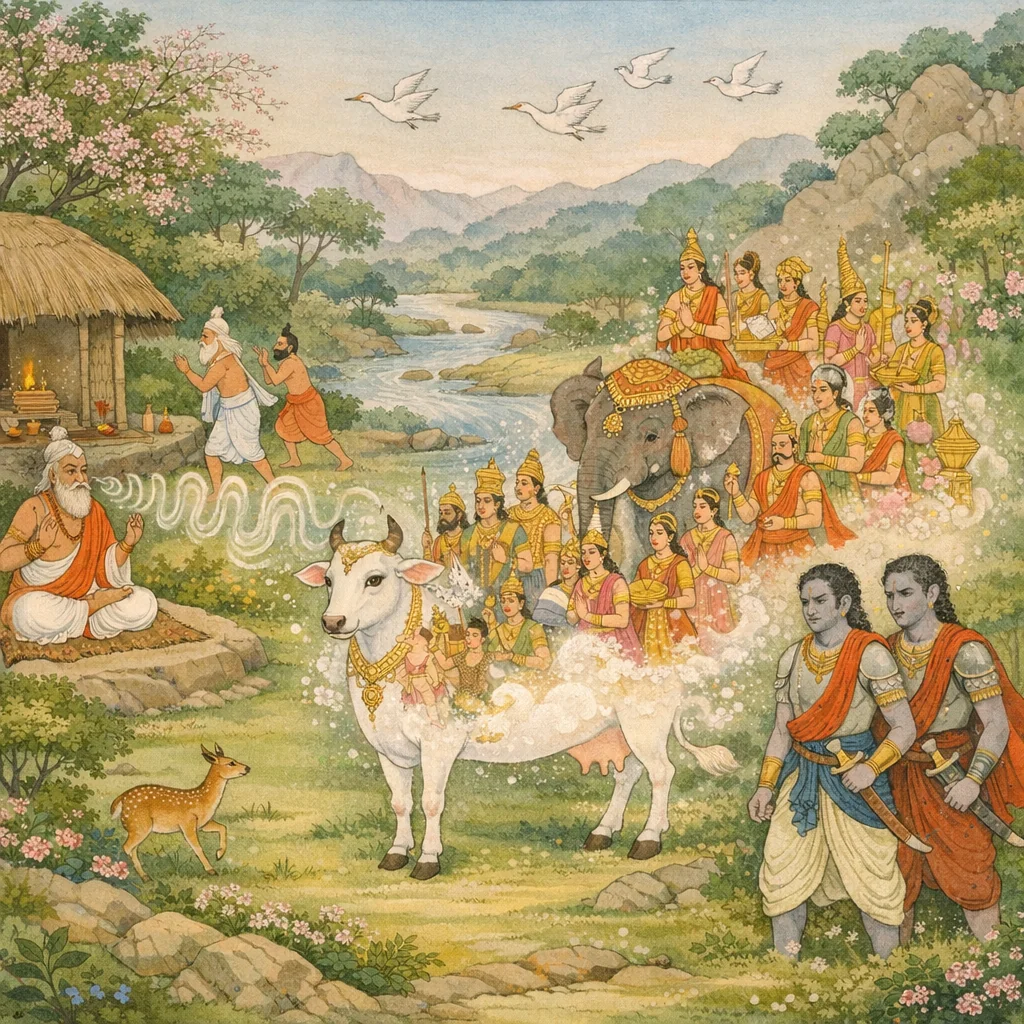
In Sarga 55, the contest between kṣātra might and brahma-tejas grows fiercer. Seeing Viśvāmitra’s forces overwhelmed by astras, Vasiṣṭha commands Kāmadhenu to bring forth fresh armies through yogic power; from her body and from her sound arise many hosts, and Viśvāmitra’s army is swiftly destroyed. Viśvāmitra’s sons, armed and enraged, rush at Vasiṣṭha, but the sage’s humkāra reduces them to ashes. Bereft of sons and military strength, the king sinks into despair. He appoints a remaining son to rule according to kṣatriya custom and withdraws to the slopes of Himavat to perform tapas and propitiate Mahādeva. Śiva appears as boon-giver. Viśvāmitra asks for mastery of Dhanurveda with its branches and secrets, and for the revelation of all divine and non-human weapons. Granted these gifts, his pride swells; thinking Vasiṣṭha already defeated, he returns to the hermitage and releases astras that burn the ascetic forest. As sages, disciples, animals, and birds flee, Vasiṣṭha reassures them, then—righteously angered—condemns Viśvāmitra’s misconduct and raises his staff like a second Yama-daṇḍa, signaling the imminent escalation of spiritual power against arrogant violence.
Shlokas
Verse 1
ततस्तानाकुलान् दृष्ट्वा विश्वामित्रास्त्रमोहितान्।वसिष्ठश्चोदयामास कामधुक् सृज योगत:।।1.55.1।।
Then Vasiṣṭha, seeing them distressed and bewildered by Viśvāmitra’s weapons, urged Kāmadhenu: “By your yogic power, bring forth additional forces.”
Verse 2
तस्याहुम्भारवाज्जाता: काम्भोजा रविसन्निभा:।ऊधसस्त्वथ सञ्जाता: पप्लवाश्शस्त्रपाणय:।।1.55.2।।योनिदेशाच्च यवनाश्शकृद्देशाच्छका स्तथा।रोमकूपेषु च म्लेच्छा हारीतास्सकिरातका:।।1.55.3।।
From her cry of “humbhā” were born the Kāmbojas, radiant like the sun; from her udder arose the Paplavas, weapons in their hands. From her womb came the Yavanas; from her anus, the Śakas; and from the pores of her skin sprang the Mlecchas, together with the Hārītas and the Kirātas.
Verse 3
तस्याहुम्भारवाज्जाता: काम्भोजा रविसन्निभा:।ऊधसस्त्वथ सञ्जाता: पप्लवाश्शस्त्रपाणय:।।1.55.2।।योनिदेशाच्च यवनाश्शकृद्देशाच्छका स्तथा।रोमकूपेषु च म्लेच्छा हारीतास्सकिरातका:।।1.55.3।।
From her womb-region arose the Yavanas; from the anus-region likewise the Śakas; and from the pores of the skin arose the Mlecchas—together with the Hārītas and the Kirātas.
Verse 4
तैस्तैर्निषूदितं सर्वं विश्वामित्रस्य तत्क्षणात्।सपदातिगजं साश्वं सरथं रघुनन्दन।।1.55.4।।
O joy of the Raghus, in that very instant, by those forces Viśvāmitra’s entire army—infantry and elephants, horses and chariots—was destroyed on the spot.
Verse 5
दृष्ट्वा निषूदितं सैन्यं वसिष्ठेन महात्मना।विश्वामित्रसुतानां च शतं नानाविधायुधम्।।1.55.5।।अभ्यधावत्सुसङ्कृद्धं वसिष्ठं जपतां वरम्।हुङ्कारेणैव तान् सर्वान् ददाह भगवान् ऋषि:।।1.55.6।।
Seeing the army destroyed by the great-souled Vasiṣṭha, a hundred sons of Viśvāmitra—armed with weapons of many kinds—rushed in fury at Vasiṣṭha, the foremost among those devoted to japa. But the blessed sage burned them all to ashes by the mere utterance of “huṃ”.
Verse 6
दृष्ट्वा निषूदितं सैन्यं वसिष्ठेन महात्मना।विश्वामित्रसुतानां च शतं नानाविधायुधम्।।1.55.5।।अभ्यधावत्सुसङ्कृद्धं वसिष्ठं जपतां वरम्।हुङ्कारेणैव तान् सर्वान् ददाह भगवान् ऋषि:।।1.55.6।।
Seeing the army destroyed by the great-souled Vasiṣṭha, a hundred sons of Viśvāmitra—armed with weapons of many kinds—rushed in fury at Vasiṣṭha, the foremost among those devoted to japa. But the blessed sage burned them all to ashes by the mere utterance of “huṃ”.
Verse 7
ते साश्वरथपादाता वसिष्ठेन महात्मना।भस्मीकृता मुहूर्तेन विश्वामित्रसुता स्तदा।।1.55.7।।
Then those sons of Viśvāmitra—together with their horses, chariots, and foot-soldiers—were reduced to ashes in a moment by the great-souled Vasiṣṭha.
Verse 8
दृष्ट्वा विनाशितान् पुत्रान् बलं च सुमहायशा:।सव्रीडश्चिन्तयाऽविष्टो विश्वामित्रोऽभवत्तदा।।1.55.8।।
Seeing his sons and his army destroyed, the highly renowned Viśvāmitra was filled with shame and sank into anxious reflection.
Verse 9
समुद्र इव निर्वेगो भग्नदंष्ट्र इवोरग:।उपरक्त इवादित्यस्सद्यो निष्प्रभतां गत:।।1.55.9।।
He suddenly became bereft of radiance—like an ocean stilled of waves, like a serpent whose fangs are broken, and like the sun when eclipsed.
Verse 10
हतपुत्रबलो दीनो लूनपक्ष इव द्विज:।हतदर्पो हतोत्साहो निर्वेदं समपद्यत।।1.55.10।।
With his sons and army slain, wretched like a bird with clipped wings, his pride broken and his spirit crushed, Viśvāmitra fell into despair.
Verse 11
स पुत्रमेकं राज्याय पालयेति नियुज्य च।पृथिवीं क्षत्रधर्मेण वनमेवान्वपद्यत।।1.55.11।।
He appointed one son to rule the kingdom in accordance with kṣatriya-dharma, and then departed for the forest.
Verse 12
स गत्वा हिमवत्पार्श्वं किन्नरोरगसेवितम्।महादेवप्रसादार्थं तपस्तेपे महातपा:।।1.55.12।।
That great ascetic went to the slopes of Himavat, frequented by kinnaras and nāgas, and performed austerities to win Mahādeva’s grace.
Verse 13
केनचित्त्वथ कालेन देवेशो वृषभध्वज:।दर्शयामास वरदो विश्वामित्रं महाबलम्।।1.55.13।।
After some time, the Lord of the gods—bull-bannered and bestower of boons—revealed himself to the mighty Viśvāmitra.
Verse 14
किमर्थं तप्यसे राजन् ब्रूहि यत्ते विवक्षितम्।वरदोऽस्मि वरो यस्ते काङ्क्षितस्सोऽभिधीयताम्।।1.55.14।।
“O king, for what purpose do you perform austerities? Speak what you intend. I am a giver of boons—declare the boon you desire.”
Verse 15
एवमुक्तस्तु देवेन विश्वामित्रो महातपा:।प्रणिपत्य महादेवमिदं वचनमब्रवीत्।।1.55.15।।
Thus addressed by the god, the great ascetic Viśvāmitra bowed down to Mahādeva and spoke these words.
Verse 16
यदि तुष्टो महादेव धनुर्वेदो ममानघ।साङ्गोपाङ्गोपनिषदस्सरहस्य: प्रदीयताम्।।1.55.16।।
“If you are pleased, O Mahādeva, O blameless one, grant me Dhanurveda—together with its limbs and sub-limbs, its upaniṣadic teachings, and its inner secrets.”
Verse 17
यानि देवेषु चास्त्राणि दानवेषु महर्षिषु।गन्धर्वयक्षरक्षस्सु प्रतिभान्तु ममानघ।।1.55.17।।
“And whatever weapons are known among the gods, dānavas, great seers, gandharvas, yakṣas, and rākṣasas—O blameless one—may they all arise clearly within my understanding.”
Verse 18
तव प्रसादाद्भवतु देवदेवममेप्सितम्।एवमस्त्विति देवेशो वाक्यमुक्त्वा गतस्तदा।।1.55.18।।
“O God of gods, by your grace let my desire be fulfilled.” Saying, “So be it,” the Lord of the gods spoke and then departed.
Verse 19
प्राप्य चास्त्राणि राजर्षिर्विश्वामित्रो महाबल:।दर्पेण महता युक्तो दर्पपूर्णोऽभवत्तदा।।1.55.19।।
Having obtained the weapons, the royal sage Viśvāmitra, mighty in strength, became filled with great pride, swollen with arrogance at that time.
Verse 20
विवर्धमानो वीर्येण समुद्र इव पर्वणि।हतमेव तदा मेने वसिष्ठमृषिसत्तमम्।।1.55.20।।
As his might swelled—like the ocean on the days of the full moon—he then imagined that Vasiṣṭha, the best of seers, was as good as slain.
Verse 21
ततो गत्वाऽऽश्रमपदं मुमोचास्त्राणि पार्थिव:।यैस्तत्तपोवनं सर्वं निर्दग्धं चास्त्रतेजसा।।1.55.21।।
Then the king went to the hermitage-ground and loosed the weapons—by whose fiery force the entire ascetics’ forest was burned.
Verse 22
उदीर्यमाणमस्त्रं तद्विश्वामित्रस्य धीमत:।दृष्ट्वा विप्रद्रुतास्सर्वे मुनयश्शतशो दिश:।।1.55.22।।
Seeing that weapon being set in motion by the astute Viśvāmitra, all the sages fled—by the hundreds—toward every direction.
Verse 23
वसिष्ठस्य च ये शिष्यास्तथैव मृगपक्षिण:।विद्रवन्ति भयाद्भीता नानादिग्भ्यस्सहस्रश:।।1.55.23।।
Vasiṣṭha’s disciples too—and likewise the animals and birds—stricken with fear, fled in their thousands toward many directions.
Verse 24
वसिष्ठस्याश्रमपदं शून्यमासीन्महात्मन:।मुहूर्तमिव निश्शब्दमासीदिरिणसन्निभम्।।1.55.24।।
The great-souled Vasiṣṭha’s hermitage-place became empty; in but a moment it fell silent, like a barren tract of land.
Verse 25
वदतो वै वसिष्ठस्य मा भैरिति मुहुर्मुहु:।नाशयाम्यद्य गाधेयं नीहारमिव भास्कर:।।1.55.25।।
Even as Vasiṣṭha repeatedly said, “Do not fear,” he declared: “Today I shall destroy Gādheya (Viśvāmitra), just as the sun dispels mist.”
Verse 26
एवमुक्त्वा महातेजा वसिष्ठो जपतां वर:।विश्वामित्रं तदा वाक्यं सरोषमिदमब्रवीत्।।1.55.26।।
Having spoken thus, the radiant Vasiṣṭha—foremost among those who recite sacred prayers—then addressed Viśvāmitra with these words, in anger.
Verse 27
आश्रमं चिरसम्वृद्धं यद्विनाशितवानसि।दुराचारोऽसि तन्मूढ तस्मात्त्वं न भविष्यसि।।1.55.27।।
“You have destroyed an āśrama that had grown and flourished over a long time. Therefore your conduct is wicked, O fool; hence you shall not endure—you shall not survive.”
Verse 28
इत्युक्त्वा परमक्रुद्धो दण्डमुद्यम्य सत्वर:।विधूममिव कालाग्निं यमदण्डमिवापरम्।।1.55.28।।
Having spoken thus, Vasiṣṭha—seized by extreme wrath—swiftly raised his staff, which shone like the smokeless fire of cosmic dissolution and like another very rod of Yama, the Lord of Death.
Frequently Asked Questions
The pivotal action is Viśvāmitra’s escalation from rivalry into destructive misconduct: after receiving astras through tapas, he attacks an established tapovana and threatens ascetic life, testing the boundary between legitimate kṣatriya power and adharmic violence against protected sacred space.
The chapter teaches that power gained—whether by arms or austerity—requires inner restraint; otherwise darpa (inflated pride) converts capability into ethical collapse. It also asserts the primacy of brahma-tejas (spiritual authority) in safeguarding dharma when worldly force becomes disruptive.
Himavat’s slopes function as the ascetic geography for tapas and divine encounter, while Vasiṣṭha’s āśrama and its surrounding tapovana represent protected cultural space of yajña, japa, discipleship, and non-violent coexistence with animals and birds.