Sarga 19
एकोनविंशः सर्गः (Sarga 19): Rāma’s Unshaken Acceptance of Exile and Kaikeyī’s Urgency
अयोध्याकाण्ड
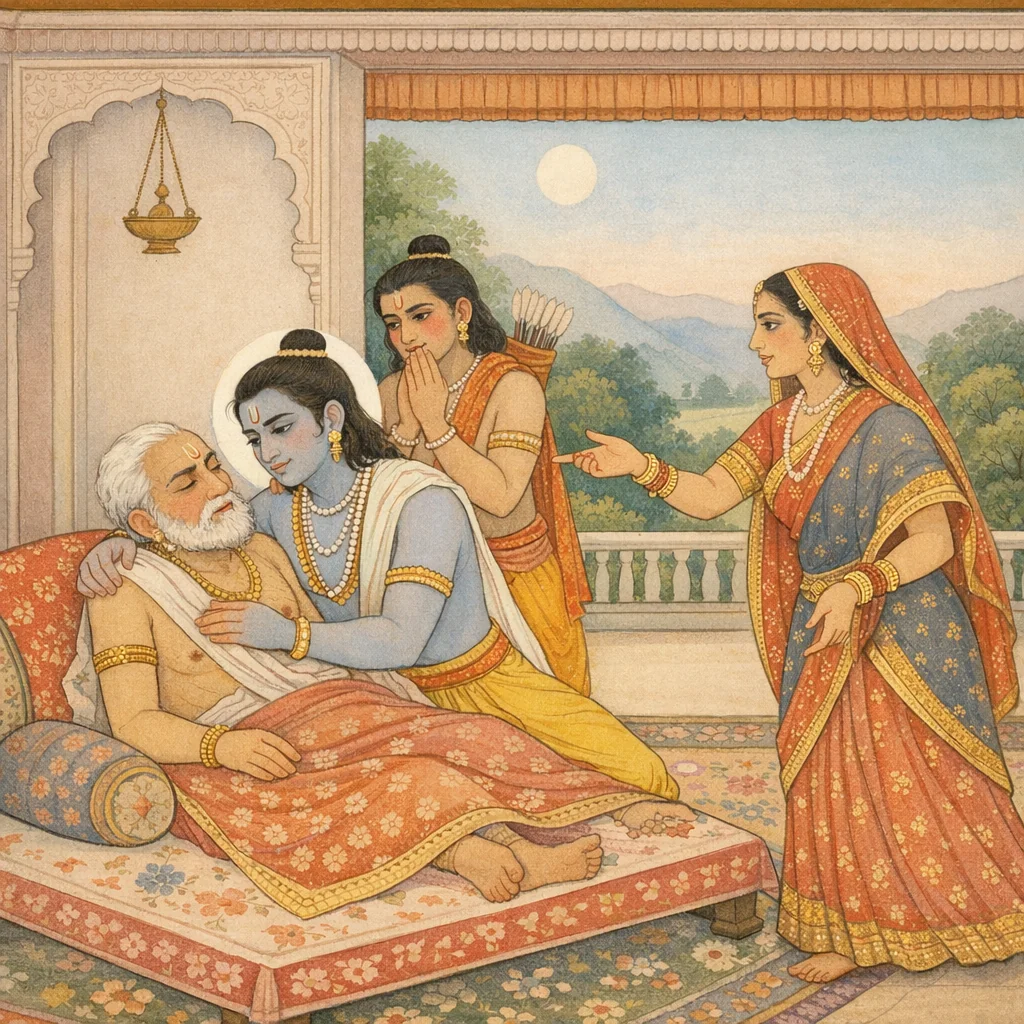
This sarga presents a concentrated discourse within the antaḥpura. Rāma receives Kaikeyī’s demand—words “like death”—yet shows no outward distress. Seeking the reason for Daśaratha’s silence, he openly commits to forest-life in bark-garments and matted locks to uphold the king’s promise. He proclaims obedience to a father’s word as the highest dharma, declaring himself indifferent to wealth, like sages devoted solely to righteousness. At once the kingdom’s arrangements begin: messengers are ordered to bring Bharata from his maternal uncle’s house. Kaikeyī, convinced of Rāma’s departure, urges him on and even wields Daśaratha’s fasting as pressure—until Rāma leaves, the king will neither bathe nor eat. Daśaratha collapses in grief; Rāma lifts him, reverently circumambulates his father and Kaikeyī, and exits. The narration emphasizes Rāma’s unwavering composure—his splendor undiminished like the moon—and his care to conceal the bitter news from friends. He dismisses royal emblems (umbrella, fans, chariot), restrains his senses, and enters his mother’s residence to announce the reversal, while Lakṣmaṇa follows with tearful anger.
Shlokas
Verse 1
तदप्रियममित्रघ्नो वचनं मरणोपमम्।श्रुत्वा न विव्यथे रामः कैकेयीं चेदमब्रवीत्।।2.19.1।।
Hearing those unpleasant words—painful as death—the enemy-slayer Rāma did not waver; instead, he spoke these words to Kaikeyī.
Verse 2
एवमस्तु गमिष्यामि वनं वस्तुमहं त्वितः। जटाजिनधरो राज्ञः प्रतिज्ञामनुपालयन्।।2.19.2।।
So be it. From here I shall go to the forest and dwell there, wearing matted locks and a deerskin, upholding the king’s promise.
Verse 3
इदं तु ज्ञातुमिच्छामि किमर्थं मां महीपतिः।नाभिनन्दति दुर्धर्षो यथापूर्वमरिन्दमः।।2.19.3।।
Yet I wish to know why the king—unassailable, a subduer of enemies—does not greet me as he used to before.
Verse 4
मन्युर्न च त्वया कार्यो देवि ब्रूमि तवाग्रतः।यास्यामि भव सुप्रीता वनं चीरजटाधरः।।2.19.4।।
“O Devi, you must not give way to anger or distress. I declare before you: I will go to the forest, wearing bark-cloth and matted locks. Be at peace.”
Verse 5
हितेन गुरुणा पित्रा कृतज्ञेन नृपेण च।नियुज्यमानो विस्रब्धः किं न कुर्यामहं प्रियम्।।2.19.5।।
When I am commanded by my father—my benefactor, my teacher, a man of grateful heart, and the king—how could I not, without hesitation, do what pleases him?
Verse 6
अलीकं मानसं त्वेकं हृदयं दहतीव मे।स्वयं यन्नाह मां राजा भरतस्याभिषेचनम्।।2.19.6।।
One thing alone pains me and burns my heart: that the king himself did not tell me directly about Bharata’s consecration.
Verse 7
अहं हि सीतां राज्यं च प्राणानिष्टान्धनानि च।हृष्टो भ्रात्रे स्वयं दद्यां भरतायाप्रचोदितः।।2.19.7।।
Unprompted, I would gladly give Bharata the kingdom, wealth, even my cherished life—and even Sītā—if it served my brother.
Verse 8
किं पुनर्मनुजेन्द्रेण स्वयं पित्रा प्रचोदितः।तव च प्रियकामार्थं प्रतिज्ञामनुपालयन्।।2.19.8।।
How much more so, when my own father—the king—has commanded it, and when I am upholding a promise for the sake of your cherished wish?
Verse 9
तदाश्वासय हीमं त्वं किन्विदं यन्महीपतिः।वसुधासक्तनयनो मन्दमश्रूणि मुञ्चति।।2.19.9।।
Therefore, console him. Why is it that the king, his gaze fixed upon the ground, is letting tears fall slowly?
Verse 10
गच्छन्तु चैवानयितुं दूताश्श्रीघ्रजवैर्हयैः।भरतं मातुलकुलादद्यैव नृपशासनात्।।2.19.10।।
By the king’s command, let messengers go today itself on swift horses to bring Bharata back from his maternal uncle’s household.
Verse 11
दण्डकारण्यमेषोऽहमितो गच्छामि सत्वरः।अविचार्य पितुर्वाक्यं समा वस्तुं चतुर्दश।।2.19.11।।
As for me, I shall depart from here at once to the Daṇḍaka forest; without disputing my father’s word, I will dwell there for fourteen years.
Verse 12
सा हृष्टा तस्य तद्वाक्यं श्रुत्वा रामस्य कैकयी।प्रस्थानं श्रद्धधाना हि त्वरयामास राघवम्।।2.19.12।।
Hearing Rāma’s words, Kaikeyī rejoiced; convinced that his departure was certain, she hastened Rāghava to set out.
Verse 13
एवं भवतु यास्यन्ति दूता श्शीघ्रजवैर्हयैः।भरतं मातुलकुलादुपावर्तयितुं नराः।।2.19.13।।
“So be it.” Messengers will go on swift horses to bring Bharata back from his maternal uncle’s household.
Verse 15
व्रीडान्वित स्स्वयं यच्च नृपस्त्वां नाभिभाषते।नैतत्किञ्चिन्नरश्रेष्ठ मन्युरेषोऽपनीयताम्।।2.19.15।।
Since the king, ashamed, does not himself speak to you—this is nothing else, O best of men; set aside this distress.
Verse 16
यावत्त्वं न वनं यातः पुरादस्मादभित्वरन्।पिता तावन्न ते राम स्नास्यते भोक्ष्यतेऽपि वा।।2.19.16।।
O Rāma, until you hasten from this city to the forest, your father will neither bathe nor even eat.
Verse 17
धिक्कष्टमिति निःश्वस्य राजा शोकपरिप्लुतः।मूर्छितो न्यपतत्तस्मिन्पर्यङ्के हेमभूषिते।।2.19.17।।
Sighing, “Fie—what a calamity!”, the king, overwhelmed by grief, fainted and fell back upon that couch adorned with gold.
Verse 18
रामोऽप्युत्थाप्य राजानं कैकेय्याभिप्रचोदितः।कशयेवाहतो वाजी वनं गन्तुं कृतत्वरः।।2.19.18।।
Rāma, having helped the king up, and urged on by Kaikeyī, hastened to go to the forest—like a horse driven by the lash.
Verse 19
तदप्रियमनार्याया वचनं दारुणोदयम्।श्रुत्वा गतव्यथो रामः कैकेयीं वाक्यमब्रवीत्।।2.19.19।।
Having heard those unpleasant words of the ignoble woman—words with dreadful consequences—Rāma, free from agitation, spoke to Kaikeyī.
Verse 20
नाहमर्थपरो देवि लोकमावस्तुमुत्सहे।विद्धिमामृषिभिस्तुल्यं केवलं धर्ममास्थितम्।।2.19.20।।
O lady, I do not strive to live in this world for wealth. Know me as akin to sages—one who stands solely upon dharma.
Verse 21
यदत्र भवतः किञ्चिच्छक्यं कर्तुं प्रियं मया।प्राणानपि परित्यज्य सर्वथा कृतमेव तत्।।2.19.21।।
Whatever—even the least—I can do here to please my venerable father, I shall do in every way, even if it costs my life.
Verse 22
न ह्यतो धर्मचरणं किञ्चिदस्ति महत्तरम्।यथा पितरिशुश्रूषा तस्य वा वचनक्रिया।।2.19.22।।
Indeed, there is no greater practice of dharma than attending upon one’s father—or carrying out his command.
Verse 23
अनुक्तोऽप्यत्रभवता भवत्या वचनादहम्।वने वत्स्यामि विजने वर्षाणीह चतुर्दश।।2.19.23।।
Even though my venerable father has not himself spoken it, by your word I shall live now for fourteen years in the solitary forest.
Verse 24
न नूनं मयि कैकयि किञ्चिदाशंससे गुणम्।यद्राजानमवोचस्त्वं ममेश्वरतरा सती।।2.19.24।।
Surely, O Kaikeyī, you do not credit me with even a little virtue—since, though you hold greater authority over me, you pressed the king for this.
Verse 25
यावन्मातरमाप्नच्छे सीतां चानुनयाम्यहम्।ततोऽद्यैव गमिष्यामि दण्डकानां महद्वनम्।।2.19.25।।
Once I have taken leave of my mother and consoled Sītā, I shall depart today itself for the vast forest of Daṇḍaka.
Verse 26
भरतः पालयेद्राज्यं शुश्रूषेच्च पितुर्यथा।तथा भवत्या कर्तव्यं स हि धर्म स्सनातनः।।2.19.26।।
Let Bharata rule the kingdom and serve his father as is proper; so too must you act, for that is the eternal dharma.
Verse 27
स रामस्य वचश्श्रृत्वा भृशं दुःखहतः पिता।शोकादशक्नुवन्वकतुं प्ररुरोद महास्वनम्।।2.19.27।।
Hearing Rāma’s words, the father—struck down by intense grief—unable to speak from sorrow, cried out in a loud voice.
Verse 28
वन्दित्वा चरणौ रामो विसंज्ञस्य पितुस्तथा।कैकेय्याश्चाप्यनार्यायाः निष्पपात महाद्युतिः।।2.19.28।।
The radiant Rāma bowed to the feet of his father, who had fallen senseless; he also bowed to the feet of Kaikeyī—called ignoble—and then departed.
Verse 29
स रामः पितरं कृत्वा कैकेयीं च प्रदक्षिणम्।निष्क्रम्यान्तःपुरात्तस्मात्स्वं ददर्श सुहृज्जनम्।।2.19.29।।
After circumambulating his father and Kaikeyī, Rāma stepped out from that inner palace and saw his own circle of well-wishers and friends.
Verse 30
तं बाष्पपरिपूर्णाक्षः पृष्ठतोऽनुजगाम ह।लक्ष्मणः परमक्कृध्दः स्सुमित्रानन्दवर्धनः।।2.19.30।।
Lakshmana—Sumitra’s joy—followed behind him, his eyes brimming with tears and anger rising within.
Verse 31
अभिषेचनिकं भाण्डं कृत्वा रामः प्रदक्षिणम्।शनैर्जगाम सापेक्षो दृष्टिं तत्राविचालयन्।।2.19.31।।
Rama circumambulated the vessels prepared for the consecration and then walked away slowly, keeping his gaze fixed on them with attentive composure.
Verse 32
न चास्य महतीं लक्ष्मीं राज्यनाशोऽपकर्षति।लोककान्तस्य कान्तत्वाच्छीतरश्मेरिव क्षपा।।2.19.32।।
Nor did the loss of a kingdom diminish his great splendour; for, being beloved of the people, his radiance remained—like night cannot lessen the cool-rayed moon’s shine.
Verse 33
न वनं गन्तुकामस्य त्यजतश्च वसुन्धराम्।सर्वलोकातिगस्येव लक्ष्यते चित्तविक्रिया।।2.19.33।।
In one resolved to go to the forest and renounce the earth (the kingdom), no disturbance of mind could be seen—as though he had transcended all worldly concerns.
Verse 34
प्रतिषिध्य शुभं छत्रं व्यजने च स्वलङ्कृते। विसर्जयित्वा स्वजनं रथं पौरांस्तथा जनान्।।2.19.34।। धारयन् मनसा दुःखमिन्द्रियाणि निगृह्य च।प्रविवेशात्मवान्वेश्म मातुरप्रियशंसिवान्।2.19.35।।
Self-possessed, Rama set aside the auspicious umbrella and the well-adorned fans; dismissing his attendants, chariot, townsmen, and others, he held his sorrow within, restrained his senses, and entered his mother’s residence to deliver the unwelcome news.
Verse 35
प्रतिषिध्य शुभं छत्रं व्यजने च स्वलङ्कृते। विसर्जयित्वा स्वजनं रथं पौरांस्तथा जनान्।।2.19.34।। धारयन् मनसा दुःखमिन्द्रियाणि निगृह्य च।प्रविवेशात्मवान्वेश्म मातुरप्रियशंसिवान्।2.19.35।।
Self-possessed, Rama set aside the auspicious umbrella and the well-adorned fans; dismissing his attendants, chariot, townsmen, and others, he held his sorrow within, restrained his senses, and entered his mother’s residence to deliver the unwelcome news.
Verse 36
सर्वोह्यभिजनश्श्रीमान् श्रीमतस्सत्यवादिनः।नालक्षयत रामस्य किञ्चिदाकारमानने।।2.19.36।।
Indeed, all the noble and illustrious people around Rama could not detect even the slightest change upon the face of that dignified, truth-speaking man.
Verse 37
उचितं च महाबाहुर्नजहौहर्षमात्मनः।शारद स्समुदीर्णांशुश्चन्द्रस्तेज इवात्मजम्।।2.19.37।।
The mighty-armed Rama did not abandon the fitting cheerfulness of his own nature—just as the autumn moon, radiant with full beams, does not forsake its native light.
Verse 38
वाचा मधुरया रामस्सर्वं सम्मानयञ्जनम्।मातुस्समीपं धीरात्मा प्रविवेश महायशाः।।2.19.38।।
With sweet speech, the firm-minded and illustrious Rama honored everyone and then went into his mother’s presence.
Verse 39
तं गुणैस्समतां प्राप्तो भ्राता विपुलविक्रमः।सौमित्रिरनुवव्राज धारयन्दुःखमात्मजम्।।2.19.39।।
Lakshmana—mighty in valor and equal to his brother in virtues—followed him, holding his inward-born sorrow in check.
Verse 40
प्रविश्य वेश्मातिभृशं मुदाऽन्वितं समीक्ष्य तां चार्थविपत्तिमागताम्।न चैव रामोऽत्रजगामविक्रियां सुहृज्जनस्यात्मविपत्तिशङ्कया।।2.19.40।।
Entering the palace, filled with great joy, Rāma saw that an obstacle had arisen to his purpose; yet he showed no outward change, fearing that his friends would be distressed.
Frequently Asked Questions
The dharma-sankat is whether Rāma should resist an unjust demand or uphold the king’s pledged word; he chooses immediate compliance—fourteen years in Daṇḍakāraṇya—treating vow-keeping and filial obedience as non-negotiable.
Rāma articulates a model of righteous agency: non-attachment to artha (wealth/power), unwavering composure, and the doctrine that service to one’s father and execution of his word constitute a highest form of dharma.
Daṇḍakāraṇya is named as the exile destination; Bharata’s location is specified as the mātula-kula (maternal uncle’s household), and royal culture is marked through abhiṣeka-vessels and regalia (umbrella, fans, chariot) that Rāma deliberately relinquishes.