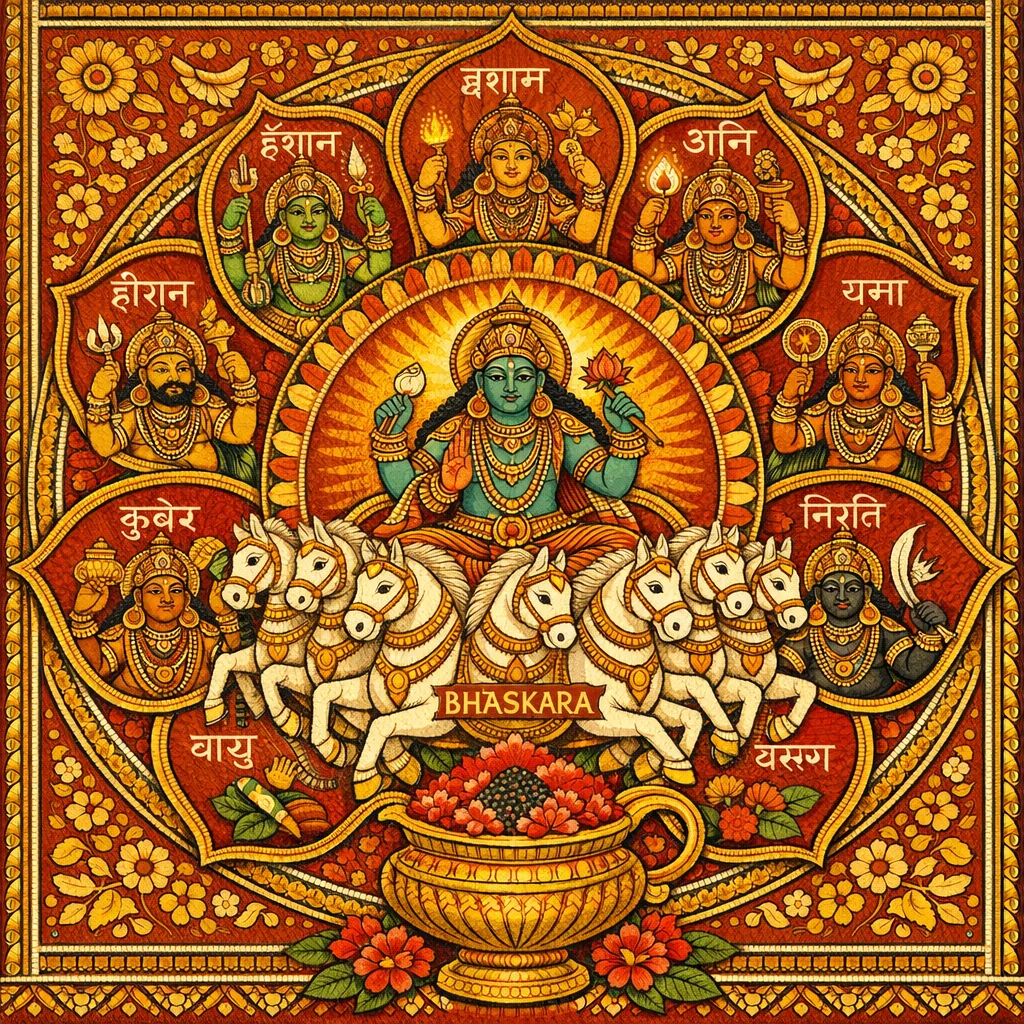
Adhyaya 97: The Sun-Vow (Sūrya-vrata): Naktāśana, Lotus-Maṇḍala Worship, and Annual Abhiṣeka for Health and Sovereignty
सूर्यव्रतविधिः (अब्दाभिषेक-सूर्याराधना)
Speaker: Nārada, Nandikeśvara (Nandīśa)
Nārada asks for a vrata that bestows health, inexhaustible fruit, and peace. Nandikeśvara replies that the Supreme abides in three forms—Sun, Fire, and Moon—and prescribes Sunday discipline (naktāśana: eating only at night), with a special rule when Sunday coincides with Hasta: ekabhakta on Saturday (one meal). The rite includes feeding brāhmaṇas; offering a red-sandal lotus with twelve leaves; drawing a lotus-maṇḍala and installing deities by the directions; offering arghya with red flowers, red sesame, and red sandal; and reciting protective solar mantras. It is concluded at night with oil-free food; after a year one commissions and donates a golden lotus and a two-armed Puruṣa image, along with a richly adorned kapilā cow and other gifts to a qualified brāhmaṇa. The phala promises Sūryaloka and Indra-loka for performers and listeners, special protection and sovereignty for kings, and merit for devoted women.
Key Concepts
Shlokas in Adhyaya 97
Verse 1
*नारद उवाच यदारोग्यकरं पुंसां यदनन्तफलप्रदम् यच्छान्तये च मर्त्यानां वद नन्दीश तद्व्रतम् //
Nārada said: “Tell me, O Lord Nandīśa, of that vow (vrata) which brings health to people, bestows endless results, and grants peace to mortals.”
Verse 2
*नन्दिकेश्वर उवाच यत्तद्विश्वात्मनो धाम परं ब्रह्म सनातनम् सूर्याग्निचन्द्ररूपेण तत्त्रिधा जगति स्थितम् //
Nandikeśvara said: That eternal Supreme Brahman—abode of the Universal Self—stands established in the world in a threefold manner, assuming the forms of the Sun, Fire, and the Moon.
Verse 3
तदाराध्य पुमान्विप्र प्राप्नोति कुशलं सदा तस्मादादित्यवारेण सदा नक्ताशनो भवेत् //
O brāhmaṇa, by worshipping Him (Āditya, the Sun) a man always attains well-being and prosperity; therefore, on Sundays one should regularly observe the discipline of naktāśana, eating only at night.
Verse 4
यदा हस्तेन संयुक्तम् आदित्यस्य च वासरम् तदा शनिदिने कुर्याद् एकभक्तं विमत्सरः //
When Sunday coincides with the nakṣatra Hasta, then—on Saturday—one who is free from malice should undertake the ekabhakta observance, taking only a single meal.
Verse 5
नक्तमादित्यवारेण भोजयित्वा द्विजोत्तमान् पत्त्रैर्द्वादशसंयुक्तं रक्तचन्दनपङ्कजम् //
On a Sunday evening, having fed the best of the twice-born Brahmanas, one should offer a lotus anointed with red sandal paste, accompanied by twelve leaves.
Verse 6
विलिख्य विन्यसेत्सूर्यं नमस्कारेण पूर्वतः दिवाकरं तथाग्नेये विवस्वन्तमतः परम् //
After drawing the figure, one should install Sūrya in the east in a posture of reverent salutation; likewise, one should place Divākara in the south-east, and thereafter Vivasvān in the next position.
Verse 7
भगं तु नैरृते देवं वरुणं पश्चिमे दले महेन्द्रमनिले तद्वद् आदित्यं च तथोत्तरे //
Bhaga is to be placed in the south-west; Varuṇa on the western petal; likewise Mahendra in the windy quarter (north-west), and similarly Āditya in the northern quarter.
Verse 8
शान्तमीशानभागे तु नमस्कारेण विन्यसेत् कर्णिकापूर्वपत्त्रे तु सूर्यस्य तुरगान्न्यसेत् //
In the Īśāna (north-eastern) sector, one should install Śānti with an act of reverent salutation. And on the eastern petal of the central pericarp (karṇikā), one should place the horses of Sūrya, the Sun.
Verse 9
दक्षिणे ऽर्यमनामानं मार्तण्डं पश्चिमे दले उत्तरे तु रविं देवं कर्णिकायां च भास्करम् //
On the southern side one should place Aryaman; on the western petal, Mārtaṇḍa; on the northern side, the god Ravi; and in the central pericarp (the core), Bhāskara.
Verse 10
रक्तपुष्पोदकेनार्घ्यं सतिलारुणचन्दनम् तस्मिन्पद्मे ततो दद्याद् इमं मन्त्रमुदीरयेत् //
One should offer arghya made with water infused with red flowers, together with sesame and reddish sandal paste. Then, placing it upon that lotus (offering-seat), one should make the offering and recite the following mantra.
Verse 11
कालात्मा सर्वभूतात्मा वेदात्मा विश्वतोमुखः यस्मादग्नीन्द्ररूपस्त्वम् अतः पाहि दिवाकर //
You are the very Self of Time, the indwelling Self of all beings, the very essence of the Vedas, and the One whose face is everywhere. Since you manifest as Agni and as Indra, therefore protect (us), O Divākara (Sun).
Verse 12
अग्निम् ईडे नमस्तुभ्यम् इषेत्वोर्जे च भास्कर अग्न आयाहि वरद नमस्ते ज्योतिषां पते //
I praise Agni; salutations to you. O Bhāskara, you who grant nourishment and vital strength—O Agni, come here as the giver of boons. Salutations to you, Lord of all lights.
Verse 13
अर्घ्यं दत्त्वा विसृजाथ निशि तैलविवर्जितम् भुञ्जीत वत्सरान्ते तु काञ्चनं कमलोत्तमम् पुरुषं च यथाशक्त्या कारयेद्द्विभुजं तथा //
Having offered arghya (the respectful water-offering), one should release (conclude) the observance at night and take a meal free from oil. At the end of the year, one should, according to one’s means, commission a golden lotus of excellent form, and also have a two-armed figure of a man made likewise.
Verse 14
सुवर्णशृङ्गीं कपिलां महार्घ्यां रौप्यैः खुरैः कांस्यदोहां सवत्साम् पूर्णे गुडस्योपरि ताम्रपात्रे निधाय पद्मं पुरुषं च दद्यात् //
One should gift a highly valuable tawny kapilā cow, fitted with golden horns and silver hooves, with a bronze milking-vessel, together with its calf. Having placed this gift in a copper vessel filled with jaggery, one should also give a lotus and a golden human figure.
Verse 15
सम्पूज्य रक्ताम्बरमाल्यधूपैर् द्विजं च रक्तैरथ हेमशृङ्गैः संकल्पयित्वा पुरुषं सपद्मं दद्यादनेकव्रतदानकाय अव्यङ्गरूपाय जितेन्द्रियाय कुटुम्बिने देयमनुद्धताय //
After duly worshipping with red garments, garlands, and incense, and likewise honoring a brāhmaṇa (dvija) with red offerings and a gift bearing golden horns, one should, having made the formal resolve (saṅkalpa), donate the lotus-bearing Puruṣa (an image of Viṣṇu) as a gift embodying the fruit of many vows and charities. It should be given to one whose body is unblemished, who is self-controlled, who maintains a household, and who is humble, not arrogant.
Verse 16
नमो नमः पापविनाशनाय विश्वात्मने सप्ततुरंगमाय सामर्ग्यजुर्धामनिधे विधात्रे भवाब्धिपोताय जगत्सवित्रे //
Salutations, again and again, to the Destroyer of sin; to the Soul of the universe; to Him who rides the chariot drawn by seven steeds; to the Ordainer (Vidhātṛ), the treasure-house of the sacred radiance of the Sāma, Ṛg, and Yajus Vedas; to the Boat that carries one across the ocean of becoming; to the Sun, Savitṛ, the Inspirer of the world.
Verse 17
इत्यनेन विधिना समाचरेद् अब्दभेकमिह यस्तु मानवः सो ऽधिरोहति विनष्टकल्मषः सूर्यधाम धुतचामरावलिः //
Whoever, as a human being, performs here the annual consecratory bathing (abda-abhiṣeka) according to this very procedure, with his sins destroyed, ascends to the abode of the Sun, where rows of cāmara fly-whisks are waved in honor.
Verse 18
धर्मसंक्षयमवाप्य भूपतिः शोकदुःखभयरोगवर्जितः द्वीपसप्तकपतिः पुनः पुनर् वर्ममूर्तिर् अमितौजसा युतः //
Having attained the full consummation of dharma, the king becomes free from grief, suffering, fear, and disease. Again and again he becomes the lord of the seven continents, endowed with immeasurable splendor and embodied as the very form of protective armor (varma).
Verse 19
या च भर्तृगुरुदेवतत्परा वेदमूर्तिदिननक्तमाचरेत् सापि लोकममरेशवन्दिता याति नारद रवेर्न संशयः //
That woman who is devoted to her husband, her teacher, and her chosen deity—who serves the Veda embodied, by day and by night—she too, O Nārada, attains the world of Ravi (the Sun), honored even by the lords of the gods; of this there is no doubt.
Verse 20
यः पठेदपि शृणोति मानवः पठ्यमानमथ वानुमोदते सो ऽपि शक्रभुवनस्थितो ऽमरैः पूज्यते वसति चाक्षयं दिवि //
Whoever recites this, or listens as it is recited, or even assents with appreciative approval—he too attains the realm of Śakra (Indra), is honored by the immortals, and dwells in heaven with imperishable felicity.
Frequently Asked Questions
Adhyāya 97 teaches a structured Sūrya-centered vrata for health (ārogya), peace (śānti), and lasting merit: observe Sunday naktāśana, perform a lotus-maṇḍala worship with directional placements of solar forms/deities, offer arghya with red flowers, sesame, and red sandal while reciting the given mantras, and complete the yearly cycle with abda-abhiṣeka and prescribed dānas (golden lotus, Puruṣa image, and kapilā cow) to a qualified brāhmaṇa.
This chapter is primarily Dharma/Ācāra: vrata-vidhi, mantra, nyāsa on a lotus-maṇḍala, dāna rules, and phala-śruti (results). It does not focus on Vāstu-śāstra construction measurements or Purāṇic genealogy; instead it uses ritual geometry (padma-maṇḍala) and directional installation as a liturgical/architectural-style layout for worship.
Key offerings include a lotus anointed with red sandal paste and accompanied by twelve leaves, arghya made from water infused with red flowers plus sesame and reddish sandal, and concluding gifts such as a golden lotus, a two-armed Puruṣa figure, and a kapilā cow with golden horns and silver hooves (with its calf and milking vessel).
The text promises sin-destruction and ascent to Sūryaloka for the annual performer, heavenly honor for reciters/listeners, and for kings specifically: freedom from grief, fear, disease, and repeated attainment of sovereignty over the seven continents (dvīpa-saptaka). It also states that devoted women who serve dharma and their chosen deity attain Ravi’s world honored by gods.