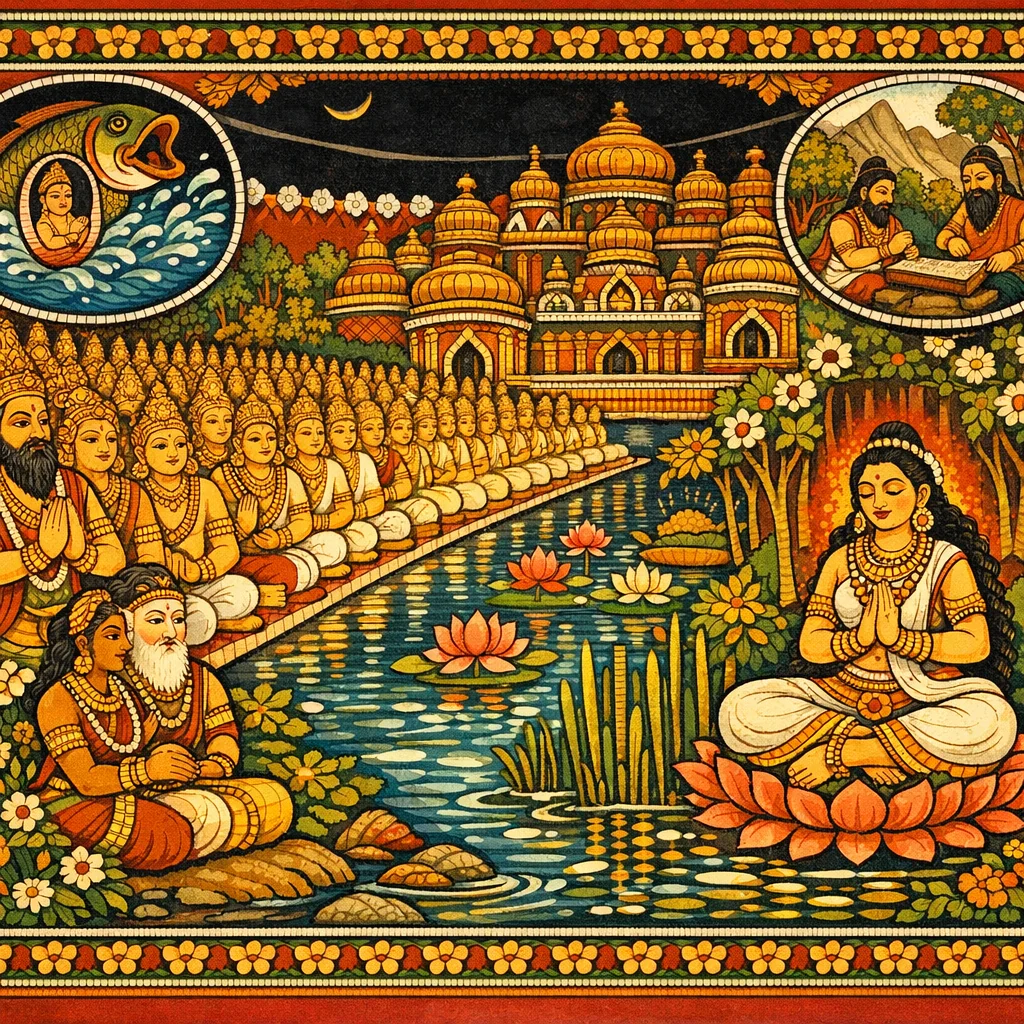
Adhyaya 14: The Legend of Acchodā: Pitṛloka, the Origin of Amāvāsyā, and the Prophecy of Satyavatī
अच्छोदोपाख्यानम् (पितृलोक-अमावास्या-माहात्म्य-प्रसङ्गः)
Speaker: Sūta
Sūta describes the Somapatha realms inhabited by Marīci’s line and the Pitṛs, and introduces Acchodā as a mind-born river/maiden linked with the Agniṣvātta Pitṛs and an ancient lake fashioned by the Fathers. After intense tapas the Pitṛs appear to grant a boon, but Acchodā, overcome by Kāma, slips from yogic restraint and incurs a karmic consequence. The episode becomes the origin-story of Amāvāsyā, proclaimed especially प्रिय to the Pitṛs and bestowing akṣaya fruit upon offerings. Ashamed, Acchodā petitions the Pitṛs; they teach that karmaphala is experienced through fitting bodies and may ripen at once or after death in divine or human states. They prophesy her rebirth in the 28th Dvāpara from a fish-womb as King Vasu’s daughter; later she will bear one son by Parāśara—Bādarāyaṇa—who will divide the Veda near Badarī. She will also enable kṣetraja sons for the lineage (Chitrāṅgada and Vichitravīrya context), then dwell in Pitṛloka as Aṣṭakā, and finally become the famed river Acchodā again.
Key Concepts
Shlokas in Adhyaya 14
Verse 1
*सूत उवाच लोकाः सोमपथा नाम यत्र मारीचनन्दनाः वर्तन्ते देव पितरो देवा यान्भावयन्त्यलम् //
Sūta said: There are worlds called the Somapathas, where the sons of Marīci dwell; there too are the divine Pitṛs and the gods, and the gods in abundance sustain and cherish those realms.
Verse 2
अग्निष्वात्ता इति ख्याता यज्वानो यत्र संस्थिताः अच्छोदा नाम तेषां तु मानसी कन्यका नदी //
There dwell the sacrificial sages renowned as the Agniṣvāttas; and for them there is a river named Acchodā—born of the mind, a maiden-like, pure stream.
Verse 3
अच्छोदं नाम च सरः पितृभिर्निर्मितं पुरा अच्छोदा तु तपश्चक्रे दिव्यं वर्षसहस्रकम् //
There is a lake named Acchoda, fashioned long ago by the Pitṛs, the ancestral Fathers. And Acchodā performed austerities for a thousand divine years.
Verse 4
आजग्मुः पितरस्तुष्टाः किल दातुं च तां वरम् दिव्यरूपधराः सर्वे दिव्यमाल्यानुलेपनाः //
Then the Pitṛs, pleased indeed, came intent on granting her that boon—each assuming a celestial form, all adorned with divine garlands and sacred unguents.
Verse 5
सर्वे युवानो बलिनः कुसुमायुधसंनिभाः तन्मध्ये ऽमावसुं नाम पितरं वीक्ष्य साङ्गना //
All of them were youthful and strong, radiant like Kāma, the Flower-weaponed one. In their midst, the womenfolk, seeing their father named Āmāvasu, looked on.
Verse 6
वव्रे वरार्थिनी सङ्गं कुसुमायुधपीडिता योगाद्भ्रष्टा तु सा तेन व्यभिचारेण भामिनी //
Tormented by Kāma, the Flower-weaponed one, she—seeking a husband—chose companionship; but, fallen from her yogic discipline, that passionate woman lapsed into misconduct through that act of infidelity.
Verse 7
धरां तु नास्पृशत्पूर्वं पपाताथ भुवस्तले तिथाव् अमावसुर् यस्याम् इच्छां चक्रे न तां प्रति //
But before it could even touch the earth, it fell upon the ground—on that lunar day, the tithi of Amāvāsyā (new moon), toward which it could not fix its intention or take effect as expected.
Verse 8
धैर्येण तस्य सा लोकैर् अमावास्येति विश्रुता पितॄणां वल्लभा तस्मात् तस्यामक्षयकारकम् //
Because of his steadfast endurance, that night became renowned among the worlds as “Amāvāsyā”. Therefore, since it is especially dear to the Pitṛs (ancestral Fathers), whatever is offered on that day yields an inexhaustible result.
Verse 9
अच्छोदाधोमुखी दीना लज्जिता तपसः क्षयात् सा पितॄन् प्रार्थयामास पुरे चात्मप्रसिद्धये //
Acchodā, downcast and facing downward, wretched and ashamed because her tapas (austerity) had been exhausted, implored the Pitṛs (ancestral Fathers) in the city, seeking relief and her own good repute.
Verse 10
विलप्यमाना पितृभिर् इदमुक्ता तपस्विनी भविष्यमर्थमालोक्य देवकार्यं च ते तदा //
As the Pitṛs (ancestral Fathers) lamented, they spoke these words to the ascetic woman. Then, foreseeing what was to come and the divine task to be fulfilled at that time, she resolved accordingly.
Verse 11
इदम् ऊचुर् महाभागाः प्रसादशुभया गिरा दिवि दिव्यशरीरेण यत् किंचित् क्रियते बुधैः //
Thus spoke those noble ones, with gracious and auspicious words: “In heaven, whatever is done by the wise is accomplished through a divine body.”
Verse 12
तेनैव तत्कर्मफलं भुज्यते वरवर्णिनी सद्यः फलन्ति कर्माणि देवत्वे प्रेत्य मानुषे //
By that very agent the fruit of that deed is experienced, O fair-complexioned lady. Actions bear results—some at once, and others after death, whether in a divine state or in a human birth.
Verse 13
तस्मात्त्वं पुत्रि तपसः प्राप्स्यसे प्रेत्य तत्फलम् अष्टाविंशे भवित्री त्वं द्वापरे मत्स्ययोनिजा //
Therefore, O daughter, after death you shall obtain the fruit of your austerities (tapas). In the twenty-eighth Dvāpara age, you will be born from a fish-womb, as Matsyayonijā.
Verse 14
व्यतिक्रमात्पितॄणां त्वं कष्टं कुलमवाप्स्यसि तस्माद्राज्ञो वसोः कन्या त्वम् अवश्यं भविष्यसि //
Because you have transgressed the ancestral injunctions, you will attain a troubled lineage; therefore, you shall certainly become the daughter of King Vasu.
Verse 15
कन्या भूत्वा च लोकान्स्वान् पुनराप्स्यसि दुर्लभान् पराशरस्य वीर्येण पुत्रमेकमवाप्स्यसि //
Having become a maiden, you shall regain again your own worlds that are hard to attain; and by the potency of Parāśara you shall obtain a single son.
Verse 16
द्वीपे तु बदरीप्राये बादरायणमच्युतम् स वेदमेकं बहुधा विभजिष्यति ते सुतः //
But on the island—near Badarī—your son, the unfailing one (Acyuta) known as Bādarāyaṇa, will divide the single Veda into many portions.
Verse 17
पौरवस्यात्मजौ द्वौ तु समुद्रांशस्य शंतनोः विचित्रवीर्यस्तनयस् तथा चित्राङ्गदो नृपः //
Now, Paurava had two sons: Chitrāṅgada, the king, and Vichitravīrya, the son of Śaṃtanu, who was said to be a partial incarnation of the Ocean.
Verse 18
इमाव् उत्पाद्य तनयौ क्षेत्रजावस्य धीमतः प्रौष्ठपद्यष्टकारूपा पितृलोके भविष्यसि //
Having brought forth these two sons for the wise man by kṣetraja-procreation, you shall dwell in the world of the Fathers (Pitṛloka), assuming the form of Aṣṭakā in the month of Prauṣṭhapada.
Verse 19
नाम्ना सत्यवती लोके पितृलोके तथाष्टका आयुरारोग्यदा नित्यं सर्वकामफलप्रदा //
In the human world she is known as Satyavatī, and in the world of the Ancestors she is called Aṣṭakā. She ever bestows long life and freedom from disease, and grants the fruits of all desired aims.
Verse 20
भविष्यसि परे काले नदीत्वं च गमिष्यसि पुण्यतोषा सरिच्छ्रेष्ठा लोके ह्य् अच्छोदनामिका //
In a later age you shall become a river; you will attain the state of a sacred stream, renowned in the world as Acchodā, foremost among rivers, delighting in holy merit.
Verse 21
इत्युक्त्वा स गणस्तेषां तत्रैवान्तरधीयत साप्यवाप च तत्सर्वं फलं यदुदितं पुरा //
Having spoken thus, that host of attendants vanished right there before them; and she too obtained in full that entire reward which had been declared earlier.
Frequently Asked Questions
The chapter teaches that karmic results (karma-phala) are inevitably experienced through appropriate embodiments—some fruits arise immediately, while others mature after death in divine or human births. It also instructs that Amāvāsyā is especially dear to the Pitṛs, and offerings made on that tithi become akṣaya (inexhaustible) in merit.
This adhyāya is primarily Pitṛ-dharma and ritual time (Amāvāsyā), cosmography (Pitṛloka/Somapatha), and Puranic genealogy/Itihāsa linkage through the prophecy of Acchodā’s rebirth as Satyavatī, her union with Parāśara, and the birth of Bādarāyaṇa (Vyāsa), alongside kṣetraja lineage-continuation themes. Vāstu/architecture is not a focus in this chapter.