Adhyaya 149: The Devasura War: Tumult, Weaponry, and Battlefield Devastation
देवासुरसंग्रामे तुमुलवर्णनम्
Speaker: Sūta, Ṛṣis (Naimiṣāraṇya audience)
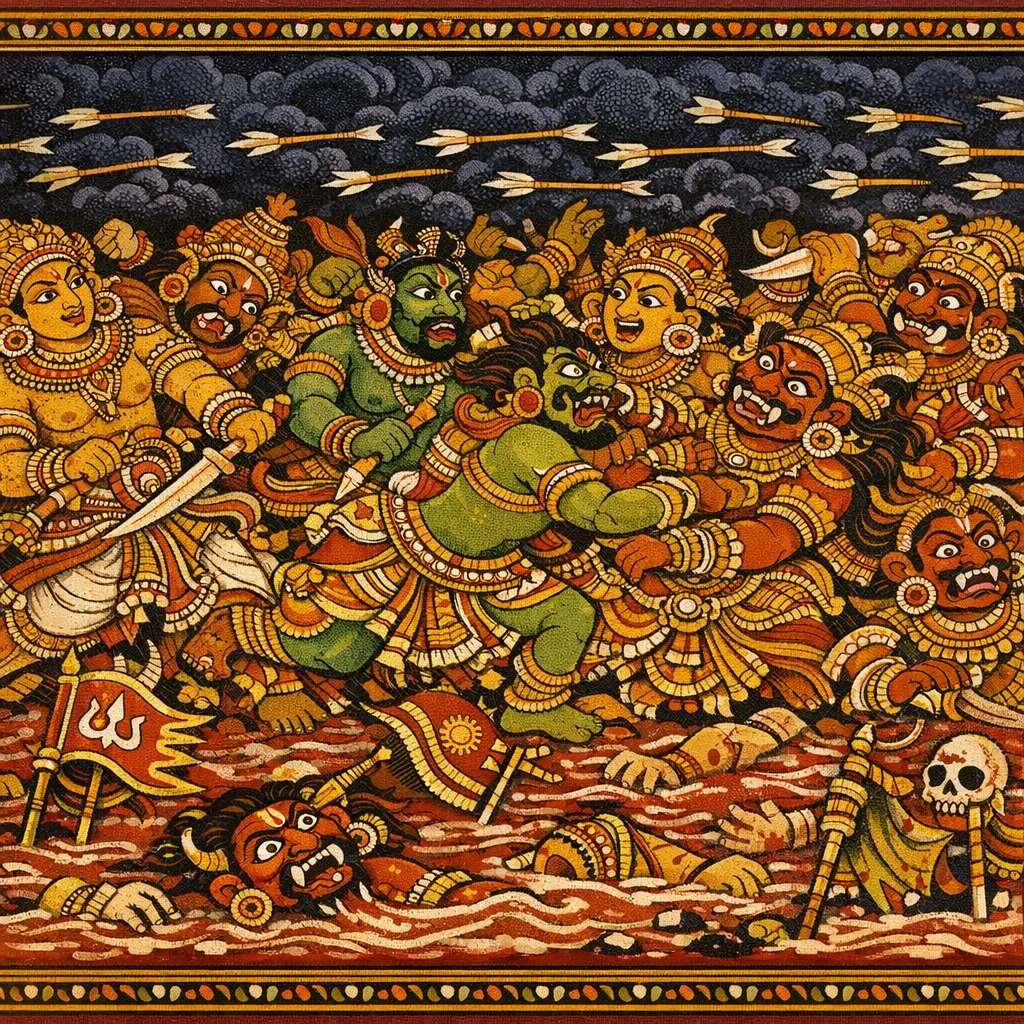
Continuing the war account, Sūta describes devas and daityas crashing together amid overwhelming roar and fury. As the armies draw close, he notes the coordinated pairings and support among troop-types—pādāti (infantry), turaga (cavalry), ratha (chariots), and gaja (elephants)—and the order in which they engage. He then lists the chief weapons and specialized arrowheads. A thick, darkening storm of missiles fills the sky, breeding confusion and indiscriminate fire. The chapter closes on a grim aftermath: severed limbs and standards, crushed elephants and chariots, rivers of blood, and the battlefield turned into a haunt of flesh-eaters and vetālas.
Key Concepts
Shlokas in Adhyaya 149
Verse 1
*सूत उवाच सुरासुराणां सम्मर्दस् तस्मिन्नत्यन्तदारुणे तुमुलो ऽतिमहानासीत् सेनयोरुभयोरपि //
Sūta said: In that exceedingly dreadful clash between the gods and the asuras, a tumult of overwhelming magnitude arose on both armies’ sides.
Verse 2
गर्जतां देवदैत्यानां शङ्खभेरीरवेण च तूर्याणां चैव निर्घोषैर् मातंगानां च बृंहितैः //
As the gods and the daityas roared, the din swelled—resounding with conches and kettle-drums, with the blare of martial instruments, and with the trumpeting of elephants.
Verse 3
ह्वेषतां हयवृन्दानां रथनेमिस्वनेन च ज्याघोषेण च शूराणां तुमुलो ऽतिमहानभूत् //
From the neighing of the masses of horses, from the rumbling sound of chariot-wheels, and from the thunderous twang of warriors’ bowstrings, a vast and dreadful tumult arose.
Verse 4
समासाद्योभये सेने परस्परजयैषिणाम् रोषेणातिपरीतानां त्यक्तजीवितचेतसाम् //
When the two armies closed upon one another—each yearning to conquer the other—those warriors, overwhelmed by wrath, fought on with minds that had cast away all thought of life itself.
Verse 5
समासाद्य तु ते ऽन्योन्यं प्रक्रमेण विलोमतः रथेनासक्तपादातो रथेन च तुरंगमः //
When they have closed in upon one another, they should maneuver in reverse order, step by step: the foot-soldier whose feet are caught by a chariot, and likewise the horseman, should be dealt with by the chariot.
Verse 6
हस्ती पदातिसंयुक्तो रथिना च क्वचिद्रथी मातंगेनापरो हस्ती तुरंगैर्बहुभिर्गजः //
An elephant may be accompanied by foot-soldiers, and at times a chariot-warrior (rathin) is paired with a chariot. Elsewhere, one elephant is supported by another great elephant (mātaṅga), and an elephant-force is further reinforced by many horses.
Verse 7
पदातिरेको बहुभिर् गजैर्मत्तैश्च युज्यते ततः प्रासाशनिगदाभिन्दिपालपरश्वधैः //
Then the surplus of infantry is deployed together with many rutting elephants, and thereafter the engagement proceeds with spears, darts, iron clubs, gadas, bhindipāla missiles, and battle-axes.
Verse 8
शक्तिभिः पट्टिशैः शूलैर् मुद्गरैः कुणपैर्गडैः चक्रैश्च शङ्कुभिश्चैव तोमरैरङ्कुशैः सितैः //
With śakti-spears, paṭṭiśa battle-axes, śūla tridents, mudgara maces, kuṇapa heavy bludgeons and gadā clubs; with cakra discus-weapons and śaṅku spikes as well; with tomara javelins and bright, gleaming aṅkuśa elephant-goads—thus were they armed.
Verse 9
कर्णिनालीकनाराचवत्सदन्तार्धचन्द्रकैः भल्लैश्च शतपत्त्रैश्च शुकतुण्डैश्च निर्मलैः //
—with ear-finned arrows, reed-shafted darts, iron arrows, calf-tooth–shaped heads, and half-moon blades; with bhalla-type bolts, hundred-leafed (multi-bladed) heads, and parrot-beak points—bright, pure, and finely finished.
Verse 10
वृष्टिरत्यद्भुताकारा गगने समदृश्यत संप्रच्छाद्य दिशः सर्वास् तमोमयमिवाकरोत् //
A rain of utterly wondrous form appeared in the sky; veiling all the quarters, it made them seem as though they were fashioned of darkness.
Verse 11
न प्राज्ञायत ते ऽन्योन्यं तस्मिंस्तमसि संकुले अलक्ष्यं विसृजन्तस्ते हेतिसंघातमुद्धतम् //
In that dense, bewildering darkness they could not recognize one another; seeing no mark at all, they hurled a clamorous, tumultuous barrage of weapons at random.
Verse 12
पतितं सेनयोर्मध्ये निरीक्षन्ते परस्परम् ततो ध्वजैर्भुजैश्छत्त्रैः शिरोभिश्च सकुण्डलैः //
Fallen between the two armies, they looked upon one another. Then the ground was strewn with banners, severed arms, parasols of state, and heads still adorned with earrings.
Verse 13
गजैस्तुरंगैः पादातैः पतद्भिः पतितैरपि आकाशसरसो भ्रष्टैः पङ्कजैरिव भूः स्तृता //
The earth was carpeted with elephants, horses, and foot-soldiers—some still falling, others already fallen—like ground strewn with lotuses that have dropped from a lake in the sky.
Verse 14
भग्नदन्ता भिन्नकुम्भाश् छिन्नदीर्घमहाकराः गजाः शलनिभाः पेतुर् धरण्यां रुधिरस्रवाः //
The elephants—with broken tusks, shattered temples, and their long mighty trunks severed—fell upon the earth like felled śāla trees, streaming with blood.
Verse 15
भग्नेषादण्डचक्राक्षा रथाश्च शकलीकृताः पेतुः शकलतां यातास् तुरंगाश्च सहस्रशः //
With their poles and yokes broken, and their wheels and axles shattered, the chariots were smashed to pieces; and thousands of horses fell, reduced to mangled fragments.
Verse 16
ततो ऽसृघ्रददुस्तारा पृथिवी समजायत नद्यश्च रुधिरावर्ता हर्षदाः पिशिताशिनाम् वेतालाक्रीडमभवत् तत्संकुलरणाजिरम् //
Then the earth became impassable, as though filled with lakes of blood; and the rivers, swirling with blood, became a delight to flesh-eaters. That crowded field of battle turned into a playground for vetālas (ghoulish spirits).
Frequently Asked Questions
The chapter’s main thrust is descriptive rather than prescriptive: Sūta portrays the devas–daityas battle to show the overwhelming force of rage-driven conflict and its catastrophic consequences. Alongside the moral atmosphere, it preserves a structured view of warfare—how the four arms (infantry, cavalry, chariots, elephants) interact and what weapons and arrow-types are deployed—before concluding with the gruesome aftermath that illustrates war’s dehumanizing, chaotic end-state.
This adhyāya is not about Vāstu or genealogy. It primarily belongs to Rajadharma-adjacent material through its martial focus (battle organization, troop coordination) and to Purāṇic narrative theology via the devas–asuras conflict. The content emphasizes ancient warfare imagery, weapon catalogues, and the ethical-philosophical tone of destruction and confusion on the battlefield.
Read Matsya Purana in the Vedapath app
Scan the QR code to open this directly in the app, with audio, word-by-word meanings, and more.