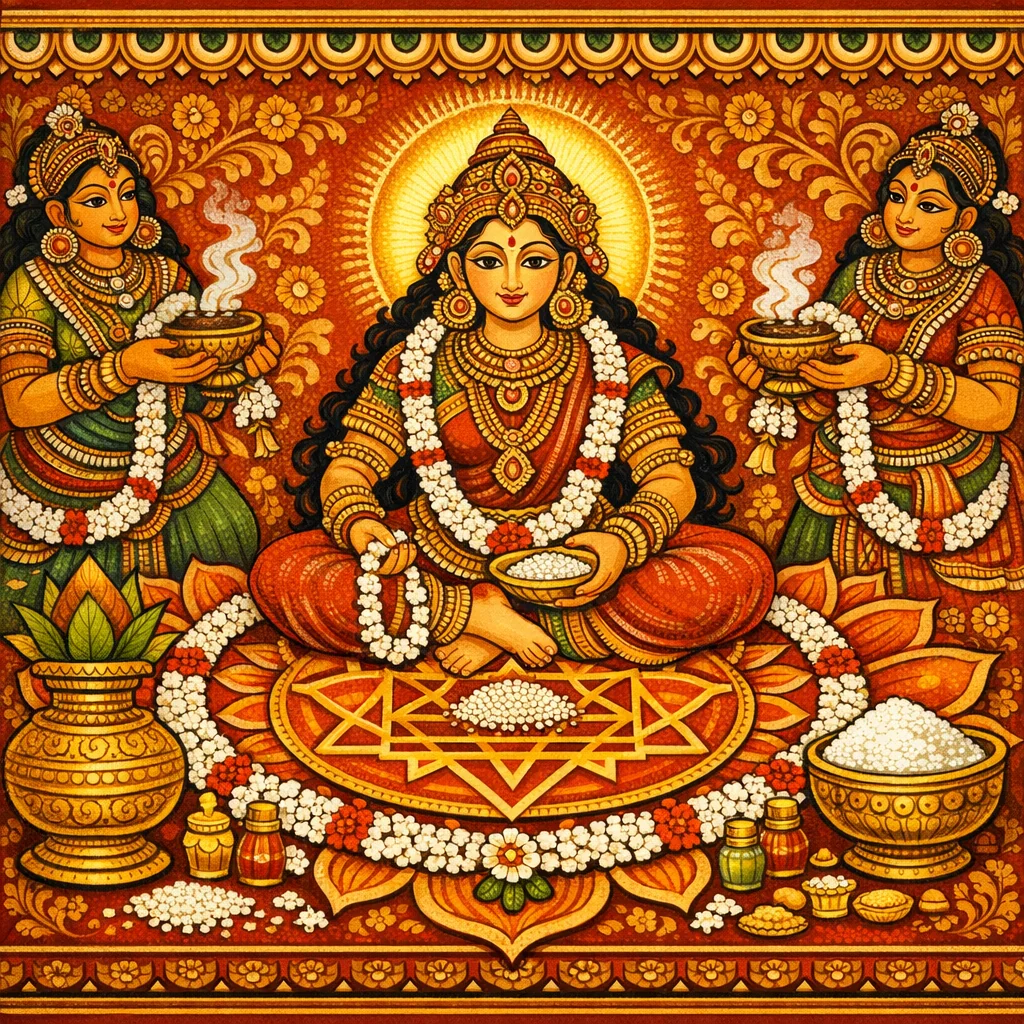
Adhyaya 77: Śarkarā-Saptamī Vrata: The Sugar Offering Rite to Savitṛ (Sun) for Health, Longevity, and Prosperity
शर्करासप्तमी-व्रतविधानम्
Speaker: Īśvara (the Lord, as narrator/teacher)
The Lord proclaims He will teach the Śarkarā-saptamī observance, which destroys sin and grants longevity, health, and prosperity. He specifies its time as the bright Saptamī (Śukla Saptamī) of Mādhava and prescribes pure, white-coded materials—white sesame, garlands, and unguents. The votary draws a lotus diagram, worships Savitṛ (the Sun) with fragrance and incense, installs a water pot and a sugar vessel, adorns them with white cloth and gold, and recites a mantra praising Savitṛ as Veda-embodied and peace-bestowing. Then come disciplines: pañcagavya, sleeping on the ground, remembrance of Saura hymns, and listening to the Purāṇa. On Aṣṭamī the entire arrangement is gifted to a learned Brāhmaṇa; Brāhmaṇas are fed sugar-ghee payasa, while the observer eats simply and restrains speech. The Lord enjoins monthly repetition and a year-end completion with greater dānas (a bed with sugar jars; also house, cow, and gold), warns against deceit in wealth, recounts sugar’s nectar-origin myth linked to the Sun, and concludes with exalted fruits—Aśvamedha-like merit, pacification of evil, increase of lineage, heaven for a kalpa, and divine honor for those who hear, recite, or teach it.
Key Concepts
Shlokas in Adhyaya 77
Verse 1
*ईश्वर उवाच शर्करासप्तमीं वक्ष्ये तद्वत्कल्मषनाशिनीम् आयुरारोग्यमैश्वर्यं ययानन्तं प्रजायते //
The Lord said: “I shall explain the Śarkarā-saptamī (the seventh-day rite involving śarkarā), which likewise destroys sin. By performing it, boundless longevity, freedom from disease, and prosperity are attained.”
Verse 2
माधवस्य सिते पक्षे सप्तम्यां नियतव्रतः प्रातः स्नात्वा तिलैः शुक्लैः शुक्लमाल्यानुलेपनः //
On the seventh lunar day (Saptamī) of the bright fortnight in the month of Mādhava, the vow-observer—self-restrained—should bathe in the morning, and then worship using white sesame, wearing white garlands and applying white unguents (as marks of purity).
Verse 3
स्थण्डिले पद्ममालिख्य कुङ्कुमेन सकर्णिकम् तस्मिन्नमः सवित्रे तु गन्धधूपौ निवेदयेत् //
On a purified ground-space, one should draw a lotus with saffron (kuṅkuma), complete with its pericarp; upon that, offering reverence to Savitṛ, one should present fragrance and incense.
Verse 4
स्थापयेदुदकुम्भं च शर्करापात्रसंयुतम् शुक्लवस्त्रैरलंकृत्य शुक्लमाल्यानुलेपनैः सुवर्णेन समायुक्तं मन्त्रेणानेन पूजयेत् //
One should set up a water-filled ritual pot (kalaśa) together with a vessel of śarkarā (sugar); adorning it with white cloth and decorating it with white garlands and white unguents, and furnishing it with gold, one should worship it with this very mantra.
Verse 5
विश्ववेदमयो यस्माद् वेदवादीति पठ्यसे सर्वस्यामृतमेव त्वम् अतः शान्तिं प्रयच्छ मे //
Since you are constituted of the Veda that pervades the entire universe, you are recited in praise as the very voice of the Veda. You alone are the amṛta, the nectar of immortality for all; therefore grant me peace.
Verse 6
पञ्चगव्यं ततः पीत्वा स्वपेत्तत्पार्श्वतः क्षितौ सौरसूक्तं स्मरन्नास्ते पुराणश्रवणेन च //
Then, having drunk the pañcagavya, one should sleep on the ground beside it, remaining mindful of the Saura hymn (Saura-sūkta) and also engaged in listening to Purāṇic recitation.
Verse 7
अहोरात्रे गते पश्चाद् अष्टम्यां कृतनैत्यकः तत्सर्वं विदुषे तद्वद् ब्राह्मणाय निवेदयेत् //
When a full day and night have passed, on the Aṣṭamī (eighth lunar day), having completed the prescribed daily rites, one should formally present all of that to a learned Brāhmaṇa in the same proper manner.
Verse 8
भोजयेच्छक्तितो विप्राञ् छर्कराघृतपायसैः भुञ्जीतातैललवणं स्वयमप्यथ वाग्यतः //
According to one’s means, one should feed the Brāhmaṇas with sweet pāyasa (rice-milk pudding) prepared with sugar and ghee; then oneself should eat only oil and salt, remaining restrained in speech.
Verse 9
अनेन विधिना सर्वं मासि मासि समाचरेत् संवत्सरान्ते शयनं शर्कराकलशान्वितम् //
Following this procedure, one should duly perform everything month after month; and at the end of the year, one should make the ritual offering of a bed (śayana), accompanied by jars (kalaśa) filled with sugar.
Verse 10
सर्वोपस्करसंयुक्तं तथैकां गां पयस्विनीम् गृहं च शक्तिमान्दद्यात् समस्तोपस्करान्वितम् //
A capable person should donate a house furnished with all necessities, and also give a single milch-cow; the house should be endowed with complete household equipment.
Verse 11
सहस्रेणाथ निष्काणां कृत्वा दद्याच्छतेन वा दशभिर्वाथ निष्केण तदर्धेनापि शक्तितः //
Having arranged a gift of a thousand niṣkas (gold coins), one may instead give a hundred; or (if not that), ten niṣkas—or even half of that—according to one’s ability.
Verse 12
सुवर्णाश्वः प्रदातव्यः पूर्ववन्मन्त्रवादनम् न वित्तशाठ्यं कुर्वीत कुर्वन्दोषं समश्नुते //
A horse (or horse-figure) of gold should be given, accompanied—just as before—by the recitation of mantras. One should not practice deceit regarding wealth; for the one who does so incurs (and must bear) the fault.
Verse 13
अमृतं पिबतो वक्त्रात् सूर्यस्यामृतबिन्दवः निपेतुर्ये धरण्यां तु शालिमुद्गेक्षवः स्मृताः //
As the Sun drank the nectar, drops of that nectar fell from his mouth onto the earth; those drops are remembered as rice, green gram, and sugarcane.
Verse 14
शर्करा तु परा तस्माद् इक्षुसारो ऽमृतात्मवान् इष्टा रवेरतः पुण्या शर्करा हव्यकव्ययोः //
Therefore sugar (śarkarā) is superior, for it is the nectar-like essence of sugarcane. It is dear to the Sun and is auspicious; and in both offerings to the gods (havis) and to the ancestors (kavya), sugar is considered meritorious.
Verse 15
शर्करासप्तमी चेयं वाजिमेधफलप्रदा सर्वदुष्टप्रशमनी पुत्रपौत्रप्रवर्धिनी //
This Śarkarā-Saptamī (the seventh lunar-day observance involving sugar) bestows the fruit of the Aśvamedha sacrifice; it pacifies all evil influences and promotes the increase of sons and grandsons.
Verse 16
यः कुर्यात्परया भक्त्या स वै सद्गतिमाप्नुयात् कल्पमेकं वसेत्स्वर्गे ततो याति परं पदम् //
Whoever performs this with supreme devotion indeed attains a blessed destiny; he dwells in heaven for one kalpa, and thereafter goes to the highest abode.
Verse 17
इदमनघं शृणोति यः स्मरेद्वा परिपठतीह दिवाकरस्य लोके मतिमपि च ददाति सो ऽपि देवैर् अमरवधूजनमालयाभिपूज्यः //
Whoever—being free from sin—hears this, or remembers it, or recites it here in the world of Divākara (the Sun), and even imparts this teaching to others, is honored even by the gods and worshipped with garlands by the companies of celestial maidens.
Frequently Asked Questions
Adhyaya 77 instructs the performance of the Śarkarā-Saptamī vrata—Sun (Savitṛ) worship on bright-fortnight Saptamī in Mādhava—using a lotus drawing, a water kalaśa and sugar vessel, white offerings, mantra-recitation, disciplined conduct (pañcagavya, sleeping on the ground, remembrance of Saura hymns), and concluding dāna to a learned Brāhmaṇa on Aṣṭamī. The text frames the practice as sin-destroying and as a means to longevity, health, prosperity, and high spiritual merit.
This chapter primarily discusses Dharma in the form of vrata-vidhi (ritual observance), dāna (charitable gifting), purity disciplines, and merit outcomes. It also includes a brief mythic-etymological note explaining sugarcane products as nectar-drops associated with the Sun, but it does not teach Vastu Shastra, Rajadharma, or detailed genealogies in this adhyaya.
The chapter links sugar to a myth where nectar drops fall from the Sun’s mouth onto earth, remembered as rice, green gram, and sugarcane. Because śarkarā is presented as the nectar-like essence of sugarcane and dear to the Sun, it is declared auspicious and meritorious in both havis (offerings to deities) and kavya (offerings to ancestors).
The text promises destruction of sin, boundless longevity, freedom from disease, prosperity, pacification of evil influences, increase of sons and grandsons, and merit comparable to the Aśvamedha sacrifice. With supreme devotion, the performer is said to dwell in heaven for one kalpa and then attain the highest abode; even hearing, reciting, remembering, or teaching the rite is praised as highly meritorious.