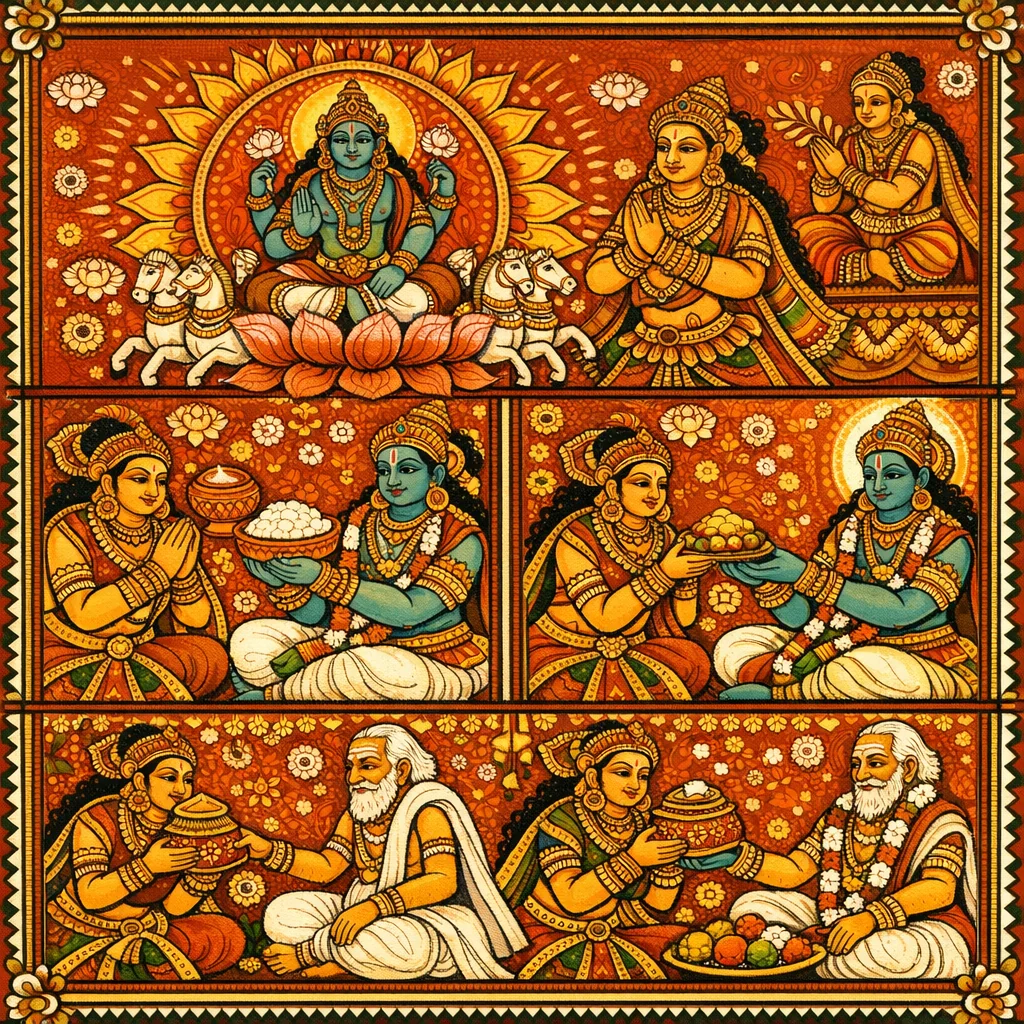
Adhyaya 76: Phala-Saptamī Vow (Fruit-Saptamī) and Ubhaya-Saptamī: Sun-focused fasting, gifts, and mantra-recitation
फलसप्तमी-व्रतविधिः (उभयसप्तमी-सहितः)
Speaker: Īśvara
Īśvara continues his instruction by introducing a new Saptamī observance called Phala-saptamī. He sets its calendrical beginning in Mārgaśīrṣa, details the order of fasting, the making of gold ritual emblems (a lotus, later a golden fruit), and the chief act of dāna to Brāhmaṇas with sugar, cloth, garlands, and a small golden image of Ravi. He prescribes timely giving at the two sandhyās and provides an ordered Sun-mantra composed of many divine epithets. The practice is then extended into a year-long Ubhaya-saptamī discipline, with monthly recitation of Saptamī names and fortnightly phala-tyāga (renunciation of fruits). The chapter ends with the vrata’s phala-śruti: cleansing of grave sins, honor in Sūrya-loka, freedom from disease, and salvific benefit for a fixed number of persons, reaching even listeners and reciters.
Key Concepts
Shlokas in Adhyaya 76
Verse 1
*ईश्वर उवाच अन्यामपि प्रवक्ष्यामि नाम्ना तु फलसप्तमीम् यामुपोष्य नरः पापाद् विमुक्तः स्वर्गभाग्भवेत् //
Īśvara said: “I shall also teach another observance, called the Phala-saptamī. By fasting in that rite, a man is freed from sin and becomes a sharer in heaven.”
Verse 2
मार्गशीर्षे शुभे मासि सप्तम्यां नियतव्रतः तामुपोष्याथ कमलं कारयित्वा तु काञ्चनम् //
In the auspicious month of Mārgaśīrṣa, on the seventh lunar day (Saptamī), one disciplined in vow should fast on that day; then, having a lotus made of gold, he should proceed with the rite.
Verse 3
शर्करासंयुतं दद्याद् ब्राह्मणाय कुटुम्बिने रविं काञ्चनकं कृत्वा पलस्यैकस्य धर्मवित् दद्याद्द्विकालवेलायां भानुर्मे प्रीयतामिति //
A knower of dharma should give an offering accompanied by sugar to a householder Brāhmaṇa; having fashioned a small golden image of Ravi (the Sun) weighing one pala, he should donate it at the two junction-times (morning and evening), saying, “May Bhānu (the Sun) be pleased with me.”
Verse 4
भक्त्या तु विप्रान्सम्पूज्य चाष्टम्यां क्षीरभोजनम् दत्त्वा कुर्यात्फलयुतं यावत्स्यात्कृष्णेसप्तमी //
Having reverently honored the Brahmins with devotion, on the eighth lunar day (aṣṭamī) one should give a meal of milk (or milk-based food). One should continue this observance together with fruit until the seventh lunar day (saptamī) of the dark fortnight (kṛṣṇa-pakṣa) arrives.
Verse 5
तामप्युपोष्य विधिवद् अनेनैव क्रमेण तु तद्वद्धैमफलं दत्त्वा सुवर्णकमलान्वितम् //
For that observance as well, fasting properly and in this very same sequence, one should likewise perform the prescribed gift—offering a golden fruit adorned with a lotus of gold.
Verse 6
शर्करापात्रसंयुक्तं वस्त्रमाल्यसमन्वितम् संवत्सरं च तेनैव विधिनोभयसप्तमीम् //
Along with a vessel filled with sugar, and accompanied by cloth and garlands, one should observe—by that very prescribed method—the ‘Ubhaya-saptamī’ vow for a full year.
Verse 7
उपोष्य दत्त्वा क्रमशः सूर्यमन्त्रमुदीरयेत् भानुरर्को रविर्ब्रह्मा सूर्यः शक्रो हरिः शिवः श्रीमान्विभावसुस्त्वष्टा वरुणः प्रीयतामिति //
Having observed a fast and then given the prescribed donation in due order, one should recite the Sun-mantra sequentially: “Bhānu, Arka, Ravi, Brahmā, Sūrya, Śakra, Hari, Śiva, Śrīmān, Vibhāvasu, Tvaṣṭṛ, Varuṇa—may (the Sun) be pleased.”
Verse 8
प्रतिमासं च सप्तम्याम् एकैकं नाम कीर्तयेत् प्रतिपक्षं फलत्यागम् एतत्कुर्वन्समाचरेत् //
On the seventh day of each month, one should recite aloud a single sacred Name each time; and every fortnight one should renounce the fruits of one’s actions. Practising thus, one should duly observe the vow.
Verse 9
व्रतान्ते विप्रमिथुनं पूजयेद्वस्त्रभूषणैः शर्कराकलशं दद्याद् धेमपद्मदलान्वितम् //
At the conclusion of the vow, one should honor a Brahmin couple with garments and ornaments, and should donate a pot filled with sugar, adorned with golden lotus-petals.
Verse 10
यथा न विफलाः कामास् त्वद्भक्तानां सदा रवे तथानन्तफलावाप्तिर् अस्तु मे सप्तजन्मसु //
O Ravi (Sun-god), just as the wishes of your devotees are never fruitless, so too may I attain endless merit and its fruits through seven births.
Verse 11
इमामनन्तफलदां यः कुर्यात्फलसप्तमीम् सर्वपापविशुद्धात्मा सूर्यलोके महीयते //
Whoever performs this Phala-saptamī—bestowing endless results—becomes purified of all sins and is honored in the realm of the Sun.
Verse 12
सुरापानादिकं किंचिद् यदत्रामुत्र वा कृतम् तत्सर्वं नाशमायाति यः कुर्यात्फलसप्तमीम् //
Whatever sin—such as drinking liquor—has been committed here (in this life) or elsewhere (in another existence), all of it comes to destruction for the one who performs the Phala-saptamī observance.
Verse 13
कुर्वाणः सप्तमीं चेमां सततं रोगवर्जितः भूतान्भव्यांश्च पुरुषांस् तारयेदेकविंशतिम् यः शृणोति पठेद्वापि सो ऽपि कल्याणभाग्भवेत् //
By continually observing this Saptamī rite, one remains free from disease. He delivers twenty-one persons—both those already departed and those yet to come. And whoever even hears it or recites it, he too becomes a sharer in auspiciousness.
Frequently Asked Questions
Adhyāya 76 teaches the procedure (vidhi) and promised results (phala-śruti) of the Phala-saptamī vow, a Saptamī fast devoted to Sūrya. It emphasizes disciplined fasting, crafting and donating gold ritual items (lotus, Ravi image, later a golden fruit), honoring Brāhmaṇas, and reciting an ordered Sun-mantra to attain sin-purification, health, and Surya-loka merit.
This chapter is primarily Dharma in the form of Vrata-vidhi (ritual observance). It does not teach Vastu measurements or genealogies; instead it focuses on Surya-upasana, dāna (gifting), fasting rules, mantra/nāma recitation, and the ethical-ritual logic of merit and purification.
It begins in Mārgaśīrṣa on Saptamī with fasting and making a golden lotus; sugar-accompanied dāna is given to a householder Brāhmaṇa, along with a small golden Ravi image (one pala) donated at both junction-times (morning/evening). On Aṣṭamī one gives a milk-meal after honoring Brāhmaṇas, maintains fruit-based restraint until Kṛṣṇa-saptamī, and repeats the fast and gifting with a golden fruit adorned with a golden lotus.
The chapter gives an ordered sequence of Sūrya epithets to recite after fasting and gifting: “Bhānu, Arka, Ravi, Brahmā, Sūrya, Śakra, Hari, Śiva, Śrīmān, Vibhāvasu, Tvaṣṭṛ, Varuṇa—may (the Sun) be pleased.”
It promises freedom from sin (including grave sins such as surā-pāna), a share in heaven, honor in Surya-loka, freedom from disease through continual practice, and salvific benefit described as delivering twenty-one persons (past and future). Even hearing or reciting the account is said to confer auspiciousness.