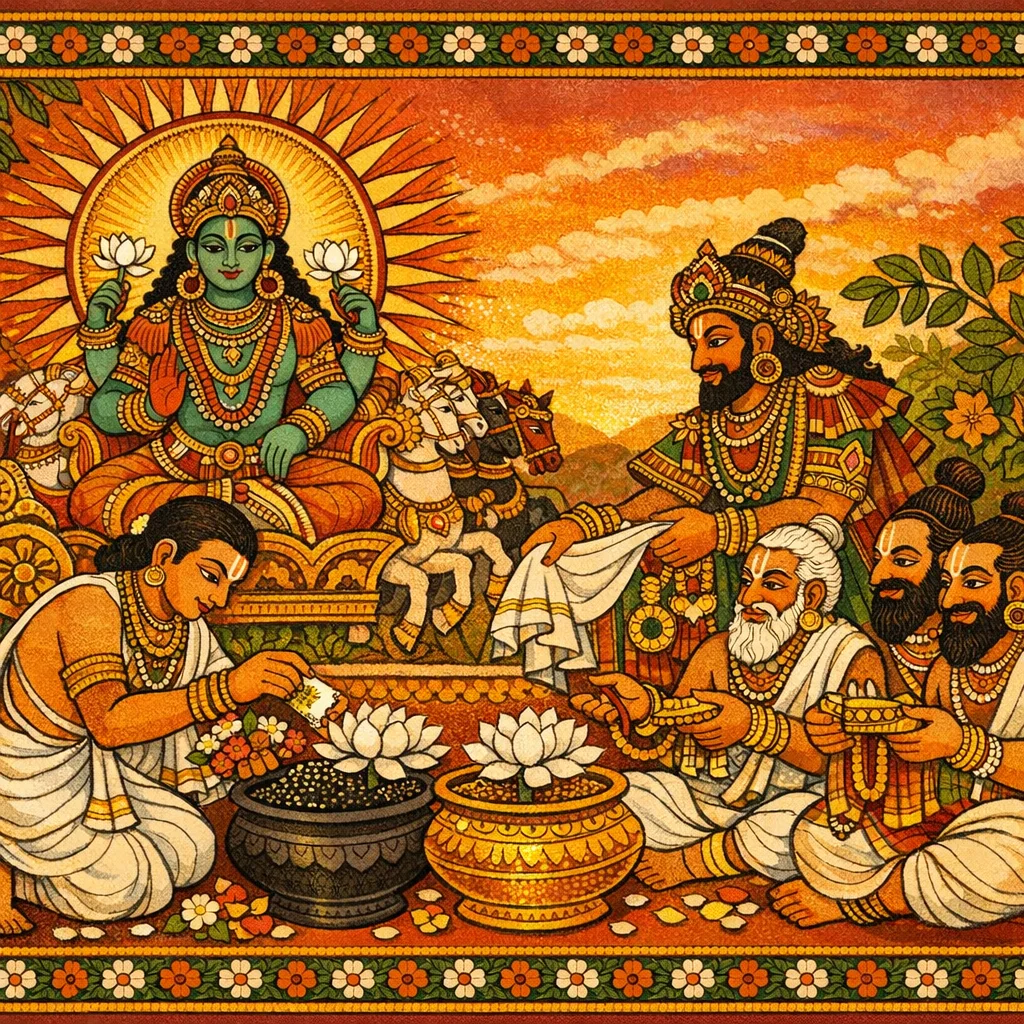
Adhyaya 78: Kamalā-Saptamī Vow: Lotus Rite for Sūrya (Sun) and Prosperity
कमलासप्तमी-व्रतविधिः
Speaker: Īśvara (speaker/teacher within the adhyaya)
Īśvara proclaims the Kamalā-Saptamī observance, saying that even simple recitation and praise delight Divākara (the Sun). He then teaches the rite in order: on the appointed Saptamī one bathes with white mustard seeds; makes an auspicious lotus and places it in a sesame-filled vessel and in a golden vessel; covers the deity/icon with paired garments and worships with sandal and flowers, reciting salutations to the lotus-handed supporter of the universe; offers salutations to Divākara/Prabhākara and performs the rite at the two daily junction-times with a water-pot. The devotee honors a brāhmaṇa with garments, garlands, and ornaments and gives charity, including (as able) a properly adorned tawny cow. After observing a full day and night, on the eighth one feeds the twice-born and then eats with restraints (no meat, no oil). The vow is repeated monthly on bright Saptamī with devotion, free from deceit and miserliness. At completion one donates a bed bearing a golden lotus and, if possible, a gold-adorned milch cow and other useful gifts. The chapter ends with a phala-śruti for performers, reciters, listeners, and explainers.
Key Concepts
Shlokas in Adhyaya 78
Verse 1
*ईश्वर उवाच अतः परं प्रवक्ष्यामि तद्वत्कमलसप्तमीम् यस्याः संकीर्तनादेव तुष्यतीह दिवाकरः //
Īśvara said: “Now, next, I shall expound that very observance called Kamalā-Saptamī; by merely reciting and praising it, Divākara (the Sun) becomes pleased here, in this very world.”
Verse 2
वसन्तामलसप्तम्यां स्नातः सन्गौरसर्षपैः तिलपात्रे च सौवर्णे विधाय कमलं शुभम् //
On the Vasantāmala-Saptamī, having bathed with fair (white) mustard seeds, one should fashion an auspicious lotus, placing it in a sesame-filled vessel and also in a golden vessel.
Verse 3
वस्त्रयुग्मावृतं कृत्वा गन्धपुष्पैः समर्चयेत् नमः कमलहस्ताय नमस्ते विश्वधारिणे //
Having covered (the deity or icon) with a pair of garments, one should worship reverently with sandal fragrance and flowers, saying: “Salutations to the Lotus-handed One; salutations to You, the Supporter of the universe.”
Verse 4
दिवाकर नमस्तुभ्यं प्रभाकर नमो ऽस्तु ते ततो द्विकालवेलायाम् उदकुम्भसमन्विताम् //
“O Divākara (Sun), salutations to you; O Prabhākara (Maker of light), may homage be to you.” Thereafter, at the two junction-times of the day, one should perform the rite equipped with a water-pot (kumbha).
Verse 5
विप्राय दद्यात्सम्पूज्य वस्त्रमाल्यविभूषणैः शक्त्या च कपिलां दद्याद् अलंकृत्य विधानतः //
Having duly honored a Brahmin (vipra) with garments, garlands, and ornaments, one should give charity to him; and according to one’s capacity, one should also donate a tawny cow (kapilā), properly adorned, in the prescribed manner.
Verse 6
अहोरात्रे गते पश्चाद् अष्टम्यां भोजयेद्द्विजान् यथाशक्त्यथ भुञ्जीत मांसतैलविवर्जितम् //
After a full day and night have passed, on the eighth lunar day (aṣṭamī) one should feed the twice-born (Brahmins). Then, according to one’s capacity, one may eat as well—avoiding meat and oil.
Verse 7
अनेन विधिना शुक्लसप्तम्यां मासि मासि च सर्वं समाचरेद्भक्त्या वित्तशाठ्यविवर्जितः //
Following this prescribed method, on the bright-lunar seventh day (śukla-saptamī)—and month after month—one should duly perform the entire observance with devotion, free from deceit regarding one’s wealth (i.e., without miserliness or dishonest withholding).
Verse 8
व्रतान्ते शयनं दद्यात् सुवर्णकमलान्वितम् गां च दद्यात्स्वशक्त्या तु सुवर्णाढ्यां पयस्विनीम् //
At the conclusion of the vow (vrata), one should donate a bed furnished with a golden lotus. And, according to one’s means, one should also give a milch cow adorned with gold.
Verse 9
भाजनासनदीपादीन् दद्याद् इष्टानुपस्करान् अनेन विधिना यस्तु कुर्यात्कमलसप्तमीम् लक्ष्मीमनन्तामभ्येति सूर्यलोके महीयते //
One should give, as desired gifts, items such as vessels, seats, lamps, and other useful requisites. Whoever performs the Kamalā-saptamī observance according to this procedure attains endless prosperity (Lakṣmī) and is honored in the world of the Sun (Sūryaloka).
Verse 10
कल्पे कल्पे ततो लोकान् सप्तगत्वा पृथक्पृथक् अप्सरोभिः परिवृतस् ततो याति परां गतिम् //
In each successive aeon (kalpa), he goes on to the seven distinct worlds one after another; surrounded by celestial nymphs (apsarās), he then proceeds onward to the supreme state.
Verse 11
यः पश्यतीदं शृणुयाच्च मर्त्यः पठेच्च भक्त्याथ मतिं ददाति सो ऽप्यत्र लक्ष्मीमचलामवाप्य गन्धर्वविद्याधरलोकभाक्स्यात् //
Any mortal who beholds this, listens to it, recites it with devotion, and also offers counsel or understanding—he too, in this very world, attains unwavering prosperity (Lakṣmī) and becomes a partaker of the realms of the Gandharvas and Vidyādharas.
Frequently Asked Questions
Adhyaya 78 instructs the full procedure (vidhi) of the Kamalā-Saptamī vrata for pleasing Sūrya (Divākara/Prabhākara). It details bathing with white mustard seeds, lotus construction and placement in sesame and golden vessels, worship with garments/sandal/flowers and solar salutations, dvikāla observance with a water-pot, brāhmaṇa-honoring and charity (including kapilā cow), fasting/discipline followed by feeding brāhmaṇas on Aṣṭamī, and concluding gifts such as a bed with a golden lotus—promising prosperity and Sūryaloka merit.
This chapter is primarily Dharma in the form of Vrata-Dharma (ritual vow), Sūrya-upāsanā (Sun worship), and Dāna-vidhi (prescribed gifting and brāhmaṇa-feeding). It does not discuss Vastu Shastra measurements, Rajadharma/statecraft, or Puranic genealogy/creation narratives within these verses.